Archive for the ‘Activism’ Category

TONIGHT: Mythbusting Lyme Disease

Join Dr. Bill Rawls as he debunks myths and reveals critical insights into the real cause of symptoms, testing, and treatment options for Lyme disease.

When: Tonight May 29, 2024

Time: 8:00 ET

Cost: FREE

Go here to register & join network

ACTION: Protect CBD

https://anh-usa.org/action-center/? Go here to contact your reps.

Take Action Now to Protect CBD!

The House Agriculture Committee is considering amendments to the upcoming Farm Bill. We need to act fast to oppose a terrible amendment that would federally ban all ingestible hemp products with any level of THC. 

This would destroy a huge percentage of the industry, including many CBD and full-spectrum hemp oil products that have many health-supporting cannabinoids along with naturally-occurring but non-intoxicating levels of THC.

You can read the text of the amendment here. 

We must oppose this amendment and preserve our access to CBD and full-spectrum hemp oil products. Write to your member of Congress to oppose this amendment!

For more:

CBD is what pharmacologists call a promiscuous drug. That means it could be effective for treating a number of medical conditions. In broad strokes, CBD affects more than one process in the body – a term called polypharmacology – and so could benefit more than one medical condition.

As of early 2023, there are 202 ongoing or completed scientific trials examining the effectiveness of CBD in humans on such diverse disorders as chronic pain, substance use disorders, anxiety and arthritis.

In particular, CBD appears to be an anti-inflammatory agent and analgesic, similar to the functions of aspirin. This means it might be helpful for treating people suffering with inflammatory pain, like arthritis, or headaches and body aches.

CBD also holds potential for use in cancer therapy, although it has not been approved by the FDA for this purpose.

And this, right here, is why it simply must go.  It does too many things simultaneously that interferes with Big Pharma profits and since most of our politicians are all in bed with Big Pharma, there is a concerted effort to ban it, plain and simple.


Despite Ivermectin’s Success For COVID, Washington State Doctor Fined For Prescribing It

https://popularrationalism.substack.com/p/combined-early-treatment-of-dewormer?

Combined Early Treatment of Dewormer, Combined with Antihistamine, Expectorant and SSRI Shows Major Clinical Efficacy Against Serious Illness From COVID19

Amazing, it only took 3 years.

Article Excerpts:

Public health, allopathic medicine, the press, and politicians infamously railed against ivermectin as a “horse dewormer.” Fauci himself single-handedly killed a good study by Henry Ford Hospital on corticosteroids and hydroxychloroquine by claiming that because we did not know if it was the corticosteroids or the hydroxychloroquine, the study was “flawed.” That study had a 1/4 reduction in mortality in hospitalized patients.

Now, a study from Thailand has been published that has found that early treatment of dewormer combined with antihistamine, expectorant, and SSRI shows major clinical efficacy against serious illness from COVID-19.

The study investigates a combined early treatment regimen of a dewormer, an antihistamine, an expectorant, and an SSRI, demonstrating significant clinical efficacy in preventing serious illness from COVID-19.This approach challenges the earlier narratives and suggests a potential shift in the treatment paradigm for COVID-19, emphasizing the benefits of combination therapy that simultaneously targets multiple aspects of the disease. (See link for article)

http://

Lancet Study: Early COVID Treatment Prevented Clinical Deterioration

Dr. Been Medical Lectures

_______________

**Comment**

One would think this would shift the treatment paradigm, but nope.  Not gonna happen.

_______________

https://www.theepochtimes.com/health/doctor-fined-for-prescribing-ivermectin-against-covid-19-post

Doctor Fined for Prescribing Ivermectin Against COVID-19

Dr. Wei-Hsung Lin prescribed ivermectin to five patients.
By Zachary Stieber, Senior Reporter
5/17/2024

A doctor in Washington state has been fined for prescribing ivermectin against COVID-19. He must also take continuing education classes, according to newly filed documents.

Dr. Wei-Hsung Lin must pay $5,000, according to an order signed by the Washington Medical Commission on May 2.

Ivermectin is approved by the U.S. Food and Drug Administration for treating several conditions, including parasitic worms. Prescribing medicine for unapproved usage is common in the United States, but administration officials have warned against prescribing and using ivermectin as a COVID-19 treatment. Regulators have pointed to a database of clinical trials, some of which found ivermectin did not confer a benefit against COVID-19 and some of which found ivermectin was beneficial against the illness.  (See link for article)

_______________

**Comment**

All of this over 12 mg of ivermectin for FIVE DAYS!  A drug on the WHO list of essential medicine which is handed out like candy in Africa without a prescription!

Of course, this doctor was attacked for not discussing alternative treatments, for not using the government approved treatment of remdesivir, and for not discussing the COVID gene therapy injections which have caused more reports of adverse reactions and death than any other vaccine in the history of VAERS.

If you had any doubts about mainstream medicine, doubt no more.  It is absolutely corrupt.

Oh – besides paying a fine and needing continuing education, the doctor must write two papers of at least 1,000 words describing what he learned.  The commission is also going to make annual compliance visits including a random selection of records, and the doctor must appear within a year and on an annual basis as part of compliance oversight.  

Compliance = mainstream medicine.  Check your brains at the door, doctors.

I truly hope he sues them.  The madness must end.

For more:

https://covid19criticalcare.com/ivermectin/

High Containment

https://theintercept.com/2022/11/01/biosafety-avian-flu/

HIGH CONTAINMENT

Lab That Created Risky Avian Flu Had “Unacceptable” Biosafety Protocols

Mara Hvistendahl

11/1/2022

Article Summary & other tidbits (See link for article)

“Someone finally convinced me to do something really, really stupid,” virologist Ron Fouchier.

  • To find out if H5N1 could morph to be transmittable between humans, Foucher and his team “mutated the hell out of H5N1” and looked at how readily it would bind with cells in the respiratory tract. They found it only took 5 mutations to give it the ability to latch onto cells in the nasal and tracheal passageways.
  • The “really, really stupid” part consisted of a high risk experiment letting the virus itself evolve to gain killer capacity. They put the mutated virus in the nose of a ferret and then put the infected material from the first ferret into the nose of the second ferret. After repeating this 10 times, H5N1 became as transmissible as the seasonal flu.  
  • This means the virus is airborne and reassortment with mammalian viruses isn’t required for it to evolve to spread through the air. According to virology professor Ab Osterhaus, the mutations are out there but they haven’t gotten together yet.  He also flatly stated that eradicating the flu is impossible.
  • Experts admit they are clueless on how viruses spread, although recently the worse purveyor of misinformation, the WHO, flip-flopped and is now admitting the COVID virus and other germs spread ‘through the air,” when in 2020 the agency tweeted: “FACT: #COVID19 is NOT airborne.” There’s no definition of particle size and no cutoff for these supposed infectious respiratory droplets (IRPs) which is quite convenient for tyrants and mask lovers.  This article gives all the credit to the worthless measures that imposed and ignore the fact that the reason the flu, RSV and other respiratory infections disappeared during COVID is because they counted EVERYTHING as COVID!
  • ‘Professor Lockdown,’ Neil Ferguson, the man behind the Imperial College model that erroneously predicted a tidal wave of COVID deaths in the US that allowed politicians to lock down the population, was also the man behind a number of similarly over-the-top mortality projections in previous public health scares, including wildly faulty death forecasts for the 2005 bird flu scare and the 2009 swine flu scamdemic test run. Ferguson is actually on record admitting that lingering immunity in older populations reduces the spread.
  • The research making H5N1 airborne was so controversial that a Dutch court required Fouchier to secure an export permit before he could publish his findings. The permit was designed to prevent the spread of nuclear, chemical, and biological weapons. The rules include dangerous flu viruses and related technical data. At the time, the backlash for this research was so potent that Fouchier, and Yoshihiro Kawaoka of the University of Wisconsin-Madison and other prominent flu scientists voluntarily agreed to pause the transmissibility work. NIAID funded both labs and Fouchier was also a sub-awardee on a grant to a U.S. institution.  
  • After a biosafety staffer in Madison spoke to an audience to dispel what she called myths about safety, Kawaoka’s lab saw two accidents just a week apart involving lab-created flu viruses.  This caused a 6-week flurry of spats between high level administrators on both sides.
  • It must be noted that The Intercept obtained over 5,500 pages covering 18 years detailing lab accidents reported to NIH that show various animal bites, escapes, needlesticks, equipment malfunctions, and even some human infections.
  • The NIH’s reaction to the accidents was more extreme than in any other instance examined. After many other accidents, including for some involving potential pandemic pathogens, the same bureaucrats responded with brief thank-you emails. In a few cases, they asked for corrective actions. In no other instance did they threaten to withhold funding like they did with Kawaoka.

“We should be brave enough to say that some experiments should not be done.” ~ Simon Wain-Hobson, virologist at the Pasteur Institute in Paris 

  • A U.S. government moratorium on funding for ‘gain of function’ research occurred in 2014 yet just 3 years later, the pause was lifted and the DHHS shifted to a framework called P3CO, where a special review process was required to get funding.  
  • In 2016 NIAID administrators flagged a proposal by EcoHealth Alliance for their collaborative work with the Wuhan Institute of Virology on bat coronavirus research as being covered by the moratorium, but instead of insisting on modifications to make the research safer, they let the organization craft an unusual rule to govern itself.  Since P3CO was adopted, only three projects have undergone special review, but the Washington Post identified 8 projects that warranted review, and according to  Stat and Science, two more risky experiments emerged that had not undergone review.
  • Part of the problem is that the NIH charged the National Science Advisory Board for Biosecurity with reconsidering the P3CO policy, along with a policy on dual-use research. The NSABB has a fraught history, and its members are appointed by NIH itself. There is an inherent conflict of interest in having a group appointed by an agency to review that agency’s work.  Another problem is that when lab accidents happen it is handled quietly and they don’t put it in the local newspaper to warn the public.

(See link for article)

________________

For more:

_______________

https://worldcouncilforhealth.substack.com/p/concerned-about-bird-flu?

Should We Be Concerned About Bird Flu?

Rumours of a deadly bird flu pandemic, hot on the heels of Covid-19, remind us of the disastrous results of implementing novel GMO gene products in the guise of vaccines without adequate testing.

You’ve got a dangerous vaccine for a non-threatening disease … It’s supposedly for a life-threatening illness. Of course, conjunctivitis is not life-threatening! The whole purpose of the bird flu scare is to make you think that pandemics are always lurking, they’re coming for you all the time, and you need [the health bureaucracy] to save you.  ~ Dr Meryl Nass, Internist and Epidemiologist

Written by WCH Health & Science Committee lead Christof Plothe DO.

Largest ever bird flu outbreak

The United States Centers for Disease Control and Prevention (CDC) reports that since January 2022, the largest outbreak of avian influenza (bird flu) in recorded history has occurred worldwide (CDC, 2024). By 7 May 2024, what has been identified as a subtype of influenza, referred to as H5N1, had apparently been detected in over 9,000 wild birds and affected more than 90 million poultry in the United States alone. Bird flu outbreaks have affected regions such as Asia, Africa, Europe, the Pacific, and the Near East (CDC, 2024), wreaking havoc on the poultry industry and impacting farmers’ livelihoods and international trade.

In 2022, an independent journalist reported that former CDC Director Robert Redfield had predicted that bird flu would jump to humans and prove highly lethal, triggering a ‘Great Pandemic’, which would make Covid-19 seem like a mere warm-up (Westbrook 2022). In 2005, then-President George Bush spent over $7 billion on preparations for bird flu, warning that it could kill more than two million Americans (Bush, 2005).  Despite this, naturally occurring avian influenza (H5N1) has never posed a threat to humans.

Humans at low risk from H5N1

The CDC maintains that H5N1 poses a low risk to humans and that there is currently no known mechanism for human-to-human transmission. According to the World Health Organization (WHO), bird flu has been responsible for only 463 deaths worldwide over the past 20 years. They do not mention if the deceased died from  bird flu or with it.  (See link for article & at home treatments)

______________

**Comment**

The article points out that a PCR test cannot detect the identity of the virus nor can it detect its variants or sub-varients, so we are at the mercy, once again, of a ‘casedemic’ caused by a fraudulent test which is being manipulated for a predetermined outcome: high cases to push a fear narrative to get a lucrative injection.

This time, they will indiscriminately inject animals and humans alike with their conveniently stockpiled ‘vaccines.’

County-Level Tick-Borne Disease Data in the U.S.: A Comprehensive Guidebook

https://lymediseaseassociation.org/blogs/lda-guest-blogs/sarah-maxwell-county-level-tick-borne-disease-data-in-the-usa/

May Awareness LDA Guest Blogger

Dr. Sarah Maxwell, Ph.D.

Dr. Sarah Maxwell, Ph.D., Associate Professor, Public Health and Public Policy, University of Texas at Dallas.  Dr. Maxwell is an expert on tick-borne disease surveillance and the use of triangulation and thematic mapping to assess tick-borne disease risk, particularly in perceived non-endemic areas and among vulnerable populations. Her recent work includes a grant from the Rita & Alex Hillman Foundation, titled Nursing in the Fields: Vector-borne Illness Prevention and Detection among Migrant and Seasonal Farmworkers. She has numerous publications on tick-borne diseases in high-impact journals. Dr. Maxwell served as a Fellow and continues her role as Faculty Affiliate at Boston University School of Medicine, Laboratory for Human Neurobiology. She is also a Research Affiliate, Center for Science, Technology, and Innovation Policy, George Mason University and founding member of Integrate, Communicate, Inform (ICI)-Vector-borne Disease Working Group.

County-Level Tick-Borne Disease Data in the U.S.: A Comprehensive Guidebook for Researchers

by Dr. Sarah Maxwell, Ph.D.*

Challenges Associated with Tick-Borne Disease Data

Navigating tick-borne diseases (TBDs) in the United States is analogous to traversing a labyrinth, filled with obscure pathways and blind alleys. These complex passageways found throughout state public health websites fail to provide researchers, public health officials, and medical practitioners with a quick reference to assess locally-acquired disease risk. Additionally, the Centers for Disease Control and Prevention generally do not provide county-level data on tick-borne diseases in the U.S., other than Lyme disease.[1] State public health departments offer limited TBD data, while the presentation of data is typically unhelpful at best. State reporting skips years; is inconsistently presented; or is presented in formats that make it very difficult to build a dataset, even for just one state.

For states with emerging tick-borne diseases, large states with varying eco-systems, and counties outside of the Northeastern U.S., TBDs other than Lyme disease are largely ignored. At the state level, data are often located in various formats (e.g., PDF or maps) and are inconsistently presented, particularly across years and among groups (e.g., age, gender). Knowledge of county-level disease presence is key to improved testing and diagnosis. A national data guidebook that documents all county-level TBD data is needed to assist medical practitioners in determining disease risk and travel-acquired TBDs, and to provide data access to TBD researchers so desperately need.

I therefore, reached out to the Lyme Disease Association, Inc. (LDA) with the goal to create a one-stop, quick-reference online, easy-access data guidebook. The overarching goal of this grant-funded initiative is to create a national, county-level guidebook on all tickborne diseases. The Data Guidebook will contain links to all state public health department pages related to TBDs, with a comprehensive summary of all available data. As I have begun this daunting task, however, I have also been downloading all PDFs, maps, written reports, and anything I can locate that will assist researchers to improve tick-borne disease surveillance and public health communication. These reports provide historical and fixed information so that links and changes to state public health department websites do not negatively affect the main goal, i.e., to secure TBD, county-level data in the United States over as many years as possible.

The products of this LDA-funded grant will allow researchers, epidemiologists, summer camps, schools, medical practitioners, and anyone requiring local information to obtain official data via a quick-reference manual. Researchers can quickly assess, for example, if a state offers downloadable data; if county-level data are available, and in what format; and what those data offer (see detailed description below). 

Measurable Objectives Contained within the Data Guidebook Grant Proposal:

a) By March, 2024: A complete directory of state TBD state public health links and information will be entered into an excel file. Note: many states have data that are only publicly available through very detailed search criteria and may not appear on the main public health websites, underscoring the importance of a one-stop source for TBD data.

  • Texas is an example, depending on year: Texas has changed its TBD reporting multiple times, resulting in data that are completely disconnected and not available to researchers in any single database. In 2017, Texas reported TBDs via PDF by region. In 2023, the website was updated to direct visitors in search of TBD data to the CDC. County-level data are no longer available. https://healthdata.dshs.texas.gov/# However, a search for specific diseases produces a dataset from 2000-2019, but does not provide county-level data. This muddled reporting structure requires a researcher to become a detective, and limits data availability to all TBDs.

b) By December, 2024: complete an analysis by state that is ready for preparation into a professional report. Examples of full report information include the following descriptive information for each state, allowing researchers and others to effectively locate and analyze TBD data:

  • Executive summary of each state’s data and data availability
  • County vs only state level data availability
  • List of reportable tick-borne diseases (with county data)
  • List of reportable emerging TBDs, if any
  • Usability and presentation of data – e.g., maps, excel, Word, PDF (links provided)
  • Available dates for each disease
  • Does public health identify imported/non-locally acquired identified in maps or data? Y/N
  • Data by age, gender, seasons Y/N and at the county or state level Y/N

c) By March 15th, 2025: a professional, 50-page report is prepared with one page per state. Information will be presented for quick reference by any researcher or end user, allowing open access, once and for all, to TBD county-level data in the U.S.

d) By December, 2025: publish a research note in a peer-reviewed journal outlining the report and presenting an overview and analysis of TBD public health data in the United States. This peer-reviewed research note will describe the state-of-the-states’ TBD data availability, presented in both written and summary form, similar to a health dashboard.

Preliminary Findings:

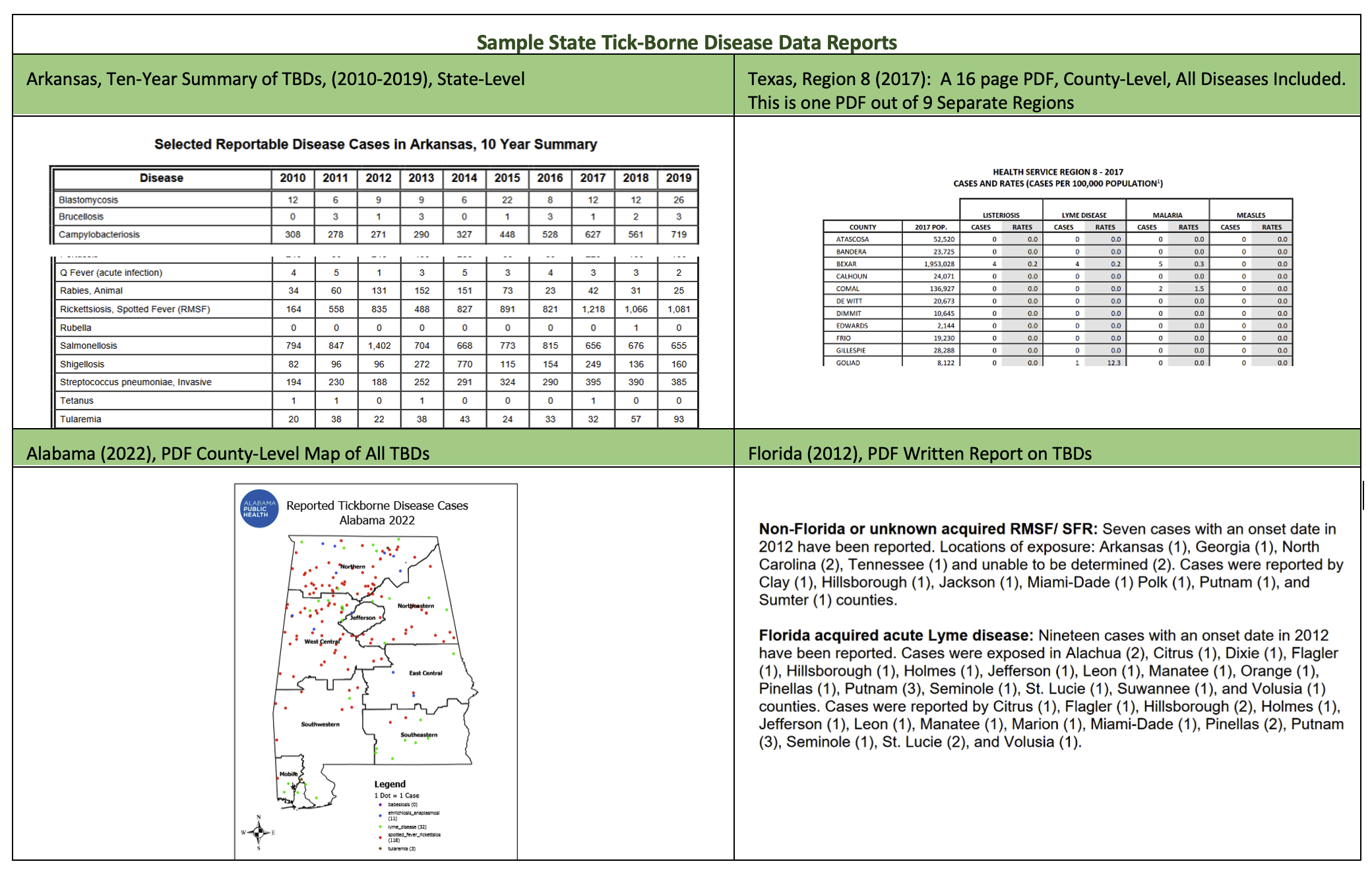
To fully comprehend the daunting task of mismatched data facing tick-borne disease researchers, visual illustrations are necessary. The grant launched in January, 2024, and as I now assemble the County-Level Tick-Borne Disease Data Guidebook, I can attest that it is worse than I first anticipated. States may or may not provide county-level data. If they do, it is often located in a PDF and, within that PDF, data may or may not be organized. In fact, many states present data in written paragraph form, rather than data that can be cut and pasted, and data across the board cannot be easily downloaded or converted to Excel. Additionally, within these PDFs are multiple other reportable/communicable diseases. A researcher might spend a full day pulling data from multiple links, PDFs, past reports, or even in Word documents, and most of these data are not necessarily located on one easy-to-locate website. Tick-borne diseases must be sorted out from other reportable diseases in the process. Historical data reports, if ever collected in the first place, often require significant sleuthing, digging, and searching.

Let’s face it, the United States tick-borne disease data situation is so inconsistent and complex, ChatGTP cannot even fix the problem. The complexities are shown below with examples of reports from selected states.

Sample State Tick-Borne Disease Data Reports

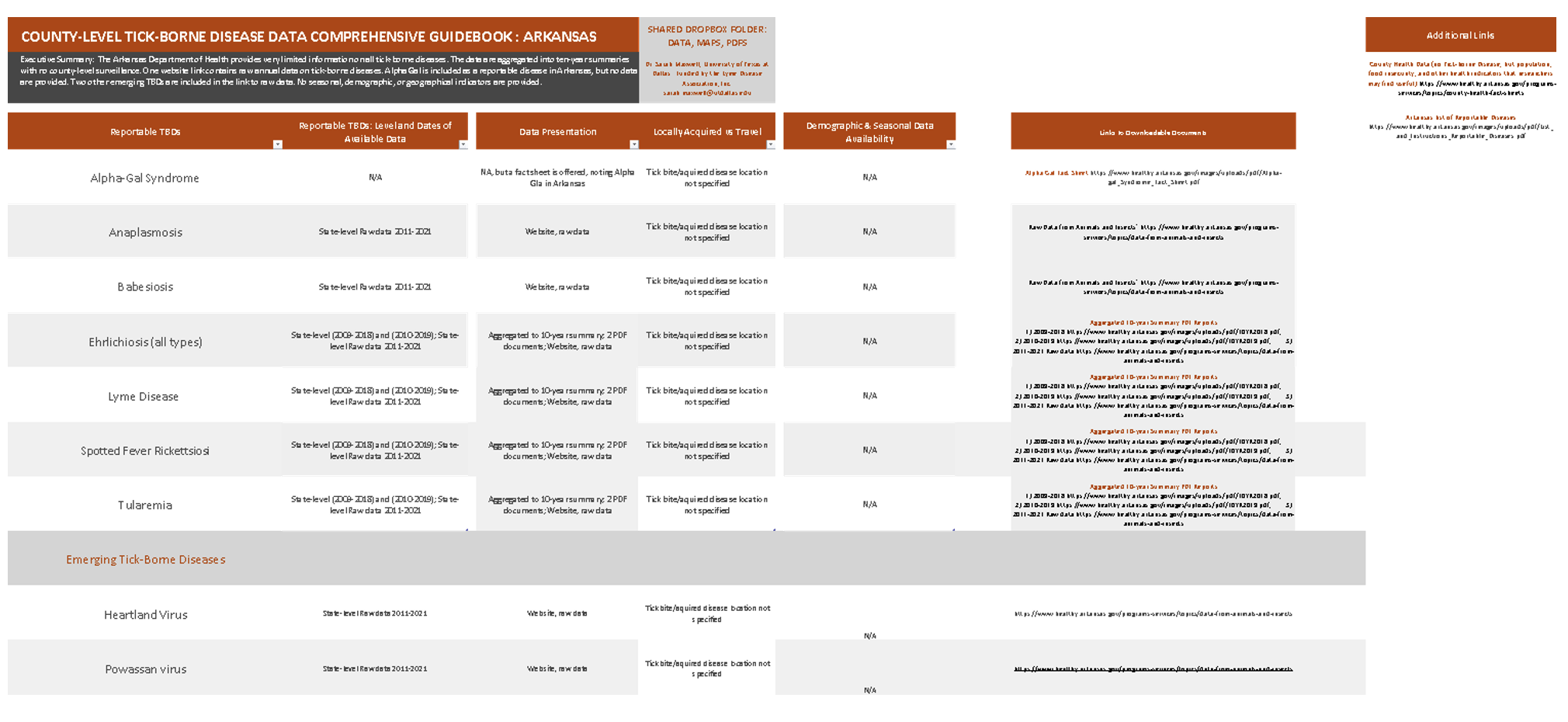
Sample Draft Data Guidebook: Arkansas

The Tick-Borne Disease Data Guidebook provides a summary for each state. The Excel file screenshot below highlights available data in Arkansas, one of the few states I have reviewed thus far that offers downloadable or cut-and-paste raw data that includes emerging TBDs. Good job, Arkansas!  But, my request to you, Arkansas Department of Public Health, can you please start posting county-level data? With so many summer camps in Arkansas, along with countless state and national parks, historical sites, campers, backpackers, and hikers…along with notably high (and increasing) cases of diseases such as Tularemia and Rickettsiosis, Spotted Fever (RMSF), those who are unaware or are visitors to the state, may find themselves with flu-like symptoms and no explanation from their medical provider.

(Low resolution sample)

County Level Tick Borne Disease in Arkansas

What Comes Next:

Will this grant fully solve the data problem? Sadly, no, but the Lyme Disease Association, Inc. has just funded the platform on which our collective work can now change the entire field of tick-borne disease research. We must continue to address the lack of public health information, and particularly, communication. What comes next is simple: The data will be held in separate files for each state, along with the Data Guidebook. The LDA will offer all collected information, along with the Data Guidebook entries online for anyone to access. From there, we, collectively, must develop a dashboard of all known TBDs at the county and state-levels across the United States. I am committed to this project, and the next step will be accomplished. Do you have ideas? Are you an institutional prospective partner? Feel free to reach out: sarah.maxwell@utdallas.edu Let’s support the LDA and the University of Texas at Dallas in taking that next step so that disease surveillance becomes easy and accessible, and let’s work together so that patients can be diagnosed quickly and properly with local data.

[1] The CDC offers one county-level data set for selected tick-borne diseases from 2016-2019 https://www.cdc.gov/ticks/resources/Reported-Tickborne-Disease-Cases-by-County-of-Residence_2016-2019.xlsx

*Author Note: The opinions expressed in this Blog are personal opinions of author Dr. Sarah Maxwell only and do not necessarily reflect those of any other entity.