Tourists visiting ancient caves in Israel. (Yonatan Sindel/Flash90)
The Health Ministry on Monday warned the public not to enter caves in a section of the Judean hills after three children were infected with tick-borne Lyme disease in the area.
The youngsters, from the Kfar Eldad settlement in the West Bank, near Jerusalem, were bitten by ticks during the summer while helping to renovate caves near Nokdim, southeast of Bethlehem. The cases came to light in reports to the Jerusalem district health department.
The children were hospitalized, and one had to return to hospital two weeks after her antibiotic treatment had finished because of a resurgence of the infection.
Lyme disease is caused by the tick-borne Borrelia bacteria and enters the bloodstream via saliva when an infected tick bites a human or animal.
The ticks flourish in the cracks and on the floors of caves.
The risk of infection is low if the tick is attached for less than 24 hours, but detection is difficult because they are small. The incubation period from infection to the onset of symptoms is usually one to two weeks, but can be days, or months and even years. Symptoms include high temperature, shortness of breath, coughing, nausea, muscle and joint pain, and skin rashes.
In rare cases, symptoms such as fatigue and joint or muscle aches can last for more than six months.
The Health Ministry advises the public to avoid caves in the Nokdim area. The cases have been reported to the Environmental Protection Ministry, the Nature and Parks Authority and to the district sanitation inspector.
By Capt. Angela L. Brewer, Chief, Environmental Health Clinic, Kenner Army Health Clinic October 5, 2017
FORT LEE, Va. (Oct. 5, 2017) — Due to the milder winter last year, this summer had more ticks than usual.
And even while the fall season has begun, individuals still need to take precautions when enjoying outdoor activities while warm weather continues.
People may not realize, but most vector-borne diseases are tick-borne. Infections from these diseases are on an increase and the geographic ranges of ticks also are expanding. Reducing exposure and eliminating habitats is the best course of action to protect adults and children.
The Blacklegged tick, Lone star tick and the American dog tick cause most human diseases. Most ticks found on Fort Lee and the local area are Lone star ticks and can possibly carry diseases, such as Ehrlichiosis, Tularemia and Heartland virus. Nearly all tick-borne diseases have many of the same symptoms — fevers and chills, aches and pains and rashes around bite location. Few cases result in death, especially if quickly diagnosed and treated.
Although these are referred to as tick-borne diseases, ticks are all born disease free. The tick feeds on a host organism infected with a blood-borne pathogen. The organism is ingested into the tick thus becoming the vector of the disease. If the vector feeds on a human for its next meal, then that person could acquire the pathogen and become ill. Not all organisms are infected, and not all vectors carry diseases. If the tick is infected, the pathogen takes approximately 24 hours to “reactivate” and get into the tick’s saliva. Ticks have specialized saliva that numbs the skin and acts as a cementing agent, which is how they can get such a firm grip on a person. A tick must be actively feeding on you for several hours to transmit a disease.
Prevention strategies include personal protection, environmental modification and tick suppression. The DOD insect repellent system is the service member’s personal protection method. A properly worn uniform is the best defense. All uniforms are now pre-treated with permethrin, which kills ticks on contact. Uniforms must be worn properly with the trouser tucked inside the boots. Also, application of a DEET-based insect repellent to any exposed skin will provide an additional layer of defense.
Off-duty service members, civilians and their families can use the same principles as well. Wear long pants when in wooded or brushy areas and tuck them into high-top boots or long socks. Wear light- colored clothing so ticks can be easily spotted and brushed off. Additionally, there are permethrin treatment kits that can be purchased to treat civilian clothing. A well landscaped yard or area surrounding buildings is an example of environmental modification. A smart landscaping tip would be to make the yard less attractive to ticks. For example, short grass and bright sunlight help reduce the tick populations in yards or on golf courses. Remove leaves branches and debris that will eliminate hiding places for ticks as well as their hosts. Install some type of barrier along the perimeters of child development centers or create gravel or wood chip pathways through wooded areas. Tick suppression is simply the application of pesticides or reducing or eliminating the hosts that ticks seek for blood meals, i.e. deer.
If bitten by a tick and the skin has been broken, remove it carefully with fine point tweezers. Do not burn, apply petroleum jelly or utilize any other mythical home remedies because there is no substitute for the following proper technique. First, disinfect the surrounding area with an alcohol swab.
Next, place tweezers as close to skin as possible and grasp the insect firmly. Pull straight up slowly until the tick either comes out or breaks. The infectious material is much farther back in the tick’s body, so there is no reason to fret if the head breaks off during removal.
After removal, keep it in a clean plastic bag and store it in a cool dry place like a refrigerator. Make an appointment to take the tick to your primary care provider. The PCM has procedures in place with Environmental Health to have the tick identified and tested for the presence of diseases.
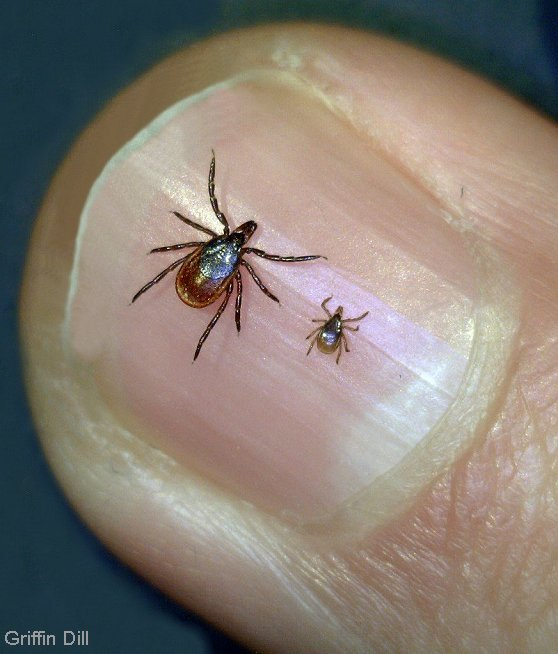
Logan Swallow, 14, of Oakfield shows off the 247-pound deer he shot on Youth Deer Day, Oct. 22, 2016, in Smyrna. The deer was an 11-pointer.
Griffin Dill | BDN
A female deer tick (left) and a nymph deer tick
On Saturday morning, hundreds of young hunters will head afield for Youth Deer Day, a day set aside for those age 15 and younger to enjoy the woods under the supervision of a parent or adult supervisor.
This year, a state wildlife biologist is stressing safety even more than in most years. And the source of his concern may surprise you.
“I would make a suggestion that especially from [Bangor] south, people have to absolutely be focused on deer ticks,” Lee Kantar of the Maine Department of Inland Fisheries and Wildlife said. “They are out in force right now, and we’ve been running into them for the last two weeks.”
Deer ticks can carry Lyme disease and can be transmitted to humans. According to the Maine Medical Center’s Research Institute, humans have the greatest risk of contracting Lyme disease during the seasonal peak of deer tick nymphs. About two-thirds of Maine cases of the disease are reported in June, July and August.
But Kantar said at this time of the year, adult ticks are looking for a blood meal from a host. Hunters may find them on their clothing from now through November, he said.
“We walk our dog every day. My dog is blonde. And every day this week, the week before Youth Deer Day, that dog has picked up deer ticks in the morning,” Kantar said. “Even [Tuesday] morning, when it was 30 degrees out.”
While Kantar said many recognize Youth Deer Day as a great time to spend outdoors with family members, he wants to make sure that a tick bite doesn’t turn that celebration into something much less pleasant.
“We’d be remiss not to make a real strong point here that people getting out there with their kids need to be absolutely vigilant and check for ticks, and probably do some good spraying on their clothes [of tick-repellent containing permethrin], to do everything they can to prevent deer ticks,” Kantar said.
Permethrin sprays can be found at most outdoor stores and big-box retailers and typically are designed to be sprayed onto clothing, not onto a person’s skin. Clothing items that have been treated with permethrin also are available for sale in some locations.
Kantar said he’ll be spending part of Saturday in his typical Youth Deer Day spot, Bob’s Kozy Korner store in Orrington, where he’ll help tag deer and chat with hunting parties. He said he looks forward to hearing the stories from excited young hunters on what might be their first hunt.
“It’s youth day at its best, when you have a parent or family member with a youth who is absolutely excited to get out there and have their first chance at it,” Kantar said. “When we see that, and we see the excitement within a family … that’s good stuff.”
And the bonds parents can form and the traditions they begin while spending time in the woods with their children are special.
“The parent can put his or her complete focus on the kid on that day because they’re not hunting. They’re just out there with their kid,” Kantar said. “In this day and age, that helps all of us, when we can just have a singular focus on our kid [and say], ‘This is your day. Let’s go out and have a fun day.’”
All Mainers will kick off their firearms season on deer with residents-only day on Oct. 28, while non-residents will be allowed to hunt beginning Oct. 30. The firearms season ends a half-hour after sunset on Nov. 25. Muzzleloader season stretches until Dec. 2 or Dec. 9, depending on which part of the state a hunter is in.
Japanese barberry, an invasive plant species banned for sale in New York and Connecticut, could be making an already bad Lyme disease problem in the tri-state worse. Brian Thompson reports in the fourth edition of a five-part series on the fight against Lyme disease.
Park Police Officer, Margie Raimondi, picked ticks off of her daily as if they were mosquitoes. She was 4.5 months bed bound from Lyme Disease and is now recovering and on disability.
Dr. Scott Williams, an expert on the Japanese Barberry, states the shrub is a perfect habitat for ticks by creating a higher humidity. Six states have banned or limit the shrub.
Barberry has a stronger form of Berberine, according to some experts, than what’s found in Goldenseal, Coptis, or golden thread and the Oregon Grape and is used in both Indian and Chinese medicine. Master herbalist, Steven Buhner states it is active against a large number of resistant bacteria and numerous strains of Mycoplasma, a common coinfection of Lyme.
I’m so glad Ms. Raimondi spoke up about being infected as I often worry about our public servants who work outside. Please warn these workers about tick prevention as they are in harm’s way. Please share this info with them: https://madisonarealymesupportgroup.com/2017/05/11/tick-prevention-and-removal-2017/ (Great info plus Consumer Report review on tick repellents & how to remove ticks)
Unfortunately, public servant uniforms are nearly always dark which is going to make seeing ticks nearly impossible; however, they should definitely spray their clothing and shoes with Permethrin and keep Picaridin repellent in their vehicle to spray on skin if they have to go into tick infested areas. Please read info in blue link for more helpful tips.
GERALDINE DAWSON, JESSICA M. SUN, KATHERINE S. DAVLANTIS, MICHAEL MURIAS, LAUREN FRANZ, JESSE TROY, RYAN SIMMONS, MAURA SABATOS-DEVITO, REBECCA DURHAM, JOANNE KURTZBERG
Autologous Cord Blood Infusions Are Safe and Feasible in Young Children with Autism Spectrum Disorder: Results of a Single-Center Phase I Open-Label Trial
ABSTRACT
Despite advances in early diagnosis and behavioral therapies, more effective treatments for children with autism spectrum disorder (ASD) are needed. We hypothesized that umbilical cord blood derived cell therapies may have potential in alleviating ASD symptoms by modulating inflammatory processes in the brain. Accordingly, we conducted a phase I, open-label trial to assess the safety and feasibility of a single intravenous infusion of autologous umbilical cord blood, as well as sensitivity to change in several ASD assessment tools, to determine suitable endpoints for future trials.
Twenty-five children, median age 4.6 years (range 2.26–5.97), with a confirmed diagnosis of ASD and a qualified banked autologous umbilical cord blood unit, were enrolled. Children were evaluated with a battery of behavioral and functional tests immediately prior to cord blood infusion (baseline) and 6 and 12 months later. Assessment of adverse events across the 12-month period indicated that the treatment was safe and well tolerated.
Significant improvements in children’s behavior were observed on parent-report measures of social communication skills and autism symptoms, clinician ratings of overall autism symptom severity and degree of improvement, standardized measures of expressive vocabulary, and objective eye-tracking measures of children’s attention to social stimuli, indicating that these measures may be useful endpoints in future studies. Behavioral improvements were observed during the first 6 months after infusion and were greater in children with higher baseline nonverbal intelligence quotients. These data will serve as the basis for future studies to determine the efficacy of umbilical cord blood infusions in children with ASD.
___________
**Comment**
**UPDATE July, 2022**
Roughly 1 in 30 children and adolescents ages 3-17 were diagnosed with an autism spectrum disorder in 2020, according to a JAMA Pediatrics research letter, which referenced a new study showing a 53% increase in ASD in young Americans since 2017.
According to the documentary Trace Amounts as of 2014, 1 in 68 children have Autism. That’s 1 Million US children.
http://soundchoice.org/wp-content/uploads/notbornwithit-2.pdf According to Sound Choice Pharmaceutical Institute, the Duke study is remarkable in that 60-70% or more of children with Autism have de novo gene mutations (not found in either parent) that must have occurred after birth according to the results, not in the egg, sperm or early utero development as previously, and erroneously assumed.
This new finding reveals research should now be geared to finding out what environmental damage after birth leads to these mutations and/or what pathogens are acting as triggers.
Autism like Lyme/MSIDS is an epidemic and according to one Wisconsin LLMD, 80% of his Autistic patients are also infected with Lyme/MSIDS.






 Madison Area Lyme Support Group