https://www.medpagetoday.com/publichealthpolicy/generalprofessionalissues/85044

Docs Said It Was Cancer; She Didn’t Believe Them, and She Was Right

— What a 60-year-old refugee taught me about skepticism of medical professionals

The public wants to believe in the profession of medicine. These beliefs are often justified. But not always.

For example, one day, a 60-year-old woman came to the ED for abdominal pain. A refugee from El Salvador, she was admitted to a team of doctors and medical students at a county hospital. The supervising attending physician on that team was an oncologist. He held a high position at the medical school that was affiliated with this hospital. (See link for full article)

Important excerpts:

There was also a “summary of the case” on that requisition. It said, “60-year-old with liver mass, suspect hepatocellular carcinoma.” When the pathologist read this, she assumed that she was looking for liver cancer.

Most pathologists do not review clinical records. Rather, they read the summaries of the case on the requisitions. This summary seemed straightforward — i.e., “suspect hepatocellular carcinoma.”

The pathologist took the biopsy sample, put it on slides, and looked at those slides with the bias of hepatocellular carcinoma in mind.

Excerpt:  

This woman never had cancer. Had she gotten chemotherapy she probably would have died. Treating a patient with chemo when they have a serious underlying infection would likely cause that infection to kill. But had she died in that manner, the doctors would have said that she died from liver cancer. No one would have known the truth.

___________________

**Comment**

Ends up she had amebiasis – a parasitic infection found in contaminated water which can migrate from the intestine to the liver, where it forms a cyst. 

After being treated for the infection she improved.

Doctors are human and have biases. Never forget that.


The following petition update by Lyme advocate Carl Tuttle is about this recent publication:  https://www.frontiersin.org/articles/10.3389/fmed.2020.00057/full In it, the authors discuss the subgroups of those who go on to develop persisting symptoms, as well as the continuing controversy in medicine over this disabling disease(s). The authors present both sides of the fence and state:

However, ILADS CLD is a symptom-based definition and therefore ongoing infection is difficult to assess in individual patients with no currently available biomarker test, and given the large degree of symptom overlap between CLD and other illnesses.

This is important, as the IDSA on the other side of the fence wants to define everything by testing – which research has proven to be abysmal. It’s important for medical professionals to remember that the criteria for reporting Lyme disease is extremely stringent and that even the CDC states diagnosis should be clinical.  Their own website indicates that doctors should be looking for signs, symptoms, and exposure.  Then, it says “results of laboratory testing when indicated.” https://www.cdc.gov/lyme/diagnosistesting/index.html  Regarding testing, you’d have to have your head under the sand to not know it misses over half of all cases, and not to mention takes precious time to develop antibodies for the test to even pick it up – which means the patient, if it’s Lyme, will worsen and be added to the ever growing large group with persisting symptoms. https://madisonarealymesupportgroup.com/2018/10/12/direct-diagnostic-tests-for-lyme-the-closest-thing-to-an-apology-you-are-ever-going-to-get/

“Insanity is doing the same thing over and over and expecting different results,” so why on earth would a doctor WAIT when the signs, symptoms, and exposure indicate a Lyme disease infection?

https://www.change.org/p/the-us-senate-calling-for-a-congressional-investigation-of-the-cdc-idsa-and-aldf/u/25808085?

Post-treatment Lyme Disease as a Model for Persistent Symptoms in Lyme Disease

FEB 26, 2020 — 

Today’s letter…….

———- Original Message ———-
From: CARL TUTTLE <runagain@comcast.net>
To: tickbornedisease@hhs.gov, jaucott2@jhmi.edu
Cc: (98 Undisclosed recipients)
Date: February 26, 2020 at 9:44 AM
Subject: Post-treatment Lyme Disease as a Model for Persistent Symptoms in Lyme Disease

Frontiers in Medicine

Post-treatment Lyme Disease as a Model for Persistent Symptoms in Lyme Disease
Alison W. Rebman and John N. Aucott*
https://www.frontiersin.org/articles/10.3389/fmed.2020.00057/full
Feb 26, 2019

Johns Hopkins Lyme Disease Clinical Research Center
At Greenspring Station  Joppa Concourse
2360 W. Joppa Rd, Suite 320
Lutherville, MD 21093
Attn: John N. Aucott, M.D.

Dr. Aucott,

The content of this letter should not be misconstrued as disrespectful.

As someone whose entire family with firsthand experience of the late stage disabling effects of Lyme, it becomes crystal clear when reading your manuscript that we don’t know how to treat Lyme disease. And yet, state medical boards will go after those clinicians who are attempting to help these patients: (Past IDSA president Paul Auwaerter testified against this doctor)

Before the Virginia Board of Medicine
In RE: Leila Haddad Zackrison, M.D.

Order of Summary Suspension
http://www.dhp.virginia.gov/Notices/Medicine/0101045689/0101045689Order09122019.pdf

I stopped reading your publication at page three simply because it’s the same information that we have seen over and over and over and over again for the past four decades.

The suppression of a mountain of evidence identifying persistent infection after extensive antibiotic treatment has misclassified this disease as a low-risk and non-urgent health threat.

The deliberate avoidance of the horribly disabled allows the CDC to ignore public outcry:

From your publication:

“….the CDC does not track disease outcomes or cases of persistent symptoms (34). Estimating the population-level prevalence of persistent symptoms following Lyme disease is challenging due to this lack of standardization or consensus in operationalizing a case definition.”

If we’re not counting the number of lives ruined by the disease we can continue the well-established racketeering scheme indefinitely.

Until those responsible for this health disaster are removed from positions of authority we will have another decade of unimaginable pain and suffering.

We have a public health emergency that requires a response on the level of a Manhattan Project [1] as patient testimony all across America (and the globe) is describing a disease that is destroying lives, ending careers while leaving its victim in financial ruin.

We are dealing with a life-altering/life-threatening infection with faulty/misleading antibody tests, inadequate treatment, no medical training and absolutely no disease control whatsoever; a public health disaster misclassified as a simple nuisance disease.

Lyme disease is a 21st Century incurable plague hidden in plain site as we are dealing with an antibiotic resistant/tolerant superbug and it is time to acknowledge the severity of this crippling disease.

Respectfully Submitted,

Carl Tuttle
Lyme Endemic Hudson, NH

Reference:

1. Lyme Disease: Call for a “Manhattan Project” to Combat the Epidemic
Raphael B. Stricker, Lorraine Johnson

Published: January 02, 2014 DOI: 10.1371/journal.ppat.100379

http://www.plospathogens.org/article/info:doi/10.1371/journal.ppat.1003796

In summary, preliminary studies from the CDC indicate that the Lyme disease epidemic has reached an unprecedented level with at least 300,000 people and as many as one million people, a majority of them women and children, diagnosed with Lyme disease each year in the United States. The staggering magnitude of the epidemic should prompt the CDC to show leadership in developing new guidelines for the diagnosis and treatment of Lyme disease. A coordinated “Manhattan project” similar to the attack mounted against the HIV/AIDS epidemic is urgently needed to address the serious worldwide threat of Lyme disease.

_______________

**Comment**

While Rebman and Aucott respectfully present both sides of the controversy, I agree with Tuttle that nothing has been done for the sickest patients.  I also realize from a researcher’s perspective that the PTLDS group is the easiest to study as the parameters are extremely narrow and defined.  The problem is, the sickest patients don’t fit into this group yet continue to suffer – with nobody studying them.  

We desperately need researchers to dig into this group of patients that is growing exponentially by the minute:  https://madisonarealymesupportgroup.com/2019/02/25/medical-stalemate-what-causes-continuing-symptoms-after-lyme-treatment/

According to microbiologist Holly Ahern,

60% go onto develop chronic/persistent symptoms.
That’s nothing to sniff at.

https://parasitesandvectors.biomedcentral.com/articles/10.1186/s13071-020-3954-1?

Review, Open Access, Published:

The global serological prevalence of Toxoplasma gondii in felids during the last five decades (1967–2017): a systematic review and meta-analysis

Mahbobeh Montazeri, Tahereh Mikaeili Galeh, Mahmood Moosazadeh, Shahabeddin Sarvi, Samira Dodangeh, Javad Javidnia, Mehdi Sharif & Ahmad Daryani

Abstract

Background

Felids (domestic and wild cats) are important in the epidemiology of the parasite Toxoplasma gondii because they are the only hosts that can excrete the environmentally resistant oocysts. We conducted a systematic review and meta-analysis to estimate the global prevalence of T. gondii in species of the family Felidae.

Methods

We searched seven databases (PubMed, Embase, Google Scholar, ScienceDirect, Scopus, Proquest and Web of Science) for studies reporting seroprevalence of T. gondii in felids from 1967 to 31 December 2017. A total of 217 published papers, containing 223 datasets were eligible for inclusion in the meta-analysis, comprised 59,517 domestic and 2733 wild cats from 1967 to 2017.

Results

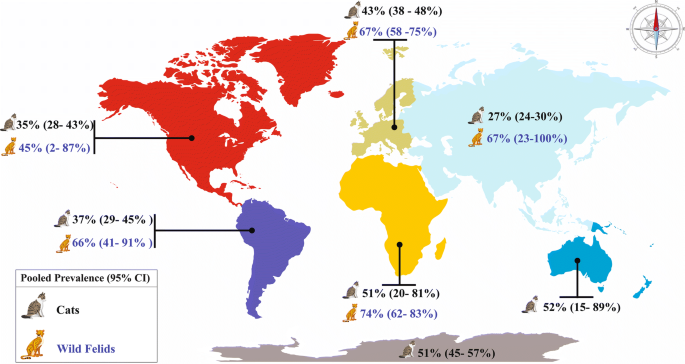
The pooled global T. gondii seroprevalence was estimated to be 35% (95% CI: 32–38%) and 59% (95% CI: 56–63%) in domestic cats and wild felids, respectively, using random effects model. The seroprevalence was higher in Australia and Africa where the T. gondii seropositivity in domestic cats was 52% (95% CI: 15–89%) and 51% (95% CI: 20–81%), respectively. The lowest seroprevalence was estimated in Asia 27% (95% CI: 24–30%). The seroprevalence values for T. gondii in wild felids were 74% (95% CI: 62–83%) in Africa, 67% (95% CI: 23–111%) in Asia, 67% (95% CI: 58–75%) in Europe and 66% (95% CI: 41–91%) in South America.

Conclusions

Our study provides the global prevalence of T. gondii in species of the family Felidae and is a source of information to aid public health workers in developing prevention plans.

_________________
**Comment**
The following excerpt from the study is important:
Based on formal reports, over one billion people in the world are estimated to be infected with T. gondii[3], which is transmitted mainly by ingestion of food, water, vegetables and fruits contaminated with sporulated oocysts shed from cats or ingesting tissue cysts from raw or undercooked meat [1]….The Centers for Disease Control and Prevention (CDC) reported that toxoplasmosis is the second most common cause of death due to food-borne diseases.
T. gondii has been found in ticks:  http://europepmc.org/article/med/25780833
Here it was found in 64.91% of all examined ticks.
Transmission by ticks has been questioned with mixed results:  https://scialert.net/fulltext/?doi=jp.2015.142.150#1508959_ja
Excerpt:
Nymphs of Ixodes ricinus are most susceptible to infection with T. gondii and they reported that the role of ticks in transmitting of toxoplasmosis should be considered in further investigations. They also added that Toxoplasma artificially (intracoelomatically) introduced into the organism of I. ricinus females can penetrate and multiply in hypoderma, salivary glands, peritracheal connective tissue and muscular tissue. Moreover, Jagow and Hoffmann (1970) found that Toxoplasma lived in Nymphs and adults of Ornithodoros moubata up till 10 and 2 days, respectively. They also found transmission was unsuccessful either through sucking or with the next stage of the same ticks or through the F1-generation of the ticks infected with Toxoplasma. Whereas, Gidel and Provost (1965) isolated Toxoplasma gondiifrom to the genus Amblyomma parasiting a bovine in Centre African Republic by inoculation into rabbits and guinea pigs and proved pathogenic for mice.
Prudence would err on the side of caution and transmission of T. gondii by ticks should be highly suspected.

For more:  https://madisonarealymesupportgroup.com/2016/05/21/toxoplasmosis/ T. gondii is responsible for about 1/5 of schizophrenia cases.  

https://madisonarealymesupportgroup.com/2019/12/31/psychiatric-disorders-are-infectious-agents-to-blame/

https://madisonarealymesupportgroup.com/2018/08/01/risky-business-linking-t-gondii-entrepreneurship-behaviors/

https://madisonarealymesupportgroup.com/2019/04/06/toxoplasmosis-outbreak-due-to-undercooked-deer-meat-from-illinois/

And lastly, I’ll never forget this information on how parasites affect human behavior by Dr. Klinghardt, which I found here:  http://www.betterhealthguy.com/a-deep-look-beyond-lyme

  • Parasite patients often express the psyche of the parasites – sticky, clingy, impossible to tolerate – but a wonderful human being is behind all of that.

  • We are all a composite of many personalities. Chronic infections outnumber our own cells by 10:1. We are 90% “other” and 10% “us”. Our consciousness is a composite of 90% microbes and 10% us.

  • Our thinking, feeling, creativity, and expression are 90% from the microbes within us. Patients often think, crave, and behave as if they are the parasite.

  • Our thinking is shaded by the microbes thinking through us. The food choices, behavioral choices, and who we like is the thinking of the microbes within us expressing themselves.

  • Patients will reject all treatments that affect the issue that requires treating.

  • Patients will not guide themselves to health when the microbes have taken over.

With this information in mind, it’s quite clear how Lyme/MSIDS is such a complex disease as many are dealing not only with Lyme but other coinfections including parasites which are either directly transmitted by a tick or activated due to a trigger and a dysfunctional immune system.

Approx. 17 Min

Brian Wilson reveals how U.S. biological warfare programs led to the proliferation of disease carrying ticks, causing a health crisis of epic proportions.

Much of the research presented in this investigative report can be found in Kris Newby’s acclaimed book: “Bitten: The Secret History of Lyme Disease and Biological Weapons.”

The ‘Swiss Agent’ article:  https://www.statnews.com/2016/10/12/swiss-agent-lyme-disease-mystery/

To listen to an interview with Charles Piller on the ‘Swiss Agent’:  https://www.wbur.org/hereandnow/2016/10/12/swiss-agent-lyme-disease

Important to note: US laboratories don’t test for the Swiss Agent.

**Correction** Wilson called Rickettsia a virus – when it’s a bacteria that is often pleomorphic (shape-shifts). Rickettsia helvetica or the ‘Swiss Agent’ is in the spotted fever family along with Rocky Mountain Spotted Fever.  That’s not to say viruses aren’t involved, just that Rickettsia is a bacteria:  https://www.bayarealyme.org/about-lyme/what-causes-lyme-disease/rickettsia-helvetica/

Interestingly, Dr. Steere, first on the Lyme, Connecticut scene initially thought the cause of the juvenile arthritis was viral.

“A virus is the most likely candidate,” Dr. Steere said. “Just because we haven’t found one yet doesn’t mean it isn’t there. We’ll keep looking.” Dr. Allen Steere https://www.nytimes.com/1976/07/18/archives/a-new-type-of-arthritis-found-in-lyme-new-form-of-arthritis-is.html

An ironic quote for sure considering the fact this man has denied the possibility of chronic/persistent Lyme disease, yet when it was his work in question he was willing to entertain something he couldn’t find or see.

Please note another important quote in the same article by Steere:

“Mycoplasmas, another type of microbe, do cause arthritis in some animals, but the available tests for them have proved negative.”  https://www.nytimes.com/1976/07/18/archives/a-new-type-of-arthritis-found-in-lyme-new-form-of-arthritis-is.html

The only person seriously doing work on Mycoplasma is Dr. Garth Nicolson who states 80% of those with Lyme also have Mycoplasma:  https://madisonarealymesupportgroup.com/2020/02/25/pathogenic-mycoplasma-infections-in-chronic-illnesses-general-considerations-in-selecting-conventional-and-integrative-treatments/  He uncovered a particularly lethal, bioweaponized form of Mycoplasma. Mainstream medicine doesn’t bat an eye at this.

Also important: when I spoke with Dr. Hoffman (deceased), probably the most experienced Lyme doctor in Wisconsin, he told me that as a medical resident in Illinois he treated patients with something he called a “rickettsial-like” illness before it was given the label of Lyme disease.

This video points out the importance of coinfections and the fact that this is often a polymicrobial illness – of which little research has been done:  https://madisonarealymesupportgroup.com/2018/10/30/study-shows-lyme-msids-patients-infected-with-many-pathogens-and-explains-why-we-are-so-sick/  This recent study gave a 85% probability that a randomly selected TBD (tick borne disease) patient will respond to Borrelia and other related TBD microbes rather than to Borrelia alone.

We never hear about the polymicrobial issue in mainstream research.  They avoid it with a 10-foot pole. If one adds in flawed testing based on antibodies, coinfection involvement (mycoplasma and others), pleomorphism/persisters, as well as the bioweaponization aspect, you begin to  understand that the very definition of “designed” microbes means they are difficult to detect as well as treat.

Until these issues are acknowledged and resolved, many people will remain ill.

For more:  https://madisonarealymesupportgroup.com/2019/07/29/usas-history-of-testing-bioweapons-on-the-public-were-ticks-used-too/

https://madisonarealymesupportgroup.com/2019/07/19/biological-warfare-experiment-on-american-citizens-results-in-spreading-pandemic/

https://madisonarealymesupportgroup.com/2019/07/31/tick-expert-admits-to-working-on-ticks-dropping-them-out-of-airplanes/


https://www.channel3000.com/assembly-passes-lyme-disease-brochure-bill/

Assembly passes Lyme disease brochure bill

Wisconsin State Capitol
File photo

MADISON, Wis. — The state Assembly has passed a bipartisan bill that would require state wildlife officials to include information on Lyme disease in state park and launch a public awareness campaign about the disease….(See link for article)

__________________

For more on the bill:  https://madisonarealymesupportgroup.com/wp-content/uploads/2019/05/time-to-bite-back-against-lyme-disease-05-23-19.pdf

  1. LRBs 2738 and 3358 – Requires the DNR to post information in certain Parks brochures to raise awareness of Lyme Disease, inform on how to prevent tick bites, and encourage visitors to check for ticks after visiting a State Park, and requires the DNR to complete an annual awareness campaign in May of each year, which is Lyme Disease Awareness Month, on digital and print platforms to raise awareness of Lyme Disease, inform on how to prevent tick bites, and encourage visitors to check for ticks after spending time outdoors.