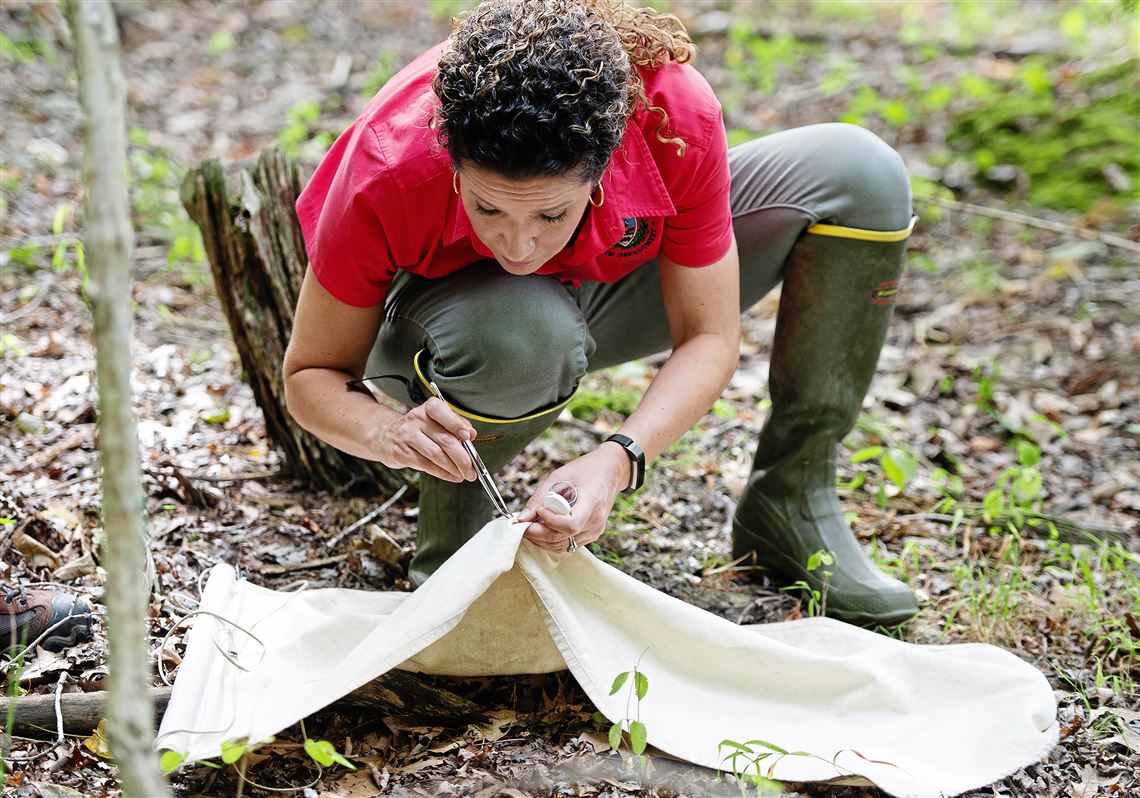
Allegheny County’s tick collector warns of Lyme disease risks
Pam Panchak / Post-Gazette
AUG 7, 2020
After dragging a swath of white cloth the size of a doormat through the forest duff along a shaded, onetime bridle trail now well used by walkers and joggers in Hartwood Acres county park, Leah Lamonte had her tweezers out.
Ms. Lamonte is the vector control program coordinator for the Allegheny County Health Department, and the specks she plucked from the “drag cloth” last week looked like smudges of finely ground black pepper. Except they were moving.
As she delicately grabbed each tiny crawling dot and dropped it into a clear plastic vial filled with alcohol, she explained that she was collecting ticks, especially blacklegged ticks, the kind that carry Lyme disease and pass it to thousands of Pennsylvanians every year. (See link for article)
_______________________
**Comment**
Important takeaways:
Lamonte states she’s finding ticks in every one of the city and county parks.
She rightly assumes that every time she’s been in a park she’s been exposed to Lyme (if not other things as well).
According to their results, 25% of nymphal deer ticks carry Lyme, while 50% of adults do. She states this is because adults have had two blood meals thereby increasing their risk.
Gov. Mike DeWine of Ohio Tests Positive, Then Negative, for Coronavirus
The governor said he felt confident in the results of a negative test that was taken hours after he tested positive while being screened to greet President Trump.
Gov. Mike DeWine tested negative for the coronavirus hours after a positive rapid-result test had prevented him from welcoming President Trump to Ohio on Thursday, a whiplash reversal that reflected the nation’s increasingly complex state of testing.
In a high-profile example of a new testing frontier, Mr. DeWine first received an antigen test, which allows for results in minutes, not days, but has been shown to be less accurate. The positive result came as a “big surprise,” said Mr. DeWine, a Republican, who had not been experiencing symptoms other than a headache.
Later on Thursday, he was tested using a more standard procedure known as polymerase chain reaction, or P.C.R., an accurate but time-intensive method that requires samples to be processed at a laboratory. His wife, Fran, and staff members also tested negative. (See link for article)
_____________________
**Comment**
And this is where testing remains…..
Important excerpt:
Public health experts say that widespread, rapid testing is necessary for quarantining and contact tracing to effectively control the virus.
This, not the virus, should frighten us.
They have been and will continue to use abysmal testing to take peoples’ freedoms away.
Are you infectious if you have a positive PCR test result for COVID-19?
August 5, 2020
Tom Jefferson, Carl Heneghan, Elizabeth Spencer, Jon Brassey
PCR detection of viruses is helpful so long as its accuracy can be understood: it offers the capacity to detect RNA in minute quantities, but whether that RNA represents infectious virus may not be clear.
During our Open Evidence Review of oral-fecal transmission of Covid-19, we noticed how few studies had attempted or reported culturing live SARS-CoV-2 virus from human samples.
This surprised us, as viral culture is regarded as a gold standard or reference test against which any diagnostic index test for viruses must be measured and calibrated, to understand the predictive properties of that test. In viral culture, viruses are injected in the laboratory cell lines to see if they cause cell damage and death, thus releasing a whole set of new viruses that can go on to infect other cells.
We, therefore, reviewed the evidence from studies reporting data on viral culture or isolation as well as reverse transcriptase-polymerase chain reaction (RT-PCR), to understand more about how the PCR results reflect infectivity. (See link for article)
___________________
**Comment**
In one of the best reviews I’ve read on PCR testing so far the authors point out the fly in the ointment: few studies have cultured live SARS-CoV-2 virus from human samples. This is a big deal. BIG. Without injecting live viruses into cells lines to determine infectivity, it’s all theoretical. And I’ll add one more to that: these viruses must be not only isolated but purified from all else. In the case of COVID, to my knowledge, this has not been done. According to David Crowe, all they have is pieces and parts they are labeling “virus.” This is an important distinction and quite fundamental. For a great read on this: https://madisonarealymesupportgroup.com/2020/03/16/does-the-coronavirus-exist/
Back to the paper on PCRtesting.…Viral cultures for COVID-19 infectivity assessment. Systematic review. Tom Jefferson, Elizabeth Spencer, Jon Brassey, Carl Heneghan medRxiv 2020.08.04.20167932; doi: https://doi.org/10.1101/2020.08.04.20167932
The authors reviewed 14 studies that they labeled of “moderate quality” due to being inadequately sized, lack of protocols, standardized methods and reporting and reporting bias. They hit on some interesting issues like time of testing in relation to symptom severity, viral shedding, etc. They also pointed out that time of testing is important because:
The lower the cycle threshold level the greater the amount of RNA (genetic material) there is in the sample. The higher the cycle number, the less RNA there is in the sample.
In other words, the test is picking up RNA material but the patient isn’t infected any more. The authors point out that this material can linger for weeks in the body.
The authors then sum it up by stating that the 14 studies provided limited data of variable quality of PCR results and are unlikely to predict viral culture from human samples. They state:
Insufficient attention may have been paid how PCR results relate to disease.The relation with infectiousness is unclear and more data are needed on this.
And the most important point:
If this is not understood, PCR results may lead to restrictions for large groups of people who do not present an infection risk.
Rasnick’s advice for people who want to be tested for COVID-19.
“DON’T DO IT, I SAY, WHEN PEOPLE ASK ME,” HE REPLIES. “NO HEALTHY PERSON SHOULD BE TESTED. IT MEANS NOTHING BUT IT CAN DESTROY YOUR LIFE, MAKE YOU ABSOLUTELY MISERABLE.”
INTERNATIONAL PANEL OF MEDICAL EXPERTS URGES U.S. GOVERNMENT TO STOP IGNORING INTRAVENOUS VITAMIN C AS A PROMISING OPTION TO TREAT COVID-19
Jul 21, 2020
Studies in Korea and the United States and ongoing trials in Canada and China suggest high doses of Vitamin C in patients admitted to the ICU with sepsis, including COVID-19 patients, could be the difference between life and death.
A new paper reveals promising results from the use of intravenous (IV) treatment of ascorbate or ascorbic acid — better known as Vitamin C — for hospitalized COVID-19 patients.
“Given preliminary data, intravenous high-dose Vitamin C may be a life-saving treatment for patients with COVID-19 and could provide an extremely safe and low-cost treatment option that can be scaled immediately for worldwide use,” said Dr. Kogan, medical director of George Washington University’s Center for Integrative Medicine.
Dr. Kogan added, “It is imperative that Vitamin C be assessed in quality randomized trials. Unfortunately, the U.S. government appears to not be interested in financing such a trial. It is unethical to ignore growing evidence of the efficacy of IV Vitamin C and deny funding of a definitive trial.”
“Were reliable nontoxic treatments such as the use of ascorbate validated for this novel virus, this would greatly facilitate the return to a new normal for medicine and for civil society,” said Dr. Davis, president of the Environmental Health Trust. “While our findings are not definitive, they provide an important indication that there could be means to reduce mortality, along with the use of dexamethasone for advanced cases. It is imperative that these findings be taken seriously given the lack of alternative means for limiting deaths from this highly infectious pandemic agent.”
The authors report that a specialized interdisciplinary panel of medical experts in Shanghai and Guangzhou, China, in March advised treating physicians to expand clinical uses of ingested ascorbate for prophylaxis and higher dose intravenous (IV) therapy for COVID-19 and acute respiratory distress syndrome (ARDS), along with other supportive therapies, including Vitamin D and zinc.
The use of Vitamin C, a relatively low-cost and nontoxic treatment, “should be considered an important option in light of the growing impact COVID-19 is having on public health and the global economy,” said Richard Cheng, MD, PhD, first author of the report who is an American currently living in Shanghai.
Dr. Cheng is working with Chinese experts in Wuhan, Shanghai, and Beijing, who are carrying out the largest clinical trial of Vitamin C in history aimed at reducing deaths from COVID.
For decades Vitamin C has been known to help people with the common cold to ARDS to sepsis, which is caused by a flood of inflammatory bacterial and viral pathogens.
Cytokine storms, the explosion of free radicals that damage the body’s important biological molecules, is a prime cause of mortality among COVID-19 patients. Cytokine storms lead to uncontrolled inflammation, oxidative injury, and damage to the alveolar-capillary barrier, with secondary bacterial infection.
COVID-19 patients with infections are generally found to have depleted levels of Vitamin C in their systems.
“We need to stay vigilant and the social distancing, personal protective measures are essential, but don’t forget to focus on individual health and individual nutritional immunity,” Dr. Cheng said. “It’s cheap. It’s effective, and it’s not being talked about enough despite its successful past use in the treatment of other viral infections, including viruses similar to SARS-Cov2 like SARS and MERS.”
The article recounts that in March 2020, high-dose IV administration successfully treated 50 moderate to severe COVID-19 patients in Shanghai, China. Doses ranged from 2g to 10g per day, given over a period of eight to 10 hours, for five to seven days. For this group of recent patients, the oxygenation index improved in real time and all were discharged from intensive care and released from the hospital as of March 23, 2020. Doctors in the United States and Korea reported similar outcomes.
High-dose ascorbate has been clinically used for decades with few serious side effects, except in limited cases of carriers of G6PD, a genetic blood disorder most frequently found in males.
The doctors acknowledge that more randomized clinical trials will further validate the effectiveness of Vitamin C but stressed that during an exponentially “growing pandemic where more than a quarter of all children who are positive for COVID-19 have few or no symptoms and many transmitters of the disease are asymptomatic,” innovative approaches are needed to prevent and treat the disease.
“it was the crowning of stupidity to claim that someone could have Covid-19 without any symptoms at all or even to pass the disease along without showing any symptoms whatsoever.”
But what the article does get right is the suppression by ‘authorities’ for anything that competes with their own lucrative drugs and vaccines:
Comments Off on International Panel of Medical Experts Urges U.S. Government to Stop Ignoring Intravenous Vitamin C As A Promising Option to Treat COVID-19
Regular blood testing is an important way to keep track of your overall well-being. Getting tested at routine intervals can allow you to see how your body is changing over time and empower you to make informed decisions about your health.
Here are five blood tests you should consider getting every year.
Complete Thyroid Panel
Most physicians, including endocrinologists, will only check one or two thyroid markers: TSH and/or total T4. These tests do not give you a complete picture of your thyroid function. At HMG, there are 6 additional thyroid-related values that we routinely check for our patients: Free T4, Total T3, Free T3, Reverse T3, anti TPO Ab, and anti Thyroglobluin Ab. If any of these blood test values are not optimal, we take the steps to prevent or treat thyroid dysfunction or disease.
Essential Nutrients
Nutrients such as iron, vitamin D, vitamin B12, and magnesium are important for optimal bodily function, but they’re rarely checked at a routine primary care visit. Many people are deficient in these nutrients, so it’s imperative they are checked and supplements suggested when levels are not optimal.
Complete Metabolic Panel and Complete Blood Count
Unlike the other tests we run, the comprehensive metabolic panel (CMP) and the complete blood count (CBC) are ordered when you see your primary care physician. These tests are essential to understanding electrolyte and hydration status, kidney function, liver function, and blood cell values. These values can also tell us if someone is fighting an acute or chronic infection.
Metabolic Markers
Metabolic markers such as Hemoglobin A1c, fasting glucose and insulin, and a lipid panel are essential to understanding how a person is processing macronutrients. Most primary care visits include a yearly basic lipid panel and glucose level – rarely will you receive a Hemoglobin A1c. These tests help determine whether there is an increased risk of heart disease from cholesterol levels or not. Many times people are told that they have high cholesterol levels when they are not actually a risk.
Inflammatory Markers
Inflammatory markers like hsCRP and homocysteine are rarely checked at a routine primary care visit. hsCRP is an inflammatory marker which can indicate general inflammatory status. An elevation can tell us there is inflammation happening in the body that should be addressed, whether it be from physical trauma, emotional stress, oxidative stress, environmental toxicity, allergy, sedentary lifestyle, or food sensitivities. Homocysteine is an amino acid that requires methylated-vitamin B12 and folate to be cleared. Elevations in this level can help us understand your stroke and heart disease risk, B vitamin status, ability to methylate, ability to detox, and make neurotransmitters.
‘Pestered’ Belgians sue Bill Gates and Belgium over coronavirus restrictions
Wednesday, 29 July 2020
Donning plague doctor masks, over 200 Belgians are taking their government, Bill Gates and a British epidemiologist to court, in a bid to get all lockdown and coronavirus measures revoked. Pictured: Maxime, a truck driver and plaintiff. Credit: Provided by Michael Verstraeten
Bill Gates, Belgium and a British epidemiologist are being taken to court by hundreds of Belgians who are against all coronavirus regulations and want to get them abolished.
Around 240 Belgians have joined a group called Viruswaanzin, which translates to ‘viral madness’ in Dutch and was launched by members of the restaurant and hospitality industry, according to their lawyer Michael Verstraeten. (See link for article)
____________________
**Comment**
Key quote:
“With no lockdown, there would have been fewer deaths,” Verstraeten said. “You have no idea how many people are dying due to lockdown.”