http://

COVID-19 Data

October 6, 2020

Ivor Cummins (Dublin) With Julia Hartley-Brewer (London)

On Julie Hartley-Brewer’s fantastic TalkRadio current affairs show this morning, compressing a lot of perspective on this viral issue into a tight 10 minute slot. No-one has a monopoly on the truth – but let’s bring some PERSPECTIVE and PROPORTIONALITY back…before we ruin our society like vandals.

NOTE: My extensive research and interviewing / video/sound editing and much more does require support – please consider helping if you can at my Patreon Link: https://www.patreon.com/IvorCummins For monthly donation to support me directly, or one-off payment – simply use the following link: https://www.tinyurl.com/IvorCummins

_____________________

**Comment**

At 6:54 Cummins discusses that since APRIL the data has clearly shown lockdowns do not work.

Once again, the lockdowns have not helped and in many ways have been harmful. There is NO reason to continue them.

Once again, Sweden got it mostly right:  https://madisonarealymesupportgroup.com/2020/09/15/its-like-using-a-hammer-to-kill-a-fly-architect-of-swedens-covid-19-anti-lockdown-strategy-finally-vindicated/

https://madisonarealymesupportgroup.com/2020/09/24/swedens-very-different-approach-to-the-covid-19-pandemic-video/

https://astho.org/StatePublicHealth/Tick-Borne-Disease-Warning-Signs-in-State-Parks/10-01-20/

Tick-Borne Disease Warning Signs in State Parks

iu-11

https://www.campgroundsigns.com/tick-warning-signs

October 01, 2020|3:57 p.m.| ASTHO Staff

Incidences of tick-borne disease are on the rise, according to the CDC. In 2018, state and local health departments reported about 47,000 cases of tick-borne disease to CDC, 33,000 of which were Lyme disease. According to CDC, state health departments report 30,000 Lyme disease cases each year. However, tick-borne diseases are considered very underreported as recent estimates suggest that approximately 300,000 people contract Lyme disease annually.

Though late spring and summer is considered “tick season,” ticks are still a threat in the fall as many areas of the country continue to see temperatures that ticks can thrive later and later in the year, and as people continue to get outdoors and enjoy their state parks.

Unlike in the case of mosquito-borne disease, where chemical control methods such as adulticiding and larviciding are often used, public health relies on outreach and education for reducing an individual’s exposure to ticks and tick bites. To combat this, some state legislatures are directing state agencies to develop public outreach for preventing tick-borne disease, including signage and communication materials for the public. Below is a look at existing state laws and proposed bills that were introduced or enacted in the past year and a half to determine the legislative landscape around tick-borne disease signage requirements or printed materials in state parks.

Since 2019, three states have introduced legislation requiring state parks to feature warning signage or printed materials on tick-borne diseases at their parks, campgrounds, or other recreation areas. Two states (New York and Wisconsin) have enacted laws surrounding tick-borne disease information signs at state parks since 2019. Wisconsin considered a second bill addressing the state’s Department of Natural Resources’s efforts to raise awareness about Lyme disease. Michigan also introduced a bill in 2019 requiring the installation of signage at state park entrances warning of ticks and tick-borne illnesses.

New York state enacted companion bills in August 2019 requiring its office of Parks, Recreation, and Historic Preservation to install Lyme and tick-borne disease warning signs at all state-managed parks, including trail entryways and campgrounds. Assembly Bill A 6752 and Senate Bill S4355 directs the Preservation to conduct an assessment of state parks to determine the best spots to install signage warning the public about Lyme and other tick-borne infections.

Wisconsin enacted a bill in January directing the Department of Natural Resources—along with the Department of Health Services—to design signs in each state park, trail, and recreation area that will raise awareness on Lyme disease, how to avoid tick bites, and encouraging the public to check for bites after each visit. Wisconsin also considered a bill directing each state park that produces its own brochure to also include information on Lyme disease, how to prevent tick bites, and encouraging visitor to check for ticks after visiting. The bill also calls on the Department of Natural Resources to conduct a Lyme disease awareness campaign during the month of May, in connection with Lyme Disease Awareness Month. If enacted, the campaign would have used a combination of digital platforms, including the department’s website, social media, digital newsletters, and print platforms, including the Wisconsin Natural Resources Magazine.

Michigan is considering a bill that would amend the Natural Resources and Environmental Protection Act. House Bill 4659 would add a section requiring the Department of Natural Resources to install and maintain signs warning the public about the presence of ticks and the threats of tick-borne diseases at each state park entrances, state park and state forest campgrounds, and access points to state trails. The bill defines “state trail” as a right-of-way owned or operated by the department and adapted to hiking, horseback riding, cross country skiing, bicycling, or snowmobile or off-road vehicle use.

Developing and posting signage and communication materials is a low-cost approach to inform the public about potential risks of tick bites, as well as strategies to prevent exposure to ticks. While park services may be hesitant to develop these materials due to a potential reduction in the number of visitors, equipping the public with information about timely prevention strategies and empowering the public to make informed decisions about risks may increase comfort and trust in the park service overall. This is especially important, since public warning and education is the strongest defense against tick-borne diseases.

ASTHO will continue to monitor legislative and executive activity to protect and educate the public on tick-borne diseases.


Courtney Youngbar is a senior analyst of environmental health at ASTHO
Kathy Dolan is the director of environmental health at ASTHO

____________________

For more:  https://madisonarealymesupportgroup.com/2020/01/31/tony-evers-signs-two-lyme-bills/

https://madisonarealymesupportgroup.com/2019/06/01/news-story-update-lawmakers-introduce-package-of-bills-aimed-at-lyme-awareness-in-wisconsin/

https://madisonarealymesupportgroup.com/2019/05/30/tick-prevention-lyme-disease-awareness-are-goals-of-new-bills-wisconsin-has-fallen-behind/

https://madisonarealymesupportgroup.com/2019/05/30/newscasts-on-proposed-lyme-bills-tonight-at-6-9-pm-wisconsin/

https://madisonarealymesupportgroup.com/2020/02/27/wisconsin-assembly-passes-lyme-disease-brochure-bill/

https://madisonarealymesupportgroup.com/2019/11/01/update-on-wisconsin-lyme-bills-please-contact-your-representative-on-ab-313/

https://ca.news.yahoo.com/alberta-horse-owners-struggle-disease-  News Video Here

Alberta horse owners struggle with disease

Horse owners and veterinarians in Alberta are on alert after an outbreak of Potomac horse fever, which causes death in up to 30 percent of cases. The disease causes diarrhea, depression and intestinal problems and can occur after horses ingest snails, slugs and insects in their food. (See link for article)

_________________

**Comment**

Equine monocytic ehrlichiosis, or Equine neorickettsiosis is commonly known as Potomac horse fever (PHF).  

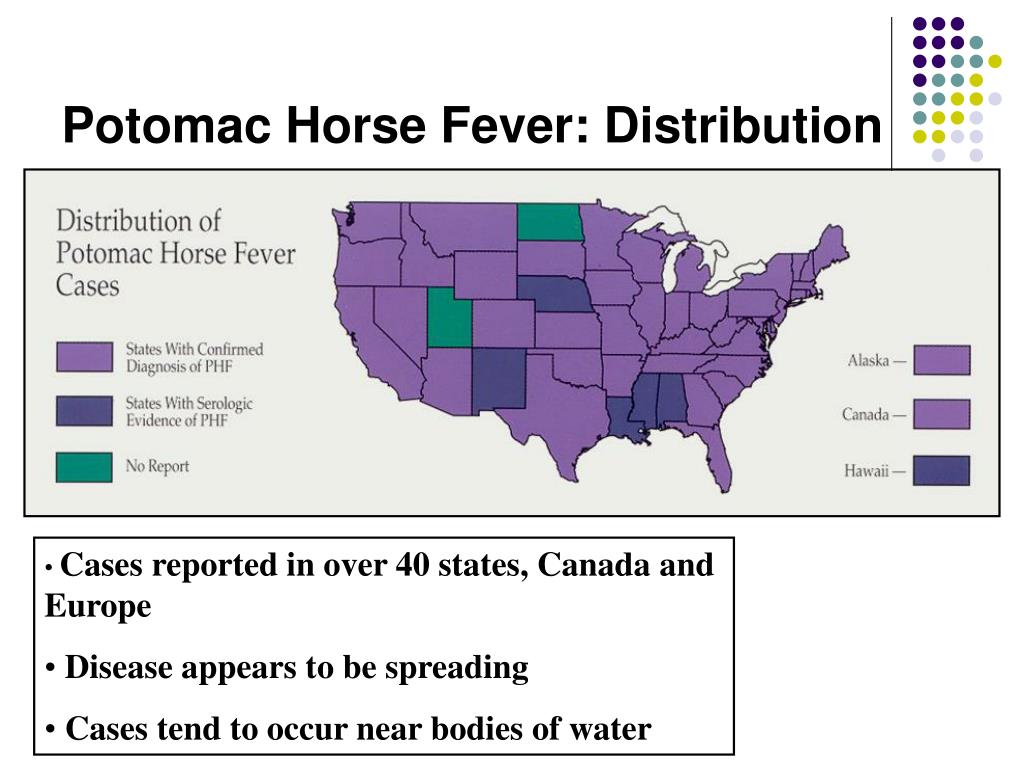
While PHF occurs typically in late spring and early fall in temperate areas, it is spreading and has been reported in over 40 states, Canada, and Europe.  It tends to occur near bodies of water:

https://www.slideserve.com/vito/equine-vaccinations

The agent behind it is Neorickettsia risticii, found in flukes (flatworms) that develop through one stage in aquatic snails. Horses drinking from streams swallow them but they are also picked up by aquatic insects – the second stage (caddisflies, mayflies, damselflies, dragonflies) that might transmit it to horse as they graze.

The second link in the cycle are in bats and barn swallows (N. risticci has been found in their intestinal tracts) that feed on the aquatic insects. It is unknown if bat and barn swallow fecal material infects horses as well.

Potomac horse fever can be mild to life-threatening affecting intestinal cells and monocytes. It causes fever, poor appetite, depression, and diarrhea. Possible lameness with limb edema may occur as well as elevated heart rate, dark mucus membranes, sweating, and signs of mild colic.

PHF is confirmed by lab identification in blood or manure samples. It may be confused with salmonella and the horse should be considered contagious to both animals and humans until fecal salmonella tests are negative.

Treatment is antibiotics, particularly oxytetracycline, IV fluids, electrolyte therapy, and non-steroidal anti-inflammatory drugs to alleviate pain.

There was a 2005 outbreak in Minnesota. They theorize mayflies from the Missippi River were attracted to bright lights outside barns which blew into the show grounds and infected at least six horses. Other cases occured on area farms at the same time that had lights by horse barns.

Turn off lights when aquatic insects are hatching in summer.

For more:  https://thehorse.com/124471/potomac-horse-fever-cause-and-treatment/

According to this article, PHF is NOT considered contagious or is passed between horses with casual contact. If more than one horse is affected it is believed that they all consumed infected insects: https://equusmagazine.com/diseases/potomac-horse-fever-brief

https://unherd.com/2020/10/covid-experts-there-is-another-way/  Video Here

Covid experts: there is another way

Three eminent epidemiologists met in Massachusetts to plan a better response to the pandemic

BY , AND

As infectious disease epidemiologists and public health scientists we have grave concerns about the damaging physical, and mental health impacts of the prevailing COVID-19 policies and recommend an approach we call Focused Protection.   (See link for article)

“This is the saner approach, the more scientific approach,” the authors tell Freddie Sayers
  • Dr Sunetra Gupta is a professor at Oxford University, an epidemiologist with expertise in immunology, vaccine development, and mathematical modelling of infectious diseases
  • Dr Bhattacharya is a professor at Stanford University Medical School, a physician, epidemiologist, health economist, and public health policy expert focusing on infectious diseases and vulnerable populations.
  • Dr Kulldorff is a Professor of medicine at Harvard University, a biostatistician, and epidemiologist with expertise in detecting and monitoring of infectious disease outbreaks and vaccine safety evaluations.

To read and sign the Great Barrington Declaration:  https://gbdeclaration.org

The video and article point out the following:
  1. COVID-19 death risk is more than 1,000 fold higher in the elderly and the infirm
  2. In children, COVID-19 is less dangerous than influenza
  3. As immunity grows in the public, the risk of infection to all falls
  4. Even the WHO states 1 in 10 people have likely been infected:  https://apnews.com/article/virus-outbreak-archive-united-nations-
  5. All populations will eventually reach herd immunity (and is not dependent upon a vaccine)
  6. Our goal should be to minimize death and social harm until we reach herd immunity
  7. Allow those at minimal risk to live NORMALLY to build up immunity
  8. Those not vulnerable should be IMMEDIATELY allowed to resume NORMAL life
  9. Schools and Universities should be completely open
  10. Extra-curricular activities should be resumed
  11. Restaurants and other businesses should open
  12. Arts, music, sports and other cultural activities should resume
Numerous experts worldwide have stated the exact same things since the beginning of this debacle.
It is logical, sound advice based on basic immunology.  These posts go all the way back to March:  
Reminder:  Dr. Heneghan reminds us of the following:
Between now and Dec. doctors see a:
  • four-fold increase in consultations in general practice in a GOOD Year
  • an 8 fold increase in an epidemic year
  • a 50% increase in deaths between now and January
This has NOTHING to do with COVID so don’t let the media mislead you.

https://pubmed.ncbi.nlm.nih.gov/33001978/

Transmission of Bartonella henselae within Rhipicephalus sanguineus: Data on the Potential Vector Role of the Tick

Free article

Abstract

Bartonella henselae is a fastidious intraerythrocytic, gram-negative bacteria that causes cat scratch disease in humans. Ixodes ricinus (castor bean tick) has been confirmed to be a competent vector of B. henselae, and some indirect evidences from clinical cases and epidemiological studies also suggested that some other tick species, including Rhipicephalus sanguineus (brown dog tick, pantropical dog tick or kennel tick), may transmit the bacteria. B. henselae has been detected in R. sanguineus but no experimental investigations have been performed to evaluate the vector competency of this tick species regarding B. henselae transmission.

To this end, this work aimed to assess the transstadial transmission of B. henselae between larvae and nymphs of R. sanguineus as well as transmission by nymphs infected at the larval stage. Four hundred B. henselae negative larvae were fed with B. henselae-infected blood by using an artificial membrane feeding system.

After five days of feeding:

  • B. henselae was detected by PCR in 57.1% (8/14) of engorged larval pools
  • 66.7% (4/6) of semi-engorged larval pools
  • 66.7% (2/3) of larval feces pools
  • after molting, B. henselae DNA was also detected in 10% (1/10) of nymph pools, but not in tick feces
  • after a pre-fed step of nymphs infected at the larval stage on non-infected blood meal, B. henselae was detected by PCR in blood sample from the feeder, but no Bartonella colonies could be obtained from culture

These findings showed that B. henselae could be transstadial transmitted from R. sanguineus larvae to nymphs, and also suggest that these nymphs may retransmitted the bacteria through the saliva during their blood meal.

This is the first study that validated the artificial membrane feeding system for maintaining R. sanguineus tick colony. It shows the possibility of transstadial transmission of B. henselae from R. sanguineus larvae to nymphs.

_______________________

**Comment**

For decades now, ‘authorities’ have denied ticks can transmit Bartonella.  Since so many Lyme/MSIDS patients have Bartonella it’s always seemed highly likely to me that ticks play a role. This study adds to the growing body evidence that yes, in fact, ticks play a significant role.  For more:  https://madisonarealymesupportgroup.com/2020/09/02/bartonella-found-in-ticks-biting-midges-and-moose/

https://madisonarealymesupportgroup.com/2017/04/18/bartonella-vectors/

The other theory is that the tick’s ability to suppress the immune system reactivates a latent Bartonella infection already within the body.  Bartonella is prolific and can be obtained in many, many ways besides the bite or scratch of a cat:  https://madisonarealymesupportgroup.com/2016/01/03/bartonella-treatment/

To date, Bartonella isn’t even on mainstream doctor’s radar for those bitten by ticks. This must change.  Bartonella can be a severe, chronic infection that causes untold damage both physically and mentally.

Psychiatric issues and Bartonella:  https://madisonarealymesupportgroup.com/2020/08/30/new-case-report-neuropsychiatric-symptoms-and-bartonella-associated-skin-lesions/

Work is being done on the connection between Bartonella and cancer:  https://madisonarealymesupportgroup.com/2020/09/11/bartonella-is-an-entity-often-diagnosed-in-breast-imaging-department-during-axullary-lymph-node-assessment/

Bartonella can cause encephalitis:  https://madisonarealymesupportgroup.com/2020/07/30/bartonella-causing-encephalitis/

Great article showing the systemic manifestations:  https://madisonarealymesupportgroup.com/2019/04/24/human-bartonellosis-an-underappreciated-public-health-problem/