https://m.medicalxpress.com/news/2018-06-migratory-birds-newly-hemorrhagic-fever.html

Ticks on migratory birds found to carry newly discovered hemorrhagic fever virus

June 1, 2018
Uppsala University
Ticks on migratory birds found to carry newly discovered hemorrhagic fever virus
Credit: Uppsala university
In a new study, researchers at Uppsala University and other institutions have identified genetic material from the recently identified Alkhurma hemorrhagic fever virus in the tick species Hyalomma rufipes. The discovery was made after thousands of ticks were collected from migratory birds captured in the Mediterranean basin. The results indicate that birds could contribute to spreading the virus to new geographical areas.

The Alkhurma  (a.k.a Alkhumra) was first found in Saudi Arabia in the mid-1990s, in patients with typical hemorrhagic fever symptoms. The condition resembles diseases like Ebola but seems to be spread by contact with cattle and camels or from tick bites and not directly between humans. The knowledge about this relatively novel virus is still limited, and it is not known exactly which animals can act as hosts for the virus and which insects or tick species transmit the disease. Previous research has pointed to camels and other domestic livestock as potential carriers of the virus, and to one or several tick species possibly spreading the disease between mammals, including humans. The virus is a close relative to another tick-borne virus (Kyasanur Forest Disease virus) found in India. So far, the Alkhurma virus has only been seen on the Arabian Peninsula and in (article cut off for some reason)

In a multi-national collaboration, researchers at Uppsala University have detected Alkhurma virus RNA in several ticks that were removed from  migrating from Africa to Europe. The purpose of the study is to find out which tick-borne diseases that could potentially spread to new regions with . Thousands of ticks were removed from migrating birds at seven different bird observatories in the Mediterranean basin.

“Our findings of the Alkhurma virus in ticks collected in Turkey and Greece are the first in the tick species Hyalomma rufipes, which is common in large parts of Africa and on the Arabian Peninsula. These findings mean that we have identified one more tick species that have carried RNA from this virus and shows that there is a risk of spread of the virus to new geographical areas,” says Tove Hoffman, leader of the study and Ph.D. student at the Department of Medical Sciences and the Zoonosis Science Center at Uppsala University.

A clearer understanding of the ecology of Alkhurma virus and continuing surveillance is important, both for populations in areas where it is already found as well as in regions in the Mediterranean basin, to where the virus could spread, since Alkhurma hemorrhagic fever is a potentially fatal disease and there is no effective treatment at present.

“We see that infectious diseases can spread to new geographical areas and that is why it is necessary to understand the role of different animal species in the dynamics of these diseases,” says Tove Hoffman.

More information: Tove Hoffman et al. Alkhurma Hemorrhagic Fever Virus RNA in Hyalomma rufipes Ticks Infesting Migratory Birds, Europe and Asia Minor, Emerging Infectious Diseases (2018). DOI: 10.3201/eid2405.171369

Provided by: Uppsala University

_________________

More on the role of birds in spreading TBD’s:  https://madisonarealymesupportgroup.com/2017/08/17/of-birds-and-ticks/

https://madisonarealymesupportgroup.com/2016/10/02/the-role-of-birds-in-tickborne-illness/

Viruses spread by ticks:  https://madisonarealymesupportgroup.com/2018/05/23/cdc-warns-about-7-new-tick-viruses/

https://madisonarealymesupportgroup.com/2018/04/08/novel-viruses-found-in-lone-star-american-dog-black-legged-ticks/

https://madisonarealymesupportgroup.com/2015/06/14/tacaribe-virus-found-in-ticks/

https://madisonarealymesupportgroup.com/2017/08/11/death-from-tick-borne-virus-sfts/

https://madisonarealymesupportgroup.com/2015/02/22/newly-found-virus-linked-to-kansas-death-after-tick-bite/


http://danielcameronmd.com/lyme-disease-science-conversation-ticks-diseases-they-carry/  Approx. 50 Min

Dr. Daniel Cameron, a leading Lyme disease expert, discusses where are the ticks and what are the diseases they carry.

________________

**Comment**

The word is finally getting out.  TICKS ARE EVERYWHERE!

Beaches:  https://madisonarealymesupportgroup.com/2018/06/07/ticks-on-beaches/

Rocks and picnic benches:  https://madisonarealymesupportgroup.com/2017/03/13/ticks-found-on-rocks/

Caves:  https://madisonarealymesupportgroup.com/2018/04/23/tick-borne-relapsing-fever-found-in-austin-texas-caves/, and https://madisonarealymesupportgroup.com/2017/10/27/israeli-kids-get-lyme-disease-from-ticks-in-caves/

Birds:  https://madisonarealymesupportgroup.com/2017/08/17/of-birds-and-ticks/

California:  https://madisonarealymesupportgroup.com/2018/05/19/infected-ticks-in-california-its-complicated/

In the South:  https://madisonarealymesupportgroup.com/2018/05/31/no-lyme-in-the-south-guess-again/, and https://madisonarealymesupportgroup.com/2017/10/06/remembering-dr-masters-the-rebel-for-lyme-patients-who-took-on-the-cdc-single-handedly/, and https://madisonarealymesupportgroup.com/2017/03/02/hold-the-press-arkansas-has-lyme/

Southern Hemisphere:  https://madisonarealymesupportgroup.com/2018/02/06/lyme-in-the-southern-hemisphere-sexual-transmission/

Australia:  https://madisonarealymesupportgroup.com/2016/11/03/ld-not-in-australia-here-we-go-again/

And everywhere else…..

Remember, there are 300 strains and counting of Borrelia worldwide and 100 strains and counting in the U.S.  Current CDC two-tiered testing tests for ONE strain!  Do the math….

For more:  https://madisonarealymesupportgroup.com/2018/05/27/study-conforms-permethrin-causes-ticks-to-drop-off-clothing/

https://madisonarealymesupportgroup.com/2018/06/06/mc-bugg-z/


http://www.wmdt.com/news/maryland/ticks-found-on-beaches/745414699  (Go here for news video)

Ticks found on beaches

th

Photo credit:  NBC News

By: Brooke Butler
Posted: May 23, 2018

47 ABC – When you’re walking along the beach, you can expect to run into some birds, some crabs, or if you’re at Assateague Island, maybe even some horses. But there’s one creepy crawly resident here that you wouldn’t expect, a tick.

Ginny Rosenkranz, an extension educator from the University of Maryland Extension office, said, “You know, it’s amazing you can find ticks a lot of places, but yes, a beach.”

Earlier in the week, one Ocean City visitor posted a disturbing photo on Facebook of a tick he found in his hair after a long walk on the beach.

Rachel Kelly, an Assateague National Seashore visitor said, “I’d never think to look for ticks on the beach that’s really gross.”

It made us wonder, how common are ticks on the beach and how do they get there in the first place?

Rosenkranz explained, “Think about it, right now there’s a lot of seagulls and other birds flying and they can carry ticks. People who are walking their dogs they are still allowed to do that they can get a tick that falls off of a dog, it’s pretty common in that sense.”

When it comes to Assateague, ticks can actually fall off the ponies and latch on to you.

Kelly Taylor, an Assistant Public Information Officer at Assateague National Seashore said, “You know you come out, ticks can be on horses so you want to keep your distance from the horses. We always recommend school bus length is the safe length for you, the safe length for the horses.”

Rachel Kelly said, “I guess, you know, maybe from the animals too it makes sense. I just never would have put those two together on my own.”

Not only do ticks reside on wild animals, but they hang out in the dune grasses as well.

We’re told this is the perfect habitat for ticks because if they have been on a mouse or other critter and they decide to get off of it, they will do something called questing.

Rosenkranz said, “They will climb up a blade of grass and they will hang with their back feet with their front legs going out like this and as soon as you walk by, they’ve got you and they’re on you.”

As for how common they are on beaches? According to Assateague officials, not very.

Taylor said, “They can be picked up in your backyard just as easily as they can be picked up here at the National Seashore.”

So as a safety precaution, next time you go to the beach, make sure you check for any unwelcome hitchhikers, so you can avoid picking up nasty diseases like Lyme Disease.

EDIT: According to the CDC, in most cases a tick must be attached for 36 to 48 hours before Lyme Disease can be transmitted, but there are still exceptions to that rule, so it is best to get a tick off of you as soon as possible.

The best way to remove a tick is with tweezers. Grab the tick as close to the skin as possible with the tweezers and pull upward with steady even pressure so the mouth does not break off and remain in your skin.

After the tick is removed, the CDC suggests thoroughly cleaning the bite area with rubbing alcohol and disposing of the tick either in rubbing alcohol, down the toilet, or in a sealed plastic bag.

If you develop a fever or rash several weeks after being bitten, you are encouraged to see your doctor.

_______________

**Comment**

Now do you see why climate change has ZIPPO to do with infection rates?  Ticks are marvelous ecoadaptors and will be the last species on earth besides cockroaches and the IRS:  https://madisonarealymesupportgroup.com/2017/08/14/canadian-tick-expert-climate-change-is-not-behind-lyme-disease/

Glad they added that there are exceptions to becoming infected in under 39-48 hours because that’s the truth and no minimum time for infection has ever been ascertained.  In one case it only took about 6 hours for a little girl bitten by a tick to lose the ability to walk and talk:  https://madisonarealymesupportgroup.com/2017/04/14/transmission-time-for-lymemsids-infection/

Ticks have been found in caves, on rocks, underneath picnic benches, and have fallen from trees onto patios: https://madisonarealymesupportgroup.com/2018/05/31/no-lyme-in-the-south-guess-again/, https://madisonarealymesupportgroup.com/2018/04/23/tick-borne-relapsing-fever-found-in-austin-texas-caves/, https://madisonarealymesupportgroup.com/2017/03/13/ticks-found-on-rocks/, https://madisonarealymesupportgroup.com/2017/08/17/of-birds-and-ticks/, https://madisonarealymesupportgroup.com/2017/07/13/tv-anchor-speaks-out-about-lyme-disease/  (TV news anchor got bit at a garden party on a deck with an overhanging tree)

Also, I would never take a “wait and see” approach if you are bitten by a tick.  Why they keep regurgitating this is beyond me.  Everyone knows that prompt medical treatment is what separates those who get better and those who don’t.  Demand a minimum of 3 weeks of treatment:  http://www.ilads.org/lyme/what-to-do-if-bit-by-tick.php

Go here for more dispelled myths.  I write a comment after the video:  https://madisonarealymesupportgroup.com/2018/06/06/mc-bugg-z/


https://www.necn.com/news/health/State-Health-Leaders-Dispute-CDCs-Claim-of-Drop-in-Lyme-Cases-484635141.html

State Health Leaders Dispute CDC’s Claim of Drop in Lyme Disease Cases

A top Massachusetts health official says the CDC’s numbers on Lyme disease cases don’t reflect reality

By Alysha Palumbo, June 5, 2018

Tiny ticks can carry some serious diseases with them, including Lyme disease, but, according to the Centers for Disease Control and Prevention, there has been a 95-percent drop in Lyme disease cases in Massachusetts in just one year.

“If only that were true!” exclaimed Massachusetts Department of Public Health Deputy State Epidemiologist Dr. Catherine Brown.

Dr. Brown says those numbers don’t reflect reality.

That’s because the CDC only allows states to count Lyme disease cases with both a positive lab test and clinical diagnosis.

“This was an extraordinarily burdensome system, not just for us in the department but for our local boards of health and also for our health care providers,” Dr. Brown said.

In 2016, DPH stopped spending time and resources trying to track down the clinical information, instead relying solely on positive lab results to give a more accurate estimate of Lyme disease case numbers.

And what they found is, instead of a 95-percent drop, the numbers stayed almost exactly the same year to year.

“I think DPH’s decision was spot on correct. They know that they’re working with a flawed reporting system that is unfixable,” said entomologist Larry Dapsis, the Tick Project Coordinator with the Cape Cod Cooperative Extension.

Dapsis says the message this should send to people is to remain vigilant – use repellants and check for ticks when you’ve been outside – because the best way to reduce these numbers is to prevent tick bites in the first place.

“You’ve got to not be tick afraid, but tick aware,” said Dapsis.

Dr. Brown says with the amount of time the Department of Public Health has been able to save not trying to track down clinical diagnoses of Lyme disease cases, they’ve actually been able to spend more time studying Lyme in hopes of being able to prevent more cases in the future.

__________________

**Comment**

There you have it:  “A flawed reporting system that is unfixable.”


https://www.lymedisease.org/life-with-lyme-wedding/

Life with Lyme: one missed wedding and a Mother’s Day surprise

Jemmott-293x300

By Janet Jemmott

There was no stopping the barreling train of this Herxheimer reaction.

I’d been in a migrainous state for ten days. I’d medicate with Imitrex; the headache would fade, only to pop back up the next morning or late in the afternoon.

I planned my activity carefully, alternating a day out with a day at home resting. I tried to eat some protein at each meal. I drank lots of water and took far-infrared saunas to detox. I meditated every morning to keep my chill on. But when I woke on the morning of my son’s wedding, there was no mistaking The Sick.

My son is 31 years old, a millennial through and through, unmotivated by amassing material goods, a nerd, an intellect, and a most peaceable man. Like many of his friends, he found Brooklyn to be a wonderful place to live. When he moved there from our Hudson Valley region, I mourned. For the last eight years, he had been a huge support to me. Trained and certified as a registered nurse, he cared for my PICC line when I went through six months of IV ceftriaxone.

Afterwards, he gave me daily and then every other day injections of Rocephin in my gluts, switching sides so the pain wouldn’t be so tough. The injections were harder to handle than the PICC line: sometimes a muscle would inadvertently seize up, and sometimes a small vein would get nicked. I hated the injections and he did too, knowing they caused me great pain. But as with so many therapies for tick-borne diseases, the pursuit of a cure overrode the immediate and fleeting pain.

No Stopping It
When I had a herx – and I had many – there was no stopping the misery. The pain in my head was excruciating; I would start vomiting and continue for up to 18 hours. I couldn’t keep anything in, anywhere. Waves of heat would flood my body and when it hit my head, I ran to the bathroom. It was like my body was purging itself of its inner contents.

Then I would rinse my mouth with water, not daring to swallow even a drop, and shuffle towards my bed, barely lifting my feet, trying not to jostle my head. The chills and shakes would start and I would be freezing, my teeth chattering, until the bed covers finally warmed me. And then it would start all over again.

Sometimes, I wanted to die. The pain was so severe and the vomiting so relentless, I despaired. It was the thought of my son and my daughter finding me lifeless that kept me going. I could not do that to them. So even then they saved me.

The only relief came from an ice pack on my head. It drew the heat out of my head just a bit and distracted me from the god-awful pain. But the ice melted in short order, and it was often my son who would check on me and refill the bag with ice. Kind acts and kind words are a balm indescribable.

Emergency Room–Yes Or No?
I did wind up in the ER once. I was in New Jersey for a gathering of the Three Ladies – my two best friends from college. When I got sick, my friends tried to nurse me but couldn’t ease the sickness. After hours of vomiting, they were alarmed about the possibility of dehydration and its impact on my body.

So, despite my protests, they insisted on taking me to a local hospital ER, where an IV replenished my fluids, Reglan stopped the vomiting, and an opioid diminished the pain and put me to sleep.

After that incident, my son and I went to my neurologist, asking for an injectable to give me relief when I reached this awful state. But she turned me away, saying she couldn’t prescribe them to me. I wondered what it would take for me to get help. I was a middle-aged woman with a documented illness and no history of substance abuse. I gave up.

And I got better, but not well. I stopped taking antibiotics. My gut was hurting and four years of non-stop pharmaceuticals left me longing for a break. I was willing to try to live without them. I used a Rife machine and a far-infrared sauna; found joy in every day; managed to walk and sometimes swim. I started to travel but after every trip, I would get sick in this same way, finding just enough spirit within to endure the suffering.

The Steady Slide
Then last summer, after a glorious trip to Paris, I got sick and never bounced back. The slide was gradual but steady. I sought help from a naturopathic doctor and started an herbal protocol that including antimicrobials for Borrelia, Babesia, Bartonella, and Ehrlichia. The doctor prescribed adrenal support and liposomal glutathione for detoxing. We worked at replenishing my depleted levels of minerals and vitamins, and addressing the crushing fatigue. Some symptoms improved: small victories.

When my son told me he was getting married, I was delighted. He’d found a wonderful person to share life with. We looked forward to their wedding day for months. Members of my family flew in from the Washington, California, and Texas, and drove from Vermont and Delaware. My house was full of people and happiness. The night before the wedding, my sister and I picked out jewelry from my mom’s box of sparkly things, and decided what sweater or jacket to bring to throw over our summery dresses, since the forecast was for rain and cool temperatures.

Oh, No!
Then, the morning of the wedding I woke up feeling awful. I took an Imitrex and an ondansetron (for nausea). A half hour later, I started vomiting and the misery and pain overtook me. It’s one thing to just be in pain but uncontrolled vomiting does not lend itself to a car ride or a wedding or anything but a trip into a very dark place. My husband understood immediately that I couldn’t go. But he had to go, to leave me and represent our family.

Of course, my son understood. He knew exactly the state I was in, having seen it so many times before. And they had a fabulous day. I saw it through the eyes of my friends and family, heard it in their voices relating the day’s events. I knew my son and new daughter were supported in their expression of trust and love and celebration.

The Day After
The next day was Mother’s Day. I felt hollowed out and still unwell, but no longer in the Pit of Despair. My nephew cooked dinner and my sister set the table. I sat in a chair and delighted in the wedding photos and video clips people sent me, crying again because I wasn’t there to lend my support.

And then the front door opened and my dog ran to see who had arrived. She’s a funny little creature who sings when someone she loves arrives. I heard her bark turn into song, and then I heard my new daughter-in-law Emily’s voice. And she and my son John Henry strode into the kitchen wearing their wedding garb, bringing flowers and a gift I never expected: their presence, a day after their day. I couldn’t imagine a better Mother’s Day.

Janet Jemmott is the editor of the Lyme Connection newsletter and a long-time Lyme warrior. She lives and writes in New York’s Hudson Valley.

_____________________

**Comment**

Another unbelievably sad story from Lyme-land.  The suffering is unimaginable.  What’s quite unbelievable, if you think about it, is the human ability to plod on despite grueling, relentless symptoms that frankly make you question your sanity and your desire to keep going.

I too had a wedding to plan for and I remember distinctly the fear that my husband or I wouldn’t be well that day.  On top of that I had a gaping spot under one eye I was trying to cover up until I could get MOHS surgery.  It was a once in a lifetime event that left me struggling with many emotions – one of which was outright fear.

11703189_529270353892658_3991587155581343699_n

We are all smiles but underneath it all was a boiling cauldron of emotions.

A month later.…..I was told by the plastic surgeon I’d need two more surgeries and while I was desperately excited to have him take skin from my hip for it, I declined and used ozonated olive oil.  It healed perfectly – no further surgeries needed.  It did hurt like a Mother!
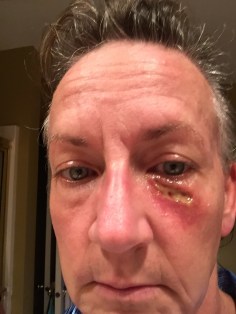
IMG_0037 - Version 2

Life can definitely include some lemons.  Let’s just take all those lemons and make the best lemonade ever.