Also, our next support group meeting will be April 13, 2019 at 2:30. A support group member has graciously agreed to share what he’s learned about tips for gut health and how you can implement these practical ideas yourself at home.
Our last meeting of the year in May, Lyme Awareness Month, will be a FREE viewing of “Under Our Skin,” the best primer on Lyme disease on the market. I hope to bring copies of the poster in April for all of you to help distribute. It’s a great event to bring family, friends, and anyone who needs to be educated.
Sometimes when I’m describing tick-borne illness, I feel like I’m speaking a foreign language.
Most people have heard of Lyme disease—though too many mistakenly call it “Lyme’s” when there is actually no possessive form. I often get blank stares when I use words like babesia, ehrlichia, and bartonella. Another term that confuses people, even those who have been diagnosed with Lyme, is Jarisch-Herxheimer reaction, more commonly referred to as a “Herx”.
A what? Bear with me.
Discovered by dermatologists Adolf Jarisch and Karl Herxheimer in their studies of syphilis—another illness like Lyme whose bacterium is a spirochete, meaning having a spiral shape—a Jarisch-Herxheimer reaction is an adverse response to toxins released by bacteria killed by antibiotics. In the case of Lyme disease, antibiotics sometimes kill spirochetes faster than the body can eliminate them. This means the patient is stuck with a backlog of dead bacteria which takes time to expel. The buildup of this toxic waste can make the patient feel much worse before it makes them feel better; their symptoms increase until their bodies can expel the dead spirochetes.
That’s one explanation of a Herxheimer reaction, but what does it feel like to actually have one?
When I started taking intravenous antibiotics, the first six weeks were awful. I’d expected the medicine to slowly clear up my symptoms the way antibiotics work, for example, on a sinus infection or simple bronchitis. But within a week of beginning treatment, I started feeling worse than I ever had before. My fatigue was as intense as it was when I first took ill. I felt a pulling sensation in my limbs stronger than I’d ever had before. I couldn’t find a comfortable position in bed because of all the the pains in my joints. Usually easy tasks like brushing my hair and washing dishes felt like workouts. My sleep became so heavy that my blood stopped circulating properly, and my limbs felt weighted. I wondered how I could still be alive when my body seemed so lifeless.
“This is great news,” my doctor said, paradoxically. “It means the medicine is working. Stay the course.”
My doctor said I was Herxing, meaning that the antibiotics were doing exactly what they were supposed to do.
“Once your body gets rid of that build up of dead bacteria, you’ll start to feel better.”
You may wonder how the bacteria gets eliminated. Some of it, especially the toxins from the parasitic tick-borne co-infection babesia, is sweated out. I’d wake two or three times a night completely soaked from head to toe, as if I’d just showered. The sweat felt slimy on my body, like a lotion or oil. I often had to change pajamas and sometimes even the sheets of my bed in the middle of the night.
But most dead spirochetes are eliminated as you might imagine: through the stool. I’d sit up in bed and suddenly feel a great urge for the bathroom. Once there, I’d barely get my nightgown raised and underwear down before my bowels exploded. The release came with the rush of diarrhea but the consistency was of foam noodles snaking out of me in long tubes. The toilet filled so quickly that I had to flush before continuing to go. The toilet steamed with hot dung the color of dead, hardened manure. The smell made me gag.
During my most intense Herxes, I ran to the bathroom upwards of ten times a day. I had to make sure to drink lots of electrolyte-enhanced water, to combat the dehydration brought on by night sweats and frequent elimination. I ate bananas to keep up my potassium levels. I spent a lot of time sleeping, or trying to sleep. During these periods my neurological symptoms would also worsen, because dead spirochetes were piling in my central nervous system, which for me meant insomnia or even hallucinatory nightmares.
The span of a Herx differs by patient. It depends on how you respond to treatment. How much bacteria do you have in your body to start with? Moreover, how quickly can your body detox? For me, a Herx could last anywhere from a couple days to a couple weeks. Then, I’d get a reprieve for a week or two, and then the cycle would start all over. Each time, the Herxheimer reaction was a little less intense, but shorter. You might feel like you’re dying when you’re having one, but in fact it’s actually the bacteria that is dying, and that’s really a good thing.
You can’t control how well your body will respond to antibiotics, but you can help the detox process. There are many theories on how to do so. Some Lyme Literate Medical Doctors (LLMDs) use actual detox protocols. What helped me the most was electrolyte- augmented water, decaffeinated green tea, and lemon juice. Talk to your LLMD about how you can best support your body during a detox, so that your Herxes aren’t so bad. And when you do have a Herx and someone asks, “What’s that?” just show them this article.
Opinions expressed by contributors are their own.
Jennifer Crystal is a writer and educator in Boston. She has written a memoir about her journey with chronic tick borne illness, for which she is seeking representation. Contact her at:
One of the hardest things to understand about this complex disease(es) is that you feel a whole lot worse before you feel better and this can take considerable time. Managing the herx is a challenging job. Many find sauna’s to be of great help. I also found drinking lemon water, green tea, MSM, and taking enzymes helpful. As Dr. Burrascano says, “Now is the time for pristine health habits.”
Pharmaceutical companies are under the spotlight with congressional hearings on the cost of drug prices and allegations of the industry’s role in the opioid crisis.
Dr. Raeford Brown, a pediatric anesthesia specialist at the UK Kentucky Children’s Hospital and chair of the Food and Drug Administration (FDA) Committee on Analgesics and Anesthetics, has been openly critical of big pharma and the lack of proper oversight from the FDA.
Despite many politicians, particularly declared presidential candidates, beginning to speak out against big pharma, Brown does not think that anything will come out of it “because Congress is owned by pharma.”
“The pharmaceutical industry pours millions of dollars into the legislative branch every single year,” he told Yahoo Finance. “In 2016, they put $100 million into the elections. That’s a ton of money.”
‘It’s really about Congress’
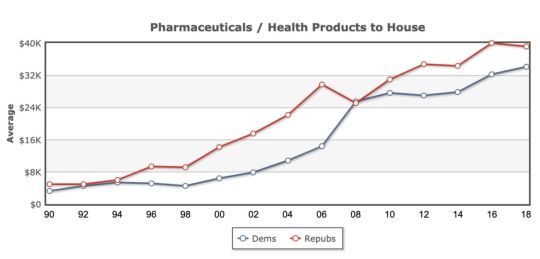
Contributions from the pharmaceutical and health products industry during the 2017-2018 election cycle. (Photo: screenshot/OpenSecrets)
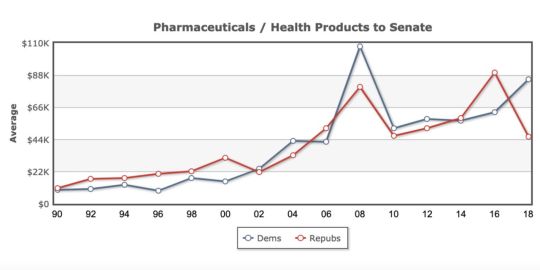
OpenSecrets, a website operated by the nonpartisan Center for Responsive Politics, tracks money in U.S. politics. It ranked the top 20 members of the House and the Senate that have received the most campaign contributions from the pharmaceutical and health products industry during the 2017-2018 election cycle.
The website defines the industry as including “not only drug manufacturers but also dealers of medical products and nutritional and dietary supplements.”
Sen. Heidi Heitkamp, (D-N. Dak)., leaves the Capitol after a vote on Thursday, June 14, 2018. (Photo By Bill Clark/CQ Roll Call)
During the ‘17-’18 election cycle, Kevin McCarthy, now the House minority leader after midterms, received the second-highest amount of funds in Congress. The California-based politician received a total of $380,350 in campaign contributions, with a large sum coming from pharma companies such as Abbott Laboratories (ABT), Pfizer (PFE), Johnson & Johnson (JNJ), Eli Lilly (LLY), Amgen (AMGN), and Merck (MRK).
“I’m really much more concerned because Congress is supposed to have oversight for the FDA,” Brown said. “If the FDA isn’t going to hold pharma accountable, and Congress is getting paid to not hold pharma accountable, then it really doesn’t matter who the president is because it’s really about Congress.”
Democrats and Republicans alike benefit from Big Pharma donations. (Photo: screenshot/OpenSecrets)
Paul Ryan (R-Wis.), the former speaker of the House, was ranked 10th among members of Congress. He received $222,070, seeing most of the funds coming from Merck.
Fourteen out of the top 20 recipients in the House were Republicans.
Beto O’Rourke (D-Texas), a former congressman who almost upset Senator Ted Cruz (R-Texas) in the 2018 midterms, was 18th on the list. O’Rourke, seen as a potential 2020 Democratic presidential candidate, received $171,255.
Dems top list of big pharma Senate donations
Democrats and Republicans alike benefit from Big Pharma donations. (Photo: screenshot/OpenSecrets)
In the Senate, notable names include Orrin Hatch (R-Utah), Kirsten Gillibrand (D-N.Y.), and Senate Majority Leader Mitch McConnell (R-Ky.).
Hatch received $238,289 in donations, with Merck being the biggest donor among manufacturing companies. McConnell, ranked 12th among senators on the list, received $149,113, with Eli Lilly being the prevailing big pharma company.
Fifteen out of the top 20 recipients in the Senate were Democrats.
Gillibrand, a Democratic candidate for president in the 2020 election, was ranked 11th on the list.
Over half of the big pharma money she received during the 2017-2018 cycle came from Pfizer, with Amgen, AbbVie (ABBV), and Johnson & Johnson also in the mix. Overall, she received a total of $151,197 from the pharmaceutical/health product industry.
Gillibrand announced in February 2019 that she and Senator Sherrod Brown (D-O.H.) were introducing legislation that would “penalize pharmaceutical companies believed to be engaging in price gouging without cause, leading to price spikes for patients who rely on medication to treat diseases ranging from cancer to addiction.”
Democratic presidential candidate Sen. Kirsten Gillibrand (D-N.Y.) on Monday, Feb 25, 2019.(AP Photo/Manuel Balce Geneta)
Minnesota senator and Democratic presidential candidate Amy Klobuchar (D-Minn.) has repeatedly stated in public appearances that she will not be bought by big pharma.
“In Minnesota and across the country, no place has been immune from the devastating effects of opioid abuse,” Sen. Klobuchar said in a statement to Yahoo Finance. “In my state, deaths from prescription drug abuse now claims the lives of more Minnesotans than homicides or car crashes. We need to continue to work together to tackle the scourge of opioid addiction that continues to take lives each day.”
At the same time, thanks to the U.S. campaign finance system, Klobuchar has also received money from some of the companies contributing to the opioid epidemic.
According to OpenSecrets, Klobuchar received $65,491 in campaign funds during the 2017-2018 election cycle, with $8,500 coming from pharmaceutical companies. Abbott Laboratories was her biggest pharma donor at $8,000.
‘If we don’t change … it will happen again’
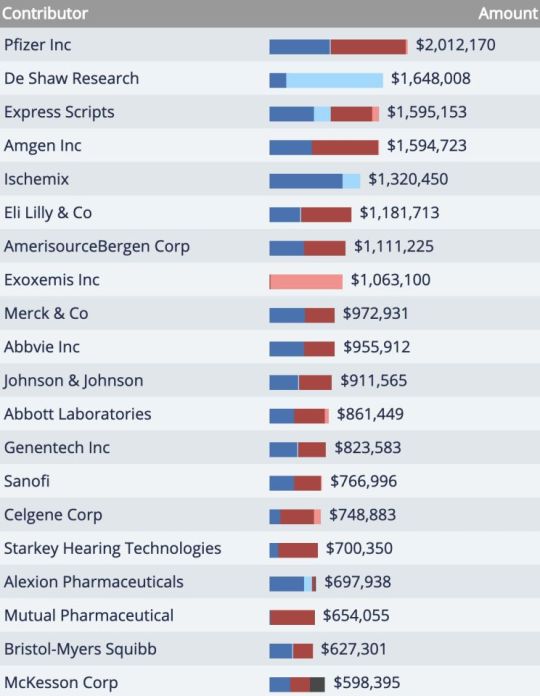
Democratic medical adviser:‘Congress is owned by pharma’Top pharma contributions in the 2017-18 election cycle by company.(Photo:screenshot/OpenSecrets)
Purdue Pharma is one company that has come under fire as of late, as it faces roughly 2,000 lawsuits, including one by the state of Massachusetts that alleged that it “created the [opioid] epidemic and profited from it through a web of illegal deceit.”
Although Senator Richard Burr (R-N.C.) isn’t among the top 20 senators in big pharma money, he did receive the largest sum of donations from Purdue in the 2017-2018 election cycle, a total of $6,000. Since 2007, Purdue has contributed $170,250 to his campaigns, according to Kaiser Health News.
As a result of the lawsuits, Purdue Pharma is exploring filing for bankruptcy. Filing for Chapter 11 protection “would halt the lawsuits and allow Purdue to negotiate legal claims with plaintiffs under the supervision of a U.S. bankruptcy judge,” Reuters reported this month.
The lawsuit is only one part of the massive opioid epidemic plaguing the country, which Brown said derives from the pharmaceutical industry’s desire to make a profit.
“If we don’t change the regulatory process for opioids, it will happen again,” Brown said.
Adriana is an associate editor for Yahoo Finance. Follow her on Twitter @adrianambells.
Dr. Paul Thomas commissioned an independent quality assurance project. The researcher found 3,345 patients born into Thomas’ practice in the last 10.5 years.
715 in his practice had ZERO vaccines. Autism rate 1 in 715.
Remaining 2,630 followed his “vaccine friendly” schedule getting between 7-18 vaccines. There were 6 cases making the Autism rate 1 in 440.
The recommended CDC schedule mandates kids of this age group get 25-40 vaccines with an Autism rate of 1 in 45.
The “vaccine friendly” plan gave 1,000% improvement from the CDC vaccine schedule.
Borrelia crocidurae is endemic in West Africa, where it represents the leading cause of tick-borne relapsing fever (TBRF). TBRF typically presents with high fever and systemic symptoms, followed by recurrent episodes. Neurological complications may occur during febrile relapses. B. crocidurae is considered the most neurotropic agent of TBRF and is associated to severe neurological manifestations i.e. meningitis and encephalitis.
To date, European cases of B. crocidurae infection have been reported in travelers returning from endemic areas. We report the first autochthonous case in Europe of B. crocidurae infection, presenting as meningitis with cranial polyneuritis and cavernous sinus thrombosis that were not preceded by classical febrile recurrences.
It also demonstrates once again that current CDC 2-tiered testing will NEVER pick this up.
Cranial polyneuritis = inflammation of many nerves simultaneously.
Cavernous sinus thrombosis = when the immune system creates a blood clot to prevent bacteria or other pathogens from spreading within a cavity at the base of the brain which drains deoxygenated blood from the brain back to the heart. Typically it is caused by an infection. The clot increases pressure inside the brain which can cause damage. Mortality is 30%.
Symptoms of cavernous sinus thrombosis may include:
Altered mental status that can range from confusion to coma
Tests for Cavernous Sinus Thrombosis
Doctors may order brain scans, including CT and MRI scans, to look for cavernous sinus thrombosis. They may also test blood or spinal fluid to check for signs of infection.
Treatment of Cavernous Sinus Thrombosis
Doctors treat cavernous sinus thrombosis with high-dose antibiotics. These are usually given though an IV drip.
Corticosteroid medications may also be used to reduce swelling. Blood thinners are sometimes given.
Surgery may be needed to drain the site of the initial infection.




 Contributions from the pharmaceutical and health products industry during the 2017-2018 election cycle. (Photo: screenshot/OpenSecrets)