Archive for the ‘Viruses’ Category

Tick-borne Encephalitis Found in Serbian Dogs, Horses, Wild Boar, and Roe Deer

Molecular Detection and Serological Evidence of Tick-Borne Encephalitis Virus in Serbia

Authors:  Potkonjak Aleksandar, Petrović Tamaš, Ristanović Elizabeta, Lalić Ivica, Vračar Vuk, Savić Sara, Turkulov Vesna, Čanak Grozdana, Milošević Vesna, Vidanović Dejan, Jurišić Aleksandar, Petrović Aleksandra, and Petrović Vladimir. Vector-Borne and Zoonotic Diseases.

https://doi.org/10.1089/vbz.2017.2167

Online Ahead of Print: October 24, 2017
Serbia
E-mail: ale@polj.uns.ac.rs

ABSTRACT
Tick-borne encephalitis (TBE) is a zoonotic flaviviral infection that is a growing public health concern in European countries. The aims of this research were to detect and characterize tick-borne encephalitis virus (TBEV) in Ixodes ricinus ticks at presumed natural foci in Serbia, and to determine seroprevalence of TBEV IgG antibodies in humans and animals.

A total of 500 I. ricinus ticks were examined for the presence of TBEV by real-time RT-PCR, and conventional nested PCR and sequencing. To determine TBEV seroprevalence, 267 human sera samples were collected, as were 200 sera samples from different animal species. All sera samples were examined by ELISA for the presence of anti-TBEV antibodies. To exclude cross-reactivity, all sera samples were tested for anti-West Nile virus (WNV) antibodies and all human sera samples were also tested for anti-Usutu virus antibodies by ELISA.

Results of this preliminary study indicated TBEV activity in Serbia at two microfoci. Several decades after the previous documentation of TBEV in Serbia, we have demonstrated the presence of TBEV in I. ricinus questing nymphs (prevalence 2% and 6.6% at the two different localities) and anti-TBEV antibodies in humans (seroprevalence 0.37%). Moreover, we show for the first time TBEV seroprevalence in several animal species in Serbia, including dogs (seroprevalence 17.5%), horses (5%), wild boars (12.5%), cattle (2.5%), and roe deer (2.5%). None of the goats tested was positive for anti-TBEV IgG antibodies. TBEV isolate from I. ricinus tick in this study belonged to the Western European subtype. To understand the true public health concern in Serbia, detailed epidemiological, clinical, virological, and acarological research are required. This is important for implementation of effective control measures to reduce the incidence of TBE in Serbia.

___________________

http://authoritycure.com/tick-borne-encephalitis-tbe/TBE (Tick-borne encephalitis) Treatment   Therapeutic approaches for viruses can only support the body in its fight against the pathogen by alleviating symptoms and preventing long-term damage; however, TBE patients can suffer from life-threatening symptoms and need to be closely monitored.
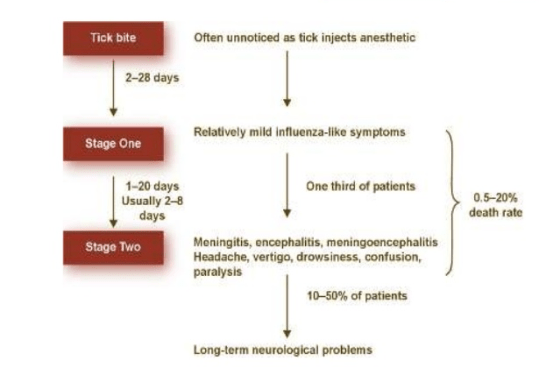
Tick-borne-encephalitis-symptoms

It is only in the second stage of disease that early meningoencephalitis can be detected by laboratory tests (blood, brain and spinal fluid).

https://www.cdc.gov/vhf/tbe/index.html  Other Flaviviridae viruses closely related to TBEV:  Omsk hemorrhagic fever virus in Siberia, Kyasanur Forest disease virus in India and its close relative, Alkhurma virus in Saudi Arabia, Louping ill virus (United Kingdom) that causes disease primarily in sheep but has been reported as the cause of a TBE-like illness in laboratory workers and persons with contact to sick sheep (e.g., veterinarians, butchers), and Powassan virus in the USA and Russia, is responsible for encephalitis in humans.

More on Powassan:  https://madisonarealymesupportgroup.com/2016/02/21/powassan-virus/

Viruses in general: https://madisonarealymesupportgroup.com/2016/03/28/combating-viruses/

https://madisonarealymesupportgroup.com/2017/10/15/vaccines-and-retroviruses-a-whistleblower-reveals-what-the-government-is-hiding/  Since the 1970’s scientists have done disease research in the same labs manufacturing vaccines.  They erroneously believed that mouse viruses and human viruses would not interact, or travel from one part of the research facility to another. This belief was proven wrong in 2009 by Dr. Judy Mikovits and other scientists who discovered that a retrovirus called XMRV (xenotropic murine retrovirus) and other related retroviruses were now present in 6% of Americans and that this retrovirus was appearing in a very high percentage of people with diseases such as prostate cancer, Chronic Fatigue Syndrome, autism, Lou Gehrig’s Disease, treatment resistant Lyme disease, and Parkinson’s Disease.




Lyme Wars Part 5 – Coinfections

http://www.nbcnewyork.com/on-air/as-seen-on/Lyme-Wars-Part-V-Doctors-Sound-the-Alarm_New-York-453724883.html Oct. 27, 2017 (News video in link)

Man dies of Powassan virus and doctors are sounding the alarms to not only Lyme disease, but other tick-borne illnesses. Stefan Holt reports in the final part of News 4’s 5-part series on the Lyme Wars.

______________

**Comment**

Another informative report on the dangers of other TBI’s (tick borne illness) besides Lyme Disease.  Please remember that a tick’s gut is a literal garbage can of pathogens that work synergistically to make us extremely sick.  This is why throwing doxycycline like napalm doesn’t work for a significant portion of patients and until doctors become educated and admit that Lyme Disease is usually MSIDS (multi systemic infectious disease syndrome) we are doomed as there is often far more than just Lyme (borrelia) at play requiring different medications.  The CDC/IDSA unscientific and antiquated guidelines are seriously behind the 8 ball.

https://madisonarealymesupportgroup.com/2017/07/01/one-tick-bite-could-put-you-at-risk-for-at-least-6-different-diseases/  (The actual number of pathogens is far greater than 6 and new ones are being continually discovered)

Also, please do not be taken in by doctors such as Dr. Wormser, chief of infectious diseases at NY Medical College, who claim this or that disease is “rare.”  That type of verbiage has kept thousands from being tested, diagnosed, and treated for decades.  I assure you all of this is more common than currently believed and until every TBI is reportable we have no clue about numbers.  Reporting criteria also needs to be brought up to speed as a majority of patients don’t meet the current arbitrary standards created by the CDC that follows the controlled narrative.

Powassan https://madisonarealymesupportgroup.com/2017/05/05/powassan-another-reason-to-avoid-ticks/

https://madisonarealymesupportgroup.com/2017/05/15/wisconsin-health-officials-warn-of-tick-borne-diseases-as-summer-nears/

As of 2015, Wisconsin has the 2nd highest number of cases of Powassan:  http://www.tmj4.com/news/local-news/deadly-tick-borne-virus-on-the-rise-in-wisconsin  While it’s true Powassan can be spread in mere minutes, the minimum transmission time for Lyme (borrelia) as not been determined.  Please know multitudes have become infected with LD in far less than 24 hours:  https://madisonarealymesupportgroup.com/2017/04/14/transmission-time-for-lymemsids-infection/

Babesia

https://madisonarealymesupportgroup.com/2017/07/09/2600-increase-in-babesia-in-12-years-in-wisconsin/

https://madisonarealymesupportgroup.com/2016/01/16/babesia-treatment/

https://madisonarealymesupportgroup.com/2017/08/30/babesia-spread-to-newborn/

Bartonella – Dr. Phillips states many doctors completely ignore Bartonella, and while the CDC states there is no convincing evidence that ticks transmit Bartonella, Phillips is not surprised.  He says research on Bartonella is where Lyme was 30 years ago.  The majority of WI patients I work with have Bart symptoms.

Bartonella Treatment

https://madisonarealymesupportgroup.com/2017/09/13/dr-fox-cat-scratch-fever-warning/

https://madisonarealymesupportgroup.com/2017/10/01/bartonella-in-mouth-of-hiv-infected-man/

Borrelia Miyamotoi (Relapsing Fever Group)

https://madisonarealymesupportgroup.com/2016/11/06/survival-of-b-miyamotoi/

https://madisonarealymesupportgroup.com/2017/09/14/bm-in-manitoba-2011-2014/

https://madisonarealymesupportgroup.com/2017/08/03/transmission-of-borrelia-miyamotoi-sensu-lato-relapsing-fever-group-spirochetes-in-relation-to-duration-of-attachment-by-ixodes-scapularis-nymphs/  Antibiotics that have been used effectively include doxycycline for uncomplicated B. miyamotoi infection in adults and ceftriaxone or penicillin G for meningoencephalitis.

Ehrlichiosis

http://www.slh.wisc.edu/wp-content/uploads/2013/11/ArbovirusandEhrlichiosisinWI.pdf

  • Prior to 2008, anaplasmosis and ehrlichiosis infections were referred to as human granulocytic ehrlichiosis (HGE) and human monocytic ehrlichiosis (HME), respectively.
  • Since 2008, surveillance for human anaplasmosis and ehrlichiosis are classified as:
    • –  Anaplasmosis caused by the A. phagocytophilum bacteria (transmitted by the blacklegged tick).
    • –  Ehrlichiosis caused by E. chaffeensis, E. ewingii (transmitted by the Amblyomma americanum or lone star tick).
    • –  Anaplasmosis/Ehrlichiosisundetermined(speciesunknown) including the new species E. muris-like (EML).
  • Increase in probable cases of E. chaffeensis (lone star tick vector not traditionally seen in Wisconsin.)
  • In 2009, identified a cluster of novel E. muris-like cases.
    • In 2009, EML was first identified in a cluster of four case-patients from Wisconsin (3) and Minnesota (1). This atypical Ehrlichia had never before been identified in North America.
      • From 2009-2012, a total of 33 confirmed EML cases have been identified from both states and one case-patient was cultured positive.
  • It is uncertain how widely spread the E. muris-like infections are in Wisconsin because of the limited testing available.
  • DPH is currently working with laboratories to bring the 34 multiplex PCR testing on board.

https://www.ncbi.nlm.nih.gov/pubmed/8603945   Human granulocytic ehrlichiosis in Wisconsin and Minnesota: a frequent infection with the potential for persistence.

Anaplasmosis

https://madisonarealymesupportgroup.com/2017/10/14/anaplasmosis-nightmare/

https://madisonarealymesupportgroup.com/2016/03/08/anaplasmosis/ Treatment

Prevention Tips:

https://madisonarealymesupportgroup.com/2017/05/11/tick-prevention-and-removal-2017/

If one thing is clear it’s that none of this is straight forward and simple.  Research and testing for all things TBI is abysmal and has been a controlled narrative from the beginning.  Until researchers and doctors have an unbiased approach patients are caught in the Lyme Wars.

Please spread the word.


No Lyme in Oklahoma – Yeah Right

https://globallymealliance.org/bursting-woods-new-england-bubble/

by Jennifer Crystal

JENNIFER CRYSTAL ADDRESSES THE COMMON MYTH THAT LYME DISEASE ONLY EXISTS IN NEW ENGLAND.

Last summer, a friend who lives in Oklahoma found a classic bullseye rash on her seven-year-old daughter.

“That’s a spider bite,” a local pediatrician told her. “We don’t have Lyme in Oklahoma.”

The doctor was wrong. Had my friend taken his advice, her daughter would not have been diagnosed in a timely fashion and she would likely have developed symptoms over the next few months or years. She probably would have become severely debilitated, and the infections might have crossed the blood-brain barrier and become chronic.

In other words, the little girl could have wound up like me. For as it turns out, she did not have a spider bite. She had Lyme disease and two co-infections, Babesia and Bartonella.

Now she’s a healthy, happy second grader because a Lyme Literate Medical Doctor (LLMD) was brought in who accurately saw the bullseye rash for what it was. Another pediatrician ordered special tests, and started the child on proper medication for all three infections. Because they were caught early, those infections have now cleared up.

This little girl was lucky, but that’s because her mother was informed about Lyme and knew to persist beyond the “spider bite” diagnosis. But what about all those children whose parents and pediatricians aren’t Lyme literate? Especially those who live outside the so-called endemic areas?

I don’t believe the Oklahoma pediatrician meant harm with his inaccurate diagnosis. His lack of awareness stemmed from a common myth that Lyme only exists in New England, and specifically in the woods. I’ve had people in Massachusetts say to me,

“Oh Lyme—that’s the thing you get when you’re hiking, right?”

Yes and no. Ticks live not only in the woods but also in long grasses, gardens, woodpiles, leaf litter and on lawns. They love any moist, shady area. They feed not just on deer—another common myth—but also on mice, chipmunks, shrews, birds, and other small mammals. Therefore, they travel a lot. People travel, too. Someone from South Carolina might take a vacation in Maine, get bitten by a tick, and later be told by their doctor, “It can’t be Lyme. We don’t have it in the South.” In fact, cases of Lyme disease have been documented across the United States, and throughout the world.

New research published in the Journal of Medical Entomology shows that infected ticks are now in half the counties across the country, a number that has almost doubled since a similar survey was done in 1998. The study notes that over the past two decades, the black-legged tick

“has expanded from its northeastern focus northward into upstate New York, Vermont, New Hampshire, and northern Maine; westward across Pennsylvania, eastern Ohio, and New York; and south—and southwestward into West Virginia, Virginia, and North Carolina.” The study also notes a similar geographic expansion in the North-Central states. “The two previously distinct foci in the Northeast and North-Central states appear to be merging in the Ohio River Valley to form a single contiguous focus.”[1]

Ticks are spreading across the country, bringing not just Lyme but co-infections. These require different treatment and can complicate recovery.

Had my friend’s daughter only been treated for Lyme and not for Babesia and Bartonella, she would still be sick.

Some of these co-infections are specific to states that are nowhere near New England. Bourbon virus, a rare but potentially deadly illness, has been reported in Kansas and Oklahoma. The Heartland virus, spread through the bite of an infected Lone Star tick, has been found in Missouri, Tennessee and Oklahoma. Also transmitted by the Lone Star tick is Southern Tick-Associated Rash Illness (STARI), while dog ticks and Rocky Mountain wood ticks carry Rocky Mountain Spotted Fever.

Tick borne illnesses are rampant not just in New England, not just deep in the woods, but all across the country and world. As the International Lyme and Associated Diseases Society states on its website,

“ticks know no borders and respect no boundaries.”[2]

No matter where you live, if you have symptoms of Lyme and/or co-infections, it’s critical to see an LLMD. If you still have the tick, you can also get that tested. Follow the smart lead of my friend in Oklahoma, so you don’t wind up like me.

Opinions expressed by contributors are their own.

Jennifer Crystal is a writer and educator in Boston. She is working on a memoir about her journey with chronic tick-borne illness. Contact her at jennifercrystalwriter@gmail.com

[1] Rebecca J. Eisen, Lars Eisen, Charles B. Beard; County-Scale Distribution of Ixodes scapularisand Ixodes pacificus (Acari: Ixodidae) in the Continental United States , Journal of Medical Entomology, Volume 53, Issue 2, 1 March 2016, Pages 349–386, https://doi.org/10.1093/jme/tjv237

[2] http://www.ilads.org/lyme/about-lyme.php

_____________

**Comment**

Lyme/MSIDS is everywhere.  Do not let anyone tell you otherwise.  The entomology maps of tick locations have been used for decades keeping patients undiagnosed and untreated.  For a great article on how the Spielman maps have been an iron curtain keeping patients from getting tested:  https://doczz.net/doc/4593057/the-confounding-debate-over-lyme-disease-in-the-south (scroll to page 6 & 7 for details)

https://madisonarealymesupportgroup.com/2016/09/24/arkansas-kids-denied-lyme-treatment/ (Southern patients are STILL told there is no Lyme in the South.)

https://madisonarealymesupportgroup.com/2017/10/12/the-cdc-needs-a-good-dictionary/  This article is a perfect example of why all things related to Lyme/MSIDS has hardly budged in over 40 years.

As to testing, the current CDC two-tiered testing misses over half of all cases.  The “special” tests Ms. Crystal mentions are more sensitive but are not supported by main stream medicine for reasons I won’t delve into here (essentially governmental collusion, patents, power and money – read article about the CDC needing a good dictionary above).  

Great testing info here: https://www.lymedisease.org/lyme-basics/lyme-disease/diagnosis/ and here,  https://madisonarealymesupportgroup.com/2016/12/07/igenex-presentation/

Lyme literate doctors (LLMD’s) use the more sensitive testing but also diagnose patients clinically as some NEVER test positive.  This is important to know.  Here is a common checklist you can print out and complete on your own.  https://madisonarealymesupportgroup.com/wp-content/uploads/2016/01/symptomlist.pdf              If you have a preponderance of symptoms – think TBI’s (tick borne illness); however, there is a caveat – some people present differently and don’t fit the classic mold.  For instance, for some, the only significant symptom is psychiatric:  

https://madisonarealymesupportgroup.com/2017/10/24/the-lyme-wars-faces-of-the-health-crisis-a-digital-documentary/Kyra, didn’t have the normally thought of symptoms – just horrible anxiety, depression, and hopelessness. Her doctor knows Lyme is the great imitator and suspected it despite a negative test. She tested positive for Ehrlichia, which implies contact with a tick. Due to the Lyme/MSIDS diagnosis Kyra went from blaming herself to understanding she now had something she could fight. After doxycycline they chose IV Rocephin – and Kyra became herself again. “The feeling of actually starting to recognize pieces of what I was before was such an amazing feeling.”

And don’t ever forget the probable involvement of coinfections which will significant complicate everything:  https://madisonarealymesupportgroup.com/2017/05/01/co-infection-of-ticks-the-rule-rather-than-the-exception/

Misdiagnosed: How Children With Treatable Medical Issues Are Mistakenly Labeled as Mentally Ill

https://www.huffingtonpost.com/entry/misdiagnosed-how-children-with-treatable-medical-issues_us_59d6b302e4b0705dc79aa68f by A. Elizabeth Washington, Writer, Advocate, Mother

Misdiagnosed: How Children With Treatable Medical Issues Are Mistakenly Labeled as Mentally Ill

10/05/2017 

In the fall of 2015, eleven-year-old Sophia Cahill* began blinking her eyes. Though an eye doctor dismissed the blinking as a symptom of dry eyes, her parents would look back later and realize the blinking was a tic. Sophia was otherwise healthy and unbothered by the blinking so life carried on as usual. The simple tic would unfortunately foreshadow much darker days to come.

As Sophia entered seventh grade the following year, she enjoyed spending time with friends and family, performed well academically, and excelled in several sports. She played softball and skied black-diamond slopes with ease. With a love of horseback riding, she had spent two weeks the prior summer at an overnight riding camp. Independent and responsible, she had flown alone across the country to see her cousins and was a trustworthy babysitter for her siblings. Sophia was happy and healthy, with a precocious sense of humor and an easygoing demeanor. Sophia’s parents, both medical doctors, had no concerns about her behavior or health that could have predicted that her life would soon be dramatically and abruptly turned upside down.

Shortly after the school year started, Sophia became sick with a virus and then pneumonia. The illnesses would have been easily forgotten were it not for the troubling episodes that began the following month. Out of the blue and generally in the evenings, Sophia would become extremely distressed and inconsolable, crying for hours at a time. In a state of extreme anguish, she’d rip up boxes of Kleenex, pound her fists on the bed, and repeat bizarre and senseless phrases. Her pupils would dilate and with sheer terror in her eyes and panic on her face, she would scream “Mommy! Mommy, help me!” but no amount of consoling could ease her suffering. Eventually, her hysterical sobbing was punctuated with the disturbing sight and sound of the usually calm twelve-year-old banging her head against the wall. By the wee hours of the morning, she would collapse from utter exhaustion and fall sleep.

The morning after each episode, Sophia would awake in good spirits showing no signs of the turmoil that had transpired the night before. A few nights would pass before another episode would occur. Gradually the episodes became more frequent and began lasting longer. Within three months, she had racked up a number of mental health diagnoses from several different doctors and had started an SSRI, yet her mental health continued to deteriorate.

Shortly after the New Year, the distressing symptoms that Sophia had exhibited only intermittently in the prior months turned into an around-the-clock nightmare for her and her family. With the addition of peculiar involuntary movements and constant moaning that would later be recognized as a vocal tic, Sophia was admitted into the hospital.

While hospitalized, her mother received a call from the pediatrician. The strep titers that she had asked the pediatrician to order were positive. This indicated that Sophia had likely had a fairly recent strep infection. Coupled with her dramatic neuropsychiatric deterioration, the pediatrician believed her mother’s suggestion that Sophia might have pediatric autoimmune neuropsychiatric disorders associated with streptococcal infections, commonly referred to as PANDAS, was likely accurate. She asked that Sophia’s mother discuss the possibility with the doctors at the hospital. Because Sophia also had a virus and pneumonia in the month before her symptoms began, pediatric acute-onset neuropsychiatric syndrome, or PANS, was also a consideration. PANDAS, a subset of PANS, requires documentation of previous strep infection. Diagnosis of PANS does not require identification of a specific trigger.

Sophia’s parents shared the labs and their suspicions with the hospital, but the attending physicians were adamant that Sophia did not have PANS. Relentlessly symptomatic, Sophia was transferred to an inpatient child and adolescent unit at another hospital with a diagnosis of anxiety. Here too, her symptoms continued to worsen and she developed an extreme startle response, jerking violently at the slightest sound. One week passed and high doses of anti-psychotics, beta-blockers, and other medications as well as additional investigation into medical causes produced no relief. Desperate for help, Sophia’s parents brought her back to the first hospital.

An MRI, EEG, and lumbar puncture provided no insight into what might be wrong and a neurologist reported she could find nothing amiss neurologically. After seeing another psychiatrist, Sophia picked up yet another diagnosis. This time her parents were told she had a conversion disorder and that they were to bring her home and behave as though nothing was wrong with her. With that, Sophia was discharged from the hospital.

At home, she continued to moan around the clock, jerked her arms uncontrollably, screamed hysterically, and was frequently catatonic. Frantic for answers, Sophia’s parents took her to yet another psychiatrist. This time she was diagnosed with a panic disorder, and though the psychiatrist admitted he honestly was not sure what was wrong with her, he prescribed two different anti-psychotics in an effort to stabilize her.

The attempt failed and by February, Sophia had refused to eat or drink for a full week. Treated for dehydration and released by the hospital, she was sent to an in-patient psychiatric facility. She was initially placed on an eating disorder unit and then moved to the OCD and anxiety unit. The two psychiatrists who evaluated her quickly encouraged her parents to have Sophia evaluated by a doctor who specialized in PANS and PANDAS. Sophia and her parents traveled out of state to see a specialist. With a virus and pneumonia preceding her initial neuropsychiatric symptoms, as well as positive streptococcus titers, the specialist confidently diagnosed Sophia with PANS and its subset PANDAS. Returning to the psychiatric facility with a proper diagnosis and treatment plan in place, Sophia was discharged.

Still suffering horrifically, Sophia tried to end her own life two days later. She was rushed back to the same hospital that had encouraged her parents to take her home and behave as though nothing was wrong the month before.

Now open to the possibility of PANS, hospital physicians agreed to treat her with intravenous immunoglobulin, or IVIG. Derived from the plasma of over a thousand donors, IVIG is used to treat a number of serious and life threatening medical conditions, including PANS. Sophia also underwent plasmapheresis, a procedure in which the plasma is separated from the blood cells, treated to remove auto-antibodies that may be attacking the body, and then returned to the body. Next she received Rituximab, a medication that halts autoimmune disorders by targeting and destroying B-cells, a type of blood cell responsible for antibody production

Though patients receiving these treatments often wait eight or more weeks for relief, Sophia was well enough to leave the hospital by the end of the month. Just as she was beginning to resume a few normal activities, pharyngitis caused relapse and she was readmitted to the hospital for an additional six weeks of aggressive immunomodulatory therapies, antibiotics, tonsillectomy and adenoidectomy. This time, the treatment would provide complete remission.

Four months after her final release from the hospital, Sophia is functioning just as well today as she had been prior to the onset of PANS. She is content, doing well academically, and on the school volleyball team. Surrounded by friends to celebrate her thirteenth birthday last month, Sophia showed no evidence of the year-long nightmare she had endured.

To understand how the physicians of a highly regarded hospital system could repeatedly misdiagnose Sophia, it is helpful to understand the history of PANS and PANDAS. National Institute of Mental Health researcher, Dr. Susan Swedo, first recognized what would come to be called PANDAS more than 25 years ago. While researching Sydenham’s chorea and obsessive-compulsive disorder (OCD), the mother of a patient with severe OCD and tics mentioned that her son had strep throat less than two weeks before his onset of symptoms. She had also noticed her older son’s tics would worsen a couple days before the start of a sore throat and positive strep test. As Dr. Swedo investigated further, she became aware that other infections also triggered OCD, tics, psychiatric issues, and behavioral problems in certain children.

Focusing early research on strep-triggered cases of obsessive-compulsive and tic disorders, Dr. Swedo published a paper in 1998 that provided clinical description of the first 50 children she had observed with PANDAS. All cases were characterized by an abrupt onset of OCD or tics following a strep infection. Many of the children also suffered from emotional lability, changes in school performance, personality changes, bedtime fears, separation anxiety, irritability, sensory defensiveness, impulsivity, distractibility, deterioration in handwriting and math skills, oppositional defiant behaviors, and nightmares (1).

A small handful of neurologists were swift to criticize the research. Quickly labeled as controversial, Dr. Swedo and other researchers would find themselves defending the concept of PANS for decades to come. Ruthless in their attack of PANS and PANDAS, several critics published a paper in 2012 in the Journal of Pediatrics titled “Moving From PANDAS to CANS (2).” Despite a large body of evidence to the contrary, they again called into question the scientific evidence for its existence. They also criticized the use of antibiotics to treat children with abrupt onset OCD and tics despite evidence that the health of many children with PANS was restored with antibiotic treatment.

After the paper was published, it was revealed that three of the authors, Dr. Roger Kurlan, Dr. Harvey Singer, and Dr. Donald Gilbert, failed to disclose that they had received financial support from the pharmaceutical company Psyadon (3). The company manufactures a medication for tics, providing a possible motive for their persistent criticism of the concept of PANS and use of inexpensive antibiotics to treat it.

Despite the frequent negative publicity, significant progress has been made in the understanding and treatment of PANS. In 2012, Lucile Packard Children’s Hospital at Stanford started a program treating children with PANS. In 2013, they hosted a conference with a number of experts from prestigious medical institutions and published a paper with clear diagnostic guidelines (4). In February 2015, an entire edition of the Journal of Child and Adolescent Psychopharmacology (5) was dedicated to PANS and PANDAS and in 2017, the same journal published three articles detailing full treatment guidelines (6). The articles were co-authored by an incredible team of experts like Dr. James Leckman, Professor of Child Psychiatry at Yale University, who served as the Director of Research for the Yale Child Study Center for more than twenty years; Dr. Mark Pasternack, infectious disease doctor and Associate Professor of Pediatrics at Harvard University; Dr. Jennifer Frankovich, PANS rheumatologist and Director of the PANS Program at Stanford; and more than two dozen other experts from prominent institutions.

Though experts consider the controversy to be resolved, the vast majority of pediatricians, child psychiatrists, and neurologists are unapprised of the latest research and continue to misdiagnose children who have PANS with any number of mental health disorders. The PANDAS Physician Network, an organization that educates medical professionals and sponsors research of the disorder, lists only one or two physicians who treat PANS in many states. Considering that by National Institute of Mental Health estimates, at least 350,000 children in the United States have PANS, the number of doctors who recognize and treat it is woefully inadequate to meet the needs of suffering children.

For now, many children with PANS continue to wait for the medical community to catch up to what experts have known for decades. We can only hope they’ll be as lucky as Sophia and receive proper medical attention before it’s too late.


*Name has been changed to protect privacy.


References

1. Swedo, Susan E., et al. “Pediatric autoimmune neuropsychiatric disorders associated with streptococcal infections: clinical description of the first 50 cases.” American Journal of Psychiatry 155.2 (1998): 264-271.

2. Singer, Harvey S., et al. “Moving from PANDAS to CANS.” The Journal of pediatrics 160.5 (2012): 725-731.

3. Singer, Harvey S., et al. “Moving from PANDAS to CANS.” The Journal of pediatrics 160.5 (2012): 725-731. (see correction)

4. Chang, Kiki, et al. “Clinical evaluation of youth with pediatric acute-onset neuropsychiatric syndrome (PANS): Recommendations from the 2013 PANS Consensus Conference.” Journal of Child and Adolescent Psychopharmacology 25.1 (2015): 3-13.

5. Chang, Kiki, Harold S. Koplewicz, and Ron Steingard. “Special issue on pediatric acute-onset neuropsychiatric syndrome.” Journal of child and adolescent psychopharmacology 25.1 (2015): 1-2.

Second Jamestown Canyon Virus Case in New Hampshire

http://outbreaknewstoday.com/new-hampshire-reports-2nd-jamestown-canyon-virus-case-27643/  Sept. 2017

New Hampshire health officials have recorded the second human Jamestown Canyon virus (JCV) case of the year in an adult from Goffstown. This follows a case confirmed in mid-August in Hanover.

Image/Elionas
Image/Elionas

It is likely that this case was acquired in New Hampshire, but due to recent travel, location of exposure is not certain.

“As we head into the fall, it’s important for people to remember that mosquito-borne diseases like Jamestown Canyon Virus are still a risk in New Hampshire,” said State Epidemiologist Dr. Benjamin Chan. “We want residents and visitors to continue to enjoy the outdoors, but they should take steps to protect themselves from mosquito bites as long as mosquitoes are still around.”

LISTEN: Powassan virus: The spread is inevitable

Until the second hard frost of the season, residents and visitors to New Hampshire should continue to protect themselves and their family members from mosquito-borne diseases by using an effective mosquito repellant that contains 30% DEET, wearing long sleeves and pants at dawn and dusk when mosquitoes are most active, and removing standing water from around your home so mosquitoes do not have a place to breed. Repellents with picaridin, IR3535 and some oil of lemon eucalyptus and para-menthane-diol products also provide protection against mosquito bites. A hard frost is defined as two consecutive hours of temperatures below 28 degrees Fahrenheit.

Related: Iowa reports 1st West Nile virus death of 2017

Initially described in the early 1970s, JCV is a mosquito-borne pathogen that circulates widely in North America primarily between deer and a variety of mosquito species, but it can also infect humans. Reports of JCV in humans are rare (Since 2000, more than 50 cases of JCV have been identified nationally. The cases have primarily been in the Midwest and Northeast) and most reported illnesses caused by Jamestown Canyon virus have been mild, but moderate-to-severe central nervous system involvement has been reported.