Archive for the ‘Treatment’ Category

Lyme-Induced Cardiac Problems Persist Despite Antibiotic Treatment

https://danielcameronmd.com/lyme-cardiac-antibiotic-treatment/

LYME-INDUCED CARDIAC PROBLEMS PERSIST DESPITE ANTIBIOTIC TREATMENT

lyme-cardiac

In their article, “An Unusual Presentation of Lyme Carditis and Adenosine-Sensitive Atrioventricular Block,” Alexandre and colleagues present the case of a 20-year-old female with Lyme disease and cardiac manifestations, who continued to experience cardiac problems despite 4 weeks of antibiotic treatment. [1]

The young woman was admitted to the emergency department with acute pleuritic chest pain and shortness of breath. (Pleuritic chest pain is characterized by sudden and intense sharp, stabbing, or burning pain in the chest when inhaling and exhaling.)

The woman exhibited only mild tachycardia (100/min). However, “Considering the suspicion of acute myocarditis, the patient was admitted to an intensive cardiac care unit,” the authors state.

During hospitalization, cardiac monitoring revealed several asymptomatic episodes of paroxysmal AV block, including second-degree Mobitz I AV block, second degree AV block, and high-grade AV block.

Although there was no evidence of tick exposure or skin lesions, clinicians ordered testing for Lyme disease, which was positive by Western blot. “… an IgM Western-Blot test was performed, confirming positivity and recent Borrelia spp. infection.”

The patient was diagnosed with Lyme disease with cardiac manifestations of high-grade AV block. She was treated with a 4-week course of IV ceftriaxone, which led to a complete resolution of chest pain and shortness of breath.

However, the AV conduction disturbance continued after 4 weeks of antibiotic treatment. And subsequently, the woman was given an alternative diagnosis of extrinsic idiopathic paroxysmal AV block (“adenosine-sensitive AV block”).

This could be an extremely rare course of Lyme carditis, or the patient may have had asymptomatic AV conduction problems that surfaced when she developed Lyme disease, according to the authors.

“The patient was started on theophylline 400 mg twice daily, and after one week of treatment, the Holter monitoring demonstrated a significant reduction in AV conduction disturbances,” the authors state.

At her 18-month follow-up appointment, the woman continued to have fewer AV conduction disturbances, no cardiac complaints, and no need for a permanent pacemaker.

Authors conclude:

“This case illustrates a challenging scenario of [Lyme carditis] with high grade AV block, which persisted after appropriate antibiotic treatment and had key features supporting the diagnosis of extrinsic idiopathic paroxysmal AV block (‘adenosine sensitive AV block’).

References:
  1. Alexandre A, Ribeiro D, Sousa MJ, Reis H, Silveira J, Torres S. An Unusual Presentation of Lyme Carditis and Adenosine-Sensitive Atrioventricular Block. Arq Bras Cardiol. 2024 Jan;121(1):e20230228. Portuguese, English. doi: 10.36660/abc.20230228. PMID: 38324857.

For more:

The Parasite, Virus, & Cancer Connection

https://gregreese.substack.com/p/parasitic-science-and-the-unproven?  Video Here (Approx. 5 Min)

Parasitic Science and the Unproven Virus

If you want to routinely cull the population, then an invisible virus that you cannot see or prove would be the perfect lie to cover it up.

https://rumble.com/v4fq6a5-the-spike-protein-is-a-lie.html  Video Here (Approx. 55 Min)

Parasites

Dr. Lee Merritt

2/27/24

This must see 55 minute video is a deep dive into the involvement of parasites in many disease processes.

Merritt states the dangerous parasites are not the earth-worm type, but the intracellular type which are nearly impossible to see.  She points out that high powered microscopes are needed for this but aren’t used.

She also talks about bacterial vs viral isolation.  Isolating bacteria from all else is very simple; however, this is not what is done with ‘viruses,’ and that since they are so small, virologists are taking computer generated algorithm genetic material and calling it ‘isolated.’

Merritt goes through the dark web in history of the same names we see now (Rockefeller, Gates, etc)  She also goes through the dark web of medical journals – also with the same names we see today (Maxwell, Iger, etc.)

One thing is for certain: someone doesn’t want us to get to the truth.

Now to further muddy the waters…..

I highly recommend this article, again by Wellness Journeys, and the author’s experience with Dr. Sam Chachoua who had the only working Rife microscope because he had repaired it.  He claims the HIV retrovirus was initially dubbed the M-P virus due to its similarity to a virus discovered in 1965 by scientists Molmos and Pathalus. The scientists gave the M-P virus to animals and all of them developed catastrophic immune system failure and died. The article states that every cancer cell comes with a M-P virus that attacks the immune system if the immune system tries to attack the cancer. The MP virus is protecting cancer.  In sum, Chachoua believes cancer has an evolutionary purpose in protecting us from infections, but that there’s a window of opportunity when cancer stops secreting the M-P virus making it an optimal time to  give immuno-therapies to effectively stop cancer.

For more:

Hormone Secrets

http://

 Approx. 2.5 Hours

Hormones Secrets: Feel Great and Age Well Using the Bio-Identicals

By Dr. Robert Yoho

USE NATURAL HORMONES TO STAY HEALTHY, FEEL FANTASTIC, AND AVOID OVERPRICED, TOXIC DRUGS

Are you all worn out and wonder if it’s your hormones? Do you have questions about menopause or testosterone replacement? Have you heard that hormones cause cancer and heart disease?

Hormone Secrets will clear up the controversies for you.

Robert Yoho is an award-winning author who spent a career studying and prescribing hormones. He is retired, so he can tell you the truth. Hint: big Pharma and big money are involved, and you have been listening to lies.

Are some hormones dangerous? YES, and this book explains which ones. You will go to your doctor armed with exactly what to ask for. Is hormone replacement expensive? NO, not if you learn the secrets from Hormone Secrets.

THE PROMISE: Study this book and you will know more about hormones than 99 percent of doctors. THE GUARANTEE: I will help you find a doctor who can help. Hormones are difficult for physicians to prescribe—they are pressured to use toxic, expensive patent drugs instead.

http://

Hormone Secrets Part 2

______________

For more:

Superior Efficacy of Combination Antibiotics Therapy Versus Monotherapy For Lyme Disease in Mouse Model

https://www.frontiersin.org/journals/microbiology/articles/10.3389/fmicb.2023.1293300/full

Front. Microbiol., 20 November 2023
Sec. Infectious Agents and Disease
This article is part of the Research TopicInsights in Infectious Agents and Disease: 2023View all 11 articles

Superior efficacy of combination antibiotic therapy versus monotherapy in a mouse model of Lyme disease

Yasir Alruwaili1,2,3Mary B. Jacobs2Nicole R. Hasenkampf2Amanda C. Tardo2Celine E. McDaniel2Monica E. Embers2,3*

Lyme disease (LD) results from the most prevalent tick-borne infection in North America, with over 476,000 estimated cases annually. The disease is caused by Borrelia burgdorferi (Bb) sensu lato which transmits through the bite of Ixodid ticks. Most cases treated soon after infection are resolved by a short course of oral antibiotics. However, 10–20% of patients experience chronic symptoms because of delayed or incomplete treatment, a condition called Post-Treatment Lyme Disease (PTLD). Some Bb persists in PTLD patients after the initial course of antibiotics and an effective treatment to eradicate the persistent Bb is needed. Other organisms that cause persistent infections, such as M. tuberculosis, are cleared using a combination of therapies rather than monotherapy. A group of Food and Drug Administration (FDA)-approved drugs previously shown to be efficacious against Bb in vitro were used in monotherapy or in combination in mice infected with Bb. Different methods of detection were used to assess the efficacy of the treatments in the infected mice including culture, xenodiagnosis, and molecular techniques. None of the monotherapies eradicated persistent Bb. However,

  • 4 dual combinations (doxycycline + ceftriaxone, dapsone + rifampicin, dapsone + clofazimine, doxycycline + cefotaxime)
  • 3 triple combinations (doxycycline + ceftriaxone+ carbomycin, doxycycline + cefotaxime+ loratadine, dapsone+ rifampicin+ clofazimine) eradicated persistent Bb infections.

These results suggest that combination therapy should be investigated in preclinical studies for treating human Lyme disease.

________________

**Comment**

This research demonstrates clearly why many do not get better.  Mainstream doctors are still in the Dark Ages regarding all things Lyme/MSIDS and treat with the antiquated and unscientific IDSA Lyme Guidelines which have never worked and never will.

For more:

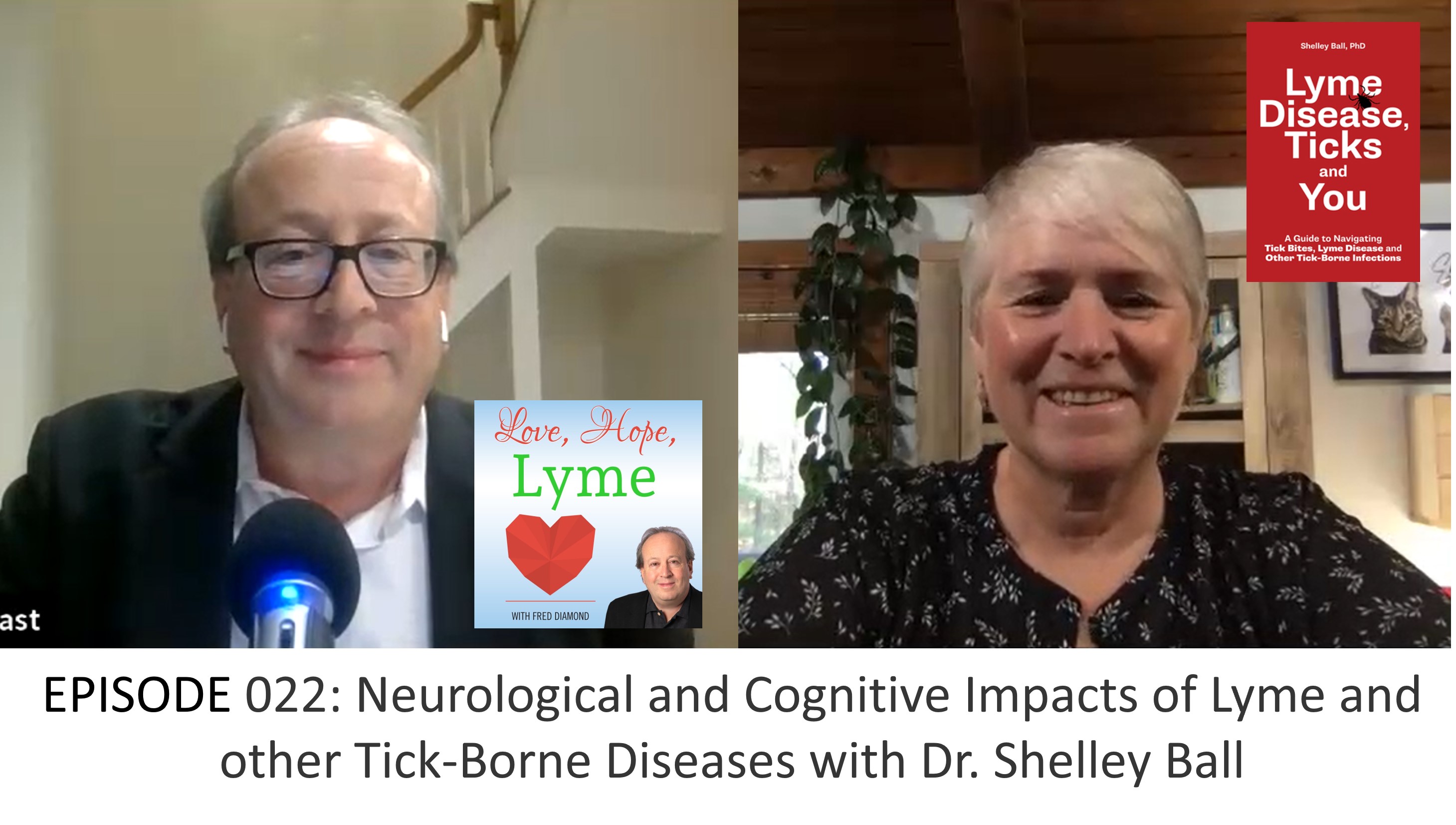
Neurological & Cognitive Issues From Lyme Podcast

https://www.lymedisease.org/podcast-shelley-ball-neurological-lyme/

PODCAST: Neurological and cognitive issues from Lyme

By Fred Diamond

On this week’s Love, Hope, Lyme podcast, biologist and Lyme survivor Dr. Shelley Ball and I discussed neurological and cognitive issues that are common with persistent Lyme disease.

There’s a chapter on neurological issues in my book Love, Hope, Lyme: What Family Members, Partners, and Friends Who Love a Chronic Lyme Survivor Need to Know. I wrote the book to understand what someone in my life with persistent Lyme was going through. Since the neurological issues concerning Lyme are so personal and potentially extreme, the chapter is intentionally light.

Shelley lives in Westport, Ontario, Canada, an area endemic for Lyme, Anaplasma and Babesia. A biologist by trade, she spent a lot of time outdoors doing field work around the world. In addition to Lyme and Bartonella, she also has Babesia odocoilei, which has been shown to be treatment resistant and contributes to “brain on fire” symptoms as well.

After she was diagnosed with Lyme, she dove into researching the disease to understand what was happening to her. She wrote her book Lyme Disease, Ticks and You: A Guide to Navigating Tick Bites, Lyme Disease and Other Tick-Borne Infections to make what she learned more accessible and less complex to the typical Lyme survivor.

Neurological and Cognitive Symptoms

“Neurological symptoms are very challenging,” she said. “I went for several months where I could barely read, which is hard when you must keep working. The brain issues were the biggest for me such as short-term memory loss. When I was in the thick of treatment, I’d be standing in front of somebody I’d known for years, and I couldn’t remember their name.”

She continued, “Executive functions such as just being able to pay your bills, plan your work, stay on schedule, is challenging. It forces you to try to find aids and little tricks and things that you can do to support yourself. They’re essentially like pre-dementia symptoms. Psychiatric issues, which are a huge part of this, can often lead to personality changes.”

She explained that these infections can cross the blood-brain barrier and cause massive inflammation, so you can end up with a permanently inflamed brain.

“We’re essentially suffering from a brain autoimmune issue where your own immune system essentially is attacking your own brain. It’s especially challenging because there are few good treatments for autoimmune conditions. Usually, it’s steroids and similar things. Those are some of the worst things that you can take if you’ve got chronic tick-borne infections.

“You feel this rage rise in you, and you have no control over it. Your brain is inflamed. This is not something that you’re doing. It is happening to you. You literally must find a way to almost step away and manage it when these things flare out.

“Your personality changes,” she continued, “Not only do the people around you see it, but you see it in yourself. You go through a grief period where you grieve for the person that you were, both mentally and in your personality, but also physically, because you’re just not capable of doing the activities that you used to do. These are very tough issues to deal with and sometimes it drives people away.”

Challenges to Treating Neurological Symptoms

Most chronic Lyme survivors struggle with pain, but the neurological issues can be the most challenging.

Shelley said, “There are so many aspects to it. There’s the direct impact on brain tissue, there’s the inflammation, there’s the autoimmunity and the immune component of it. You’re trying to deal with all these things. One of the keys is to try to get that inflammation down.”

“I’ve had some fascinating conversations with other Lyme patients about treatment, because we’ll often have flare-ups, and a lot of people will turn back to antibiotics to manage those flare-ups. They think that maybe those insistent Lyme bacteria have flared up and turned back into spirochetes and we’re back into an active infection.”

Shelley said, “There are other challenges to treatment. One is the isolation of the disease. Lyme patients especially experience this because we are gaslighted by the medical system that we reach out to, to try to regain our health. There is some initial empathy, compassion, and support, but that dwindles. Then you realize that you are very much on your own suffering in silence.”

She said that if you read the science, when the body becomes inflamed, that inflammation overstimulates your brain and puts you into permanent fight or flight mode. This is known as sympathetic dominance or sympathetic overdrive. Interestingly, it stimulates more inflammation. Then you get stuck in this positive feedback loop of inflammation. What it comes down to is trying to break that cycle of inflammation.

On the podcast, she discusses botanicals and neuro-retraining techniques that might be helpful.

Final Thoughts

I asked for her recommendations for how to live a higher quality life while still dealing with Lyme.

“Try to find ways to find joy. Lyme patients do a lot of grieving. We’ve lost our physical capabilities; we’ve lost our cognitive abilities. We’ve lost our old personality. Sometimes we lose people in our life who just can’t stay there to support us. I don’t believe in toxic positivity, but gratitude is important to focus on what we do have.”

She offered, “I empathize because this really is a shared disease in the sense that even if our loved ones don’t understand what we’re going through, it impacts them. Stay the course. It’s hellish, to be honest. It’s also an iceberg effect where you will probably only see the tip of the suffering that people are going through with these diseases.”

Click here to listen to all episodes of the Love, Hope, Lyme Podcast or on YouTube.

Fred Diamond is based in Fairfax, Virginia and can be contacted via Facebook. His book Love, Hope, Lyme: What Family Members, Partners, and Friends Who Love a Chronic Lyme Survivor Need to Know is available on Amazon. The e-version of the book is always free to Lyme survivors. Send Fred a private message on Facebook for your copy.

______________

**Comment**

Great information.

For more: