Please go here to see identical side by side pictures of autoimmune blistering disease, caused by the COVID shot & listed on the Pfizer list of adverse events, vs Monkeypox. Also, please go here to listen to Dr. Wolfgang Wodarg who has exposed numerous false ‘pandemics’ where he states the current monkeypox hype is nothing more than fearmongering by the corrupt globalist establishment trying to cover up the symptoms of the experimental COVID-19 gene therapy shots. He wonders why more doctors aren’t seeing through the deception. He also states these blisters accompanied by severe pain are symptoms common for shingles, which should be considered in a differential diagnosis and is also a known side effect of the COVID shots. Attorney Aaron Siri made sure that 390,000 reports from V-safe were made public.
That means 1 in 450 people reported shingles after the COVID shots.
A report by Kannan et al indicates that the US declared Monkeypox public health emergency which expired in 2023 was almost certainly because of a gain-of-function mutation in one or more genes within the Monkeypox virus. The authors do not speculate on whether this happened in a laboratory or in nature. Monkeypox has been the subject of NIAID’s gain of function research for many years and for nearly nine years, Anthony Fauci’s institute had been planning to engineer a highly pathogenic pox virus with a potential fatality rate of up to 15 percent.
Further, the data regarding Monkeypox is vague, incomplete, and contradictory and conflicts with many statements made by ‘public health’ agencies. Some data refers to ‘confirmed’ cases, some to ‘probable’ cases, and some to ‘reported’ or ‘suspected’ cases. We are right back to techniques used during COVID to conflate and frighten.
https://www.dossier.today/p/monkeypox-now-known-as-mpox-declared?
The Election Variant has arrived!
The World Health Organization (WHO) has convened its emergency mpox (yes, they no longer call it Monkeypox) committee, citing a circulating “deadlier strain” of the supposed disease, announcing that it is time to declare a “global health emergency.”
“The detection and rapid spread of a new clade of mpox in eastern DRC, its detection in neighboring countries that had not previously reported mpox, and the potential for further spread within Africa and beyond is very worrying,” said WHO Director Tedros Adhanom Ghebreyesus, during a press briefing Wednesday evening.
[“Dr” Tedros, a stooge for Bill Gates and the government of China, is a totally discredited political hack, as is the entirety of the WHO].
The CDC got in on the Chicken Little routine, blasting out a “health advisory” memo on the supposed Monkeypox (yeah, I’m going to keep calling it Monkeypox) breakout. (See link for article)
Go here for more ‘coincidences.’
_____________
https://childrenshealthdefense.org/defender/mpox-vaccine-makers-stock-price-who-global-public-health-emergency/
Mpox Vaccine Maker’s Stock Price Soars After WHO Declares Global Public Health Emergency
Bavarian Nordic share prices jumped 17% in early trading today in Copenhagen, Forbes reported, after climbing 12% Wednesday when the WHO declared mpox a global health emergency following outbreaks in nearly a dozen African countries. Sweden today announced the first case outside Africa.
August 15, 2024
Article Excerpts:
This is the second time in two years the WHO has declared mpox a “public health emergency of international concern” PHEIC — pronounced “fake” — which is its highest form of an alert.
The announcement follows a declaration Tuesday by the Africa Centres for Disease Control and Prevention that mpox is a continent-wide public health emergency.
Last week, the WHO triggered the process to grant Emergency Use Listing to two mpox vaccines, although it didn’t name which ones it would list. The agency also invited manufacturers of mpox vaccines to submit an “expression of interest” for Emergency Use Listing.
The DRC, where the outbreak is concentrated and most severe, has approved two vaccines — Japan’s LC16 and Bavarian Nordic’s Jynneos, which is also marketed as Imvamune and Imvanex. (See link for article)
_______________
**Comment**
- A report published in November 2021 called, “Strengthening Global Systems to Prevent and Respond to High-Consequence Biological Threats,” states that in March 2021, the Munich Security Conference partnered with the ‘Nuclear Threat Initiative’ (NTI) to run an exercise scenario involving a, “deadly, global pandemic involving an unusual strain of monkeypox virus that emerged in the fictional nation of Brinia and spread globally over 18 months…the fictional pandemic resulted in more than three billion cases and 270 million fatalities worldwide.” The scenario had the monkeypox outbreak emerging as a result of an act of bioterrorism in May 2022. The report’s recommendations: “aggressive measures to slow virus transmission by shutting down mass gatherings, imposing social-distancing measures, and implementing mask mandates.” Sound familiar? I recommend reading this.
The 3 monkeypox vaccines as of August, 2024:
- MVA-BN – Jynneos in the US a live, non-replicating vaccine derived from the Modified Vaccinia Ankara-Bavarian Nordic (MVA-BN) strain of vaccinia virus and
- ACAM2000 a live, replicating vaccinia virus vaccine, can cause myocarditis, pericarditis and other serious side effects at high rates including death and fetal death, as the labels for both drugs indicate. The FDA’s medication guide also warns that people who receive the vaccine may spread it to unvaccinated people, who also risk developing vaccine side effects, including death. Across all studies, a causal relationship to JYNNEOS could not be excluded for 4 Serious Adverse Events, all non-fatal, which included Crohn’s disease, sarcoidosis, extraocular muscle paresis and throat tightness. Source
- The Japanese LC16m8 vaccine is an attenuated live vaccinia virus vaccine derived from the Lister vaccinia strain and lacks the B5R envelope protein gene to reduce neurotoxicity and has been linked to encephalitis.
- The declaration is a huge money maker and grants the WHO authority to issue travel warnings or restrictions among many other powers.
- This is the 8th ‘public emergency’ the WHO has declared since 2007.
- Monkeypox, usually mild illness, causes flu-like symptoms and pus-filled lesions. It can be serious in those with weak immune systems.
- In 2022 overall, 98% of infected people were gay or bisexual men, 75% were white, and 41% had HIV; the median age was 38 years. Transmission was suspected to have occurred through sexual activity in 95% of the people infected. Source
- Officials are likely using PCR tests, which create false positive results. While the strain responsible for the current outbreak, clade 1b, is more severe, only a fraction of cases (10%) have been lab-confirmed so far. Go here to sign FDA petition for mandatory negative controls in Mpox and H5N11 PCR test kits.
- The WHO states, it “appears to be spreading mainly through sexual networks,” and it has been detected in neighboring countries of Burundi, Kenya, Rwanda and Uganda, with 100 “laboratory-confirmed cases of clade 1b” in total.
- This important transmission detail is being omitted due to woke politics. Proponents state the name is racist so changed it to Mpox. Also, stating the reality that the original version of the virus only impacted gay men got you canceled and hurt Big Pharma’s bottom line so now MSM is presenting this as broader in its reach in the effort of being diverse and equitable. So now, out of nowhere it’s an equal opportunity disease.
Important quote:
“Why would we start mass vaccination with a new product for which we know nothing about the safety profile when common sense mitigation measures can work?” she asked. “If it is sexually transmitted, use a condom or abstain from sex. If it can be transmitted through secretions, wash your hands and don’t touch people with clinical presentation.” ~ Dr. Kat Lindley, senior fellow at FLCCC Family Medicine and president of the Global Health Project
Well, because that would simply be too logical.
Go here for WHO Facts:
– Who funds them?
– Who runs them?
– Who elects them?
– Who supports them?
– Who holds them accountable?
– Who instituted them?
– Who is under their control?
_______________
https://jamesroguski.substack.com/p/we-need-stronger-surveillance?
“We Need Stronger Surveillance”
The WHO has declared Mpox (formerly known as monkeypox) to be a Public Health Emergency of International Concern (PHEIC). Dr. Maria Van Kerkhove stressed the need for stronger surveillance!
Article Excerpts:
- In previous outbreaks the vast majority of those infected were “men who have sex with men.” Why are the more recent outbreaks occurring in children?
- What is the evidence to support Dr. Maria Van Kerkhove’s claim that that “We do see new zoonotic transmission.”
- Dr. Maria Van Kerkhove clearly stated that there are many unknowns that must be researched. What is being done to clarify these unknown details regarding transmission and diagnosis?
- Has the Mpox virus every been properly isolated?
- Has the Mpox orthopox virus been proven to be the cause of the symptoms associated with the disease that is also called Mpox?
- Is it possible that the skin lesions seen in affected people could be due to other causes, such as previous vaccinations, exposure to toxins, compromised immune systems or liver disfunction?
- What are the details required to arrive at a differential diagnosis to ensure that the true cause of “Mpox” is actually a virus?
- What are the details (specificity, sensitivity and primers used) of the PCR “test” that is being used to determine confirmed “cases”? Are these protocols as flawed as those used for COVID-19?
- Have the available “vaccines” and drugs been properly tested to determine that they are “safe and effective?”
- What are the WHO’s official “temporary recommendations?” (See link for article and video)
_______________
**Comment**
Dr. Maria Van Kerkhove, is part and parcel of the problem. She states there’s complacency at both the individual and government level. She wants us to live in fear – continually and is ‘determined to really keep this marathon up.’ She hits the usual globalist talking points: lack of access to tests, drugs, and vaccines, the need for masks, social distancing, and vaccination, and that supposedly mis and disinformation is hampering efforts to mount an effective response, and the usual clap-trap.
She also doesn’t mention the medical warfare used to persecute doctors who have saved lives using these banned drugs.
Of course she wouldn’t. She’s a player.
_______________
Terminate the UN NOW and throw them out of New York City
https://sociable.co/government-and-policy/globalists-world-govt-population-reduction-truth-commission-system-currency-un-charter/
Globalists outline world govt pathway: 75% population reduction, global truth commission, earth system currency, revised UN Charter
By Tim Hinchliffe August 5, 2024
Article Excerpts:
Unelected globalists want to rewrite the UN Charter to ‘articulate the rules of a World Parliment’ for ‘world citizens’ with binding legislative & enforcement powers.
On August 1, 2024 the Club of Rome and the Council for the Human Future published a report on a Roundtable discussion they co-hosted in July.
The report, “Roundtable on the Human Future: A World Call to Action on the Multiple Crises Now Enfolding Humanity,” says that “all human life could be extinguished” in the mid-to-latter half of the 21st Century due to climate change, overpopulation, new pandemics, misinformation, nuclear proliferation, and other perceived threats.
One solution proposed by Global Governance Forum executive director Augusto Lopez-Claros was “to boost the UN´s democratic legitimacy” by rewriting the UN Charter in order to give the unelected globalist body more power, authority, and jurisdiction over sovereign nations.
This document will be released in New York in September of 2024. Among the ingredients included:
- To build on the concept of a UN of states embedded in the 1945 Charter to move to a UN of states and peoples through the creation of a Parliamentary Assembly, as a complement to the General Assembly and to boost the UN´s democratic legitimacy.
- To create an Earth System Council, giving the UN system the capacity to pass binding legislation to protect our planetary environmental system and the common goods it provides, with necessary enforcement mechanisms.
- To empower the UN to meaningfully advance disarmament globally and help create a conducive environment or sustained progress on nuclear disarmament and reduction of proliferation in other weapons systems.
- To bring about a new system to fund the UN, that provides a reliable, depoliticized, independent revenue stream, not unlike that in place already for several decades in the European Union.
- To reform the Security Council to make it more representative and to do away with the veto, which exempts its permanent members from the obligations of the Charter and is thus a practice deeply at odds with sound principles of good governance. (See link for article & videos)
https://www.armstrongeconomics.com/international-news/rule-of-law/the-un-takes-step-forward-to-create-a-one-world-government/
The UN Takes Step Forward to Create a ONE WORLD Government
by Martin Armstrong
August 15, 2024
Article Excerpts:
The power-hungry United Nations approved its first International Cybercrime Treaty despite significant objections from all the tech companies and human rights groups. This Treaty is HIGHLY DANGEROUS and will tear the world apart and further suppress human rights, which is the objective of the United Nations, just as we are witnessing with all of these hate speech crimes and imprisonment for merely criticizing a government as in Britain and Ireland.
This treaty they just proposed is called the Comprehensive International Convention on Countering the Use of Information and Communications Technologies for Criminal Purposes, pretending this is about cybercrime. Still, it is not – it is about censorship. The UN claims this is the only way to create peace by putting them in charge of the world – unelected, of course.
This Treaty will authorize electronic surveillance worldwide in the name of criminal investigations. It abandons every fundamental principle of global human rights, including freedom of speech and expression. It seeks to establish the most expansive jurisdiction for a crime, just as Britain is seeking to extradite an American for criticizing the new Labour Government in Britain.
It is most ironic that China and Russia are the two countries that will refuse to honor this tyrannical decree. What does that say for Western culture and values?
This treaty will now go to the General Assembly’s 193 member states. If this UNELECTED body of anti-democratic people accepts it by a mere majority, then it will move to the ratification process, in which individual country governments must sign on.
This Treaty is truly intended to provide a global legal framework to remove territorial jurisdiction for anything done on a computer.
Just read the text of this Treaty. There are ZERO such safeguards for a free Internet.
(See link for article)
________________
https://jamesroguski.substack.com/p/declaration-on-future-generations?
Declaration On Future Generations
The United Nations’ “Silence Procedure” has been set to end at 4pm Eastern on Friday, August 16, 2024. If no nation objects to the document, it will be assumed to have been accepted.
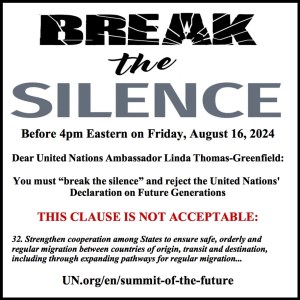
You can also fill out a form to contact her as well: https://usun.usmission.gov/mission/contact-us/
(Go to link for article, the documents, and other ways to contact Greenfield)