Archive for the ‘Treatment’ Category

Symptoms After Lyme: What’s Past is Prologue

https://www.change.org/p/the-us-senate-calling-for-a-congressional-investigation-of-the-cdc-idsa-and-aldf/u/33044899?

Symptoms after Lyme disease: What’s past is prologue (Adriana Marques, M.D.)

Carl Tuttle
Hudson, NH, United States
Nov 17, 2024

Please see the following email addressed to Dr. Adriana Marques, Chief of the NIAID Lyme Disease Studies Unit regarding her recent viewpoint published in the journal Science Translational Medicine. The Editorial Staff was Cc’d on this email.

Senior Editor Courtney Malo, Ph.D. responded to my inquiry and is posted below followed by my final comment.

Photo of Marques was found on the following NIH site:
https://www.niaid.nih.gov/research/adriana-marques-md

Inquiry to Adriana Marques:

———- Original Message ———-
From: CARL TUTTLE <runagain@comcast.net>
To: “amarques@niaid.nih.gov” <amarques@niaid.nih.gov>
Cc: “osmith@aaas.org” <osmith@aaas.org>, “mnorton@aaas.org” <mnorton@aaas.org>, “ccharneski@aaas.org” <ccharneski@aaas.org>, “cmalo@aaas.org” <cmalo@aaas.org>, “bberry@aaas.org” <bberry@aaas.org>, “dhallberg@aaas.org” <dhallberg@aaas.org>, “dneuhofer@aaas.org” <dneuhofer@aaas.org>, “mogle@aaas.org” <mogle@aaas.org>
Date: 11/14/2024 9:54 AM EST
Subject: Symptoms after Lyme disease: What’s past is prologue

SCIENCE TRANSLATIONAL MEDICINE

13 Nov 2024

Symptoms after Lyme disease: What’s past is prologue
ADRIANA MARQUES
https://www.science.org/doi/10.1126/scitranslmed.ado2103

There have been five randomized, placebo-controlled, double-blind clinical trials addressing the question of whether additional antibiotic treatment benefits patients with PTLDS or symptoms attributed to Lyme disease.”

“The results of these trials showed that prolonged antibiotic treatment had no lasting benefit while having potential serious risks.”

Adriana Marques, M.D.
Lyme Disease Studies Unit
NIH Main Campus, Bethesda, MD

Dr. Marques,

For the record there are many infections requiring long-term antibiotics so why Klempner stopped his NIH funded antibiotic treatment trials for Lyme after “12 weeks” and then claimed no benefit makes absolutely no sense whatsoever:

From the following peer-reviewed publication:

Benefit of intravenous antibiotic therapy in patients referred for treatment of neurologic Lyme disease
https://www.dovepress.com/benefit-of-intravenous-antibiotic-therapy-in-patients-referred-for-tre-peer-reviewed-fulltext-article-IJGM

Infections requiring long-term antibiotics: [See chart in the publication above with 8 examples ranging from 6mo to 5yrs]

In 1991 the Lyme disease organism, Borrelia burgdorferi, was grown from the cerebrospinal fluid of Lyme patient Vicki Logan at the Centers for Disease Control in Fort Collins, Colorado despite prior treatment with intravenous antibiotics. The patient died when the insurer refused additional IV antibiotics. Here is a copy of Logan’s CDC positive culture report for your review.

(Vicki Logan’s Chronic Lyme Autopsy results Page #1234567)

There are 700 peer-reviewed publications referencing persistent infection and in a 2018 study all patients were culture positive even after multiple years on antibiotics so there was no relief from current antimicrobials. Some of these patients had taken as many as eleven different types of antibiotics.

Thirty-four years ago Dr. Allen Steere identified chronic Lyme disease which should have set off a red flag prompting an immediate search for better antimicrobials but then did a 180° as he became principal investigator (PI) of the Phase 3 clinical trial for the first Lyme disease vaccine. So all the eggs were put into the vaccine basket while a campaign was orchestrated to discredit the sick and disabled patient population along with the courageous clinicians attempting to help these patients. Apparently, a chronic relapsing seronegative disease did not fit the business model of patent royalties, vaccine development and pharmaceutical profits.

Here is Dr. Steere’s 1990 publication summary for your review:

The New England Journal of Medicine 

Published November 22, 1990

Chronic neurologic manifestations of Lyme disease
https://www.nejm.org/doi/full/10.1056/NEJM199011223232102

The chart below summarizes Lyme research funded by the NIH and only 2.5% has been allocated for treatment: [Click on link to view the chart]

Question:

Is there a reason why these facts/references/lab reports are missing from your viewpoint published in Science Translational Medicine?

A response to this inquiry is requested.Carl Tuttle
Independent Researcher
Hudson, NH USA

Cc: Orla M. Smith, Ph.D. Editor, Science Translational Medicine

Editorial Staff

Melissa Norton, M.D.

Catherine A. Charneski, Ph.D.

Courtney S. Malo, Ph.D.

Brandon Berry, Ph.D.

Dorothy L. Hallberg, Ph.D.

Daniela Neuhofer, Ph.D.

Molly Ogle, Ph.D.

Response from Senior Editor Courtney Malo, Ph.D.

———- Original Message ———-
From: Courtney Malo <cmalo@aaas.org>
To: CARL TUTTLE <runagain@comcast.net>
Cc: “Marques, Adriana (NIH/NIAID) [E]” <amarques@niaid.nih.gov>, Orla Smith <osmith@aaas.org>
Date: 11/14/2024 11:26 AM EST
Subject: Re: Symptoms after Lyme disease: What’s past is prologue

Dear Dr. Tuttle,

Thank you for your email in response to the viewpoint “Symptoms after Lyme disease: What’s past is prologue” published in Science Translational Medicine.

We suggest that you submit your comments as an eLetter via our website. To do so, please go to the paper under discussion (https://www.science.org/doi/10.1126/scitranslmed.ado2103 and navigate to the “eLetters” option at the very bottom of the page. Our eLetters platform provides a dynamic and rapid way for readers to provide feedback on the papers we publish and to elicit discussion.

Sincerely,
Courtney Malo

Courtney Malo, Ph.D. (she/her/hers)

Senior Editor

Science Translational Medicine

cmalo@aaas.org |  https://www.science.org/journal/stm

My final reply:

———- Original Message ———-
From: CARL TUTTLE <runagain@comcast.net>
To: Courtney Malo <cmalo@aaas.org>
Cc: “Marques, Adriana (NIH/NIAID) [E]” <amarques@niaid.nih.gov>, Orla Smith <osmith@aaas.org>, “mnorton@aaas.org” <mnorton@aaas.org>, “ccharneski@aaas.org” <ccharneski@aaas.org>, “bberry@aaas.org” <bberry@aaas.org>, “dhallberg@aaas.org” <dhallberg@aaas.org>, “dneuhofer@aaas.org” <dneuhofer@aaas.org>, “mogle@aaas.org” <mogle@aaas.org>
Date: 11/16/2024 8:15 AM EST
Subject: Re: Symptoms after Lyme disease: What’s past is prologue

On 11/14/2024 11:26 AM EST Courtney Malo <cmalo@aaas.org> wrote: “We suggest that you submit your comments as an eLetter via our website.”

Dear Dr. Malo,

Thank you for responding to my email. Is my submitted eLetter in the process of being screened?

I would like to call attention to the following 1992 Science article that was listed directly below Dr. Marques’ published viewpoint:

Furor at Lyme Disease Conference: Patient-support groups got a dozen rejected papers reinstated at a Lyme disease meeting, angering researchers who had turned the work down as unscientific
https://www.science.org/doi/10.1126/science.1604309

Excerpt:

To some authors of the controversial abstracts the grudging acceptance is too little too late, from a close-minded research community. “If [a finding] is not part of a controlled study, they ignore it,” says Long Island internist Burascano.

Dr. Malo,

Isn’t that exactly what I am questioning 32 years later? I am asking Marques why the peer-reviewed references I provided are missing from her published viewpoint:

My question to Marques:

“Is there a reason why these facts/references/lab reports are missing from your viewpoint published in Science Translational Medicine?”

It would appear that the act to suppress evidence of chronic Lyme disease spans three decades. How many lives have been destroyed resulting from inadequate treatment?

It is not uncommon for these corresponding authors to ignore serious inquires. One example is from my 2020 BMJ Letter to the Editor below. It should be noted that the corresponding author refused to respond to my inquiry after multiple requests from Editor-in-Chief Dr. Fiona Godlee.

Letter to the Editor of the BMJ published June 2020 
https://www.bmj.com/content/369/bmj.m1041/rr-1

Dr. Malo…. Has your journal been used as a podium to broadcast the long-established dogma while omitting evidence of persistent infection after extensive antibiotic treatment?

Respectfully submitted,
Carl Tuttle
_______________
**Comment**
Must thanks to patient and advocate Carl Tuttle for his tireless efforts dealing with knot-heads.  Kudos to you for having the patience of a saint.

Ivermectin & Doxycycline For Lyme Disease

https://www.2ndsmartestguyintheworld.com/p/lyme-disease-cure-ivermectin-and?

LYME DISEASE CURE: Ivermectin & Doxycycline Combination Therapy – Testimonials & Research

This article is too long for email and must be opened in a browser.

This first account is courtesy of a molecular biologist’s journey in treating their Lyme Disease:


Introduction

Lyme disease, primarily caused by the bacterium Borrelia burgdorferi, has been the subject of much research and debate. Commonly transmitted through the bite of an infected black-legged tick, Lyme Disease can present a complex array of symptoms.

While most focus on the bacterial aspect of the disease, there are also protozoan co-infections, such as Babesiosis caused by Babesia parasites, to consider. Here’s how a personal experience led to some thought-provoking insights into treating Lyme Disease and associated co-infections.

Disclaimer: I am not a healthcare provider. The following narrative reflects personal experience and should not be considered as medical advice. Always consult qualified healthcare professionals for diagnosis and treatment.

The Challenge of Diagnosis and Treatment

After experiencing severe arthritic pain that we initially attributed to ‘long Covid,’ my wife observed a classic ‘bullseye’ rash indicative of a tick bite. With some medical school training, she immediately suspected Lyme Disease. As a molecular biologist, I was aware that Lyme Disease can be accompanied by protozoan co-infections like Babesiosis.

However, the majority of research focuses on the bacterial aspect, with Doxycycline often being the mainstay treatment [1].

Anecdotal Evidence and Off-Label Treatments

During our quest to manage the debilitating symptoms, we came across an anecdotal case that reported benefits from combining Doxycycline and Ivermectin [2]. While Ivermectin is primarily indicated for parasitic infections [3], we questioned whether it could have a role in treating protozoan co-infections like Babesiosis. We consulted specialists who, although hesitant, acknowledged the potential of this combo.

An Unexpected Turnaround

After a week on this unconventional regimen, my wife’s symptoms were entirely alleviated. While this is a single case and should not be generalized, it adds to a growing list of anecdotal evidence supporting a multifaceted approach to treating Lyme Disease.

The State of Lyme Disease Treatment Today

Currently, Ivermectin as part of a combination treatment for Lyme Disease is becoming more widely accepted, although this still remains an area of active research and debate [4].

Conclusion and Caution

Our experience highlights the need for more research into comprehensive treatment options for Lyme Disease, particularly for those with co-infections. While anecdotal evidence can provide valuable insights, clinical trials are necessary to establish efficacy and safety.

Always consult qualified healthcare providers for the most current and personalized medical advice. Self-prescribing medications, even if they seem to have worked in the past, can carry risks.

References

  1. Wormser, G. P., Nadelman, R. B., Dattwyler, R. J., et al. (2006). “The clinical assessment, treatment, and prevention of Lyme disease, human granulocytic anaplasmosis, and babesiosis: clinical practice guidelines by the Infectious Diseases Society of America.” Clinical infectious diseases, 43(9), 1089-1134. Link
  2. LymeVlog (2011). “Lyme Disease: Getting better with Ivermectin.” Link
  3. Omura, S., & Crump, A. (2004). “Ivermectin: enigmatic multifaceted ‘wonder’ drug continues to surprise and exceed expectations.” The Journal of antibiotics, 70(5), 495-505. Link
  4. Sapi, E. (N.D.) “Ivermectin and its potential role in treating Lyme Disease.” Link

(See link for article)

________________

SUMMARY & Comments:

The article then goes on to give another entry by a patient-turned-Lyme Disease researcher who improved on an ivermectin and Alinia combination after five years of using other antibiotics including Ciprofloxacin and Bactrim.  This treatment took away their muscle, arthritis, and heart pain, light and sound sensitivity.  It’s important to always dig into what a patient has used over time because they tend to only credit the last thing they took.  This would be a mistake as typically numerous drugs are required over time for a majority of patients.  To my knowledge there is NO magic bullet to this complex illness.  If there was, I’d be the first to tell you, believe me!  Most patients are coinfected with multiple pathogens all requiring fairly specific treatment.

Treatment nuances are given in the article – particularly the need to use anti-parasitics for the long-haul once a week or every two weeks to address all stages of the life cycle.  Ivermectin has a long half life so taking it too often will create too high of a toxic dose, (although doses vary widely for COVID on the FLCCC website) but even for COVID it is typically higher doses but only for 5 days.  

I would also like to remind the reader that in 2016 Dr. Alan MacDonald found three strains of borrelia living in parasitic nematode worms, worm eggs, or larvae in the brain tissue of 19 autopsies.

MacDonald states that both worms and borrelia can cause devastating brain damage and that:

“while patients are wrongly declared free of Lyme and other tick-borne infections, in reality, too often they contract serious neurodegenerative diseases which can kill them.”

MacDonald made his discovery from 10 specimens from the Rocky Mountain Multiple Sclerosis Center Tissue Bank.  All 10 showed evidence of borrelia infected nematodes.  Five patients who died of Glioblastoma multiforme, a malignant brain tumor, and four patients who died of Lewy Body dementia also showed infected nematodes.

MacDonald used FISH, Fluorescent In Situ Hybridization, which uses molecular beacon DNA probes to identify pieces of borrelia’s genetic material which fluoresce under the microscope with a 100% DNA match.

In other words, this is no mistake.

https://www.youtube.com/watch?v=7ZnY871HZhM&feature=youtu.be  YouTube of MacDonald explaining the results

Lyme discoverer, Willy Burgdorfer, wrote of finding nematodes in tick guts way back in 1984 and in 2014 University of New Haven researcher, Eva Sapi, found 22% of nymphs and 30% of adult Ixodes ticks carried nematodes.  

Knowing this information makes it obvious why treating patients for worms is prudent.

It’s also important to note; however, that caution must always be used with Lyme/MSIDS patients due to potentially severe herxheimer reactions.  Similarly to how dogs treated for heart worm (D. immitis) have trouble due to the heart worm medication causing Wolbachia to be released into the blood and tissues causing severe Inflammation in pulmonary artery endothelium which may form thrombi and interstitial inflammation, it is not a stretch at all to compare this deleterious reaction to a Lyme/MSIDS patient treated for worms who has borrelia hiding in worms, eggs, and larvae.  When the worms are killed, borrelia will be released into the body causing sudden widespread inflammation.  This is why treatment should most probably include things that kill and disable borrelia as well.  The patient should be closely monitored and treatment put on hold or at least have dosages lowered if severe reactions occur.  This will be particularly true of patients with central nervous system involvement (which is most of us) due to severe inflammation of the brain, particularly the meninges which can wreak all sorts of havoc including chiari.

Lastly, the author proposes doxycyline.

While doxycycline is a standard front-line drug for Lyme/MSIDS, as it addresses many infections, it also is not a perfect drug in that it does not address the non-cell wall form of borrelia or biofilm.  Further, Eva Sapi’s research showed that while doxycycline reduced spirochetal structures ~90%, it increased the number of round body forms (cysts) about twofold. Tigecycline and tinidazole treatment, on the other hand, reduced both spirochetal and round body forms by ~80%–90%.  In terms of qualitative effects, only tinidazole reduced viable organisms by ~90%. Following treatment with the other antibiotics, viable organisms were detected in 70%–85% of the biofilm-like colonies.

Persistence of viable organisms in round body forms and biofilm-like colonies may explain treatment failure and persistent symptoms following antibiotic therapy of Lyme disease.

Similarly to needing to address worms at each life cycle, ALL forms of borrelia must be addressed for treatment success.

This almost always equates to long-term treatment.

OOPS! $41B Gone Missing From World Bank’s ‘Climate Change’ Fund & WHO’s Pay to Play Racket

https://lionessofjudah.substack.com/p/41-billion-of-world-banks-climate?

🤡 $41 Billion of World Bank’s ‘Climate Change’ Fund Has Gone Missing

The globalist World Bank has “misplaced” a staggering $41 billion in “climate change” funds, an investigation has revealed.

Frank Bergman October 26, 2024

The globalist World Bank has “misplaced” a staggering $41 billion in “climate change” funds, an investigation has revealed.

Oxfam launched an investigation into the World Bank’s handling of the funds and found that billions in “misplaced funds” had gone missing.

Investigators revealed that there is “No clear public record showing where this money went or how it was used.”

The World Bank was created, in part, to help alleviate extreme poverty.

Roughly 10% of the world’s population, 700 million people, are living on less than $2 a day.

The bank gets its funding from taxpayer-funded contributions made by rich nations.

However, the World Bank recently decided to divert 45 percent of its development funds from poverty programs to globalist “climate change” schemes.

About $40 billion a year from the World Bank is now earmarked to fund green agenda efforts.

Yet, since the money shifted to “climate change” initiatives, vast sums of cash have become mysteriously “misplaced.”

An investigation by Oxfam of the World Bank’s finances shows that anywhere between $24 and $41 billion of “misplaced funds” are now missing.

There is no way of locating the missing money due to “poor record-keeping practices,” says Oxfam.

These funds were most likely stolen.  (See link for article)

For more:

https://jamesroguski.substack.com/p/the-whos-prequalification-and-emergency?

The WHO’s “Prequalification” and “Emergency Use Listing” Racket

Are products that are approved, “Prequalified” or listed for emergency use (EUL) by the World Health Organization truly “safe and effective,” or is this just another corrupt, money-making racket?

Are you aware that the World Health Organization has “prequalified” 272 vaccines? They charge over $100,000 per vaccine!

In order for “health related products” to be part of the United Nations procurement system, they must be “prequalified” by the WHO, which charges substantial one-time and ongoing fees in return for their “prequalification.”

A “racket” is defined as the act of creating demand for a “service” through extortion or intimidation when such a “service” would not have been needed otherwise.

A “racketeer” is a person who engages in organized criminal activity, typically for financial gain.

“Racketeering” is a type of organized crime in which the perpetrators set up a coercive, fraudulent, extortionary, or otherwise coordinated scheme or operation (a “racket”) to repeatedly or consistently collect a profit.

Is the WHO ethically and financially liable for the harm that results from the products that they “prequalify?”

Or does their money-making scheme enable them to create an illusion of safety and effectiveness while redirecting blame to the Responsible National Regulatory Agencies?

Click on the links below for details:

https://extranet.who.int/prequal/vaccines/fees-prequalification

https://extranet.who.int/prequal/vaccines/prequalified-vaccines

CLICK HERE to download the CSV data file.

If manufacturers want their products to be eligible for procurement by United Nations agencies, they must submit to the World Health Organization’s scheme to have their products “prequalified.”

The proposed “Pandemic Agreement” would require nations to support the World Health Organization’s growing influence over the approval process for vaccinesimmunization devices, [catalogdrugsin vitro diagnosticsinspection servicesvector control products and yes, even male circumcision devices.

Article 14.5

Each Party shall, as appropriate and consistent with applicable law, encourage relevant developers and manufacturers of pandemic related health products to diligently seek regulatory authorizations and approvals from national and/or regional regulatory authorities, including WHO listed authorities, and prequalification of such products by WHO.

https://healthpolicy-watch.news/wp-content/uploads/2024/09/Draft-WHO-Pandemic-Agreement_19-Sept_17.30.pdf

Annex 6 of the International Health Regulations already states:

1. Vaccines and prophylaxis designated by WHO shall be subject to its approval.

3. Certificates under this Annex are valid only if the vaccine or prophylaxis used has been approved by WHO.  https://apps.who.int/gb/ebwha/pdf_files/wha77/a77_aconf14-en.pdf  (See link for article)

For more:

Morgellons Treatment Insights

https://www.treatlyme.net/guide/morgellons-treatment-insights  Video Here

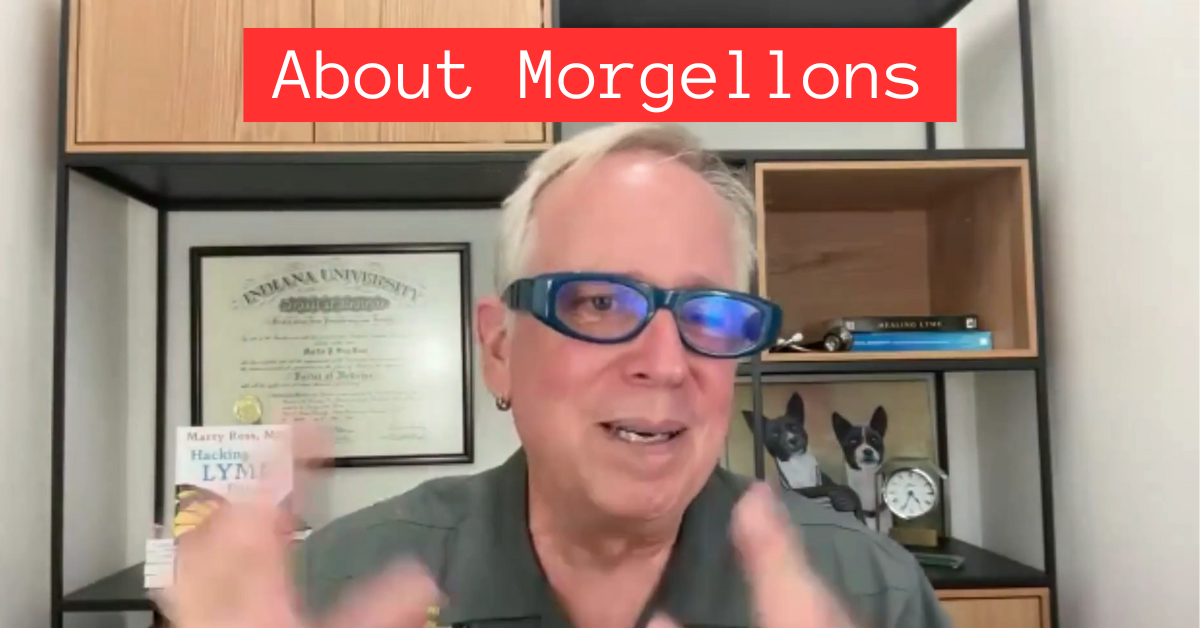
Morgellons and Treatment: Insights from Marty Ross, MD

About Morgellons Image

What’s Behind Morgellons

What’s happening: Morgellons, a condition marked by painful skin lesions and systemic symptoms, often faces skepticism. Dr. Marty Ross, a Lyme disease specialist, delves into the complexities of Morgellons, its symptoms, and potential treatment strategies.

Why it matters: Those affected by Morgellons struggle with symptoms that extend beyond the skin, often feeling dismissed by mainstream medical communities as having psychosomatic disorders. However, Dr. Ross uncovers critical links between Morgellons and Lyme disease plus tick-borne infections like Bartonella and Babesia.

Reality check: The hallmark of Morgellons is the formation of sores and ulcers that can itch, burn, and produce black and other colored filaments—concentrated keratin fibers, not parasites. Laboratory studies confirm, the lesions and fibers are not caused by parasitic infections. Complicated further by co-infections like Bartonella and Babesia, over 90% of Dr. Ross’s patients with Morgellons also have Lyme disease or other underlying tick-borne infections which are the cause. In Marty Ross, MD’s opinion, Morgellons is a skin manifestation of Lyme and other tick-borne infecions.

The big picture: Connecting Morgellons to Lyme disease guides treatment strategies. By recognizing Lyme and tick-borne infections as the cause, Dr. Ross and other experts like Ginger Savely, DNP, aim to treat with a focus on managing these infections.

Go deeper with the Ross Lyme & Tick-borne Diseases Protocol:

Follow the Ross Lyme & Tick-borne Disease Protocol to recover from Morgellons.

  • Immune Support: Utilizes probiotics, curcumin, ashwagandha, and multivitamins for enhanced recovery.
  • Detoxification: Emphasizes toxin removal to alleviate symptoms.
  • Infection Management: Balances herbal and prescription antibiotics to tackle infections.

Zoom out with lifestyle: A plant-based, anti-inflammatory diet facilitates healing, with probiotics supporting gut health during antibiotic treatment. Prioritizing sleep, exercise, and stress management is pivotal for comprehensive recovery.

The bottom line: The Ross Protocol blends medical treatment with lifestyle changes, offering hope and effective recovery strategies for individuals with Morgellons and related conditions.

Go to top link for video.

Disclaimer

The ideas and recommendations on this website and in this article are for informational purposes only. For more information about this, see the sitewide Terms & Conditions.

About The Author

Marty Ross, MD is a passionate Lyme disease educator and clinical expert. He helps Lyme sufferers and their physicians see what really works based on his review of the science and extensive real-world experience. Dr. Ross is licensed to practice medicine in Washington State (License: MD00033296) where he has treated thousands of Lyme disease patients in his Seattle practice.

Marty Ross, MD is a graduate of Indiana University School of Medicine and Georgetown University Family Medicine Residency. He is a member of the International Lyme and Associated Disease Society (ILADS), The Institute for Functional Medicine, and The American Academy of Anti-Aging Medicine (A4M).

______________

For more:

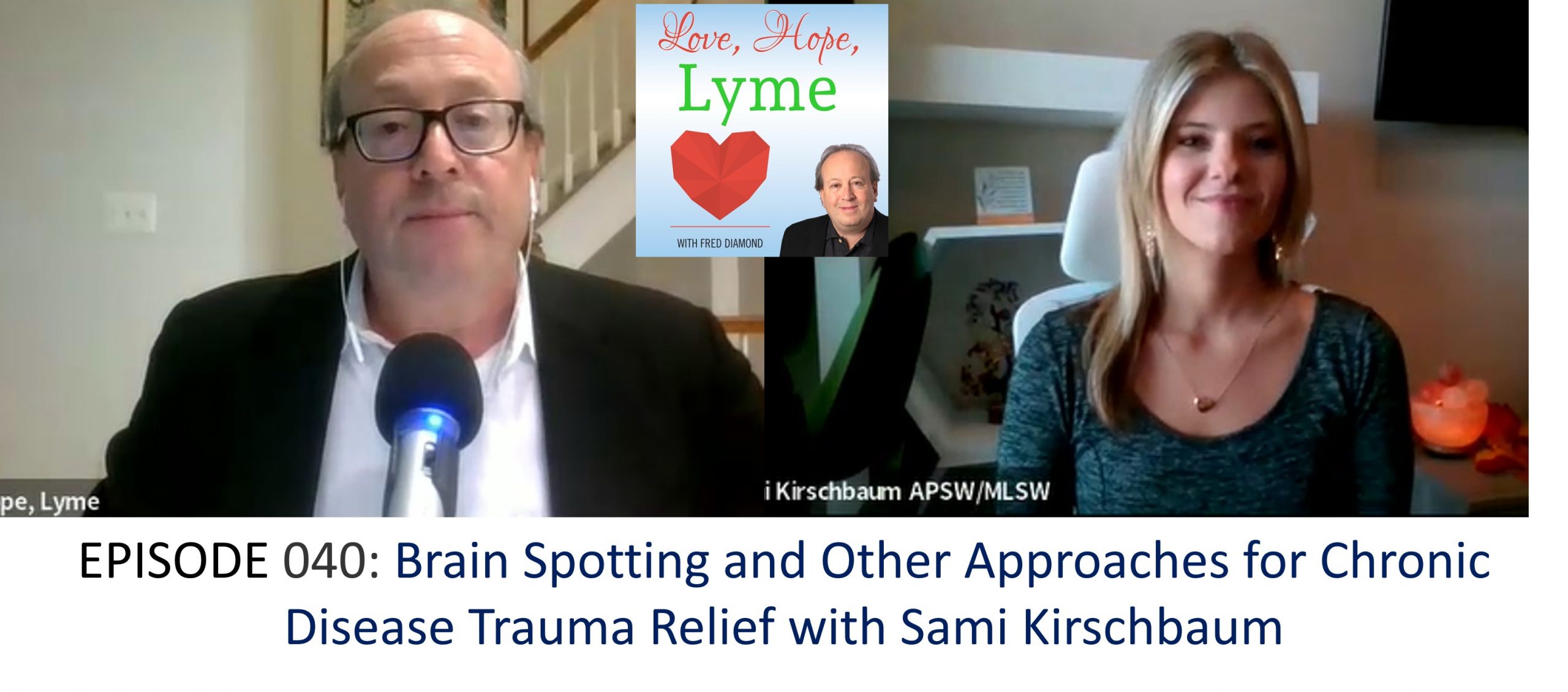
Podcast: Navigating Trauma to Heal From Chronic Lyme

https://www.lymedisease.org/navigating-trauma-chronic-lyme/

PODCAST: Navigating trauma to heal from chronic Lyme

By Fred Diamond

Chronic Lyme disease often brings trauma that can worsen symptoms and hinder healing.

In this week’s Love, Hope, Lyme podcast, I bring on Sami Kirschbaum, who helps patients heal through techniques like Brainspotting and nervous system regulation.

Sami focuses on the body’s physical response to trauma and uses methods to help patients release stored trauma and regain balance.

She also emphasizes the importance of community support in the healing process, offering a holistic approach to help Lyme survivors heal both emotionally and physically.

Every chronic Lyme survivor must navigate trauma, either induced from years of poor medical care or unresolved childhood trauma that is inhibiting healing and recovery.

When I was writing my book “Love, Hope, Lyme: What Family Members, Partners, and Friends Who Love a Chronic Lyme Survivor Need to Know,” I was surprised to see the word come up in almost every conversations. It came to a head for me when I watched a webinar with Dr. Richard Horowitz. At the 59-minute mark, Dr. Horowitz said:

“By the way, if you don’t resolve your childhood trauma, it’ll be very difficult to heal.

Chronic Lyme disease is not just a physical battle; it often comes with emotional and psychological trauma that can intensify symptoms and hinder the healing process.

Sami Kirschbaum, founder of the Lyme Resilience Collective, focuses on helping patients navigate and heal from these trauma responses through specialized techniques.

Drawing from her personal journey with Lyme disease and her training in trauma-based healing, Sami integrates Brainspotting, nervous system regulation, and community support to provide holistic care for those dealing with the emotional toll of chronic illness.

Trauma in the context of chronic illness

Many people think of trauma as the event itself, but Sami explains that trauma is really the body’s response to a stressful or overwhelming experience.

“When we go through traumatic experiences, a lot of people think that the event itself is a trauma,” she says. “But actually, what trauma is, is the person’s physical response to protect itself in a traumatic experience.”

This distinction is key for those with chronic Lyme disease, where trauma often exacerbates physical symptoms or reactivates dormant illness.

Sami’s approach to trauma healing starts with the body because, as she notes, “We know that trauma is actually held within the body. It’s not in our rational brain.”

The physical response to trauma can cause the body to remain in a heightened state of stress, which interferes with healing. This is why addressing trauma in both the mind and body is essential for those with chronic illnesses like Lyme disease.

Techniques for nervous system regulation

A central technique in Sami’s trauma healing practice is nervous system regulation. Chronic illness often puts patients in a perpetual state of stress, which she describes as being either “stuck-on” or “stuck-off.”

“The stuck-on state looks like panic, hypervigilance, high anxiety, running around, never feeling rested,” Sami explains. On the other hand, “stuck-off can look like lethargy, being depressed, shutting down, disassociating.”

Both extremes prevent the body from finding balance, or homeostasis, which is crucial for the healing process. “It’s important to have nervous system regulation so that we can stay in that flow and continue functioning appropriately through life.”

Sami offers nervous system regulation support groups as part of her services, teaching patients techniques to bring their nervous system back into balance. These techniques help patients navigate between the extremes of being stuck in high-alert states or shutting down completely.

Brainspotting: a key modality for trauma healing

One of the most powerful tools Sami uses for trauma healing is Brainspotting, a technique developed by Dr. David Grand.

“Brainspotting is a top trauma-healing modality,” Sami explains. It works by using the client’s visual field to access where the trauma is stored in the body.

Sami breaks it down further: “Where you look affects how you feel.” During Brainspotting sessions, the client focuses on a particular spot in their visual field while wearing headphones that deliver bilateral sound stimulation. This combination helps the brain and body work together to process trauma that is stored at a deeper level than the conscious mind can access.

Unlike more commonly known trauma therapies like EMDR (Eye Movement Desensitization and Reprocessing), Brainspotting allows for more flexibility and creativity.

“We trust that the person’s brain and body knows what it needs to heal itself, and the therapist, we hold the space for the client,” Sami says. The process is guided by the client’s own responses, allowing them to access and release stored trauma at their own pace.

Sami has been trained in Brainspotting for several years and credits it as one of the most effective tools for helping clients process trauma related to chronic Lyme disease. Brainspotting allows the patient to access trauma stored in the body and release it in a way that promotes both emotional and physical healing.

Trauma held in the body: healing from the inside out

A major component of Sami’s practice is helping clients recognize that trauma is stored in the body, not just in the mind. “We can’t have trauma processing from our neocortex, which is the higher part of our brain,” she explains.

This is why traditional talk therapy is often insufficient for healing trauma—especially for those with chronic illnesses.

“Trauma held in the body doesn’t have language, it has no sense of time,” Sami explains. “It just has a memory of protecting ourselves, and it is strong and sometimes gets embedded.”

This can make trauma responses seem exaggerated or irrational, but they are the body’s way of holding onto that survival mechanism. Techniques like Brainspotting are effective because they address trauma at this deep, body-based level.

Healing trauma collectively

Another important aspect of Sami’s work is the recognition that trauma and shame thrive in isolation, but healing can occur collectively. She emphasizes the importance of community in the healing process.

“Shame happens between people and it needs to be healed between people,” Sami says. By creating group settings for nervous system regulation and Brainspotting, she provides patients with a space where they can connect with others who understand their experiences.

“Coming together as a community is so important, which is why I do the group work as well as the individual work,” she explains. Chronic illness can be isolating, and many patients feel dismissed by family, friends, and even medical professionals. In Sami’s groups, patients find a safe space where they can share their experiences without fear of judgment or dismissal.

Moving beyond trauma

Sami’s ultimate goal is to help clients move beyond their trauma responses and reclaim their lives. This is why she focuses not just on trauma healing but also on cognitive rewiring and neuroplasticity.

“We can literally have neuroplasticity at our fingertips,” Sami says. “We can unlearn those programmings that we had, and then have the real adult mature brain come online and say, ‘Whoa, I am lovable.’”

For patients with chronic Lyme disease, this can mean letting go of limiting beliefs tied to their illness, such as feeling unworthy of love or incapable of leading a full life.

“Even though I can’t attend all these family events because I have chronic illness, I’m still worthy of love, I’m still worthy of belonging,” Sami says. This cognitive shift, combined with trauma healing, can help patients find emotional and physical relief.

Click here to listen to all episodes of the Love, Hope, Lyme Podcast or on YouTube.

Fred Diamond is based in Fairfax, Virginia and can be contacted via Facebook. His popular book, “Love, Hope, Lyme: What Family Members, Partners, and Friends Who Love a Chronic Lyme Survivor Need to Know” is available on Amazon. The e-version of the book is always free to Lyme survivors. PM Fred on Facebook or LinkedIn for your copy.

__________________

**Comment**

Trauma is the six letter word nobody talks about; however, unless dealt with, a person will never truly heal and be whole.

Since Lyme is a brain infection, it has the ability to stir up emotions, thoughts, feelings, and memories like nothing else.  It’s truly a mind-bender.

For more: