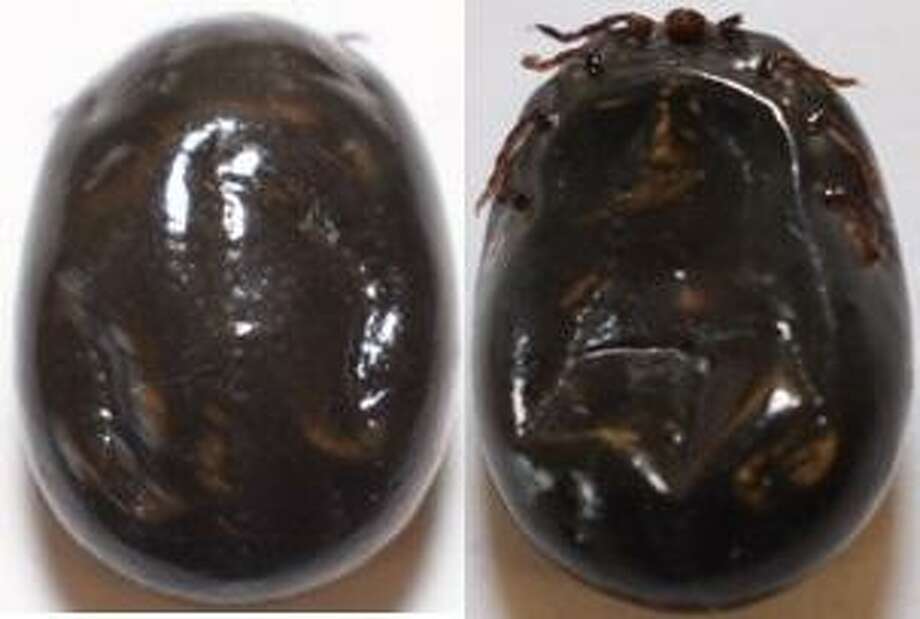
A SYDNEY woman will launch a class action against NSW Health after autopsy results showed her husband had been riddled with a disease the Health Department says does not exist in Australia.
Karl McManus, 44, died in July after being bitten by a tick while filming the television show Home and Away in Sydney. The autopsy indicated he had bacteria from Lyme disease in his liver, heart, kidney and lungs.
Samples from his organs, which were tested at the Sydney laboratory Australian Biologics, will be sent to the University of Sydney and to laboratories in the United States for more testing.
”If there is duplication of results, the government cannot dispute [that Lyme exists in Australia],” his wife, Mualla Akinci, said.
Mr McManus, from Turramurra, was diagnosed with multifocal neuropathy after testing negative at an Australian laboratory for Lyme disease, but tests carried out in the US and Germany returned positive results.
NSW Health maintains that the organisms which cause Lyme disease – three species of the genus Borrelia – are not carried here by wildlife, livestock or their parasites.
It says that anyone suffering from the illness must have caught it overseas, but Ms Akinci is adamant Mr McManus was bitten by a Lyme-infested tick in Waratah Park, home of the TV show Skippy, the Bush Kangaroo.
Ms Akinci has the support of two sufferers, and hopes more people will join the class action.
She also plans to sue Hornsby Hospital where her husband was treated before his death, and will appeal a decision by the Health Care Complaints Commission not to investigate his treatment while at the hospital.
___________________
**Comment**
Australia has been denying Lyme exists there. Time to show them otherwise. If you are infected with Lyme/MSIDS and live in Australia, now is your time. Speak up and be heard. Please contact your local Lyme/MSIDS support group and rally together.
The Tick Testing Laboratory at The Connecticut Agricultural Experiment Station is reporting the first evidence of an east Asian longhorned tick biting a resident of Fairfield County.
This newly discovered tick is a major livestock pest that feeds on a wide variety of mammals including humans, but it is not clear how often. Longhorned ticks have been found to carry several human pathogens in Asia, but it is unknown if this tick will be capable of transmitting native pathogens such as those that cause Lyme disease, babesiosis, anaplasmosis, or Powassan virus.
The tick, which has the scientific name Haemaphysalis longicornis is an invasive species that was initially discovered on a farm in New Jersey in 2017. It was most recently detected in Connecticut in July 2018.
Dr. Goudarz Molaei, who directs the CAES Tick Testing Program said in a news release that
“the laboratory is closely monitoring the human biting activity of this newly discovered invasive tick species and its potential involvement in transmission of exotic and local disease agents.”
“The identification of an Asian longhorned tick feeding on a state resident underscores the importance of our tick-testing program in helping to corroborate the capacity of this tick to bite humans outside of its native range,” said Dr. Theodore Andreadis, Director of the CAES in a news release. “Going forward, it will be imperative to more fully assess the risk associated with this tick and its capacity to transmit local disease-causing pathogens”.
The Tick Testing Program at the Connecticut Agricultural Experiment Station is a state-supported service offered to State residents since 1990. Ticks are accepted only from residents of Connecticut and should be submitted through their local health departments.
Testing is performed for three human disease causing agents: Anaplasma phagocytophilum, the causative agent of Human Granulocytic Anaplasmosis; Babesia microti, the causative agent of Babesiosis; and Borrelia burgdorferi, the causative agent of Lyme disease. Testing is performed on nearly 4,000 ticks annually.
History shows authorities downplay all of this. It’s imperative we don’t continue to allow them to take this approach. ALL ticks have the potential to spread pathogens. Prudence would err on the side of caution. Besides that, all the statistics in the world don’t matter when you are the sorry sucker who gets infected with something that shouldn’t happen! This idea that unless it’s on Pubmed to be taken seriously has to go.
The data that keeps pouring in is that ticks and the pathogens they carry continue to befuddle authorities. Don’t take their word alone for it. Corroborate their words and research it out yourself.
Infections with Bartonella spp. in free-ranging cervids and deer keds (Lipoptena cervi) in Norway.
Razanske I, et al. Comp Immunol Microbiol Infect Dis. 2018.
Abstract
Bartonella bacteria are arthropod-borne and can cause long-term bacteremia in humans and animals. The predominant arthropod vectors and the mode of transmission for many novel Bartonella species remain elusive or essentially unstudied. The aim of this study was to investigate the prevalence of Bartonella spp. in Norwegian cervids and deer keds (Lipoptena cervi) and to characterise the bacteria by sequencing of the partial gltA gene and 16 S-23 S rRNA intergenic spacer region (ITS) in order to evaluate a possible transmission route.
A total of 260 spleen samples and 118 deer keds were collected from cervids by hunters in the Southern part of Norway. Bartonella DNA was detected in 10.5% of spleen samples of roe deer (n = 67), in 35.1% red deer (n = 37), in 35.9% moose (n = 156), and in 85% pools of adult wingless deer ked (n = 59).Two Bartonella lineages were identified based on phylogenetic analysis of the gltA gene and ITS region sequences.
_______________
**Comment**
Bartonella is a HUGE player in Lyme/MSIDS. More and more is coming out on it’s impact in human disease; however, so much more needs to be done.
Critical information on Bartonella such as transmission studies on possible vectors including congenitally, via breast milk, as well as effective treatments and testing MUST be done. This type of information is critical to relieve patient suffering. Climate data WILL NOT move us forward. There’s only so many research dollars. Make them count.
From July 2006 through August 2017, a passive surveillance study of Ixodes ticks submitted from California, Oregon, and Washington was conducted by the TickReport program at the University of Massachusetts, Amherst. In total, 549 human-biting Ixodes ticks were submitted comprising both endemic and nonendemic species. We found that 430 endemic ticks were from 3 Ixodes species: Ixodes pacificus, Ixodes spinipalpis, and Ixodes angustus, whereas Ixodes scapularis (n = 111) was the most common species among the 119 nonendemic ticks. The submission peak for nymphal I. pacificus and I. spinipalpis was June, while submission peak for adult I. pacificus and nymphal I. angustus was April and September, respectively.
Endemic ticks commonly attached to the lower extremities of their victims, and individuals younger than 9 years old were frequently bitten. The infection prevalence of Borrelia burgdorferi sensu lato, Borrelia miyamotoi, and Anaplasma phagocytophilum in I. pacificus ticks was 1.31%, 1.05%, and 0.52%, respectively, and the prevalence of B. burgdorferi s. l. and A. phagocytophilum in I. spinipalpis ticks was 14.29% and 10.71%, respectively.
Furthermore, two species within the B. burgdorferi s. l. complex were detected in West Coast ticks: B. burgdorferi sensu stricto and Borrelia lanei. I. spinipalpis had the highest Borrelia prevalence among endemic ticks, and it was caused exclusively by B. lanei.Borrelia mayonii, Babesia microti, and Ehrlichia muris-like agent were not detected in these endemic ticks. In this study, we show that many nonendemic Ixodes ticks (119/549) are most likely acquired from travel to a different geographic region.
We report cases of conventionally recognized nonhuman feeders (I. spinipalpis and I. angustus) parasitizing humans.
The highest pathogen prevalence in I. spinipalpis may indicate a larger public health threat than previously thought, and the enzootic life cycle and pathogenicity of B. lanei warrant further study.
_________________
**Comment**
OOPS! “We report cases of conventionally recognized nonhuman feeders (I. spinipalpis and I. angustus) parasitizing humans.”
Now just how did that happen?
As we have feared all along, the barrel full of monkeys keeps rolling out of Pandora’s box. There are far more players in the game than is being let on.
Lyme borreliosis is a disease caused by bacteria of the genus Borrelia that are transmitted by a bite from a tick of the genus Ixodes. Scientists from the Institut Pasteur used mice to study the transmission of bacteria by ticks infected with various European and North American species of Borrelia. They found evidence of rapid bacterial transmission following a bite, with infection occurring within 24 hours of an adult tick bite and sometimes even sooner for nymph bites. This is a timely reminder of the importance of removing ticks as soon as possible after being bitten to prevent infection. Study found here: https://www.frontiersin.org/articles/10.3389/fmicb.2018.01722/full
Ixodes ricinus Public domain image/WHO via CDC
Lyme borreliosis is the most common vector-borne disease in Europe. It is caused by spirochetes belonging to the Borrelia burgdorferi sensu lato complex. This complex includes several species that are pathogenic for humans: Borrelia burgdorferi sensu stricto, B. afzelii, B. garinii, B. bavariensis, B. spielmanii, B. valaisiana and B. lusitaniae. The bacteria are transmitted through a bite from a hard tick of the genus Ixodes – in Europe, primarily Ixodes ricinus. Ticks can infect a wide variety of hosts. Humans are considered to be an accidental host; transmission can occur if they come into contact with an environment favorable to ticks.
Ticks have three lifecycle stages that can bite humans – larva, nymph and adult -, but bacteria are usually transmitted through bites from nymphs, which are higher in density and often go unnoticed because of their small size.
The amount of time a tick must remain attached to transmit bacteria to the vertebrate host is an essential parameter in assessing the risk of transmission and identifying measures to prevent infection. It is generally accepted that the longer a tick remains attached, the higher the risk of transmission. In Europe, it is regularly stated that there is a real risk of transmission only after 24 hours of attachment.
In this study, we used a mouse model to determine the kinetics of infection by Ixodes ricinus ticks (nymphs and adult females) infected with various European and North American strains or species of Borrelia. We also compared the dissemination of various strains and species of Borrelia by different modes of inoculation (via infected ticks or by injection of bacteria).
Unlike the American strains, all the European species of B. burgdorferi that we studied were detected in the salivary glands of adult ticks before a blood meal,suggesting the possibility of rapid transmission of the bacteria following a bite.
The results were consistent with this theory: infection occurred within 24 hours of a bite from an adult tick. Moreover, our analysis shows that nymphs infected by European species of B. burgdorferi are capable of transmitting these pathogens within 12 hours of attachment.
Our study proves that B. burgdorferi can be transmitted more quickly than stated in the literature.
It is therefore vital to remove ticks as soon as possible after being bitten to prevent infection.
Furthermore, the study shows that the tropism of Borrelia varies depending on the strain and species studied,which explains the variety of clinical manifestations of Lyme borreliosis. We also demonstrate a difference in the tropism of Borrelia following a tick bite, confirming the role of tick saliva in the efficacy of infection and dissemination in vertebrate hosts.
______________
**Comment**
It’s finally here. The long awaited for information that we ALL know out here in Lyme-land.
People are getting infected way before the oft repeated 24-72 hours of tick bite.
First, it’s important to remember that ALL transmission studies are on mice in a lab, therefore, it doesn’t necessarily mean the information translates to humans.
Second, it’s important to remember that the oft repeated 24-72 hour transmission mantra essentially comes from ONE mouse study that has an inch of dust on it: https://madisonarealymesupportgroup.com/2017/04/14/transmission-time-for-lymemsids-infection/ Even it says animal studies have proven that transmission can occur in under 16 hours and it occurs frequently in under 24 hours. No human studies have been done and no studies have determined the minimum time it takes for transmission.
So instead of asking “how little” time it takes, researchers have always asked“how long” it takes. Big difference.
In this instance, a little girl within 4-6 hours couldn’t walk or talk after a tick bite: https://madisonarealymesupportgroup.wordpress.com/2016/12/07/igenex-presentation/? If she wasn’t taken directly to Dr. Jones over the weekend, things could have turned out horribly. Mainstream medicine wanted her to wait until Monday for a NEURO – CONSULT despite her rapid decline. These people STILL do not get it.
Third, this study points out differences in strains of borrelia (there are 300 and counting in the world and 100 and counting in the U.S.). In the past, doctors have smugly looked at maps delineating where specific ticks are, and assuming only specific geographical borrelia strains will be present; however, birds are migrating everywhere and bringing ticks with them: https://madisonarealymesupportgroup.com/2018/08/13/study-shows-lyme-not-propelled-by-climate-change/
And fourth and lastly, this study points out a real and present danger – borrelia in the salivary glands of ticks. This is spoken about in quiet corners but most “experts” want to tout a “grace period,” regarding tick transmission and use all sorts of long words to buttress their case. If it wasn’t so serious it would be funny.
If there’s one thing I know it’s that ticks do not know the meaning of grace.