Archive for the ‘Ticks’ Category

Lyme Found in Asian Long-horned Ticks Again

https://wwwnc.cdc.gov/eid/article/27/2/20-1552_article

Disclaimer: Early release articles are not considered as final versions. Any changes will be reflected in the online version in the month the article is officially released.

Volume 27, Number 2—February 2021

Borrelia burgdorferi Sensu Stricto DNA in Field-Collected Haemaphysalis longicornis Ticks, Pennsylvania, United States

Keith J. PriceComments to Author , Christine B. Graham, Bryn J. Witmier, Holly A. Chapman, Brooke L. Coder, Christian N. Boyer, Erik Foster, Sarah E. Maes, Ying Bai, Rebecca J. Eisen, and Andrew D. Kyle
Author affiliations: Pennsylvania Department of Environmental Protection, Harrisburg, Pennsylvania, USA (K.J. Price, B.J. Witmier, H.A. Chapman, B.L. Coder, C.N. Boyer, A.D. Kyle); Centers for Disease Control and Prevention, Fort Collins, Colorado, USA (C.B. Graham, E. Foster, S.E. Maes, Y. Bai, R.J. Eisen)

Abstract

We collected questing Haemaphysalis longicornis ticks from southeastern counties of Pennsylvania, USA. Of 263 ticks tested by PCR for pathogens, 1 adult female was positive for Borrelia burgdorferi sensu stricto, yielding a 0.4% infection rate. Continued monitoring of this invasive tick is essential to determine its public health role.

Borrelia burgdorferi sensu stricto is the causative agent of Lyme disease, the most commonly reported vectorborne disease in North America (1). In Pennsylvania, which is first in the United States in the number of reported Lyme disease cases, the spirochete has been identified in nearly 50% of adult Ixodes scapularis ticks, the primary vector (2). In 2018, Pennsylvania initiated a statewide active surveillance program to monitor tick distribution and density, by county, and tickborne pathogen prevalence. Although focused primarily on collecting and testing Ixodes scapularis ticks, initial surveillance efforts recovered, among other species, Haemaphysalis longicornis (Asian longhorned tick), an exotic species recently detected in North America (3), providing quantitative records of their presence in Pennsylvania public lands (4).

Since its US discovery in New Jersey during 2017, the number of states that have detected H. longicornis ticks has increased rapidly. In its native range, H. longicornis ticks have been found to carry a variety of pathogens endemic to Pennsylvania, including B. burgdorferi (5). However, because the ecologic characteristics and the pathogen diversity and prevalence of H. longicornis ticks in the United States are understudied, potential epidemiologic risks there remain unknown. We report surveillance program data on the presence of pathogen-infected H. longicornis in public areas in Pennsylvania.

The Study

We performed surveillance activities weekly in 38 Pennsylvania counties during May 1–September 6, 2019, capturing peak nymphal I. scapularis ticks, in addition to adult and nymphal H. longicornis tick densities (6). Sampling sites, primarily high-use public areas in deciduous forests, were selected for high risk of recreational and occupational tick encounters and suitable I. scapularis and reported H. longicornis tick habitat (6).

Collection processes were standardized to minimize spatial and temporal bias. We collected questing ticks by dragging a 1 m2 white felt cloth over vegetation and leaf litter for 100–600 m. We examined cloths every 10 m and transferred recovered ticks into vials containing 80% ethanol, which we shipped to a central laboratory where they were stored at −80°C until being identified using morphological keys.

We tested the majority (84%) of collected H. longicornis nymphs and adults for pathogens, then retained the rest as voucher specimens. We prepared DNA extracts from individual H. longicornis tick homogenates on the KingFisher Flex Purification System with the MagMAX CORE Nucleic Acid Purification Kit (ThermoFisher Scientific, External Link). We tested each extract for B. burgdorferi sensu stricto, B. mayonii, B. miyamotoi, and Babesia microti using probe-based real-time PCR assays comprising multiple targets for each pathogen (Table). We amplified a segment of the Borrelia dipeptidyl aminopeptidase (PepX) gene using seminested PCR and sequenced it to confirm B. burgdorferi sensu stricto–positive specimens. We followed real-time PCR and PepX amplification protocols published elsewhere (9). We amplified and sequenced a 667-nt fragment of the cytochrome oxidase subunit I (COI) gene using primers LCO1490 and HCO2198 (11) to confirm the tick species of positive specimens. The PCR mixture (25 µL) contained forward and reverse primers at a final concentration of 0.4 µmol and 5 µL of DNA template. Thermocycling conditions followed protocols published elsewhere (11). COI and PepX amplicons were sequenced as described elsewhere (9).

Results
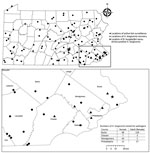
County map of Pennsylvania, USA, and the southeastern region (inset) showing locations of active tick surveillance, where Haemaphysalis longicornis ticks were recovered, and where Borrelia burgdorferi sensu stricto–positive H. longicornis ticks were found, May 1–September 6, 2019. Pennsylvania county map shows 38 counties sampled weekly and an additional 14 counties sampled opportunistically that yielded low tick recovery (Ixodes scapularis ticks only).


Figure. County map of Pennsylvania, USA, and the southeastern region (inset) showing locations of active tick surveillance, where Haemaphysalis longicornis ticks were recovered, and where Borrelia burgdorferisensu…

A total of 668 H. longicornis ticks (356 larvae, 166 nymphs, 146 adults) were collected from 4 counties in southeastern Pennsylvania (Figure). During the same period, 265 I. scapularis ticks (174 larvae, 78 nymphs, 13 adults) were collected from the same 4 counties. Of the subset of H. longicornis ticks tested by using real-time PCR (n = 263), 1 (0.4%) adult female collected from a county park in Bucks County on June 14, 2019 was positive for B. burgdorferi sensu stricto. A 570-nt segment of the PepX gene from this specimen was identical to B. burgdorferi sensu stricto reference sequences (GenBank accession nos. CP002312.1:657467–658036). The COI gene fragment from this tick showed 99.8% identity to an H. longicornis tick sequence in the GenBank database (accession no. JQ737090). No H. longicornis ticks were positive for B. miyamotoi, B. mayonii, or B. microti.

Conclusions

We document detection of the Lyme disease spirochete, B. burgdorferi sensu stricto, in invasive H. longicornis ticks. The overall infection rate of 0.4% was low. In comparison, B. burgdorferi sensu lato infection rates in I. scapularis ticks collected during the same surveillance period and in the same counties ranged from 16.7% to 57.1% (M.P. Price et al., unpub. data). This finding is consistent with recent findings that H. longicornis ticks are relatively averse to feeding on white-footed mice (Peromyscus leucopus), the primary reservoir of B. burgdorferi sensu stricto (12). Our findings support laboratory studies demonstrating that H. longicornis ticks can acquire B. burgdorferi sensu stricto while feeding on experimentally infected mice; however, those studies suggested that H. longicornis ticks are unlikely to contribute to transmission of B. burgdorferi sensu stricto because infection is lost during molting (13). However, refeeding and transmission of Lyme spirochetes by partially-fed ixodid ticks has been documented (14).

Based on microscopy, we estimated that ≈10% of the host-seeking H. longicornis ticks that we recovered were partially fed, suggesting the possibility that transmission could occur before the ticks molt. Of note, however, although we detected B. burgdorferi sensu stricto DNA in the tick, we have no evidence to suggest the spirochetes were viable. Unique ecologic traits of H. longicornis ticks (e.g., cold hardiness, parthenogenetic reproduction, host generality), which may enable the species’ rapid establishment and high density (4), could confound efforts to determine the extent to which the tick may be involved in maintenance of B. burgdorferi sensu stricto in nature.

Continued monitoring to identify infested areas is essential, especially in densely populated regions (e.g., southeastern Pennsylvania). Despite limited documentation of H. longicornis ticks biting humans in the United States (15), findings presented here support continued use of personal protective measures. H. longicornis ticks are a vector of human pathogens in its native range; further investigation is needed to determine its potential public health significance in the United States.

Dr. Price is a microbiologist at the Pennsylvania Department of Environmental Protection, Division of Vector Management, Harrisburg, PA. His research interests include vector ecology and vector-borne disease epidemiology.

Acknowledgments

We thank field personnel for collection efforts, Rebecca Eckert for helpful comments, and Pennsylvania Department of Health, especially Leah Lind, for cooperation and support.

Funding for this study was provided, in part, by an epidemiology subgrant (#4100082142) from the Pennsylvania Department of Health.

_________________________

**Comment**

While the article is quick to point out the low borrelia infection rate, this is the tick that clones itself multiplying like wild-fire and spreading geographically.  I think we should be concerned.  A study last year found the following:

At least 30 human pathogens were associated with H longicornis, including seven species of spotted fever group rickettsiae, seven species in the family of Anaplasmataceae, four genospecies in the complex Borrelia burgdorferi sensu lato, two Babesia species, six species of virus, and Francisella, Bartonella, Coxiella, and Toxoplasma, which were mainly reported in eastern Asia. The predictive modelling revealed that H longicornis might affect more extensive regions, including Europe, South America, and Africa, where the tick has never been recorded before.  https://www.thelancet.com/journals/lanplh/article/PIIS2542-5196(20)30145-5/fulltext

For more:  

The very important issue of interrupted/partial feeding in ticks is not very well understood but would explain quicker transmission times:

https://madisonarealymesupportgroup.com/2020/07/05/interrupted-blood-feeding-in-ticks-causes-and-consequences/

1st Cases of Natural Infections With Borrelia Hispanica in European Dogs and Cat

https://pubmed.ncbi.nlm.nih.gov/32824647/

First Cases of Natural Infections with Borrelia hispanica in Two Dogs and a Cat from Europe

Free PMC article

Abstract

Canine cases of relapsing fever (RF) borreliosis have been described in Israel and the USA, where two RF species, Borrelia turicatae and Borrelia hermsii, can cause similar clinical signs to the Borrelia persica in dogs and cats reported from Israel, including fever, lethargy, anorexia, thrombocytopenia, and spirochetemia. In this report, we describe the first clinical cases of two dogs and a cat from Spain (Cordoba, Valencia, and Seville) caused by the RF species Borrelia hispanica. Spirochetes were present in the blood smears of all three animals, and clinical signs included lethargy, pale mucosa, anorexia, cachexia, or mild abdominal respiration. Laboratory findings, like thrombocytopenia in both dogs, may have been caused by co-infecting pathogens (i.e., Babesia vogeli, confirmed in one dog). Anemia was noticed in one of the dogs and in the cat. Borrelia hispanica was confirmed as an infecting agent by molecular analysis of the 16S rRNA locus. Molecular analysis of housekeeping genes and phylogenetic analyses, as well as successful in vitro culture of the feline isolate confirmed the causative agent as B. hispanica.

_______________________

**Comment**

Our feline and canine friends are sentinels for human diseases and these cases are no different.

To date, 23 TBRF-related Borrelia species have been confirmed, but additional species are proposed (2). B. hispanica is the primary TBRF-related Borrelia species identified in Spain (3,4), where it is endemic.  It is transmitted mainly through the bite of O. erraticus ticks (5) but also can be transmitted by O. occidentalis ticks (4). B. hispanica also has been found in Portugal (6), Morocco (4,7,8), and Tunisia (4).  https://wwwnc.cdc.gov/eid/article/26/5/19-0745_article?deliveryName=USCDC_331-DM26146

As of 2015, B. hispanica is considered an emerging infectious agent causing Neuroborreliosis:  https://n.neurology.org/content/84/14_Supplement/P6.310

Please keep in mind that migrating birds and animals are transporting ticks everywhere and spreading the pathogens they carry.

O. erraticus ticks feed nocturnally on multiple warm- blooded vertebrate hosts, including humans, and are found living buried in soil of traditional pigpens: https://repository.uel.ac.uk/download/ef62f8a0e6b1b15a27c35d240d126464385ad171f0be9af9d7768571b17460b0/128662/Portuguese%2520hosts%2520for%2520Ornithodoros%2520erraticus%2520ticks.pdf

Regarding O. occidentals ticks, according to this 2020 article,

“we have not sampled Ornithodoros ticks to evaluate densities and infection rates, nor have we collected samples from small mammals to investigate the reservoir of Borrelia spp.” 19-0745

Important excerpt:

Because the spirochetemia phase is short and laboratory diagnosis is exclusively dependent on the observer, we believe TBRF is underdiagnosed, even in areas where suspicion should be relatively high. 19-0745

Lyme Disease Much More Common Than Previously Thought, Study Shows

https://www.consumerreports.org/lyme-disease/lyme-disease-much-more-common-than-previously-thought/

Lyme Disease Much More Common Than Previously Thought, Study Shows

With ticks spreading out across the country, the CDC says there may be nearly half a million cases of Lyme every year
A silhouette of a tick close up.

Between 2010 and 2018, the U.S. had approximately 476,000 cases of Lyme disease every year, according to a study out today from the Centers for Disease Control and Prevention (CDC).

That number is substantially higher than the CDC’s previous estimates, of about 300,000 annual Lyme cases, which was based on research from 2010 and earlier that looked at insurance claims and lab test results. The new study used more current information from a large database of commercial insurance claims. 

Despite the large jump, study author Kiersten Kugeler, Ph.D., an epidemiologist with the CDC’s Division of Vector-Borne Diseases, says the growing number of Lyme disease cases isn’t surprising.  (See link for article)

___________________

**Comment**

A few points:

  1. Medical providers use codes for insurance purposes.  If an exact code isn’t used, the patient falls through the cracks.  This has been happening to Lyme/MSIDS patients for over 40 years. Please see:  https://madisonarealymesupportgroup.com/2017/02/10/lyme-patients-denied-care-insurance-coverage-no-codes/  This 2017 article shows Lyme/MSIDS patients have been denied care and insurance coverage because of a lack of codes.  Later in 2017 we see the 1st official report on these code violations:  https://madisonarealymesupportgroup.com/2017/10/13/1st-officially-recognized-report-on-violations-of-lyme-patients-human-rights-is-released-updating-borreliosis-diagnostic-codes/  In 2019 we see improvement in the codes:  https://madisonarealymesupportgroup.com/2019/01/19/ad-hoc-committees-historical-improvement-in-the-icd-codes-for-lyme/  The recognition of Lyme/MSIDS codes is relatively new and certainly not perfect or inclusive.  There must be an exact code to correspond to the symptom or it doesn’t exist in the eyes of mainstream medicine and insurance companies.  Also, tick-borne illness includes far more than just Lyme disease and many of these diseases aren’t reportable to the CDC and probably lack codes as well.  I guarantee you they are STILL missing many, many cases that are falling through the cracks due to a lack of coding.
  2. The article makes a blatant falsehood by stating the “target -shaped” rash may not appear in 20-30% of cases.  Nope.  Hardly anyone I work with has the rash (including myself and my husband) and research shows those getting the EM rash vary widely.  Please see:  https://madisonarealymesupportgroup.com/2019/02/22/why-mainstream-lyme-msids-research-remains-in-the-dark-ages/  The actual number varies anywhere from 25-80%.  Hardly a sure thing!
  3. The article states that doctors are likely to err on the side of treating Lyme if they suspect it.  I don’t know what world these people live in but they certainly don’t live in mine.  I have patients calling me to announce they have tested positive THREE times and were still denied diagnosis and treatment!  Doctors are afraid to treat people for tick-borne infections.  The CDC/IDSA has made it perfectly clear for over 40 years that they will come after doctors who treat this.  What doctor wants to be investigated by the state medical board, have someone go through all their charts with a fine-toothed comb, be possibly fined (they will find something), be required to have medical oversight and even education, and possibly be sanctioned and even lose their license?  Yet, the word is out and every doctor knows this is what happens.  Please see:  https://madisonarealymesupportgroup.com/2020/01/21/dr-jemsek-vindicated/  This particular witch hunt drug on from 2006 – 2020 and caused untold stress on one of the best Lyme doctors we have, and he’s far from alone!
  4. The Tufts faculty member (Dr. Hu) states cases vary from year to year based on tick density, weather patterns, and more.  We need to drop this verbiage like a bad habit.  Ticks laugh at weather and are nearly impervious to it.  They seek out leaf litter and snow when conditions become harsh.  About the only thing that kills them is fire.  I know people pulling live ticks off their dogs in the middle of winter (with snow on the ground) in the most Northern parts of Wisconsin.  The mythology must stop.

For more on tick prevention:  https://madisonarealymesupportgroup.com/2019/04/12/tick-prevention-2019/

https://madisonarealymesupportgroup.com/2019/07/18/frequent-prescribed-fires-can-reduce-risk-of-tick-borne-diseases/

https://madisonarealymesupportgroup.com/2018/05/27/study-conforms-permethrin-causes-ticks-to-drop-off-clothing/

https://madisonarealymesupportgroup.com/2016/05/31/fry-and-die/

https://madisonarealymesupportgroup.com/2019/05/08/upstate-ny-disease-expert-prevention-really-works-do-it/

https://madisonarealymesupportgroup.com/2020/08/11/nootkatone-registered-by-epa-insect-repellent-products-could-be-available-by-2022/

Survey of Ticks Infesting Dogs & Cats in Ireland

https://pubmed.ncbi.nlm.nih.gov/32806603/

A Survey of Ticks Infesting Dogs and Cats in Ireland

Free PMC article

Abstract

Ticks are important ectoparasites of dogs and cats. Infestations can result in itching and localised dermatitis. In addition, ticks can act as vector of a range of viral, bacterial and protozoal pathogens. This paper reports the results of a nationwide survey of ticks infesting dogs and cats in Ireland. Seventy veterinary practices submitted a total of 120 ticks collected from 56 dogs and 16 cats.

  • Ixodes ricinus was the most abundant species on dogs
  • Ixodes hexagonus was the most abundant species on cats
  • The remainder were Ixodes canisuga and a single Rhipicephalus sanguineus specimen
  • The garden was most frequently associated with tick exposure in both dogs and cats
  • Sporting dog breeds (n = 17; 31%) were more likely to be infested with ticks than any other breed
  • Nearly all (n = 56; 95%) veterinarians indicated that ticks are a concern to their clients when they are found on their pets
  • Pet owners used a variety of products to control ectoparasites on their animals but a significant number (n = 18, 31%) indicated that they felt that the products are less effective highlighting the need for further investigations
  • Field sampling indicated that ticks are present at a low level in much of the greater Dublin area

______________________

For more:  https://madisonarealymesupportgroup.com/2017/08/12/pet-owners-have-nearly-2-times-the-risk-of-finding-ticks/

https://madisonarealymesupportgroup.com/2020/12/10/local-veterinarians-seeing-an-increase-in-tick-borne-illnesses-among-dogs/

https://madisonarealymesupportgroup.com/2020/12/21/dogs-are-testing-positive-for-new-tick-borne-bacteria/

https://madisonarealymesupportgroup.com/2020/03/19/are-current-tick-prevention-methods-for-dogs-working/

I just listened to a presentation on how the insecticide Lambda Cyhalothrin (a pyrethroid) offers nearly 100% control of the Asian Long-horned tick for up to 7 weeks when sprayed on foliage.  They sprayed in June, July, and August.  For more:  http://www.npic.orst.edu/factsheets/l_cyhalogen.pdf

Tick prevention is for your yard, yourself, and your pets:  https://madisonarealymesupportgroup.com/2019/04/12/tick-prevention-2019/

Controlled burns are also effective:  https://madisonarealymesupportgroup.com/2018/04/03/fire-good-news-for-tick-reduction/

CDC Updates Annual Estimate of Those Diagnosed/Treated For Lyme Disease From 300,000 to 476,000

https://www.cdc.gov/lyme/stats/humancases.html

CDC.Lyme_.Cases_.Bar_.Graph_.4-600x443Fig. 1: Prepared by LDA, Jan. 2021

The CDC published, in the February edition of its “Emerging Infectious Diseases,” two new papers pertaining to Lyme disease case numbers. CDC indicates that the researchers found 476,000 people are diagnosed with and treated for Lyme disease each year in the U.S.

This is a 59% increase from their previous estimate of 300,000.

Also, CDC posted a new page to its website, Syndromic Surveillance of Emergency Department Visits for Tick Bites, showing tick bites by time, age/sex, and region:  https://www.cdc.gov/ticks/tickedvisits/

While quick to state this increased number is “likely an over-estimate of actual infections because patients are sometimes treated presumptively,” they fail to mention the other side of the equation: that many fail to be diagnosed due to abysmal testing and doctor bias.  Interestingly they state tick-borne illness is a burden on the health care system but fail to state the need to improve testing and treatment, but simply say more effective prevention measures are needed.

The new numbers are based on more recent data and insurance claims.