Archive for the ‘Ticks’ Category

Study Shows: Lyme Not Propelled by Climate Change

Lyme Not Propelled by Climate Change

Recently, a plethora of books and articles have come out on how climate change is driving Lyme disease, and in fact, a recent article by The Center for Public Integrity, flat out accuses Maine’s governor, who happens to be a climate skeptic, of tying health officials’ hands and personally impeding valuable tick borne illness research:  https://madisonarealymesupportgroup.com/2018/08/09/why-the-cpis-article-on-how-a-climate-skeptic-is-holding-up-tick-borne-illness-research-is-dead-wrong/.

It has become clear to many that there is a Pied Piper pushing a climate change agenda.

Standing in opposition to the flutist’s tune, a recent study shows that warm winters are lethal to I. scapularis (black-legged) ticks.  In fact, overwinter survival dropped to 33% when the snow melted.  This has been substantiated by other researchers as well.  Scott & Scott, 2018, ticks and climate change, JVSM

The short of it is that snow cover is vital for tick survival as it serves as a buffer for when ticks find themselves exposed.  Typically ticks will seek out and hide in snow or leaf litter when conditions become harsh.  Without this buffer they are exposed and fewer survive.

http://

“Tick Guy” Tom Mather shows how ticks survive 3 degrees in 24 hours with snow cover.

The flutists insist that global warming, climate change, and pollution are the reasons for the spread of ticks and Lyme disease.  Independent tick researcher John Scott states those hypotheses are unsubstantiated.

Scott offers that yearly bidirectional, songbird migration in spring and fall is behind tick expansion and that the climate change model actually reflects migratory flight not warmer futuristic temperatures.
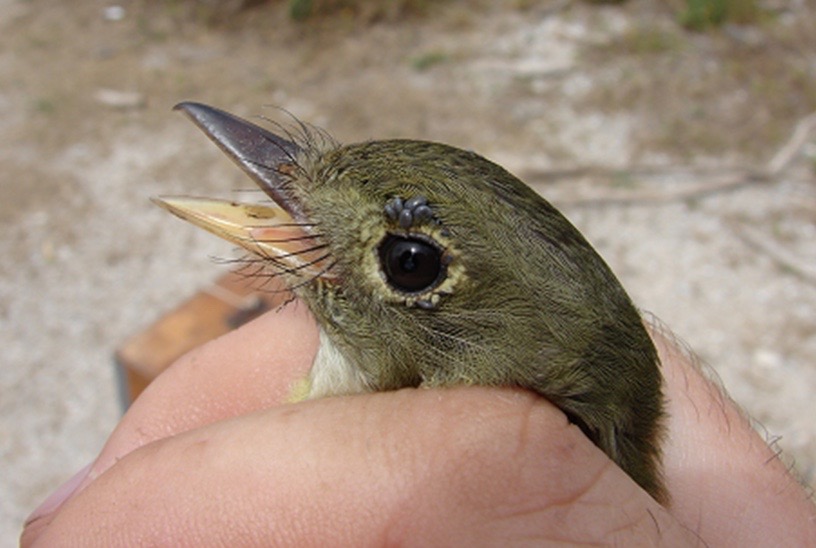
An Acadian Flycatcher with larval neotropical ticks.  (Courtesy Tim Guida)

One of Scott’s studies found 35% of song-bird transported I. scapularis nymphs to be infected with B burgdorferi (Bb).  Further, these heavily tick infested migrating song-birds can start new foci of ticks on islands and remote mainland areas.

Birds are serving as transport systems for ticks and are spreading them all over the world.

The other crucial but overlooked factor climate change researchers have not been considering is something called photoperiod.

Evidently, ticks have sensory organs that monitor the external environment which includes light.  Light wavelength as well as intensity will make the difference from if and when a nymph will molt and if and when an engorged female will lay eggs.

In a nutshell, light (photoperiod) has much more of an impact on ticks than temperature.

Scott’s in-house tick studies have shown that black-legged ticks require 14 hours of daylight to molt.  If ticks can’t molt, they can’t move on to their next life-cycle.  Photoperiod is innate and can not be altered by the climate.  He states:

“The hypothesis that I. scapularis ticks will expand further north in the Prairie Provinces because of climate change is not only unscientific, but deceiving.”

He demonstrates this by noting that I. scapularis ticks are not established in the Neotropics where the temperature is warmer.  The reason for this is the photoperiod is balanced between night and day.  In other words, the ticks have less light than they need to molt.

The study points out that both ticks and spirochetes are ecoadaptive survivors as demonstrated by the fact borrelial spirochetes have survived for thousands of years https://www.utoronto.ca/news/u-t-researchers-find-ancient-iceman-s-infection-helps-lyme-disease-bone-loss-discovery,  https://madisonarealymesupportgroup.com/2018/02/12/the-persistent-spiral-the-ancient-history-of-lyme-disease-and-tick-borne-infections/, and so have infected ticks:  http://www.sci-news.com/paleontology/blood-engorged-tick-dominican-amber-04757.html  (This one infected with a Babesia species).  This survival demonstrates adaptation to any potential climate shifts.

Another problem with the climate change models is they overlook the fact that deer ticks were established in northwestern Ontario, southern Manitoba and were already in central Canada prior to 1970.  What they predict to happen in the future has already happened in Canada.  Their oversight caused a skewed rate of tick expansion and a miscalculation of northward projected movement.

“For blacklegged ticks, climate change is an apocryphal issue.” -John Scott

The study states that another problem is the over-emphasis on white-footed mice:  https://madisonarealymesupportgroup.com/2016/06/21/first-frankenbugs-now-frankinmice/.  Scott has shown that there are established populations of deer ticks in Manitoba as well as in insular, hyper-endemic Corkscrew Island, yet both are devoid of white-footed mice.  He points out that there are numerous reservoir hosts that must be considered including other mammals, birds, and reptiles.

For decades we’ve been told it’s the mice.  Yet a real problem in the West and South are reptiles like skinks and lizards:  https://madisonarealymesupportgroup.com/2017/12/03/biologists-at-sf-state-dig-into-ticks-and-ld/,  https://madisonarealymesupportgroup.com/2018/06/25/the-confounding-geography-of-lyme-disease-in-the-u-s/

Another problem with the climate change insistence is study time vs. deer tick establishment.  The progression of studies used by some researchers follows the order in which they were conducted not the result and progression of climate change, and just because U.S. studies start in the early 80’s does not mean that was when ticks were established.  As noted before, ticks and spirochetes have both been found in fossils, obviously long before the 80’s.  This demonstrates climate adaptability.

“The time-lapse model sharply conflicts with the actual areas designated as Lyme disease foci.  Such models contradict field data, and misrepresent the Lyme disease timeline of tick establishment in Canada.”  – John Scott

Also, climate-change researchers overlooked and did not take into account established populations of I. scapularis found in the late 1960’s in the upper Midwest, as well as at Manitoba in 1991, in their climate change model maps.  Even game hunters remember ticks on the heads and necks of deer in the 1950’s and 1960’s in northwestern Ontario and southern Manitoba.  The faulty climate change maps are devoid of any ticks in those areas – yet experience shows otherwise.  This has been the experience of patients across the globe as well.

The study states that migratory song-birds transport black-legged tick larvae and nymphs hundreds of kilometers during northward migratory flights and are important drivers for wide-spread dispersal not only of ticks but of tick-associated pathogens.  

This is shown by the fact that neotropical songbirds are transporting ticks from Brazil into Canada.  Neotropical Amblyomma ticks do not overwinter in Canada yet they are being transported there.  Birds are also transporting Ixodes spp. ticks as well.  Scott claims if there was any substance to climate warming in propagating ticks the Amblyomma americium (lone star tick) would have become established in the southernmost part of Ontario, but they haven’t.

Thankfully others are studying the bird component as well:  https://madisonarealymesupportgroup.com/2017/08/17/of-birds-and-ticks/, https://madisonarealymesupportgroup.com/2016/10/02/the-role-of-birds-in-tickborne-illness/,  https://madisonarealymesupportgroup.com/2018/07/09/infected-ticks-collected-from-birds-in-northern-italy/,  https://madisonarealymesupportgroup.com/2018/08/12/bbsl-infected-ticks-in-canadian-songbirds/,  https://madisonarealymesupportgroup.com/2018/06/08/hemorrhagic-fever-virus-found-on-ticks-on-migratory-birds/.

In sum,

  • certain researchers are predicting a spread of LD due to climate change
  • independent tick research John Scott says these are “spurious and unsubstantiated” contentions
  • birds, not weather, are propagating the spread of ticks and disease
  • transmission depends on whether a tick is infected and whether the tick has vector competence
  • during bad weather ticks adapt by finding cover
  • warmer temperatures actually reduce tick populations
  • temperature and precipitation has no bearing on tick abundance
  • climate change alarmists have used Canadian studies making 1970 their benchmark for models but didn’t take into account established tick populations that had already been in existence for decades, centuries, or even millennia at northern latitudes
  • regarding ticks, climate change is insignificant

Scott JD, Scott CM. Lyme Disease Propelled by Borrelia burgdorferi-infected Blacklegged Ticks, Wild Birds, and Public Awareness – Not Climate Change. J Veter Sci Med 6(1):8 (2018)  Scott & Scott, 2018, ticks and climate change, JVSM

For more: https://madisonarealymesupportgroup.com/2018/11/07/ticks-on-the-move-due-to-migrating-birds-and-photoperiod-not-climate-change/

Recently, Scott wrote a scathing correction on erroneous research done by Ontario public officials on the fake climate change tick connection:  https://madisonarealymesupportgroup.com/2019/06/17/ontario-public-health-officials-called-out-on-shoddy-biased-research-utilizing-an-erroneous-climate-change-model-to-program-a-futuristic-tick-problem/

Please understand the DOD, DARPA, & EPA are funding this very research:  https://madisonarealymesupportgroup.com/2019/06/25/lyme-disease-cases-are-exploding-and-its-only-going-to-get-worse/This is an interesting finding considering the following excerpt from the above link:

Although conspiracy theorists have suggested — falsely — that Lyme disease was created in a U.S. military lab, it is true that in the years following World War II, the U.S. employed top German scientists who explored the tick’s potential in biological warfare for Nazi Germany. The researchers were investigating the tick’s ability to spread pathogens across wide areas with the potential to incapacitate entire populations.

Seventy-five years later, the tick timebomb is detonating on its own. Thanks to climate change, globalization, and other factors, ticks are not only proliferating but also becoming more malignant, more aggressive, and more likely to carry infection. A public health crisis is hiding in plain sight,

Can you see why our government would rather fund research on the climate and land usage? They would prefer to keep skeletons inside the closet.

For an interview with Scott:  https://madisonarealymesupportgroup.com/2017/08/14/canadian-tick-expert-climate-change-is-not-behind-lyme-disease/

“The climate change range expansion model is what the authorities have been using to rationalize how they have done nothing for more than thirty years. It’s a huge cover-up scheme that goes back to the 1980’s. The grandiose scheme was a nefarious plot to let doctors off the hook from having to deal with this debilitating disease. I caught onto it very quickly. Most people have been victims of it ever since.  This climate change ‘theory’ is all part of a well-planned scheme. Even the ticks are smarter than the people who’ve concocted this thing.  Climate change has nothing to do with tick movement. Blacklegged ticks are ecoadaptive, and tolerate wide temperature fluctuations…..It’s all a red herring to divert your attention.”- John Scott

And in conclusion, climate change data has not and will not help Lyme/MSIDS patients and/or the doctors who treat them. Time to hunker down and get to work spending money and backing research that relieves human suffering.

Bbsl Infected Ticks in Canadian Songbirds

https://www.ncbi.nlm.nih.gov/m/pubmed/30044388/

Far-Reaching Dispersal of Borrelia burgdorferi Sensu Lato-Infected Blacklegged Ticks by Migratory Songbirds in Canada.

Scott JD, et al. Healthcare (Basel). 2018.

Abstract

Lyme disease has been documented in northern areas of Canada, but the source of the etiological bacterium, Borrelia burgdorferi sensu lato (Bbsl) has been in doubt. We collected 87 ticks from 44 songbirds during 2017, and 24 (39%) of 62 nymphs of the blacklegged tick, Ixodes scapularis, were positive for Bbsl. We provide the first report of Bbsl-infected, songbird-transported I. scapularis in Cape Breton, Nova Scotia; Newfoundland and Labrador; north-central Manitoba, and Alberta. Notably, we report the northernmost account of Bbsl-infected ticks parasitizing a bird in Canada. DNA extraction, PCR amplification, and DNA sequencing reveal that these Bbsl amplicons belong to Borrelia burgdorferi sensu stricto (Bbss), which is pathogenic to humans. Based on our findings, health-care providers should be aware that migratory songbirds widely disperse B. burgdorferi-infected I. scapularis in Canada’s North, and local residents do not have to visit an endemic area to contract Lyme disease.

_____________

**Comment**

Second posting today of infected ticks being in places they supposedly shouldn’t be.  I think we need to truly accept the fact Lyme/MSIDS is everywhere.  Make sure you spread the word to medical practitioners, your family and friends – and frankly anyone who will listen.

https://madisonarealymesupportgroup.com/2018/06/07/where-ticks-are-and-what-they-carry-science-conversation-with-dr-cameron/  Infected ticks found in unlikely places including beaches.

Increasing Bbss in Tennessee Ticks

https://www.ncbi.nlm.nih.gov/m/pubmed/30044211/

Increasing Prevalence of Borrelia burgdorferi sensu stricto-Infected Blacklegged Ticks in Tennessee Valley, Tennessee, USA.

Hickling GJ, et al. Emerg Infect Dis. 2018.

Abstract

In 2017, we surveyed forests in the upper Tennessee Valley, Tennessee, USA. We found Ixodes scapularis ticks established in 23 of 26 counties, 4 of which had Borrelia burgdorferi sensu stricto-infected ticks. Public health officials should be vigilant for increasing Lyme disease incidence in this region.

______________

**Comment**

Another study showing infected ticks in places most don’t suspect and the importance of spreading the word.  I pray long gone are the days when a doc stares at a CDC map and announces it can’t be Lyme because it doesn’t exist in their state.

https://madisonarealymesupportgroup.com/2018/06/07/where-ticks-are-and-what-they-carry-science-conversation-with-dr-cameron/  Infected ticks are virtually everywhere. 


Co-Infection Patterns in Wisconsin Black Legged Ticks Show Associations Between Viral, Eukaryotic & Bacterial Microorganisms

https://www.ncbi.nlm.nih.gov/m/pubmed/30037148/

Co-Infection Patterns in Individual Ixodes scapularis Ticks Reveal Associations between Viral, Eukaryotic and Bacterial Microorganisms.

Cross ST, et al. Viruses. 2018.

Abstract

Ixodes scapularis ticks harbor a variety of microorganisms, including eukaryotes, bacteria and viruses. Some of these can be transmitted to and cause disease in humans and other vertebrates. Others are not pathogenic, but may impact the ability of the tick to harbor and transmit pathogens. A growing number of studies have examined the influence of bacteria on tick vector competence but the influence of the tick virome remains less clear, despite a surge in the discovery of tick-associated viruses.

In this study, we performed shotgun RNA sequencing on 112 individual adult I. scapularis collected in Wisconsin, USA. We characterized the abundance, prevalence and co-infection rates of viruses, bacteria and eukaryotic microorganisms.

We identified pairs of tick-infecting microorganisms whose observed co-infection rates were higher or lower than would be expected, or whose RNA levels were positively correlated in co-infected ticks. Many of these co-occurrence and correlation relationships involved two bunyaviruses, South Bay virus and blacklegged tick phlebovirus-1. These viruses were also the most prevalent microorganisms in the ticks we sampled, and had the highest average RNA levels.

Evidence of associations between microbes included a positive correlation between RNA levels of South Bay virus and Borrelia burgdorferi, the Lyme disease agent. These findings contribute to the rationale for experimental studies on the impact of viruses on tick biology and vector competence.

_____________

**Eukaryotes are protozoans or parasites which includes worms (nematodes/helminths)**

Mainstream medicine has yet to take into account the synergistic effect of all of the pathogens found within a tick upon human suffering.  So far they continue to believe this is a one pathogen/one disease/one drug paradigm, hence the mono-therapy of doxycycline as their answer to this 21st century plague.

Until this changes, we are doomed.

Why the CPI’s Article on How a Climate Skeptic is Holding up Tick-borne Illness Research is Dead Wrong

An article by The Center for Public Integrity,  https://www.publicintegrity.org/2018/08/06/21999/disease-bearing-ticks-head-north-weak-government-response-threatens-public-health states, “As Disease-bearing Ticks Head North, Weak Government Response Threatens Public Health.”

Now that’s something we can both agree upon.

What I completely and unequivocally disagree with is this statement:

 “The CDC says rising temperatures are partly to blame for the tripling of mosquito-, tick- and flea-borne illnesses from 2004 to 2016, but Maine’s governor, a climate skeptic, is tying health officials’ hands.”

This statement is called gunny-sacking which by definition means that rather than focusing on an important key point with basis in truth, you lump a bunch of unrelated issues together, some of which are true and some of which are unsubstantiated or even false, and whallop folks over the head, hoping they won’t notice inconsistencies.

“The climate change range expansion model has been used to rationalize how they have done nothing for more than thirty years.  It’s a huge cover-up scheme that goes back to the 1980’s.”  Scott says, “even the ticks are smarter than the people who have concocted this thing.”

Those are pretty bold statements coming from an infected tick expert.

BTW:  for those of you new to this crazy world, ticks have been found on beaches, in caves, underneath picnic benches, on rocks, on birds and other animals, blown into swimming pools, falling off trees, and I’ve found them climbing my walls:  https://madisonarealymesupportgroup.com/2018/06/07/where-ticks-are-and-what-they-carry-science-conversation-with-dr-cameron/,  https://madisonarealymesupportgroup.com/2017/07/13/tv-anchor-speaks-out-about-lyme-disease/.  I’m sure they’ve been found just about everywhere.  If you like Stephen King, here’s a goodie for bed-time reading:  https://madisonarealymesupportgroup.com/2017/07/30/ticks-found-on-eyeball-buttocks-and-penis/

If there’s one thing I’ve learned on this journey from hell it’s that those who are infected have a vested interest in getting down to the bottom of things.  They are more open minded, search harder, and do not blindly swallow past research.  They frankly, NEED answers for themselves.  It’s far more than just a job with a paycheck for them.  It’s also important to point out the obvious fact that being an independent researcher, Scott doesn’t answer to the people paying the bills.  So if “inconvenient” facts are discovered, he feels no pressure to hide the information.  I wish this could be said of others doing work in the Lyme/MSIDS area.

  • Fourth, and perhaps most importantly, the lumping together of Maine’s governor being a climate skeptic tying officials’ hands, is the worst gunny-sacking of all.  Let me be clear:  not swallowing the climate change propaganda does not mean you don’t care about controlling insects and lessening human suffering!  

Have we really devolved to infantile name-calling?

The real quote that says it all is:

“It’s disheartening for folks who work in climate and health. When politics come into play they feel beat down a little.”
—Chelsea Gridley-Smith, National Association of City and County Health Officials

OK, now we are getting somewhere.  Bottom line – someone feels put down.

Translation:  someone didn’t get some money – typically in the form of a grant.

And, if we are talking politics, they are clearly on the side of the climate changers.  It is used as a cat call for researchers seeking grant money despite inconclusive results.  The media, similarly to the vaccine issue, is clearly biased and promoting climate change.  Period.  Gone are the days where journalists just print the facts.  They now feel compelled to tell you how to think as well.

But, we have to ask ourselves, how is this article going to affect real research that needs to be done for Lyme/MSIDS patients?

For one, if a person takes this article at face value it will make you think that climate change research is what’s important and this “climate change skeptic” from Maine is stopping that from happening…when nothing could be further from the truth.

A tick experts claims they’ve been doing climate change research regarding ticks and Lyme for years and have ZIPPO to show for it.  Patients aren’t helped one iota.

Do we really need more climate change research or do we need more research on how to  properly test, treat, and help patients who have been suffering and have been ignored for over 40 years?  Of course we need to research how to stop ticks from transmitting disease but….

How is climate data going to help any of this?

You can show all the EM rashes you want.  You can quote disgruntled employees who feel “beat down a little,” you can state it’s all being hog-tied by a climate change skeptic, you can show maps of ticks marching North, and you can even show cute crayon-colored pictures by children, but some of us out here are on to you.  

In the end – it’s all about money.

What it isn’t about is patient care.

Let me be clear:  the federal government’s failing to prioritize Lyme/MSIDS research has NADDA to do with climate change.

Don’t be duped.  Don’t swallow the bait.  Think for yourself.

For a great read:  https://edberry.com/blog/climate-physics/agw-hypothesis/climate-change-emperors-have-no-clothes/?  “According to the scientific method, it is impossible to prove a theory is right. But climate alarmists ignore the scientific method and simply BELIEVE their theory is right. They don’t have time for any stinkin’ proof they are wrong.

This post is “stinkin’ proof” they are wrong. Yes, Virginia, it IS possible to prove a theory is wrong.”

And remember – above all – it’s important to question things and to seek out answers for yourself.  Often, the answers you find will fly in the face of accepted public opinion.

It’s your life.

Live it with conviction.