Archive for the ‘Ticks’ Category

New Tick Causes Epidemic of RMSF

https://www.nbcnews.com/health/health-care/new-tick-causes-epidemic-rocky-mountain-

New Tick Causes Epidemic of RMSF

By Maggie Fox

August, 15, 2018

A new kind of tick is causing an epidemic of Rocky Mountain spotted fever in Mexico, and it’s threatening to spread to the U.S., researchers said Wednesday.

Rocky Mountain spotted fever is already dangerous, and the new carrier is more likely to bite people than the ticks that usually spread it, the team of U.S. and Mexican researchers said.

As ticks in general become more common as the climate warms, they’re a bigger threat, they added.  (Please see my comment after article) 

“Rocky Mountain spotted fever, caused by the bacteria Rickettsia rickettsii, is responsible for more human deaths than any other tick-borne disease in North America,” the team wrote in the journal Emerging Infectious Diseases.

Rocky Mountain spotted fever was reported in 4,269 people in the U.S. in 2016, according to the Centers for Disease Control and Prevention. It can kill up to 10 percent of victims, depending on the outbreak.

It’s usually spread by the American dog tick and the closely related Rocky Mountain wood tick. But in recent years the bacterial infection has also been spread by the brown dog tick — a completely different species.

The researchers were investigating an epidemic of the infection that broke out in the border town of Mexicali starting in 2008. It’s already sickened at least 4,000 people, according to Mexican government estimates. Several hundred have died, and at least four people have died in the U.S. after crossing the border, according to this report and others.

“That’s a very big epidemic of a fatal disease,” said Dr. Janet Foley, an expert in the spread of animal-borne disease at the University of California Davis School of Veterinary Medicine. “There are likely thousands of cases.

The infection is not always easy to diagnose in human blood. If people get a rash and other symptoms of Rocky Mountain spotted fever, the advice is to treat quickly with the antibiotic doxycycline. Other symptoms are similar to those caused by many infections and include fever, nausea and headache.

Working with a team at the Universidad Autónoma de Baja California in Mexicali, Foley and colleagues tested the blood of 16 patients to see if they could find a characteristic signature of the infection.

“I was absolutely startled,” Foley said in an interview. The people who had been sickened in Mexicali had a heavy load of the infectious agent in their blood — something that had not been seen in past outbreaks.

The epidemic is worrisome because the brown dog tick is more likely to bite people and it adapts easily to living in a house, as opposed to living on wild animals, the researchers said.

“The Rocky Mountain spotted fever epidemic in Mexicali has not been contained and may be spreading to other parts of Baja California and into the United States,” the team wrote.

And now it’s possible that for some reason, the infection the brown dog tick transmits is more virulent, Foley said.

“We need to study this tick more to understand why it makes people so sick,” she said. “This Mexican strain seems more willing to feed on people.”

It’s a big problem in a poor, crowded city like Mexicali, where many people and many dogs live. Foley said she visited neighborhoods there where dogs were infected with hundreds or even thousands of the ticks.

“It’s pretty bad,” she said. She described one dog that was homeless but being fed by the community.

“This dog had ticks everywhere. Every millimeter of ear tissue was covered with ticks. They were down her back,” Foley said.

The Universidad Autónoma de Baja California veterinary team tested dogs in the town and found that more than 80 percent were infected.

“One community I worked in tried to get rid of their dogs,” Foley said. “That was so sad. We shouldn’t have to go so far.”

The key is to stop the ticks from biting dogs, but that can be expensive, as flea spray and flea collars are costly.

It’s less of a threat in more affluent communities, where dogs are vaccinated, groomed and licensed, but people can travel with infected dogs.

“It can be a threat as people go back and forth across borders, especially with dogs,” Foley said. “The tick is present in the U.S. and is moving northward.”

More than 72 million crossings were made by people from Mexico into California in 2015 alone, a CDC team reported.

The CDC says tick-borne diseases are on the rise. “Overall, since 2000, in the United States, the incidence of Rocky Mountain spotted fever has reportedly increased fourfold,” Foley’s team wrote.

The brown dog tick may be in part responsible but it could be that testing methods have made a difference as well, they said.

________________

**Comment**

Ticks are NOT becoming more common due to warmer temps.  They are becoming more common due to migrating birds:  https://madisonarealymesupportgroup.com/2018/08/13/study-shows-lyme-not-propelled-by-climate-change/  Warmer temperatures actually reduce tick populations.  Numerous studies have shown that temperature, pollution, and humidity doesn’t affect ticks.  Rather, something called “photoperiod” does.  Ticks require 14 hours to molt into the next stage of life. This study also shows numerous flaws in the climate models.  

The NBC article actually shows the importance of transit with people and dogs transiting ticks from one location to another.  Birds, other mammals, and even reptiles transit ticks across borders.  This is how ticks are traveling further.

Ticks are marvelous ecoadaptors and will seek out and hide in leaf litter or snow to survive.  The link above shows “Tick Guy” Tom Mather demonstrating how ticks can survive 3 degree temps in 24 hours when put under snow cover.

If we allow the false idea of climate driving ticks North to stand, there will be a misdirection of research funds that could go to important issues that could help patients.  For far too long we have had loads of climate data with no help what-so-ever to patients.  We are only lining the pockets of researchers who have a vested interest in pushing the climate issue.

For more on RMSF:  https://madisonarealymesupportgroup.com/2018/07/10/first-rmsf-death-in-wisconsin/
https://madisonarealymesupportgroup.com/2018/06/12/georgia-mom-warns-others-after-son-contracts-rocky-mountain-spotted-fever-after-tick-bite/

https://madisonarealymesupportgroup.com/2015/08/13/severe-case-of-rmsf-had-to-remove-patients-arms-and-legs/

https://www.ommegaonline.org/article-details/THE-ROCKY-MOUNTAIN-SPOTTED-FEVER-AND-THE-NEW-PLAGE-OF-THE-21ST-CENTURY-THE-TICKS/1898


Powassan Confirmed in Dutchess County

https://www.poughkeepsiejournal.com/story/news/local/2018/08/14/rare-tick-borne-powassan-virus-confirmed-dutchess-county/985053002/

Rare, tick-borne Powassan virus confirmed in Dutchess County

A rare, sometimes fatal tick-borne virus has been confirmed in Dutchess County.

Allison Kaufman, county public health advisor, said a case of the virus was confirmed in late July. The person who contracted the virus reported they had been ill since June, Kaufman said.

It is the second confirmed case of the virus in 2018; the first was confirmed in Columbia County in June.

“I think residents need to keep in mind this is a very serious disease but also a very rare disease,” Kaufman said. “The level of concern has to be proportional to the level of risk.”

She said county residents should maintain diligence in preventing tick bites to not only avoid the Powassan virus but also Lyme disease, anaplasmosis disease and babesiosis disease.

Powassan virus has symptoms that range from mild, flu-like symptoms to life-threatening encephalitis, an inflammation of the brain.

Kaufman said there is no “grace period” of tick attachment before the Powassan virus is transmitted. The virus could be transmitted in as little as 15 minutes as opposed to the 24-hour period connected with Lyme disease.

“Lint rollers can remove visible ticks crawling on clothes without having to touch the tick,” Kaufman said.

http://www.montgomeryadvertiser.com/videos/life/wellness/2017/07/19/do-you-know-how-dangerous-ticks-really-/103825282/  Video here
Most Americans know that ticks can make them sick, and many take steps to avoid them.
Four cases were reported in the state last year, including one reported in Dutchess County. 

According to the Center for Disease Control, 21 cases of Powassan virus were reported between 2007 and 2016 in the state.

State and county health officials urge outdoors enthusiasts to take steps to protect themselves from tick-borne diseases.

These include:

  • Wear light-colored clothing with a tight weave to spot ticks easily, as well as enclosed shoes, long pants and a long-sleeved shirt. Tuck pant legs into socks or boots and shirt into pants.
  • Check clothes and any exposed skin frequently for ticks while outdoors.
  • Consider using insect repellent.
  • Stay on cleared, well-traveled trails. Walk in the center of trails. Avoid dense woods and bushy areas.
  • Bathe or shower as soon as possible after going indoors, preferably within two hours, to wash off and more easily find ticks.
  • Do a final, full-body tick check at the end of the day and remove ticks promptly. Also, check children and pets.

The mid-Hudson Valley, and Dutchess County in particular, have been a hot spot for Lyme disease, also a tick-borne illness, for years. More than 12,000 cases were diagnosed in the county between 2000 and 2016, according to the most recent Centers for Disease Control and Prevention

https://www.poughkeepsiejournal.com/videos/news/2018/04/16/living-lyme-disease-young-girls-story/33751245/  Video here on Ella Buss who has Lyme.

Ryan Santistevan: rsantistev@poughkeepsiejournal.com; 845-437-4809; Twitter: @SantistevanRyan

________________

**Comment**

Please know that just because something is rarely reported doesn’t mean it’s rare.

  1. Powassan can be spread in minutes
  2. Lyme can be spread in hours – it does not take 24-72 hours:  https://madisonarealymesupportgroup.com/2017/04/14/transmission-time-for-lymemsids-infection/  Get ticks off you ASAP!
  3. We really need to revisit this idea of a “grace period” with tick attachment.  Really?

I recognized the little face in the second video on Ella Buss who has Lyme Disease.  Here is her story:  https://madisonarealymesupportgroup.com/2017/08/12/lyme-disease-case-started-with-headaches/


Study Shows: Lyme Not Propelled by Climate Change

Lyme Not Propelled by Climate Change

Recently, a plethora of books and articles have come out on how climate change is driving Lyme disease, and in fact, a recent article by The Center for Public Integrity, flat out accuses Maine’s governor, who happens to be a climate skeptic, of tying health officials’ hands and personally impeding valuable tick borne illness research:  https://madisonarealymesupportgroup.com/2018/08/09/why-the-cpis-article-on-how-a-climate-skeptic-is-holding-up-tick-borne-illness-research-is-dead-wrong/.

It has become clear to many that there is a Pied Piper pushing a climate change agenda.

Standing in opposition to the flutist’s tune, a recent study shows that warm winters are lethal to I. scapularis (black-legged) ticks.  In fact, overwinter survival dropped to 33% when the snow melted.  This has been substantiated by other researchers as well.  Scott & Scott, 2018, ticks and climate change, JVSM

The short of it is that snow cover is vital for tick survival as it serves as a buffer for when ticks find themselves exposed.  Typically ticks will seek out and hide in snow or leaf litter when conditions become harsh.  Without this buffer they are exposed and fewer survive.

http://

“Tick Guy” Tom Mather shows how ticks survive 3 degrees in 24 hours with snow cover.

The flutists insist that global warming, climate change, and pollution are the reasons for the spread of ticks and Lyme disease.  Independent tick researcher John Scott states those hypotheses are unsubstantiated.

Scott offers that yearly bidirectional, songbird migration in spring and fall is behind tick expansion and that the climate change model actually reflects migratory flight not warmer futuristic temperatures.

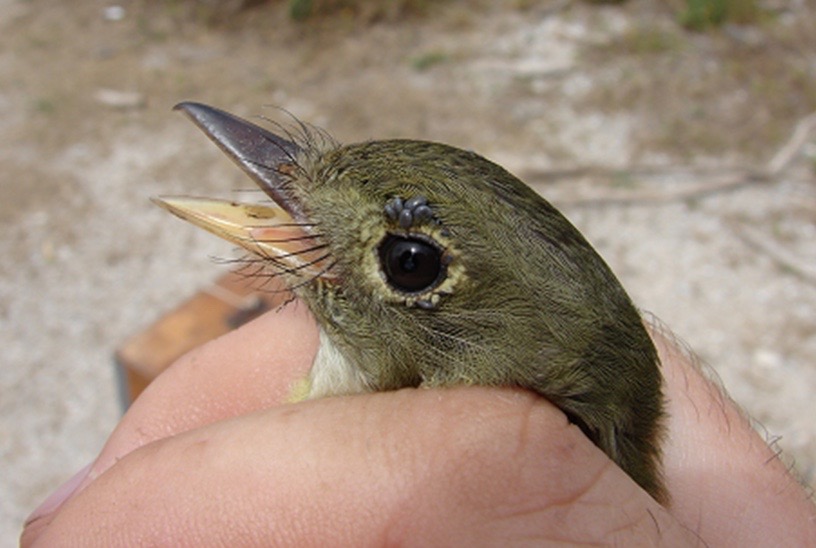
An Acadian Flycatcher with larval neotropical ticks.  (Courtesy Tim Guida)

One of Scott’s studies found 35% of song-bird transported I. scapularis nymphs to be infected with B burgdorferi (Bb).  Further, these heavily tick infested migrating song-birds can start new foci of ticks on islands and remote mainland areas.

Birds are serving as transport systems for ticks and are spreading them all over the world.

The other crucial but overlooked factor climate change researchers have not been considering is something called photoperiod.

Evidently, ticks have sensory organs that monitor the external environment which includes light.  Light wavelength as well as intensity will make the difference from if and when a nymph will molt and if and when an engorged female will lay eggs.

In a nutshell, light (photoperiod) has much more of an impact on ticks than temperature.

Scott’s in-house tick studies have shown that black-legged ticks require 14 hours of daylight to molt.  If ticks can’t molt, they can’t move on to their next life-cycle.  Photoperiod is innate and can not be altered by the climate.  He states:

“The hypothesis that I. scapularis ticks will expand further north in the Prairie Provinces because of climate change is not only unscientific, but deceiving.”

He demonstrates this by noting that I. scapularis ticks are not established in the Neotropics where the temperature is warmer.  The reason for this is the photoperiod is balanced between night and day.  In other words, the ticks have less light than they need to molt.

The study points out that both ticks and spirochetes are ecoadaptive survivors as demonstrated by the fact borrelial spirochetes have survived for thousands of years https://www.utoronto.ca/news/u-t-researchers-find-ancient-iceman-s-infection-helps-lyme-disease-bone-loss-discovery,  https://madisonarealymesupportgroup.com/2018/02/12/the-persistent-spiral-the-ancient-history-of-lyme-disease-and-tick-borne-infections/, and so have infected ticks:  http://www.sci-news.com/paleontology/blood-engorged-tick-dominican-amber-04757.html  (This one infected with a Babesia species).  This survival demonstrates adaptation to any potential climate shifts.

Another problem with the climate change models is they overlook the fact that deer ticks were established in northwestern Ontario, southern Manitoba and were already in central Canada prior to 1970.  What they predict to happen in the future has already happened in Canada.  Their oversight caused a skewed rate of tick expansion and a miscalculation of northward projected movement.

“For blacklegged ticks, climate change is an apocryphal issue.” -John Scott

The study states that another problem is the over-emphasis on white-footed mice:  https://madisonarealymesupportgroup.com/2016/06/21/first-frankenbugs-now-frankinmice/.  Scott has shown that there are established populations of deer ticks in Manitoba as well as in insular, hyper-endemic Corkscrew Island, yet both are devoid of white-footed mice.  He points out that there are numerous reservoir hosts that must be considered including other mammals, birds, and reptiles.

For decades we’ve been told it’s the mice.  Yet a real problem in the West and South are reptiles like skinks and lizards:  https://madisonarealymesupportgroup.com/2017/12/03/biologists-at-sf-state-dig-into-ticks-and-ld/,  https://madisonarealymesupportgroup.com/2018/06/25/the-confounding-geography-of-lyme-disease-in-the-u-s/

Another problem with the climate change insistence is study time vs. deer tick establishment.  The progression of studies used by some researchers follows the order in which they were conducted not the result and progression of climate change, and just because U.S. studies start in the early 80’s does not mean that was when ticks were established.  As noted before, ticks and spirochetes have both been found in fossils, obviously long before the 80’s.  This demonstrates climate adaptability.

“The time-lapse model sharply conflicts with the actual areas designated as Lyme disease foci.  Such models contradict field data, and misrepresent the Lyme disease timeline of tick establishment in Canada.”  – John Scott

Also, climate-change researchers overlooked and did not take into account established populations of I. scapularis found in the late 1960’s in the upper Midwest, as well as at Manitoba in 1991, in their climate change model maps.  Even game hunters remember ticks on the heads and necks of deer in the 1950’s and 1960’s in northwestern Ontario and southern Manitoba.  The faulty climate change maps are devoid of any ticks in those areas – yet experience shows otherwise.  This has been the experience of patients across the globe as well.

The study states that migratory song-birds transport black-legged tick larvae and nymphs hundreds of kilometers during northward migratory flights and are important drivers for wide-spread dispersal not only of ticks but of tick-associated pathogens.  

This is shown by the fact that neotropical songbirds are transporting ticks from Brazil into Canada.  Neotropical Amblyomma ticks do not overwinter in Canada yet they are being transported there.  Birds are also transporting Ixodes spp. ticks as well.  Scott claims if there was any substance to climate warming in propagating ticks the Amblyomma americium (lone star tick) would have become established in the southernmost part of Ontario, but they haven’t.

Thankfully others are studying the bird component as well:  https://madisonarealymesupportgroup.com/2017/08/17/of-birds-and-ticks/https://madisonarealymesupportgroup.com/2016/10/02/the-role-of-birds-in-tickborne-illness/,  https://madisonarealymesupportgroup.com/2018/07/09/infected-ticks-collected-from-birds-in-northern-italy/,  https://madisonarealymesupportgroup.com/2018/08/12/bbsl-infected-ticks-in-canadian-songbirds/,  https://madisonarealymesupportgroup.com/2018/06/08/hemorrhagic-fever-virus-found-on-ticks-on-migratory-birds/.

In sum,

  • certain researchers are predicting a spread of LD due to climate change
  • independent tick research John Scott says these are “spurious and unsubstantiated” contentions
  • birds, not weather, are propagating the spread of ticks and disease
  • transmission depends on whether a tick is infected and whether the tick has vector competence
  • during bad weather ticks adapt by finding cover
  • warmer temperatures actually reduce tick populations
  • temperature and precipitation has no bearing on tick abundance
  • climate change alarmists have used Canadian studies making 1970 their benchmark for models but didn’t take into account established tick populations that had already been in existence for decades, centuries, or even millennia at northern latitudes
  • regarding ticks, climate change is insignificant

Scott JD, Scott CM. Lyme Disease Propelled by Borrelia burgdorferi-infected Blacklegged Ticks, Wild Birds, and Public Awareness – Not Climate Change. J Veter Sci Med 6(1):8 (2018)  Scott & Scott, 2018, ticks and climate change, JVSM

For more: https://madisonarealymesupportgroup.com/2018/11/07/ticks-on-the-move-due-to-migrating-birds-and-photoperiod-not-climate-change/

Recently, Scott wrote a scathing correction on erroneous research done by Ontario public officials on the fake climate change tick connection:  https://madisonarealymesupportgroup.com/2019/06/17/ontario-public-health-officials-called-out-on-shoddy-biased-research-utilizing-an-erroneous-climate-change-model-to-program-a-futuristic-tick-problem/

Please understand the DOD, DARPA, & EPA are funding this very research:  https://madisonarealymesupportgroup.com/2019/06/25/lyme-disease-cases-are-exploding-and-its-only-going-to-get-worse/This is an interesting finding considering the following excerpt from the above link:

Although conspiracy theorists have suggested — falsely — that Lyme disease was created in a U.S. military lab, it is true that in the years following World War II, the U.S. employed top German scientists who explored the tick’s potential in biological warfare for Nazi Germany. The researchers were investigating the tick’s ability to spread pathogens across wide areas with the potential to incapacitate entire populations.

Seventy-five years later, the tick timebomb is detonating on its own. Thanks to climate change, globalization, and other factors, ticks are not only proliferating but also becoming more malignant, more aggressive, and more likely to carry infection. A public health crisis is hiding in plain sight,

Can you see why our government would rather fund research on the climate and land usage? They would prefer to keep skeletons inside the closet.

For an interview with Scott:  https://madisonarealymesupportgroup.com/2017/08/14/canadian-tick-expert-climate-change-is-not-behind-lyme-disease/

“The climate change range expansion model is what the authorities have been using to rationalize how they have done nothing for more than thirty years. It’s a huge cover-up scheme that goes back to the 1980’s. The grandiose scheme was a nefarious plot to let doctors off the hook from having to deal with this debilitating disease. I caught onto it very quickly. Most people have been victims of it ever since.  This climate change ‘theory’ is all part of a well-planned scheme. Even the ticks are smarter than the people who’ve concocted this thing.  Climate change has nothing to do with tick movement. Blacklegged ticks are ecoadaptive, and tolerate wide temperature fluctuations…..It’s all a red herring to divert your attention.”- John Scott

And in conclusion, climate change data has not and will not help Lyme/MSIDS patients and/or the doctors who treat them. Time to hunker down and get to work spending money and backing research that relieves human suffering.

Bbsl Infected Ticks in Canadian Songbirds

https://www.ncbi.nlm.nih.gov/m/pubmed/30044388/

Far-Reaching Dispersal of Borrelia burgdorferi Sensu Lato-Infected Blacklegged Ticks by Migratory Songbirds in Canada.

Scott JD, et al. Healthcare (Basel). 2018.

Abstract

Lyme disease has been documented in northern areas of Canada, but the source of the etiological bacterium, Borrelia burgdorferi sensu lato (Bbsl) has been in doubt. We collected 87 ticks from 44 songbirds during 2017, and 24 (39%) of 62 nymphs of the blacklegged tick, Ixodes scapularis, were positive for Bbsl. We provide the first report of Bbsl-infected, songbird-transported I. scapularis in Cape Breton, Nova Scotia; Newfoundland and Labrador; north-central Manitoba, and Alberta. Notably, we report the northernmost account of Bbsl-infected ticks parasitizing a bird in Canada. DNA extraction, PCR amplification, and DNA sequencing reveal that these Bbsl amplicons belong to Borrelia burgdorferi sensu stricto (Bbss), which is pathogenic to humans. Based on our findings, health-care providers should be aware that migratory songbirds widely disperse B. burgdorferi-infected I. scapularis in Canada’s North, and local residents do not have to visit an endemic area to contract Lyme disease.

_____________

**Comment**

Second posting today of infected ticks being in places they supposedly shouldn’t be.  I think we need to truly accept the fact Lyme/MSIDS is everywhere.  Make sure you spread the word to medical practitioners, your family and friends – and frankly anyone who will listen.

https://madisonarealymesupportgroup.com/2018/06/07/where-ticks-are-and-what-they-carry-science-conversation-with-dr-cameron/  Infected ticks found in unlikely places including beaches.

Increasing Bbss in Tennessee Ticks

https://www.ncbi.nlm.nih.gov/m/pubmed/30044211/

Increasing Prevalence of Borrelia burgdorferi sensu stricto-Infected Blacklegged Ticks in Tennessee Valley, Tennessee, USA.

Hickling GJ, et al. Emerg Infect Dis. 2018.

Abstract

In 2017, we surveyed forests in the upper Tennessee Valley, Tennessee, USA. We found Ixodes scapularis ticks established in 23 of 26 counties, 4 of which had Borrelia burgdorferi sensu stricto-infected ticks. Public health officials should be vigilant for increasing Lyme disease incidence in this region.

______________

**Comment**

Another study showing infected ticks in places most don’t suspect and the importance of spreading the word.  I pray long gone are the days when a doc stares at a CDC map and announces it can’t be Lyme because it doesn’t exist in their state.

https://madisonarealymesupportgroup.com/2018/06/07/where-ticks-are-and-what-they-carry-science-conversation-with-dr-cameron/  Infected ticks are virtually everywhere.