Archive for the ‘Ticks’ Category

Talking Tick Prevention: Ask a UW Veterinarian

https://www.vetmed.wisc.edu/ask-a-uw-veterinarian-talking-tick-prevention/

Talking Tick Prevention:  Ask a UW Veterinarian

Talking Tick Prevention

The question below was featured in the Summer 2018 issue of On Call, the magazine for friends of the UW School of Veterinary Medicine. This expert response comes from Juliet Caviness DVM’17, primary care veterinarian at UW Veterinary Care and SVM clinical instructor.

Have a question for our veterinary medical experts?
Please send them to our On Call magazine editor at oncall@vetmed.wisc.edu. We cannot guarantee responses to all submissions. For any urgent pet health issue, please contact your veterinarian directly.
Question: Are the ingestible tick preventatives okay to use on tiny dogs? My dogs are under five pounds.

–Denise, Barrington, Illinois

Answer: Tick prevention is a key component of preventative medicine to keep your pet free of parasites and reduce the risk of parasite-transmitted diseases. Tick-borne disease (like Lyme disease or Anaplasmosis) is a very common problem in Wisconsin, which makes year-round administration of tick preventative even more important.

There are many options on the market these days for tick preventatives, ranging from topical spot-on products to collars, sprays, and oral medications. Newer oral products (including brands like Simparica, NexGard, and Bravecto) have been shown to be very effective and can avoid the mess sometimes involved with liquid spot-on products (such as Frontline and Advantix), which are applied directly to the skin, usually between the shoulder blades.

Oral products are very convenient for those who might hold their pets often, have small children, or have dogs who love to swim or are bathed frequently due to allergies or other skin conditions, as one concern with topical medications is that they must remain in contact with the skin for long enough to be absorbed before the pet can get wet.

On the other hand, an oral medication may not be well-suited to dogs with sensitive digestion, as some dogs may experience vomiting or diarrhea as a side effect. Other limiting factors would include the age and weight of your pet. Some oral products are not labeled for use in very young dogs (Bravecto and Simparica are for puppies six months and older) and some are only labeled for dogs just under five pounds and up, such as NexGard and Bravecto.For the tiniest of adult dogs or older puppies, Simparica is available in 2.8-to 5.5-pound doses.

As always, we recommend that you consult with your veterinarian in choosing the appropriate medication for your pet.

Rocky Mountain Spotted Fever (RMSF)

Since the recent death of a Wisconsin resident due to Rocky Mountain Spotted Fever (RMSF) it’s important we understand this pathogen as it’s in our neck of the woods:  https://madisonarealymesupportgroup.com/2018/07/10/first-rmsf-death-in-wisconsin/

The following article by doctors Lapenta (father & son) explains how devastating this particular tick borne illness is and what you need to know about it.

http://dermagicexpress.blogspot.com/2018/05/the-rocky-mountain-spotted-fever-and.html?m=1

THE ROCKY MOUNTAIN SPOTTED FEVER AND THE NEW PLAGUE OF THE 21ST CENTURY, THE TICKS
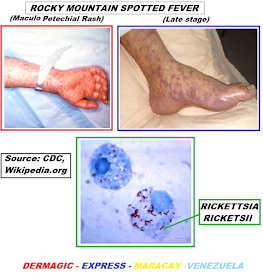
rocky

ABSTRACT

In this publication we bring you another disease caused by the bite of several TICKS; it is the ROCKY MOUNTAIN SPOTTED FEVER, which is caused by a bacterium called Rickettsia Rickettsii, and also another recently discovered the Rickettsia Parkeri. This disease, described since the 1900s, is disseminated in North America, from Canada to South America. The purpose of this publication is to know the main vectors of the disease, how it is transmitted, its symptoms, treatment and to give warning to the world once again that these parasites, ticks are the new plague of the 21st century.

Key words: Rocky Mountain Spotted Fever, spotted fever, Typhus by ticks, Black measles, Dermacentor Andersoni, Dermacentor Variabilis, Rhipicephalus Sanguineus, Rickettsia Rickettsii, Rickettsia Parkeri.

INTRODUCTION

Hello friends of the network, today DERMAGIC EXPRESS brings you another interesting topic about the TICKS and the diseases they transmit, in this case it is the ROCKY MOUNTAIN SPOTTED FEVER (RMSF), which as I said is transmitted by the a tick bite and disseminated not only in the United States, has also been described in the AMERICAS under the name of “Sao Paulo fever” or “Fever maculosa” in BRAZIL; In MEXICO “Spotted fever” and “tick Typhus” or “Tobia Fever” in COLOMBIA. Cases have also been described in Costa Rica and Panama. [1-5]

This disease is produced by the BACTERIA called Rickettsia Rickettsii; gram-negative intracellular cocobabicil considered the most pathogenic strain of the Western Hemisphere and a small part of the Eastern Hemisphere. It belongs to the Rickettsiaceae Family, Order: Rickettsiales, Class: Alphaproteobacteria, Domain: Bacteria, Genus: Rickettsia and species: Rickettsia rickettsii. The disease extends from CANADA to SOUTH AMERICA, and is the most frequent rickettisial disease in the United States. [6-11]
rocky4

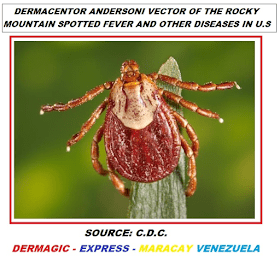
The main TICK transmitter of this bacterium are the ticks of the DERMACENTOR genus, Family Ixodidae, known as “HARD TICKS” which, in addition to transmit the Rickettsia rickettsii, are transmitters of other diseases such as: TICK PARALYSIS (neurotoxin); the POWASSAN virus (Powassan encephalitis); THE FEVER Q (Coxiella burnetii); ANAPLASMOSIS in cattle and humans (Anaplasma Marginale and Anaplasma spp.); TULAREMIA (Francisella tularensis) and the BABESIOSIS in  equine (piroplasmosis) and humans  (Babesia Caballi and Babesia spp.). [12-18]

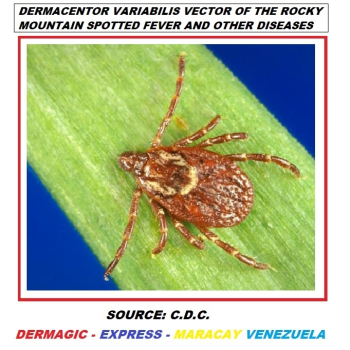
The DERMACENTOR genus of ticks belongs to the Ixodidae Family and has more than 34 described species and the most involved in the ROCKY MOUNTAIN SPOTTED FEVER are DERMACENTOR ANDERSONI (Rocky mountain tick) and DERMACENTOR VARIABILIS (American dog tick), second main vector causing this disease.
rocky1

Of this “hard tick” (DERMACENTOR VARIABILIS) I can say to you that in addition to transmit the ROCKY MOUNTAIN SPOTTED FEVER, it is transmitter of TULAREMIA (Francisella tularensis). They can also be carriers of the Anaplasma phagocytophilum that causes the HUMAN GRANULOCYTIC ANAPLASMOSIS, and Ehrlichia chaffeensis, causal agent of the HUMAN MONOCITIC EHRLICHIOSIS; and in addition they can produce TICK PARALYSIS when introduce a NEUROTOXIN when  are feeding with human blood.

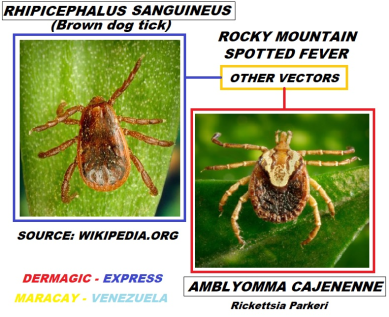
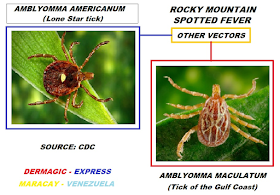
In addition to the DERMACENTOR VARIABILIS and ANDERSONI TICKS as vectors of the ROCKY MOUNTAIN SPOTTED FEVER (RMSF), other species have been described: RHIPICEPHALUS SANGUINEUS (brown tick of the dog), AMBLYOMMA CAJENNENSE (Cayena tick) which is disseminated in South and Central America, AMBLYOMMA AMERICANUM (Lone Star Tick) and AMBLYOMMA MACULATUM (Tick of the Gulf Coast) involved in the transmission of this disease. [1-22]
rocky2

On the other hand, it was discovered in the year 2002 and confirmed in 2013 another species of Rickettsia, the Rickettsia Parkeri in the tick AMBLYOMMA MACULATUM and recently in the tick AMBLYOMMA AMERICANUM capable also of transmit the ROCKY MOUNTAIN SPOTTED FEVER (RMSF).

In addition, it has been demonstrated in the tick DERMACENTOR VARIABILIS AND RETICULATUS antibodies against BORRELIA BURGORFERI which is the causal agent of the already described LYME DISEASE or ERITHEMA MIGRANS, but they are not considered vector of it.
rocky3
HISTORY

The disease ROCKY MOUNTAINS SPOTTED FEVER, is also known under the name “TYPHUS BY TICKS”, and “BLUE DISEASE” and was described in the years 1800 and 1900 in the Valleys of Montana United States, (US), known at that time as “Black measles” for its clinical characteristics. Later it was discovered that the ticks were the vector of the same one and it was in the year 1906, when the scientist Howard T. Ricketts discovered the causal agent, described as an agent “smaller than a bacterium and longer than a virus”; it was called RICKETTSIA RICKETSII in honor of its name. [22-30]

We must remember that Willy Burgdorfer is intimately linked to the ROCKY MOUNTAIN SPOTTED FEVER and study of the Rickettsias; In fact, between 1967 and 1978, he was investigating the Rickettisial Zoonoses in Egypt and then he was sent by the WHO (1976-1986 – World Health Organization) to Montana, United States, and in the course of his investigations he discovered the FEARED ESPIROCHETE BORRELIA, in the year 1981, which carries in its honor the surname BURGODERFERI.

These ticks are the NATURAL HOSTS and they serve as RESERVOIRS AND VECTORS, they transmit the RICKETTSIA through the bite to vertebrates mammals and man, and unlike other diseases they only need to be attached 2 hours to the skin to achieve the transmission of the disease, so that it is a ZOONOSIS, transmitted from animals to man. It can also be transmitted through fluids, tick feces and contaminated tissues of the same.

SYMPTOMS

Symptoms of the disease appear after an incubation period of 1 to 2 weeks, (can affect children and adults) and include threee stages:

1.) INITIAL phase: fever, headache, nausea, vomiting, loss of appetite, mumps,

2.) SECONDARY phase: characterized by maculous and petechial rash, abdominal pain, conjunctivitis and joint pain.

3.)  POSTERIOR or LATE stage: the  Rickettsia may invade the brain, heart, eyes, lungs, kidneys, gastrointestinal tract, and other organs causing definitive sequel such as: deafness, ataxia, blindness, and loss of bladder and bowel control; in extreme cases amputation of limbs by gangrene. Mortality in severe cases: 30-80%

The “CLASSICAL TRIAD” of this disease in terms of symptoms is: 1) FEVER, 2) MACULOUS AND PETECHIAL ERUPTION AND 3) THE PRECEDENT OF TICK BITE; it should be noted that only 35 to 60% of patients manifest the complete TRIAD, and 40% do not present the TYPICAL rash of the disease; it is presented in a centripetal form, from the extremities to the trunk. [1-32]

TREATMENT

The treatment of choice for THE ROCKY MOUNTAIN SPOTTED FEVER (RMSF) is the  DOXYCYCLINE (tetracycline antibiotic), the same used in the LYME disease and EHRLICHIOSIS, which is administered for a period of 10 to 14 days, and in some cases may be more longer. The other antibiotic that shows effectivity against Rickettsia is  the CHLORANPHENICOL, but this should be used with caution as it has many side effects.

With this I want to tell you in a simple way how seven (7) TICKS are capable of transmit nine (9) diseases:

Including the ticks of the Family ixodidae: IXODES SCAPULARIS or the black legged tick.

1) ROCKY MOUNTAIN SPOTTED FEVER (Rickettsia Rickettsii).

2) POWASSAN ENCEPHALITIS (Powassan virus, flavivirus).

3) TICK PARALYSIS (neurotoxin).

4) EHRLICHIOSIS (Ehrlichia chaffeensis, Ehrlichia ewingii).

5) HUMAN GRANULOCYTIC ANAPLASMOSIS (Anaplasma spp)

6) BABESIOSIS IN ANIMALS AND HUMANS (Babesia spp).

7) FEVER Q (Coxiella burnetti).

8) TULAREMIA (Francisella tularensis).

9) LYME DISEASE (Ixodes Scapularis). 1-32]

“… perhaps other diseases …. Today not well documented or simply man has not discovered yet.”

CONCLUSIONS

On the web you can find thousands of articles about the ROCKY MOUNTAIN SPOTTED FEVER, HISTORY AND SYMPTOMS, but for us the main objective of this publication is to make you UNDERSTAND the following:

1) These TIICKS are distributed practically in the entire PLANET.

2) Transmit parasitic diseases with risk of MORTALITY if the diagnosis and treatment is not made in time.

3) Some of the transmitted diseases are RESISTANT to treatment such as LYME disease, leaving permanent sequel in the body, being able to confine the patient to a wheelchair for life.

4) Apart from fighting for the human rights of the unassisted for diseases such as LYME, the final destination is to fight against the TICKS and their HOSTS.

5) THE CODES ICD-11 (International Classification of Diseases, year 2018) for this disease, Rocky Mountain Spotted Fever have been recognized by the World Health Organization (WHO) a long time ago, but  in some cases as the Lyme disease, the scientific society and affected population awaits its inclusion.

6) The new plague of the 21st century is not the mosquitoes (Dengue, Zika and Chikungunya), they are TICKS. [33-38]

… Humanity is not going to be extinguished by atomic bombs thrown into the air, atomic bombs walk in the earth attached to animals, mice, rats, birds, coyotes, deer, dogs, cats, cattle, goats, camel sheep, rabbits, etc, or the humans, feeding on his blood, contaminating and spreading vertiginously, slowly creating a incapacitated society … “

Greetings to all.

Dr. José Lapenta R Dermatologist
Dr. José M. Lapenta MD.
__________________

For more on RMSF:  https://madisonarealymesupportgroup.com/2017/10/21/mom-got-rocky-mountain-spotted-fever-while-picking-pumpkins/

https://madisonarealymesupportgroup.com/2015/08/13/severe-case-of-rmsf-had-to-remove-patients-arms-and-legs/

https://madisonarealymesupportgroup.com/2018/08/16/new-tick-causes-epidemic-of-rmsf/

https://madisonarealymesupportgroup.com/2018/06/12/georgia-mom-warns-others-after-son-contracts-rocky-mountain-spotted-fever-after-tick-bite/

https://madisonarealymesupportgroup.com/2018/08/19/monster-ticks-found-in-germany-threaten-europe-with-deadly-disease-crimean-congo-fever/  Please note the last quote of the story – that they proved a tropical form of tick typhus in one of tropical ticks found in Germany. Typhus, a bacteria, is making a comeback, particularly in the South. Common in the U.S. in the 40’s, and normally attributed to lice, now it’s been proven to be in a tick. In other words, another disease and a tick found where they supposedly shouldn’t be.
Typus is a rickettsial infection with ticks carring numerous species including rickettsia, ehrlichia, and anaplasma. Rocky Mountain Spotted Fever is also considered a tick-borne typhus fever. https://www.health.ny.gov/diseases/communicable/rocky_mountain_spotted_fever/fact_sheet.htm  Divided into the typhus group and the spotted fever group, disease is transmitted through ectoparasites (fleas, lice, mites, and ticks). Inhalation and inoculating conjunctiva with infectious material can also cause disease. The good news for most is that doxycycline is a front-line drug for it. Broad-spectrum antibiotics aren’t helpful.


Tickborne Relapsing Fever in Austin, TX

https://www.ncbi.nlm.nih.gov/pubmed/30160650

Emerg Infect Dis. 2018 Nov 17;24(11). doi: 10.3201/eid2411.172033. [Epub ahead of print]

Detection of Tickborne Relapsing Fever Spirochete, Austin, Texas, USA.

Abstract

In March 2017, a patient became febrile within 4 days after visiting a rustic conference center in Austin, Texas, USA, where Austin Public Health suspected an outbreak of tickborne relapsing fever a month earlier. Evaluation of a patient blood smear and molecular diagnostic assays identified Borrelia turicatae as the causative agent. We could not gain access to the property to collect ticks. Thus, we focused efforts at a nearby public park, <1 mile from the suspected exposure site. We trapped Ornithodoros turicata ticks from 2 locations in the park, and laboratory evaluation resulted in cultivation of 3 B. turicatae isolates. Multilocus sequencing of 3 chromosomal loci (flaB, rrs, and gyrB) indicated that the isolates were identical to those of B. turicatae 91E135 (a tick isolate) and BTE5EL (a human isolate). We identified the endemicity of O. turicata ticks and likely emergence of B. turicatae in this city.

_______________

**Comment**

For decades there has been complete denial of Lyme in the South.  Dr. Masters fought this tooth and nail:  https://madisonarealymesupportgroup.com/2017/10/06/remembering-dr-masters-the-rebel-for-lyme-patients-who-took-on-the-cdc-single-handedly/

https://madisonarealymesupportgroup.com/2018/05/31/no-lyme-in-the-south-guess-again/

https://madisonarealymesupportgroup.com/2016/10/25/hope-for-southerners/

https://madisonarealymesupportgroup.com/2018/08/18/lyme-found-in-all-50-states/

TBRF has been found in Austin, TX caves:  https://madisonarealymesupportgroup.com/2018/04/23/tick-borne-relapsing-fever-found-in-austin-texas-caves/

Thankfully more and more is coming out revealing that in fact these poor patients and the doctors who dare to treat them are not delusional but are in fact dealing with tick borne illness.  The Lyme-like illness that for all intents and purposes looks, smells, and acts just like Lyme, is caused by something that needs to be identified.  We need to quit focusing on the red herring of climate change and start identifying these bugs so people can get better.

Bartonella isn’t even on the radar yet it is a HUGE player:  https://madisonarealymesupportgroup.com/2016/12/29/cardinal-state-bartonella/

https://madisonarealymesupportgroup.com/2018/05/07/fox-news-bartonella-is-the-new-lyme-disease/

https://madisonarealymesupportgroup.com/2016/01/03/bartonella-treatment/  Various strains have been found in eye fluid, the heart (myocarditis and endocarditis), and cysts, and can infect by nearly anything puncturing the skin and exchanging bodily fluids – including needles. Evidence also suggests congenital transmission.…. Symptoms are largely associated with where the blood flow is compromised. The reason many have pain in the soles of their feet is due to inflammation caused by microvascular trauma. It has been known to cause cysts around dental roots leading to chronic and hard to diagnose head and face pain as well as root canals. This microvascular trauma is also to blame for brain issues causing psychological issues such as anxiety, anger, and suicidal thoughts, since the small vessel disease affects executive function. A cog is literally caught in the wheel. As neurotransmitters become depleted due to overstimulation, depression rears its ugly head. A vicious cycle ensues.  Due to the cyclical nature of Bartonella and that it exists in very low amounts in human blood, blood tests are unreliable. It also has a long division time between 22-24 hours and requires a special growth environment. There is a Triple Draw through Galaxy which collects blood over 8 days to maximize the test, stating a 90% reduction in false negatives.


FREE – Webinar on Ticks

https://register.gotowebinar.com/register/7750406180072174593  (register here)

New and Expanding Tick Threats to Schools

Tue, Sep 18, 2018 2:00 PM – 3:30 PM CDT, 3:00 – 4:00 p.m. ET, Live Q & A Afterward


Tick-tock the time is now. Tick season is just around the corner. EPA’s Center for Integrated Pest Management will host an informational webinar about ticks, their specific identification and how to monitor and control these pests.
Presenters will discuss tick-borne disease risk, general tick management issues that include considerations around pesticide application and integrating tick communication and action plans into current IPM management plans for schools. Register now!
Our Featured presenters:
* Susan Elias, M.S., Vector-borne Disease Ecologist, Maine Medical Center Research Institute
*Janis Hogan, BUS, RN, NCSN, School Nurse, Camden Hill Regional High School, Maine
*Larry Dapsis, M.S., Deer Tick Project Coordinator and Entomologist, Cape Cod Cooperative Extension
________________________
This webinar will prepare you to-
  •  Understand expansion history along with current and future projections of tick threats in specific geographic regions;
  • Identify ticks, successfully remove them and determine whether to test them;
  • Utilize trained staff, such as school nurses, to educate the school community about ticks and implement school IPM policies; and
  • Consider options for repelling ticks as it relates to personal protection or pesticide application. 

Miss a webinar? No problem! Most previously recorded webinars are available for on-demand viewing on EPA’s website:  <http://links.govdelivery.com:80/track?type=click&enid=ZWFzPTEmbXNpZD0mYXVpZD0mbWFpbGluZ2lkPTIwMTgwOTExLjk0NzM5ODAxJm1lc3NhZ2VpZD1NREItUFJELUJVTC0yMDE4MDkxMS45NDczOTgwMSZkYXRhYmFzZWlkPTEwMDEmc2VyaWFsPTE3MzAyMjM0JmVtYWlsaWQ9bGVtb24uamVubmlmZXJAZXBhLmdvdiZ1c2VyaWQ9bGVtb24uamVubmlmZXJAZXBhLmdvdiZ0YXJnZXRpZD0mZmw9Jm12aWQ9JmV4dHJhPSYmJg==&&&102&&&https://www.epa.gov/managing-pests-schools>.

Questions? If you have any questions about the IPM guidance or upcoming trainings and webinars, please contact us at school.ipm@epa.gov<mailto:school.ipm@epa.gov>.


EPA is committed to protecting the privacy and security of the information it holds. By clicking the “Register” button you agree to receive emails from EPA regarding this webinar. In addition, you consent to allow EPA to use your information, in aggregate, to report on webinar attendance and participant demographics. EPA will not share your information with any outside entities.


Three Surprising Things I Learned About Asian Longhorned Ticks – The Tick Guy, Tom Mather

https://tickencounter.org/tick_notes/three_surprising_things

Three SURPRISING Things I Learned About Asian Longhorned Ticks

By Tom Mather

Late in the evening Sunday August 12. Only 4 more TickSpotters pictures left to look at today. But wait, what’s THAT one. This TickSpotter had sent in something different; a simple picture of a suspicious-looking tick found on their dog after a walk earlier that day in a Staten Island (NY) park. Definitely genus Haemaphysalis, but which one of the 3 possible species: one mainly feeds on rabbits, one on birds, and the third is a presumably still rare but recently recognized exotic invader from Asia – the longhorned tick. It couldn’t be that one, could it? Well, maybe. We emailed the submitter about the possibilities and asked them to mail the tick in to the lab for a closer examination. They did. It was!! The Asian longhorned tick. It was my first.

Since then, TickSpotters have sent additional suspicious-looking ticks — from Somerville NJ, Harrison NY, Front Royal VA, Newtown PA…a bit unprecedented. Our TickSpotters crowd-sourced survey only had 3 Haemaphysalis spp. submissions over the past 2 years, presumably the rabbit type, yet here were 5 in just 3 weeks. It was late in the summer of 2018 and something new was happening in the world of ticks…and I thought to myself “this TickGuy needs to know more”. That’s when the idea of a field trip popped into my head—”let’s go find some longhorned ticks.”

After securing the probable tick encounter location on Staten Island, ITM project manager Steve and I headed south. We arrived at our destination early; it was going to be a hot day. Vials and tweezers in hand, we hurriedly unfurled our tick flag and drag, and within 20 feet of getting out of the car, pretty much still in the parking lot, our drag was already covered with microscopic tick larvae. “These must be Lone Stars”, I boldly announced. “We’ll collect some and check under the microscope later;” we needed to keep moving if we hoped to encounter those rare longicornus ticks.

But it was only one more short pull of the drag when Steve announced, “I think I have one”! It was, but it was weird. This one was a partially-engorged female tick. You don’t usually collect partially-engorged ticks on a tick drag. We were just fifty feet from the car, and less than 5 minutes into our longhorned tick collecting field trip; and it all just seemed, well, strange. I now had no idea what to expect next…but, boy was this FUN!

Soon we were joined by post-doc Maria Pilar, a graceful Argentinian scholar working with Maria Diuk-Wasser at Columbia on a project to better understand where, how and why people encounter ticks. She’d been working the Staten Island parks and backyards all summer – and had become a bit of a longicornus expert. Or at least a more experienced collector than Steve and me. Good to have her with us. We turned off the main path and onto a narrow trail into the woods. Still getting more larvae and an occasional larger tick, too. But now it felt more like the hunt was on.


In a few minutes, we emerged onto a wider grassy path with shady edges. This would become our classroom for the rest of the morning, a one hundred meter stretch of various grasses and shrubs. We were picking up more ticks now—mostly adult females, 4,5,6 … they were starting to accumulate in my collecting vial. They seemed to prefer shade over sun but then I spotted one questing on a stem right along the edge of the path about a foot from ground level, head pointing down. A curious questing pose; American dog ticks tend to quest head up. This one turned quickly to climb a little higher on the stick, it’s front pair of legs outstretched in hopeful anticipation that I might come closer. After that one, I started to look more closely.

That’s when a dark patch on a grass seed-head caught my eye. Most people would have thought they were seeds. But this was my first big surprise of the day, and something Pilar and Steve had never seen either; these were larval ticks — 50, 75, 150 – motionless, tightly clumped, seemingly knitted together almost like the overlapping scales on a snake, but tiny. And once we saw a few of these clumps, we started seeing them everywhere. In certain grassy patches there would be one every couple of feet—each of these likely the product of a single female egg batch. I thought,

“this is not a rare tick, at least not here.”

Surprise #1: Longicornus larvae hang out together on the tips of grasses, but like a bomb, they explode when something brushes by.

Even though I had spotted the adult female, and the larvae clumps, it seems my eyes aren’t what they used to be. As I was picking larger-than-larvae nymph stage ticks off of the flag, I tried separating what I thought were nympal Lone Star ticks from what I thought were nymph longhorned ticks. I even put them into separate vials. It seemed that I had collected twice as many Lone Stars than longhorned nymphs but when I checked under the microscope, I had some re-sorting to do, and as it turned out I had collected about equal numbers of both types of nymphs. Lone Star nymphs were still the fastest moving ticks but when they’re sitting still you really have to look hard at the mouthparts to tell them apart.

Surprise #2 – Without magnification, nymphal Asian longhorned ticks look very similar to nymphal Lone Star ticks.

Nymphs — Left: Asian longhorned tick, Right: Long Star tick
But my biggest surprise of the day was in witnessing first hand just how extensive this infestation appears to have become in presumably a fairly short period of time. First recognized just about one year ago on a single sheep at a single location in New Jersey, now we were wandering about one of several fairly extensive parks on Staten Island surrounded by a massive residential community in one of the most densely urban settings in the United States. We were passing dog walkers and day hikers all pretty much minding their own business and completely unaware of what we were finding. But what we were finding was all three active life stages of this longicornus tick…pretty much everywhere we looked. The edge of the parking lot, along walking trails, in the woods.
Surprise #3 – Asian longhorned ticks are way more established than I expected to find.
We know this tick is a little different than the ones we’re more familiar with – like, it doesn’t need a male to fertilize its eggs. There’s so much we don’t know though, like will it readily feed on humans and pets, what germs might it carry and transmit, will it be susceptible to tick prevention products? We had started the day wondering if we would find anything on our field trip, and in only 6 hours finished the day just wondering. Looks like we have a new tick, now found in 9 states, but from what we learned on this one field trip, that’s not likely to be where the reach of this tick stops, or where this story ends either.

______________

For more:  https://madisonarealymesupportgroup.com/2018/07/19/rutgers-racing-to-contain-asian-longhorned-tick/

https://madisonarealymesupportgroup.com/2018/08/08/an-invasive-new-tick-is-spreading-in-the-u-s/

https://madisonarealymesupportgroup.com/2018/08/30/experts-still-worried-about-this-new-tick-since-it-doesnt-carry-lyme-disease-yet/

Here’s a home video of a female Asian Longhorn tick by Gloria Kim, a NJ resident: