Archive for the ‘Lyme’ Category

HHS Releases Vector-borne Disease National Strategy

https://www.lymedisease.org/hhs-vector-borne-disease-strategy/

HHS releases vector-borne disease national strategy

The U.S. Department of Health and Human Services has released the National Public Health Strategy to Prevent and Control Vector-Borne Diseases in People (VBD National Strategy).

As directed by the 2019 Kay Hagan Tick Act—named after the U.S. Senator who died due to complications from a tickborne illness—HHS led a four-year process with civilian agencies and defense departments to deliver this strategy.

Co-led by the HHS Office of the Assistant Secretary for Health and the Centers for Disease Control and Prevention, the strategy identifies and describes federal priorities to detect, prevent, respond to, and control diseases and conditions caused by vectors in the United States.

This VBD National Strategy represents the largest formal federal coordination effort focused on vector-borne disease prevention and control with contributions by over 50 representatives across 17 federal agencies. This collaborative effort will help

  • Address the significant public health challenges related to vector-borne diseases;
  • Incorporate a One Health approach to enhance coordination and communication across human, animal, and environmental areas; and
  • Reverse the upward trends in illness, suffering, and death.

Growing Problem of Vector-Borne Diseases

Vectors—biting insects and arachnids like mosquitoes, ticks, fleas, and lice—can spread germs that make people sick. These diseases are major causes of death and illness worldwide, and they increasingly threaten the health and well-being of people in the United States.

Diseases and conditions spread by vectors include Lyme diseaseZika virusWest Nile virusdenguemalariaplagueRocky Mountain spotted fever, and alpha-gal syndrome.

According to CDC, reported cases of these diseases doubled over the last two decades. Due to shifting land use patterns, global travel and trade, and a changing climate, the threat of existing and emerging vector-borne diseases continues to grow.

As geographic ranges of vectors expand, the number of pathogens spread by vectors continues to climb—yet only one vaccine is available to protect people against almost 20 domestic threats.

Goals of the Vector-Borne Disease National Strategy

The rising public health threat of vector-borne diseases requires a comprehensive and sustained national effort to protect people. In 2020, the U.S. government published a framework responding to this need, titled A National Public Health Framework for the Prevention and Control of Vector-Borne Diseases in Humans (Framework). A consortium expanded the Framework into this comprehensive strategy.

As stipulated in the Kay Hagan Tick Act, HHS and CDC consulted the Tick-Borne Disease Working Group while developing the interagency strategy. The strategy incorporates recommendations from the now sunset Working Group.

In addition to identifying challenges and opportunities to enhance the prevention and control of vector-borne diseases, the strategy lays out an ambitious national public health approach to develop diagnostics, drugs, and treatments for coexisting conditions. Although critical to public health and wellness, clinical and healthcare services, access to care, legal protections, and reimbursement or payment for clinical services are outside the scope of this strategy.

Implementing the VBD National Strategy

The federal government envisions a nation where vector-borne diseases no longer threaten the health and well-being of people. Agencies and departments are proactively working to protect people from illness, suffering, and death due to vector-borne diseases by

  • Better understanding when, where, and how people are exposed to and get sick or die;
  • Developing, evaluating, and improving tools, methods, and guidance to diagnose diseases and their pathogens;
  • Developing, evaluating, and improving tools, methods, and guidance to prevent and control disease;
  • Developing and assessing drugs and treatment strategies; and
  • Disseminating and implementing public health tools, programs, and collaborations to prevent, detect, diagnose, and respond to threats.

Federal Government to Develop New Approaches to the Threat

Vector-borne diseases are a global threat, with national security, economic, and health implications for the United States. As the federal government continues to proactively strengthen its response to this threat, HHS and CDC plan to develop future iterations of the VBD National Strategy with opportunities for public engagement.

Read the VBD National Strategy.

SOURCE: US Department of Health and Human Services

______________

**Comment**

It’s quite easy to see where this is going.

  1. They emphasize there’s only 1 vaccine. Vaccines are the only thing these people care about because they are big business and quite lucrative.
  2. Despite more and more experts defying the climate narrative, and proof that the entire paradigm is corrupt, and being used for a much bigger agenda, it is mentioned here because it too is big business and quite lucrative.
  3. While the article mentions diagnostics, drugs, and treatments for coexisting conditions – they won’t lift a finger regarding Lyme/MSIDS, unless it’s a vaccine.  No money in these other things.
  4. The buzz word of the day – ‘One Health’ has been hijacked by the corrupt WHO as an ultimate power grab, which would give them unlimited control over humans, animals, and the environment.
  5. Similarly to the completely unobtainable goal of a ZERO COVID policy, the federal government’s vision of a nation where vector-borne diseases no longer threaten the health and well-being of people is seriously a joke.
  6. The mention that vector borne diseases are a national security threat is code for: we are going to keep working on vector bioweapons.
Again, the only thing the HHS is going to release is a lot of hot air.

It is not going to do ONE thing to help the plight of Lyme/MSIDS patients. It will gladly spend even more of our tax-dollars to do yet more worthless research showing the same things they’ve been showing for 40 years.


Peripheral Neuropathy Evaluation & Repair in Lyme Disease

https://www.treatlyme.net/guide/neuropathy-repair-heal-that-tingling-numbness-pain

Updated: 4/24/2023

Neuropathy in Lyme Disease

In chronic Lyme disease it is common to have nerve injury in locations outside of the brain and spinal cord – also called peripheral neuropathy. Common symptoms of peripheral neuropathy include:

  • numbness,
  • burning sensations,
  • and/or sharp, stabbing or electric feelings.

In this article Marty Ross MD reviews:

  • laboratory evaluation of neuropathy in chronic Lyme disease and a functional medicine approach to remove nerve insults and to repair nerve injury.

Neuropathy Laboratory Evaluation

A basic laboratory evaluation of neuropathy may include:

  • Vitamin B6 (too much Vitamin B6 causes neuropathy)
  • Vitamin B12 (low Vitamin B12 causes neuropathy)
  • Vt D3 (levels around 40 ng/ml to 80ng/ml support healthy nerve function)
  • CBC
  • CMP (evaluation of kidney and liver function)
  • TSH, Free T3, and Free T4 (evaluate for low or high thyroid function)
  • TTG-IgA & EMA (for possible celiac disease)
  • heavy metal urine testing (see the end of the article for when to do this)

(See link for video and article)

_______________

For more:

Neuropathy Laboratory Evaluation

A basic laboratory evaluation of neuropathy may include:

  • Vitamin B6 (too much Vitamin B6 causes neuropathy)
  • Vitamin B12 (low Vitamin B12 causes neuropathy)
  • Vt D3 (levels around 40 ng/ml to 80ng/ml support healthy nerve function)
  • CBC
  • CMP (evaluation of kidney and liver function)
  • TSH, Free T3, and Free T4 (evaluate for low or high thyroid function)
  • TTG-IgA & EMA (for possible celiac disease)
  • heavy metal urine testing (see the end of the article for when to do this)

Functional Medicine Neuropathy Repair

Steps to repair nerve injury include:

removing the nerve insults

  • correcting abnormal labs including thyroid, Vitamin D, Vitamin B6, and Vitamin B12
  • stopping RX meds that may cause neuropathy
  • treating infections
  • correcting mold toxicity

repairing the nerve damage

  • repairing nerve cell and mitochondria power plant membranes,
  • increasing the master cell repair antioxidant glutathione,
  • increasing the nutrient Coenzyme Q10 (CoQ10)
  • taking acetyl-l-carnitine if you do not eat red meat,
  • decreasing inflammation, and
  • using the peptide BPC-157.

Lyme-Induced Cardiac Problems Persist Despite Antibiotic Treatment

https://danielcameronmd.com/lyme-cardiac-antibiotic-treatment/

LYME-INDUCED CARDIAC PROBLEMS PERSIST DESPITE ANTIBIOTIC TREATMENT

lyme-cardiac

In their article, “An Unusual Presentation of Lyme Carditis and Adenosine-Sensitive Atrioventricular Block,” Alexandre and colleagues present the case of a 20-year-old female with Lyme disease and cardiac manifestations, who continued to experience cardiac problems despite 4 weeks of antibiotic treatment. [1]

The young woman was admitted to the emergency department with acute pleuritic chest pain and shortness of breath. (Pleuritic chest pain is characterized by sudden and intense sharp, stabbing, or burning pain in the chest when inhaling and exhaling.)

The woman exhibited only mild tachycardia (100/min). However, “Considering the suspicion of acute myocarditis, the patient was admitted to an intensive cardiac care unit,” the authors state.

During hospitalization, cardiac monitoring revealed several asymptomatic episodes of paroxysmal AV block, including second-degree Mobitz I AV block, second degree AV block, and high-grade AV block.

Although there was no evidence of tick exposure or skin lesions, clinicians ordered testing for Lyme disease, which was positive by Western blot. “… an IgM Western-Blot test was performed, confirming positivity and recent Borrelia spp. infection.”

The patient was diagnosed with Lyme disease with cardiac manifestations of high-grade AV block. She was treated with a 4-week course of IV ceftriaxone, which led to a complete resolution of chest pain and shortness of breath.

However, the AV conduction disturbance continued after 4 weeks of antibiotic treatment. And subsequently, the woman was given an alternative diagnosis of extrinsic idiopathic paroxysmal AV block (“adenosine-sensitive AV block”).

This could be an extremely rare course of Lyme carditis, or the patient may have had asymptomatic AV conduction problems that surfaced when she developed Lyme disease, according to the authors.

“The patient was started on theophylline 400 mg twice daily, and after one week of treatment, the Holter monitoring demonstrated a significant reduction in AV conduction disturbances,” the authors state.

At her 18-month follow-up appointment, the woman continued to have fewer AV conduction disturbances, no cardiac complaints, and no need for a permanent pacemaker.

Authors conclude:

“This case illustrates a challenging scenario of [Lyme carditis] with high grade AV block, which persisted after appropriate antibiotic treatment and had key features supporting the diagnosis of extrinsic idiopathic paroxysmal AV block (‘adenosine sensitive AV block’).

References:
  1. Alexandre A, Ribeiro D, Sousa MJ, Reis H, Silveira J, Torres S. An Unusual Presentation of Lyme Carditis and Adenosine-Sensitive Atrioventricular Block. Arq Bras Cardiol. 2024 Jan;121(1):e20230228. Portuguese, English. doi: 10.36660/abc.20230228. PMID: 38324857.

For more:

Superior Efficacy of Combination Antibiotics Therapy Versus Monotherapy For Lyme Disease in Mouse Model

https://www.frontiersin.org/journals/microbiology/articles/10.3389/fmicb.2023.1293300/full

Front. Microbiol., 20 November 2023
Sec. Infectious Agents and Disease
This article is part of the Research TopicInsights in Infectious Agents and Disease: 2023View all 11 articles

Superior efficacy of combination antibiotic therapy versus monotherapy in a mouse model of Lyme disease

Yasir Alruwaili1,2,3Mary B. Jacobs2Nicole R. Hasenkampf2Amanda C. Tardo2Celine E. McDaniel2Monica E. Embers2,3*

Lyme disease (LD) results from the most prevalent tick-borne infection in North America, with over 476,000 estimated cases annually. The disease is caused by Borrelia burgdorferi (Bb) sensu lato which transmits through the bite of Ixodid ticks. Most cases treated soon after infection are resolved by a short course of oral antibiotics. However, 10–20% of patients experience chronic symptoms because of delayed or incomplete treatment, a condition called Post-Treatment Lyme Disease (PTLD). Some Bb persists in PTLD patients after the initial course of antibiotics and an effective treatment to eradicate the persistent Bb is needed. Other organisms that cause persistent infections, such as M. tuberculosis, are cleared using a combination of therapies rather than monotherapy. A group of Food and Drug Administration (FDA)-approved drugs previously shown to be efficacious against Bb in vitro were used in monotherapy or in combination in mice infected with Bb. Different methods of detection were used to assess the efficacy of the treatments in the infected mice including culture, xenodiagnosis, and molecular techniques. None of the monotherapies eradicated persistent Bb. However,

  • 4 dual combinations (doxycycline + ceftriaxone, dapsone + rifampicin, dapsone + clofazimine, doxycycline + cefotaxime)
  • 3 triple combinations (doxycycline + ceftriaxone+ carbomycin, doxycycline + cefotaxime+ loratadine, dapsone+ rifampicin+ clofazimine) eradicated persistent Bb infections.

These results suggest that combination therapy should be investigated in preclinical studies for treating human Lyme disease.

________________

**Comment**

This research demonstrates clearly why many do not get better.  Mainstream doctors are still in the Dark Ages regarding all things Lyme/MSIDS and treat with the antiquated and unscientific IDSA Lyme Guidelines which have never worked and never will.

For more:

Neurological & Cognitive Issues From Lyme Podcast

https://www.lymedisease.org/podcast-shelley-ball-neurological-lyme/

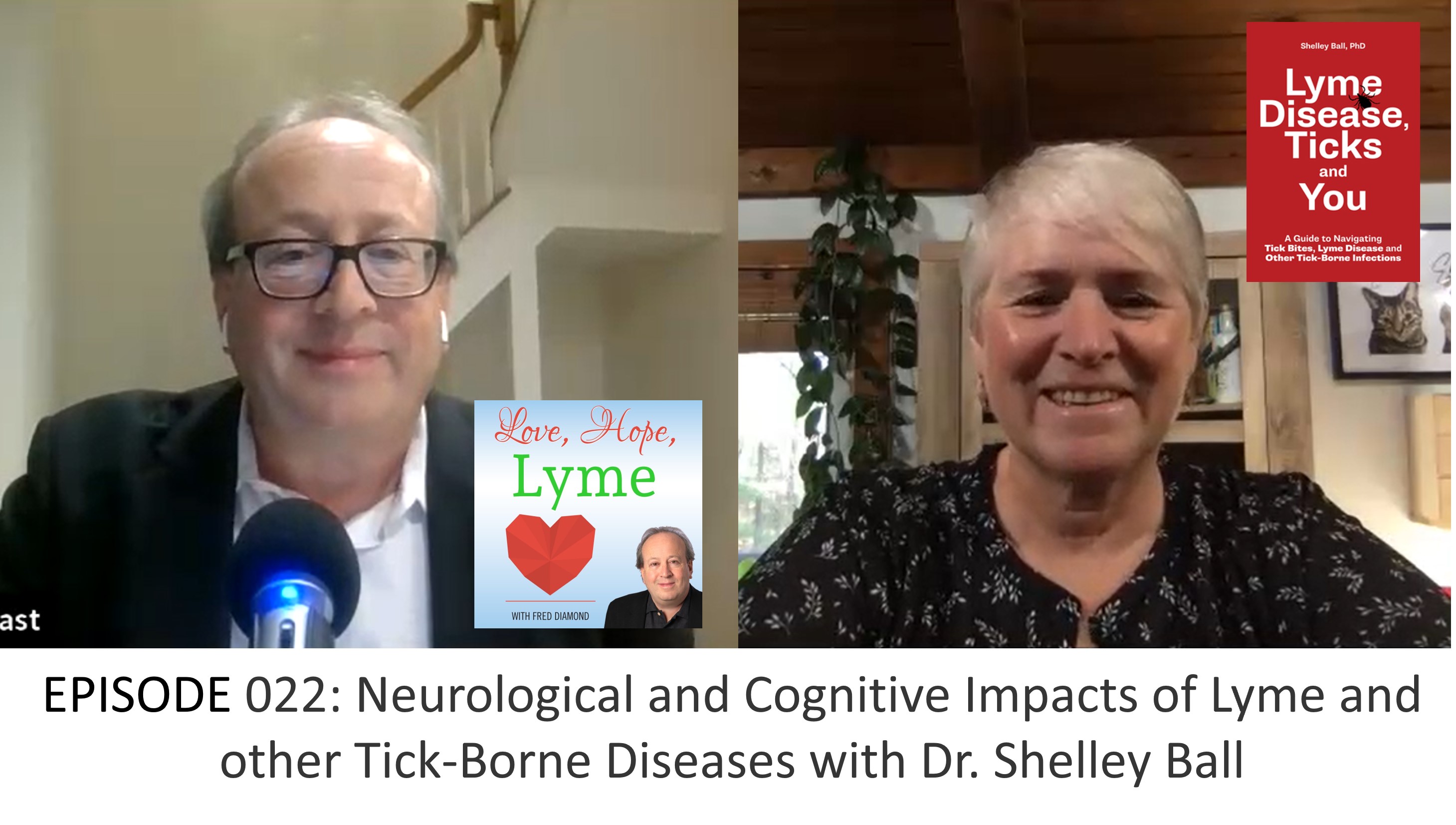
PODCAST: Neurological and cognitive issues from Lyme

By Fred Diamond

On this week’s Love, Hope, Lyme podcast, biologist and Lyme survivor Dr. Shelley Ball and I discussed neurological and cognitive issues that are common with persistent Lyme disease.

There’s a chapter on neurological issues in my book Love, Hope, Lyme: What Family Members, Partners, and Friends Who Love a Chronic Lyme Survivor Need to Know. I wrote the book to understand what someone in my life with persistent Lyme was going through. Since the neurological issues concerning Lyme are so personal and potentially extreme, the chapter is intentionally light.

Shelley lives in Westport, Ontario, Canada, an area endemic for Lyme, Anaplasma and Babesia. A biologist by trade, she spent a lot of time outdoors doing field work around the world. In addition to Lyme and Bartonella, she also has Babesia odocoilei, which has been shown to be treatment resistant and contributes to “brain on fire” symptoms as well.

After she was diagnosed with Lyme, she dove into researching the disease to understand what was happening to her. She wrote her book Lyme Disease, Ticks and You: A Guide to Navigating Tick Bites, Lyme Disease and Other Tick-Borne Infections to make what she learned more accessible and less complex to the typical Lyme survivor.

Neurological and Cognitive Symptoms

“Neurological symptoms are very challenging,” she said. “I went for several months where I could barely read, which is hard when you must keep working. The brain issues were the biggest for me such as short-term memory loss. When I was in the thick of treatment, I’d be standing in front of somebody I’d known for years, and I couldn’t remember their name.”

She continued, “Executive functions such as just being able to pay your bills, plan your work, stay on schedule, is challenging. It forces you to try to find aids and little tricks and things that you can do to support yourself. They’re essentially like pre-dementia symptoms. Psychiatric issues, which are a huge part of this, can often lead to personality changes.”

She explained that these infections can cross the blood-brain barrier and cause massive inflammation, so you can end up with a permanently inflamed brain.

“We’re essentially suffering from a brain autoimmune issue where your own immune system essentially is attacking your own brain. It’s especially challenging because there are few good treatments for autoimmune conditions. Usually, it’s steroids and similar things. Those are some of the worst things that you can take if you’ve got chronic tick-borne infections.

“You feel this rage rise in you, and you have no control over it. Your brain is inflamed. This is not something that you’re doing. It is happening to you. You literally must find a way to almost step away and manage it when these things flare out.

“Your personality changes,” she continued, “Not only do the people around you see it, but you see it in yourself. You go through a grief period where you grieve for the person that you were, both mentally and in your personality, but also physically, because you’re just not capable of doing the activities that you used to do. These are very tough issues to deal with and sometimes it drives people away.”

Challenges to Treating Neurological Symptoms

Most chronic Lyme survivors struggle with pain, but the neurological issues can be the most challenging.

Shelley said, “There are so many aspects to it. There’s the direct impact on brain tissue, there’s the inflammation, there’s the autoimmunity and the immune component of it. You’re trying to deal with all these things. One of the keys is to try to get that inflammation down.”

“I’ve had some fascinating conversations with other Lyme patients about treatment, because we’ll often have flare-ups, and a lot of people will turn back to antibiotics to manage those flare-ups. They think that maybe those insistent Lyme bacteria have flared up and turned back into spirochetes and we’re back into an active infection.”

Shelley said, “There are other challenges to treatment. One is the isolation of the disease. Lyme patients especially experience this because we are gaslighted by the medical system that we reach out to, to try to regain our health. There is some initial empathy, compassion, and support, but that dwindles. Then you realize that you are very much on your own suffering in silence.”

She said that if you read the science, when the body becomes inflamed, that inflammation overstimulates your brain and puts you into permanent fight or flight mode. This is known as sympathetic dominance or sympathetic overdrive. Interestingly, it stimulates more inflammation. Then you get stuck in this positive feedback loop of inflammation. What it comes down to is trying to break that cycle of inflammation.

On the podcast, she discusses botanicals and neuro-retraining techniques that might be helpful.

Final Thoughts

I asked for her recommendations for how to live a higher quality life while still dealing with Lyme.

Try to find ways to find joy. Lyme patients do a lot of grieving. We’ve lost our physical capabilities; we’ve lost our cognitive abilities. We’ve lost our old personality. Sometimes we lose people in our life who just can’t stay there to support us. I don’t believe in toxic positivity, but gratitude is important to focus on what we do have.”

She offered, “I empathize because this really is a shared disease in the sense that even if our loved ones don’t understand what we’re going through, it impacts them. Stay the course. It’s hellish, to be honest. It’s also an iceberg effect where you will probably only see the tip of the suffering that people are going through with these diseases.”

Click here to listen to all episodes of the Love, Hope, Lyme Podcast or on YouTube.

Fred Diamond is based in Fairfax, Virginia and can be contacted via Facebook. His book Love, Hope, Lyme: What Family Members, Partners, and Friends Who Love a Chronic Lyme Survivor Need to Know is available on Amazon. The e-version of the book is always free to Lyme survivors. Send Fred a private message on Facebook for your copy.

______________

**Comment**

Great information.

For more: