Archive for the ‘Lyme’ Category

Jacksonville Family Shares Daughter’s 9-Month Diagnosis of Rare Disease Which Isn’t Rare (Lyme)

https://www.actionnewsjax.com/news/local/jacksonville-family-shares-daughters-9-month-diagnosis-to-lyme-disease/929972299  News Video here

Jacksonville family shares daughter’s 9 month diagnosis of rare disease

By: Brittney Verner , Action News Jax

Updated:

A local mom whose daughter was diagnosed with a rare disease is now warning other parents to be on the lookout if their kids have the same symptoms.

Cynthia Donalson said it took them almost 9 months to find out their daughter was diagnosed with Lyme disease.

Donalson said for almost a year her daughter Anna who’s now 14 has been fighting to live a normal and healthier life.

“She had suffered off and on with stomach issues. She went from being 117 pounds to 104 pounds,” Donalson.

She said it started last March and that’s when they started to seek medical attention.

“She saw a gastroenterologist at Wolfson‘s had several trips to the emergency room. They tried everything and could not find anything,” Donalson said.

She said by the end of the summer she was 85 pounds. Last December a doctor diagnosed Anna with Lyme disease. The disease is caused by bacteria and is transmitted through a bite from an animal or insect.

“It was horrible to watch because she was basically disintegrating in front of me,” Donalson said.

Anna said it’s unclear where she got Lyme disease but she spent a lot of time at soccer fields diving in dirt and she believes she could have been bitten unknowingly.

Dr. Aylin Ozdemir, who is a pediatric integrative medicine doctor diagnosed Anna. Ozdemir said Lyme disease can often be difficult to diagnose.

“In many cases patients don’t even remember a tick bite so then they become patients with a myriad of symptoms, then somebody needs to connect the dots. Even the Centers for Disease Control and Infectious Disease Society of America confirms that we don’t have a good sterile-logical blood marker to diagnose Lyme disease and they fall short,” Ozdemir said.

The disease is curable and Donalson is warning other parents whose kids may have similar symptoms not to give up until they find a solution.

The Center for Disease and Control said, “People treated with appropriate antibiotics in the early stages of Lyme disease usually recover rapidly and completely.”

“Pursue, don’t give up, keep looking for help,” Donalson said.

___________________

**Comment**

Where to even begin…..

  1. Lyme IS NOT RARE!  It is twice as common as breast cancer and six times more common than HIV/AIDS.  https://www.lymedisease.org/mylymedata-lyme-disease-prevalence/.
  2. Regarding Lyme disease being curable, research has shown treatment failures since the beginning of time:  https://madisonarealymesupportgroup.com/2019/02/22/why-mainstream-lyme-msids-research-remains-in-the-dark-ages/
  3. When the CDC reports numbers they are “only talking about INCIDENCE of Lyme disease — the number of new cases each year. What about prevalence of Lyme disease — the number of people who remain ill over time?  The chart below shows Lyme disease prevalence based on the annual incidence of the disease using different assumptions about treatment failure rates. Patients diagnosed and treated early generally respond well to treatment. However, treatment failures ranging from 10-35% have been reported in early disease and higher rates are reported for late disease.”  https://www.lymedisease.org/mylymedata-lyme-disease-prevalence/.

    Chronic Lyme Disease is a big problem
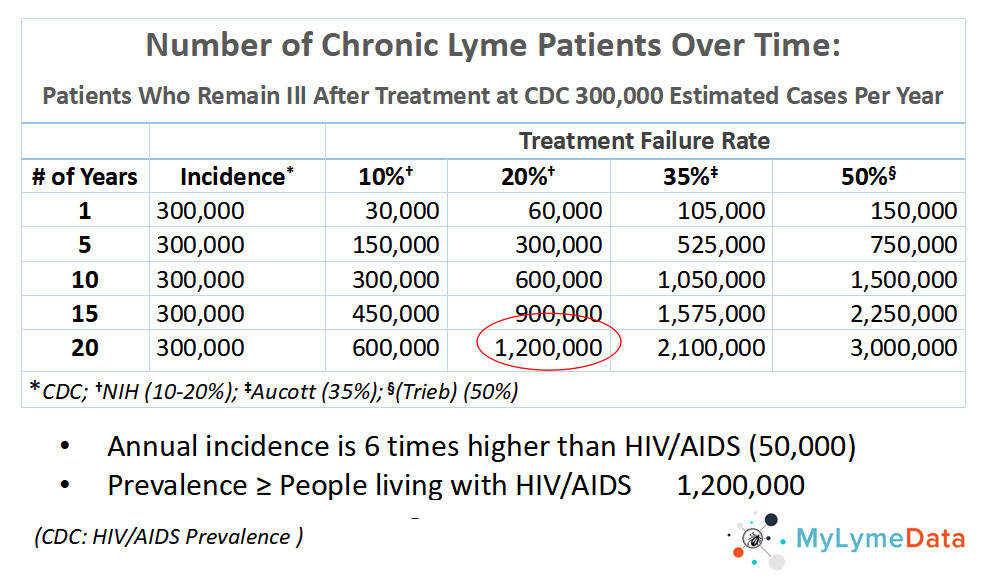
    Lyme disease prevalence cases over time

  4. Regarding soccer fields, a research team has discovered the best place to find ticks is along the edges of soccer fields with woodlines, i.e. virtually every soccer field in Wisconsin: https://madisonarealymesupportgroup.com/2019/03/06/alumnus-works-to-protect-people-from-west-nile-virus-lyme-disease/
  5. “Late stage” Lyme can occur within two weeks after tick bite.  Bob Giguere of IGeneX told our support group the story of a little girl who developed facial palsy and lost the ability to walk & talk within 4-6 hours of tick bite (2).  Whether or not you label that escalating case “late stage” or not, the infection was able to cross the blood brain barrier and cause severe symptoms in short order.  https://madisonarealymesupportgroup.com/2019/02/22/why-mainstream-lyme-msids-research-remains-in-the-dark-ages/
  6. FWY:  Lyme is alive and well in the South and it’s been there a long time:  https://madisonarealymesupportgroup.com/2018/05/31/no-lyme-in-the-south-guess-again/.  Dr. Masters fought tooth and nail to get Lyme recognized in the South:   https://madisonarealymesupportgroup.com/2017/10/06/remembering-dr-masters-the-rebel-for-lyme-patients-who-took-on-the-cdc-single-handedly/  (This happened in the late 80’s!)
  7. I had to flip back to the date of this article just to make sure my eyes read that this was written this month and in the year 2019.  Wow! is all I can say….

Lyme Disease Study Raises Possibility of Mother-to-Baby Transmission

https://www.thechronicleherald.ca/news/local/lyme-disease-can-cause-pregnancy-complications-study-292577/

Lyme disease study raises possibility of mother-to-baby transmission

 A female blacklegged tick is embedded in a human arm. A new study says that a developing fetus can be harmed if the mother has Lyme disease. - Public Health Agency of Canada
A female blacklegged tick is embedded in a human arm. A new study says that a developing fetus can be harmed if the mother has Lyme disease. – Public Health Agency of Canada

A scientist who co-authored a recent Public Health Agency of Canada study on the impact of Lyme disease during pregnancy says the illness can have fatal consequences for a developing fetus if the mother goes untreated.

“Miscarriage, newborn death, and newborns with respiratory problems or jaundice have been found to occur,” said American epidemiologist Alison Hinckley.

But the Centers for Disease Control and Prevention scientist says more research is needed to show a definitive link between Lyme disease and pregnancy complications, including whether the tick-borne illness can be passed from mother to baby in the womb.

Hinckley and four Public Health Agency of Canada scientists authored a recent report that reviewed 59 cases of pregnant mothers carrying Lyme disease and their pregnancy outcomes. The results were published in the November 2018 peer-reviewed science journal PLOS One, showing that 36 of the 59 fetuses had been harmed. Complications ranged from miscarriage and stillbirth to congenital abnormalities, respiratory distress and heart abnormalities.

“It is clear, however, that pregnant women who suspect that they might have contracted Lyme disease should see their health-care provider as quickly as possible to receive appropriate treatment and reduce the chance of poor fetal outcomes,” said Hinckley.

PHAC denied requests from the Herald to speak with any of the agency’s four scientists that coauthored the study. The Herald contacted the study’s lead author Lisa A. Waddell by email and phone but did not get a response.

The question remains, why do pregnant mothers with untreated Lyme disease risk harming their unborn baby?

Determining cause

The authors of the systematic review failed to provide a specific cause for any of the 36 pregnancies resulting in harm to the fetus, nor could they definitively say whether Lyme disease factored in any of the congenital malformations. The study couldn’t rule out transplacental transmission, that the bacteria causing Lyme disease, B. burgdorferi, could be passed from mother to baby in utero.

“It is biologically plausible that transplacental transmission of B. burgdorferi occurs given our understanding of transplacental spirochete transmission for other species of spirochetes (T. pallidum) in humans,” said the study. “However, the evidence in this systematic review on congenital malformations does not provide sufficient evidence to exclude or confirm a role for B. burgdorferi in congenital malformations.”

The study calls for more research to settle the debate.

But the topic of in utero transmission of Lyme disease is not new and cases of it have been documented over the decades. As far back as 30 years ago the federal Department of Health acknowledged it as a legitimate form of transmission, stating in a June 1988 Canada Diseases Weekly Report that,

“Transplacental transmission of B. burgdoferi has been documented and may be associated with an increased risk of adverse pregnancy outcome.”

That it occurs is not up for debate, argues biologist Vett Lloyd of the Mount Allison University Lyme Research Network.

“There is evidence from epidemiological studies that the Lyme disease bacteria can be transmitted from mother to child,” said Lloyd, who’s also a leading Canadian tick expert. “There is also evidence from case studies of this.

“But what we don’t know are the answers to questions important to pregnant mothers: How often does this occur? Is it with every pregnancy when the mother is infected or one in 10? One in 100? One in a million?”

We know what we don’t know

Ultimately, the study illustrates how much researchers don’t know about the impact of Lyme disease in pregnancy, she says. If in utero transmission occurs and the B. burgdorferi bacterium passes the placenta to the baby what happens then? In children and adults Lyme disease has the potential to target every vital organ.

“If it is transmitted in utero to a child, that increases the number of people who can potentially be infected,” said Lloyd. “There is no reason to think that a newborn would be any less affected by Lyme disease than an adult — the opposite would be a reasonable assumption.

This problem is compounded if a mother doesn’t know that she is infected with the Lyme disease bacteria, becomes pregnant while being treated or becomes infected while pregnant.”

The Herald made several attempts to speak to Dr. Robert Strang, the province’s chief medical officer of health, about the findings of the study but he declined to be interviewed. In an email statement Strang reaffirmed one of the main conclusions of the study: “There is not enough evidence to confirm that Lyme disease during pregnancy has any adverse effect on the fetus, Lyme disease can be effectively treated in pregnancy and that further research is needed,” stated Strang.

Strang’s statement also defends the way the province treats Lyme disease, including in pregnant mothers. “Nova Scotia’s approach to the diagnosis and treatment of Lyme disease, including Lyme disease in pregnancy, is based on current scientific evidence and is consistent with national and international evidence-based guidelines.”

Sue Faber, co-founder of LymeHope and a registered nurse, says PHAC is ignoring decades of documented proof of transplacental transmission and insists it’s only a matter of time before the medical community is forced to acknowledge it as a legitimate form of transmission that results in congenital Lyme disease — babies being born with the disease.

Over the year, her Lyme advocacy group has gotten thousands of letters from people across the country convinced family members have fallen victim to congenital Lyme disease. She also says a follow up study is needed to look at some of these families.

When the time comes that the medical community accepts that babies can contract the disease in utero it will be “a game changer,” she says.

“For Lyme disease to be passed from mother to child in pregnancy challenges and deconstructs the status quo from Lyme being only a tick-borne disease to one that can be transmitted from human-to-human, mother-to-baby,” said Faber. “Once we acknowledge that this disease changes and we have a big problem on our hands.”

Anna Maddison, spokeswoman for PHAC, admits more research is required to better understand if there may be adverse effects of Lyme disease during pregnancy. She did not say what current or future research is planned to target questions around transplacental Lyme disease.

But Maddison did point to a new Pan-Canadian Lyme Disease Research Network and that part of its research mandate will include working with patients and families to help address gaps in knowledge. The Society of Obstetricians and Gynecologists of Canada is also reviewing current evidence on the effects of Lyme disease and other tick-borne diseases on pregnancy, she says.

“The aim is to equip health-care providers and women with evidence-based information and tools on Lyme disease and other tick-borne diseases during pregnancy,” said Maddison.

But Faber says she sees little evidence that PHAC is responding to the findings of the study with the urgency it deserves.

“Medical and scientific research needs to follow the precautionary principal,” said Faber. “If there’s a risk, it needs to be addressed. We have identified that human-to-human transmission is possible, and even if it’s plausible there’s a social responsibility to protect the public from exposure to harm.”

_________________

**Comment**

The truly despicable thing is the potential for congenital transmission has been known about for decades yet nothing has been done.  Authorities continue to deny, deny, deny despite the lack of research.  You’d think that research in this area would be a high priority knowing Lyme is the #1 vector-borne disease in the U.S.  But no.  They want more climate data….

How many have been infected congenitally?  God only knows.

I find it highly interesting that the minute the Zika scare came out, they KNEW it was sexually transmitted and announced it with abandon.

With Lyme/MSIDS……crickets.

We desperately NEED transmission studies.  We need to know ALL the bugs that can transmit it, if it’s spread congenitally, via breast milk, tears and other bodily fluids, via blood transfusion, organ transplants, etc.

We also desperately need to know the cumulative effects of Lyme with the various coinfections (polymicrobial nature).

For more:  https://madisonarealymesupportgroup.com/2018/06/19/33-years-of-documentation-of-maternal-child-transmission-of-lyme-disease-and-congenital-lyme-borreliosis-a-review/

https://madisonarealymesupportgroup.com/2019/01/27/mothers-on-a-mission-to-prove-lyme-disease-can-be-passed-to-unborn-child/

https://madisonarealymesupportgroup.com/2018/11/17/young-boy-infected-congenitally-with-lyme-speaks-in-ottawa-house-of-commons/

https://madisonarealymesupportgroup.com/2018/07/24/congenital-transmission-of-lyme-myth-or-reality/

https://madisonarealymesupportgroup.com/2019/01/10/transmitted-in-the-womb-children-battle-lyme-disease-from-birth/

https://madisonarealymesupportgroup.com/2018/12/22/doctors-public-left-in-the-dark-on-danger-to-babies-from-lyme/

https://madisonarealymesupportgroup.com/2018/02/26/transplacental-transmission-fetal-damage-with-lyme-disease/

https://madisonarealymesupportgroup.com/2018/05/24/new-berlin-mom-given-life-altering-lyme-disease-diagnoses-after-pregnancy/

https://madisonarealymesupportgroup.com/2017/10/15/pregnancy-in-lyme-dr-ann-corson/

https://madisonarealymesupportgroup.com/2019/01/28/who-removes-congenital-lyme-from-diagnostic-reference/

https://madisonarealymesupportgroup.com/2018/11/11/gestational-lyme-other-tick-borne-diseases-dr-jones/

https://madisonarealymesupportgroup.com/2018/08/16/why-do-officials-continue-to-deny-gestational-lyme/

https://madisonarealymesupportgroup.com/2018/10/05/canada-acknowledges-maternal-fetal-transmission-of-lyme-disease/

What Does it Mean to Herx?

https://globallymealliance.org/what-does-it-mean-to-herx/?

MyLymeLife_2-4

by Jennifer Crystal

Sometimes when I’m describing tick-borne illness, I feel like I’m speaking a foreign language.

Most people have heard of Lyme disease—though too many mistakenly call it “Lyme’s” when there is actually no possessive form. I often get blank stares when I use words like babesia, ehrlichia, and bartonella. Another term that confuses people, even those who have been diagnosed with Lyme, is Jarisch-Herxheimer reaction, more commonly referred to as a “Herx”.

A what? Bear with me.

Discovered by dermatologists Adolf Jarisch and Karl Herxheimer in their studies of syphilis—another illness like Lyme whose bacterium is a spirochete, meaning having a spiral shape—a Jarisch-Herxheimer reaction is an adverse response to toxins released by bacteria killed by antibiotics. In the case of Lyme disease, antibiotics sometimes kill spirochetes faster than the body can eliminate them. This means the patient is stuck with a backlog of dead bacteria which takes time to expel. The buildup of this toxic waste can make the patient feel much worse before it makes them feel better; their symptoms increase until their bodies can expel the dead spirochetes.

That’s one explanation of a Herxheimer reaction, but what does it feel like to actually have one?

When I started taking intravenous antibiotics, the first six weeks were awful. I’d expected the medicine to slowly clear up my symptoms the way antibiotics work, for example, on a sinus infection or simple bronchitis. But within a week of beginning treatment, I started feeling worse than I ever had before. My fatigue was as intense as it was when I first took ill. I felt a pulling sensation in my limbs stronger than I’d ever had before. I couldn’t find a comfortable position in bed because of all the the pains in my joints. Usually easy tasks like brushing my hair and washing dishes felt like workouts. My sleep became so heavy that my blood stopped circulating properly, and my limbs felt weighted. I wondered how I could still be alive when my body seemed so lifeless.

“This is great news,” my doctor said, paradoxically. “It means the medicine is working. Stay the course.”

My doctor said I was Herxing, meaning that the antibiotics were doing exactly what they were supposed to do.

“Once your body gets rid of that build up of dead bacteria, you’ll start to feel better.”

You may wonder how the bacteria gets eliminated. Some of it, especially the toxins from the parasitic tick-borne co-infection babesia, is sweated out. I’d wake two or three times a night completely soaked from head to toe, as if I’d just showered. The sweat felt slimy on my body, like a lotion or oil. I often had to change pajamas and sometimes even the sheets of my bed in the middle of the night.

But most dead spirochetes are eliminated as you might imagine: through the stool. I’d sit up in bed and suddenly feel a great urge for the bathroom. Once there, I’d barely get my nightgown raised and underwear down before my bowels exploded. The release came with the rush of diarrhea but the consistency was of foam noodles snaking out of me in long tubes. The toilet filled so quickly that I had to flush before continuing to go. The toilet steamed with hot dung the color of dead, hardened manure. The smell made me gag.

During my most intense Herxes, I ran to the bathroom upwards of ten times a day. I had to make sure to drink lots of electrolyte-enhanced water, to combat the dehydration brought on by night sweats and frequent elimination. I ate bananas to keep up my potassium levels. I spent a lot of time sleeping, or trying to sleep. During these periods my neurological symptoms would also worsen, because dead spirochetes were piling in my central nervous system, which for me meant insomnia or even hallucinatory nightmares.

The span of a Herx differs by patient. It depends on how you respond to treatment. How much bacteria do you have in your body to start with? Moreover,  how quickly can your body detox? For me, a Herx could last anywhere from a couple days to a couple weeks. Then, I’d get a reprieve for a week or two, and then the cycle would start all over. Each time, the Herxheimer reaction was a little less intense, but shorter. You might feel like you’re dying when you’re having one, but in fact it’s actually the bacteria that is dying, and that’s really a good thing.

You can’t control how well your body will respond to antibiotics, but you can help the detox process. There are many theories on how to do so. Some Lyme Literate Medical Doctors (LLMDs) use actual detox protocols. What helped me the most was electrolyte- augmented water, decaffeinated green tea, and lemon juice. Talk to your LLMD about how you can best support your body during a detox, so that your Herxes aren’t so bad. And when you do have a Herx and someone asks, “What’s that?” just show them this article.


jennifer crystal

Opinions expressed by contributors are their own.

Jennifer Crystal is a writer and educator in Boston. She has written a memoir about her journey with chronic tick borne illness, for which she is seeking representation. Contact her at: 

lymewarriorjennifercrystal@gmail.com. 

_________________

**Comment**

One of the hardest things to understand about this complex disease(es) is that you feel a whole lot worse before you feel better and this can take considerable time.  Managing the herx is a challenging job.  Many find sauna’s to be of great help.  I also found drinking lemon water, green tea, MSM, and taking enzymes helpful.  As Dr. Burrascano says, “Now is the time for pristine health habits.”

For more:  https://madisonarealymesupportgroup.com/2015/08/15/herxheimer-die-off-reaction-explained/

https://www.lymedisease.org/lymesci-herxing/

https://madisonarealymesupportgroup.com/2019/01/26/lyme-herxheimer-reactions-dr-rawls/

https://madisonarealymesupportgroup.com/2015/12/06/tips-for-newbies/

Enzymes:  https://madisonarealymesupportgroup.com/2016/04/22/systemic-enzymes/

https://madisonarealymesupportgroup.com/2018/03/05/how-proteolytic-enzymes-may-help-lyme-msids/

https://madisonarealymesupportgroup.com/2018/10/24/herbs-habits-to-revive-your-gut/

MSM – another detoxifier, gut support, & inflammation & pain reducer:  https://madisonarealymesupportgroup.com/2018/03/02/dmso-msm-for-lyme-msids/


First Case of B. corocidurae in Native European Presenting as Meningitis With Cranial Polyneuritis & Cavernous Sinus Thrombosis

https://www.ncbi.nlm.nih.gov/m/pubmed/30818047/

Meningitis with cranial polyneuritis and cavernous sinus thrombosis by Borrelia crocidurae. First autochthonous case in Europe.

Malincarne L, et al. Int J Infect Dis. 2019.

Abstract

Borrelia crocidurae is endemic in West Africa, where it represents the leading cause of tick-borne relapsing fever (TBRF). TBRF typically presents with high fever and systemic symptoms, followed by recurrent episodes. Neurological complications may occur during febrile relapses. B. crocidurae is considered the most neurotropic agent of TBRF and is associated to severe neurological manifestations i.e. meningitis and encephalitis.

To date, European cases of B. crocidurae infection have been reported in travelers returning from endemic areas. We report the first autochthonous case in Europe of B. crocidurae infection, presenting as meningitis with cranial polyneuritis and cavernous sinus thrombosis that were not preceded by classical febrile recurrences.

________________

**Comment**

This is important as it shows again that Borrelia burgdorferi is not the only borrelia we need to be concerned about.  While endemic in Africa, this case is in a non-traveling European demonstrating the prolific spread of ticks and subsequently the pathogens they carry:  https://madisonarealymesupportgroup.com/2019/03/09/danish-study-shows-migrating-birds-are-spreading-ticks-their-pathogens-including-places-without-sustainable-tick-populations/

https://madisonarealymesupportgroup.com/2018/11/07/ticks-on-the-move-due-to-migrating-birds-and-photoperiod-not-climate-change/

It also demonstrates once again that current CDC 2-tiered testing will NEVER pick this up.  

Cranial polyneuritis = inflammation of many nerves simultaneously.

Cavernous sinus thrombosis =  when the immune system creates a blood clot to prevent bacteria or other pathogens from spreading within a cavity at the base of the brain which drains deoxygenated blood from the brain back to the heart. Typically it is caused by an infection. The clot increases pressure inside the brain which can cause damage.  Mortality is 30%.  

Symptoms of cavernous sinus thrombosis may include:

Tests for Cavernous Sinus Thrombosis

Doctors may order brain scans, including CT and MRI scans, to look for cavernous sinus thrombosis. They may also test blood or spinal fluid to check for signs of infection.

Treatment of Cavernous Sinus Thrombosis

Doctors treat cavernous sinus thrombosis with high-dose antibiotics. These are usually given though an IV drip.

Corticosteroid medications may also be used to reduce swelling. Blood thinners are sometimes given.

Surgery may be needed to drain the site of the initial infection.

Source:   https://www.webmd.com/brain/cavernous-sinus-thrombosis


Happy 90th to Dr. Jones, the Rock Star Who’s Treated Over 15,000 Kids With Lyme

https://www.lymedisease.org/charles-ray-jones-turns-90/

Dr. Charles Ray Jones turns 90; still helping kids with Lyme disease


Dr. Charles Ray Jones is the world’s leading pediatric Lyme specialist. He has treated well over 15,000 children from around the globe, over a period of more than four decades.

He has helped countless more, by training doctors and sharing his vast knowledge at conferences for both professionals and patients.

Despite years of harassment from the medical establishment, now, at age 90, Dr. Jones continues to see young patients at his office in New Haven, Connecticut. Many parents have credited him with saving the lives of their children.

His battles with medical authorities were documented in the 2008 Lyme documentary “Under Our Skin.” Here’s a clip from that:

The photo at the top of this blog is of Dr. Jones with LymeDisease.org’s founder and president, Phyllis Mervine.

LymeDisease.org joins the rest of the Lyme community in wishing a happy birthday to Dr. Jones–and we hope he’ll continue to help children with Lyme for many years to come.

_________________

For more:  https://madisonarealymesupportgroup.com/2018/11/11/gestational-lyme-other-tick-borne-diseases-dr-jones/

https://madisonarealymesupportgroup.com/2019/01/10/transmitted-in-the-womb-children-battle-lyme-disease-from-birth/

Dr. Charles Ray Jones: Straight Talk With a Fearless Pediatrician  Janet Jemmott interviews veteran Lyme disease Dr. Charles Ray Jones, introduced in our July, 2014 newsletter

A true rock star who’s saved the lives of thousands. May he live to celebrate many more birthdays and continue to train the next generation of doctors so our children can lead productive lives.

Dr. Jones Pic

https://sites.google.com/site/drjoneskids/home

Warning!!!

Google is deleting all websites of this kind in its system.
This is one of 15 Google websites I’ve been sharing info on.
I am trying to hurriedly save and transfer this information.
However, there is a deadline quickly approaching. 
If I am able to get a Children’s site up and running
It will be at the same address (I think)- www.DrJoneskids.org
Thank you for your patience and understanding.
Lucy Barnes
February 2019