Archive for the ‘Lyme’ Category

Illinois Lyme Insurance Bill Passes Senate Unanimously

Illinois-senate-vote-2

Legislation to give Lyme sufferers insurance coverage for antibiotics, testing and doctor visits today unanimously passed the Illinois Senate.

This comes two months after the measure unanimously passed the House.

HB 0889, sponsored by Representative Dan Swanson, amends the Illinois Insurance Code and makes conforming changes in the Health Maintenance Organization Act and the Illinois Public Aid Code.

After governor’s signature, it becomes effective on Jan. 1, 2020.

Source link

For more:  https://madisonarealymesupportgroup.com/2019/04/01/lyme-insurance-coverage-bills-move-forward-in-illinois-and-pennsylvania/

https://madisonarealymesupportgroup.com/2018/05/14/lyme-disease-treatment-measure-passes-illinois-house/


HELP! I’ve Been Bitten By a Tick. Now What?

https://www.lymedisease.org/bitten-by-tick/

LYME SCI: Help! I’ve been bitten by a tick. Now what?

Please go to link for full article written by Lonnie Marcum.  I’ve summarized necessary steps below:

  1. Take a picture of the tick while it’s still attached.  
  2. Remove the tick properly and promptly.  
  3. Place tick on clear tape and take a picture of the front and back.
  4. Put tick in plastic bag with a damp cotton ball, label with name, date, site of bite, and length of tick attachment.
  5. Wash bite area with soap and water, disinfect with rubbing alcohol and apply triple antibiotics ointment or antiseptic.
  6. Identify the tick:  tickencounter.org where you submit the picture and they will identify it for FREE.
  7. Mail tick in to see what pathogens are involved.  If your state doesn’t offer free testing, you can contact IGeneX, Tick Report, or Ticknology.
  8. See your doctor but understand testing at this point is futile as antibodies aren’t picked up in the first 4-6 weeks. Lyme has been and will always be a clinical diagnosis.
  9. ILADS recommends you discuss prophylaxis treatment (20 days of doxycycline – never the 1 dose as the research recommending this is flawed) if you’ve been bitten by a blacklegged tick. Everyone admits early diagnosis and treatment makes all the difference.  The “wait and see approach” has not worked.
  10. Understand that while this particular treatment can prevent Lyme, doxy will not touch many coinfections, so you can still develop symptoms if coinfections are involved.
  11. Write any symptoms that are not normal for you down in a calendar. Take pictures of any visual changes on the body.  Contact doctor asap if any signs appear.
  12. If tick results come back positive, ILADS recommends staying on treatment of 4-6 weeks for early Lyme.  Other confections will necessitate other medications.
How to remove a tick

While this video states it takes 24 hours to transmit, please know, it’s happened within a few hours:  https://madisonarealymesupportgroup.com/2017/04/14/transmission-time-for-lymemsids-infection/

What effective Lyme treatment looks like:  https://madisonarealymesupportgroup.com/2016/02/13/lyme-disease-treatment/

Tick prevention:  https://madisonarealymesupportgroup.com/2019/04/12/tick-prevention-2019/

While ticks are certainly a concern, there are many potential ways this is getting transmitted:  https://madisonarealymesupportgroup.com/2019/05/24/microbiology-professor-im-convinced-lyme-disease-is-transmittable-from-person-to-person/


Lyme: A practical Approach to a Complex Problem – Dr. George Papanicolaou

 Approx. 1 Hour

Lyme Disease: A Practical Approach to a Complex Problem With Dr. George Papanicolaou


Treatment & Prognosis of Lyme Disease – John Hopkins

https://www.hopkinslyme.org/lyme-disease/treatment-and-prognosis-of-lyme-disease/

Treatment and Prognosis of Lyme Disease

What is the treatment for Lyme disease?

The first-line standard of care treatment for adults with Lyme disease is doxycycline, a tetracycline antibiotic. Other antibiotics that have activity against borrelia include the penicillin-like antibiotic, amoxicillin, and the cephalosporin, Ceftin. The mainstay of treatment is with oral (pill) antibiotics, but intravenous antibiotics are sometimes indicated for more difficult to treat cases such as meningitis, late Lyme arthritis, or neurologic-Lyme disease.

Why are antibiotics the first line of treatment for Lyme disease?

The use of antibiotics is critical for treating Lyme disease. Without antibiotic treatment, the Lyme bacteria can more easily evade the host immune system and persist in the body. Antibiotics go into the bacteria preferentially and either stop the multiplication of the bacteria (doxycycline) or disrupt the cell wall of the bacteria and kill the bacteria (penicillins). By stopping the growth or killing the bacteria the human host immune response is given a leg up to eradicate the residual infection. Without antibiotics, the infection in Lyme disease can more readily persist and disseminate.

What are the side effects of Lyme disease treatments?

Antibiotics, like all medications, have the potential for side effects. Any antibiotic can cause skin rashes, and if an itchy red rash develops while on antibiotics, a patient should see their physician. Sometimes symptoms worsen for the first few days on an antibiotic. This is called a Herxheimer reaction and occurs when the antibiotics start to kill the bacteria. In the first 24 to 48 hours, these dead bacteria stimulate the immune system to release inflammatory cytokines and chemokines that can cause increased fever and achiness. This should be transient and last no more than a day or two after the initiation of antibiotics.

The most common side effect of the penicillin antibiotics is diarrhea, and occasionally even serious cases caused by the bacteria Clostridium difficile. This bacterial overgrowth condition occurs because antibiotics kill the good bacteria in our gut. It can be helpful to use probiotics to restore the good bacteria and microbiome balance.

Prognosis

The prognosis after early treatment of Lyme disease is generally very good. The prognosis worsens, however, when diagnosis and treatment are delayed.

Most patients with early Lyme disease infection recover with antibiotics and return to their normal state of health. However, some patients suffer from chronic symptoms related to Lyme disease despite standard of care antibiotic therapy. For research studies, a defined subset of this condition is called Post Treatment Lyme Disease Syndrome (PTLDS).

What is Post Treatment Lyme Disease Syndrome?

Symptoms of Post Treatment Lyme Disease

  • Include severe fatigue, musculoskeletal pain, & cognitive problems
  • Can significantly impact patients’ health and quality of life
  • Can be debilitating and prolonged

Post Treatment Lyme Disease Syndrome (PTLDS) represents a subset of patients who remain significantly ill 6 months or more following standard antibiotic therapy for Lyme disease. PTLDS is characterized by a constellation of symptoms that includes severe fatigue, musculoskeletal pain, sleep disturbance, depression, and cognitive problems such as difficulty with short-term memory, speed of thinking, or multi-tasking. In the absence of a direct diagnostic biomarker, PTLDS has been difficult to diagnose by physicians, and its existence has been controversial. However, our clinical research shows that meticulous patient evaluation when used alongside appropriate diagnostic testing can reliably identify patients with typical symptom patterns of PTLDS.

Our research indicates the chronic symptom burden related to PTLDS is significant. Although often invisible to others, the negative impact on quality of life and daily functioning is substantial for PTLDS sufferers.

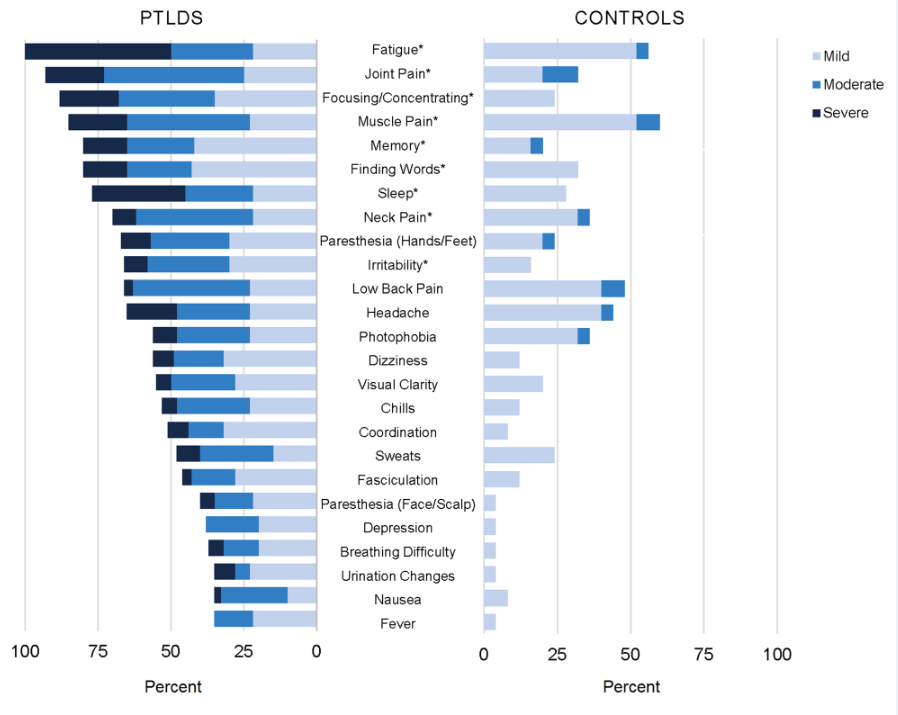
In our study, participants with Post Treatment Lyme Disease Syndrome (PTLDS) & controls were asked about presence and severity of 36 signs/symptoms over the past 2 weeks. Displayed are the 25 signs/symptoms with a statistically significant difference in severity by group (P<0.05) ordered by frequency within the PTLDS group. The nine signs/symptoms with a statistically significant difference at the p<0.001 level are indicated with an asterisk*.

The chronic symptom burden related to Lyme disease is considerable, as shown on the left side of the graph above, and statistically significantly greater than the aches and pains of daily living experienced by the control group, on the right.

What are the risk factors for Post Treatment Lyme Disease Syndrome?

Risk factors for Post Treatment Lyme Disease Syndrome include:

  • Delay in diagnosis
  • Increased severity of initial illness
  • Presence of neurologic symptoms

Increased severity of initial illness, the presence of neurologic symptoms, and initial misdiagnosis increase the risk of Post Treatment Lyme Disease Syndrome. PTLDS is especially common in people that have had neurologic involvement. The rates of Post Treatment Lyme Disease Syndrome after neurologic involvement may be as high as 20% or even higher. Other risk factors being investigated are genetic predispositions and immunologic variables.

In addition to Borrelia burgdorferi, the bacteria that causes Lyme disease, there are several other tick-borne co-infections that can also contribute to more prolonged and complicated illness.

What causes Post Treatment Lyme Disease Syndrome?

The causes of PTLDS are not yet well understood but our Center is investigating the potential roles of:

  • Infection-induced immune dysfunction or auto-immunity
  • Inflammation
  • Persistent bacterial infection or bacterial debris
  • Neural network alteration
  • Other tick-borne infections
  • Other biologic mechanisms of disease

Our research has validated PTLDS as a serious and impairing condition. However, the causes of PTLDS are not yet well understood or validated, and the term PTLDS does not mean post-infection or imply an assumption of underlying biologic mechanisms. The roles of immune dysfunction, autoimmunity, persistent bacterial infection, neural network alteration, and other potential causative biologic mechanisms of PTLDS are being investigated at our Center.

Research at our Center aims to understand the biologic drivers of all manifestations of Lyme disease so that diagnostics can be improved, and more effective treatments developed to enhance patients’ health outcomes.

Is there a cure for Post Treatment Lyme Disease Syndrome?

Currently there are no FDA approved treatments for Post Treatment Lyme Disease Syndrome. Therefore, treatments must be individualized by addressing specific symptoms and circumstances for each individual.

Late Lyme Arthritis

What is the prognosis for Late Lyme Arthritis?

Following antibiotic therapy, approximately 90% of late Lyme arthritis patients recover from extensive joint swelling, arthritis, and pain.

What happens if a patient doesn’t recover from Late Lyme Arthritis?

After extensive antibiotic treatment, approximately 10% of late Lyme arthritis patients remain symptomatic with a condition termed antibiotic refractory late Lyme arthritis. Extensive research has shown that the bacteria can no longer be found in the tissue or fluid of this subgroup of patients. Their continued swelling of the joints and pain is thought to be perpetuated by their own immune system’s autoimmune condition. Their autoimmunity continues to inflame the tissues and cause swelling and pain even in the absence of detectable bacteria.

Why are patients often referred to the Center?

Patients are often referred to the Lyme Disease Research Center for evaluation of chronic Lyme disease, an umbrella term that encompasses many different subsets of illness. Examples of defined Lyme disease subsets are Post Treatment Lyme Disease Syndrome (PTLDS), and Antibiotic Refractory Late Lyme Arthritis. The mechanisms of these Lyme disease conditions are different and effective treatments need to be tailored accordingly.

The symptoms of chronic Lyme disease are similar to and overlap with other conditions involving fatigue, pain, and cognitive symptoms. Therefore, rigorous diagnostic evaluation is necessary to determine if Lyme disease could be the trigger for ongoing disease processes or if some other disease processes are involved.

By distinguishing subsets of Lyme disease, such as PTLDS, our research program is illuminating the pathophysiology of the illness to improve diagnostics, treatments, and quality of life for patients.

USE OF THIS SITE

All information contained within the Johns Hopkins Lyme Disease Research Center website is intended for educational purposes only. Physicians and other health care professionals are encouraged to consult other sources and confirm the information contained within this site. Consumers should never disregard medical advice or delay in seeking it because of something they may have read on this website.

___________________

**Comment**

Overall, a balanced and accurate article.  A few points for consideration:

  1. There have been treatment failures from the beginning using the mono-therapy of doxycycline.  This tactic needs rethinking for numerous reasons: pleomorphism (the shapeshifting ability of borrelia), and polymicrobialism (other pathogen involvement).  https://madisonarealymesupportgroup.com/2018/10/30/study-shows-lyme-msids-patients-infected-with-many-pathogens-and-explains-why-we-are-so-sick/
  2. I like how the author states that, “for research purposes a defined subset of this condition is called Post Treatment Lyme Disease Syndrome (PTLDS).” What’s  important to understand is that this defined subset only includes patients who are diagnosed and treated early who go on to develop persistent symptoms. It does not and should not include those who were undiagnosed and untreated for months to years, which one microbiologist states is 30-40%.  By adding the two groups, a whopping 60% go onto develop chronic symptoms. To date, researches are utilizing the falsely skewed 10-20% which isn’t based in reality:  https://madisonarealymesupportgroup.com/2019/02/25/medical-stalemate-what-causes-continuing-symptoms-after-lyme-treatment/  This important fact indicates the pressing importance of this neglected group that nobody is noticing.
  3. Please note that the top reason for patients to develop PTLDS is delayed diagnosis, yet the CDC/IDSA keep pushing their worthless tests and taking a “wait and see” approach.  This tactic hasn’t worked for over 40 years yet they continue to blindly recommend this. It’s laughable if it wasn’t so serious.
  4. There are far more patients with neurological involvement than mainstream medicine has a clue of.
  5. I’m thankful the author states that one reason for PTLDS could be persistent bacterial infection or bacterial debris.  Mainstream medicine and authorities STILL are not acknowledging this. I’m also thankful they state that PTLDS is a serious and impairing condition. Now, they need to acknowledge that 60% or more suffer with this, with corresponding prioritized research reflecting the vast numbers.
  6. The authors state that there are, “no FDA approved treatments for Post Treatment Lyme Disease Syndrome; therefore, treatments must be individualized by addressing specific symptoms and circumstances for each individual.”  Since this is true, why are Lyme doctors STILL being persecuted for treating people individually and outside the CDC guidelines of 21 days of doxycycline and why won’t insurance cover it? Case in point:  https://madisonarealymesupportgroup.com/2017/06/24/llmd-daniel-cameron-disciplined-by-ny-medical-authorities/  Within this article is another article in “Sciencebasedmedicine.org,” that states, “Chronic Lyme” VIP Daniel Cameron Discipled by New York Medical Authorities. The title alone should be a foreshadowing of the type of ad hominem attacks against Lyme literate doctors for decades. Expert: “He is not a “recognized leader” among board-certified infectious diseases doctors and other experts who agree that “chronic Lyme” is not a real disease and who rely on well-conducted trials showing that long-term antibiotics do not substantially improve the outcome for patients diagnosed with so-called “chronic Lyme.” Long-term antibiotics can, in fact, result in serious harm, including death, a subject our good friend Orac covered just yesterday over on Respectful Insolence. The CDC, the Infectious Diseases Society of America (IDSA), the American Academy of Pediatrics, the American College of Physicians, the Medical Letter and the American Academy of Neurology all reject the notion that “chronic Lyme” exists and that long-term antibiotics are an appropriate treatment. (Orac’s post nicely summarizes the differences between real Lyme disease and “chronic Lyme,” “a prototypical fake medical diagnosis,” and the dangers of long-term antibiotics, as have posts on SBM, here, here, here, and here.)”  
  7. Malicious articles such as the one above which strangely chastises Cameron for not being a “recognized leader” which means part of the “Good old boy club,” among infectious disease doctors is a bit ironic when you consider that due to serious medical abuse, patients have been FORCED to go to doctors willing to listen to them to perhaps learn something new.  The “well conducted” clinical trials don’t exist.  There’s serious flaws with each of them.  And people HAVE improved immensely using long-term antibiotics.  Case in point:  https://madisonarealymesupportgroup.com/2017/07/09/idsa-founder-used-potent-iv-antibiotics-for-chronic-lyme/  Excerpt: A founding member of the IDSA, Dr. Waisbren disagreed with their stance that Lyme is hard to get and easy to treat, is not persistent, and that IV antibiotics are too dangerous to use as a treatment option.  In his book, “Treatment of Chronic Lyme Disease,” he discusses 51 difficult cases, nearly all Chronic Lyme disease sufferers that had been misdiagnosed with everything from ALS to mental disorders. They had all been neglected by main stream medicine that was following the CDC/IDSA stringent guidelines of essentially 21 days of doxycycline.  BTW:  Waisbren’s book was written nearly a decade ago yet the IDSA/CDC infectious disease “leaders” haven’t learned a thing and continue to live in the Stone Ages.


Microbiology Professor – “I’m Convinced Lyme Disease is Transmittable From Person to Person”

http://www.endowmentmed.org/pdf/endowmentupdatelymes2.pdf

lida-thumb  Dr. Lida Mattman

In this 2006 blast from the past, Dr. Lida Mattman, PhD, and author of “Cell Wall Deficient Forms:  Stealth Pathogens,” states,

“I am convinced that Lyme Disease is transmittable from person to person.”

Mattman has been able to recover live spirochetes of Borrelia burgdorferi (Bb) from mosquitos, fleas, mites, semen, urine, blood, spinal fluid, and tears, indicating the potential to be spread on hands person to person. 

To watch her 2006 presentation:  https://madisonarealymesupportgroup.com/2019/04/02/transmission-of-lyme-disease-lida-mattman-phd/  Transcript included.

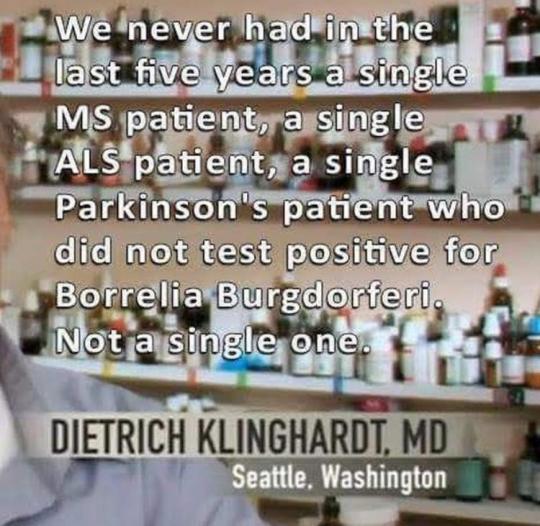
In the 90’s, Mattman obtained positive cultures for Bb in 43 out of 47 chronically infected people.  All with Parkinson’s & Alzheimer’s had Bb, and many with MS and ALS had it.

This has been substantiated clinically as well
0-2-2

Quite recently live Bb was found in a genital lesion of a chronically infected female patient:  https://madisonarealymesupportgroup.com/2019/05/11/lyme-found-in-genital-lesion-sexual-transmission-studies-screaming-to-be-done/  Key Quote:

“Our findings demonstrate the complexity of Lyme disease,” said Fesler, a lead author of the published study. “It explains why the disease is more common than one would think if only ticks were involved in transmission.”

Why isn’t an alarm being spread throughout the land?
Because this information isn’t new.  It just keeps getting buried and ignored.

Mattman and her colleague, Dr. Joanne Whitaker, a victim of Lyme disease since childhood, developed a direct test for Bb and were the first to identify the cell wall deficient form of the spirochete.  Interestingly, the CDC has made 2-tier blood serology testing for Lyme a literal mandate, purposely avoiding direct detection:  https://madisonarealymesupportgroup.com/2018/04/03/cdc-deliberately-avoids-direct-detection-testing-methods-for-ld/

There’s a long & sordid history of serology testing for Lyme:  https://madisonarealymesupportgroup.com/2018/04/03/cdc-deliberately-avoids-direct-detection-testing-methods-for-ld/  Excerpt:

It would appear that there has been a deliberate avoidance of direct detection methods and it is believed that these efforts are to insure that the current thirty year dogma remain intact.

We have a dire need to develop rapid detection methods for a serious growing health threat which has the ability to disable its victim as described in the attached letter addressed to the previous Director of the CDC. (Please see attachment in link)

I would like to point out that employees of the U.S. Centers for Disease Control hold patents on metabolomics (Lyme tests).

CDC Employee Patent:  https://www.google.com/patents/EP2805168A1?cl=en

For nearly four decades now the only FDA approved test for Lyme disease is the indirect two-tiered antibody test. Direct detection methods to identify the causative agent responsible for the disease have been avoided, criticized and shelved.

https://madisonarealymesupportgroup.com/2018/12/16/laboratory-testing-for-lyme-disease/  Direct detection laboratory testing (DNA/PCR Sequencing) is used for many infections (Ebola (1), Zika (2), Bartonella (3) etc.) but not Lyme disease.

The shenanigans don’t end there:  https://madisonarealymesupportgroup.com/2017/12/13/suppression-of-microscopy-for-lyme-diagnostics-professor-laane/  Excerpt:

After publishing the 2013 article ‘A simple method for the detection of live Borrelia spirochetes in human blood using classical microscopy techniques’, professor Laane was invited to give a lecture at the 2014 Norvect conference in Oslo. An English patient saved the pdf, so you can still read it, via the link provided.

I was present at that conference and still remember how nervous he was. The reason was that several medical professors complained to his university. He was threatened with losing his job, if he would speak at the conference.

In fact, he did not literally speak – as you can see in the movie below – but used performing arts to show the slides of the spirochetes. Professor Laane was fired anyway and his laboratory was closed down.

According to Lyme patient and advocate Carl Tuttle:
“The CDC is responsible for the current Lyme disease crisis where patients cannot obtain a timely diagnosis through accurate early detection.”
For a great read on Lyme testing:  https://www.lymedisease.org/lyme-disease-test/  In this article you will read that most testing for Lyme is indirect.  Serology testing looks for antibodies to the organism. Another great read:  https://madisonarealymesupportgroup.com/2018/10/12/paving-the-way-for-better-lyme-diagnostic-tests/
 “These serologic tests cannot distinguish active infection, past infection, or reinfection.”

In plain English, these tests don’t show squat, yet have ruled Lyme-land for 40 years like the Iron Curtain.

WHY?

For those of you new to this game, the CDC/IDSA/NIH has spread malicious information about smaller labs that specialize in virology and bacteriology and are CLIA certified, one of the toughest certification standards a lab can undergo.  On their website, the CDC has called these labs, “home-brewed.” They control testing by stating it must be FDA approved.  I actually attended a public meeting at the WI capital where a pediatric doctor quoted right off the CDC website and called the IgeneX Lyme test, “Home-brewed.”  https://www.cdc.gov/mmwr/preview/mmwrhtml/mm6315a4.htm

“Often these are laboratory-developed tests (also known as “home brew” tests) that are manufactured and used within a single laboratory and have not been cleared or approved by FDA. Recently, CDC has received inquiries regarding a laboratory-developed test that uses a novel culture method to identify Borrelia burgdorferi, the spirochete that causes Lyme disease. Patient specimens reportedly are incubated using a two-step pre-enrichment process, followed by immunostaining with or without polymerase chain reaction (PCR) analysis. Specimens that test positive by immunostaining or PCR are deemed “culture positive” (2). Published methods and results for this laboratory-developed test have been reviewed by CDC. The review raised serious concerns about false-positive results caused by laboratory contamination and the potential for misdiagnosis (3).  CDC recommends that laboratory tests cleared or approved by FDA be used to aid in the routine diagnosis of Lyme disease. A complete searchable list of such tests is available online (4).”

I can only guess what it costs a lab to go through the FDA process. Let’s just say these small specialty labs have had it rough.  They have fought tooth and nail just to keep their doors open.

Besides requiring FDA approval, the CDC has also arbitrarily set the criteria of requiring  5 out of 10 bands for a positive test result.

According to Dr. Waisbren, an IDSA founder, in his illuminating book, “Treatment of Chronic Lyme Disease: 51 Case Reports and Essays in Their Regard,” he states,

“The Western Blot studies, which are essentially antibody studies, do seem to be the most positive finding in clinical Lyme disease, but setting an arbitrary level of these antibodies to diagnose a disease that has not been amenable to Koch’s postulates seems open to question.  By the same token, ignoring antibody results unless they meet arbitrary levels seems suspect.  The vast majority of patients in this series showed some Western blot antibody exposure, but many did not meet the arbitrary limits set.”  

And then wisely states,

“We all must remember that in our preset state of knowledge, the diagnosis of Lyme disease is a clinical one.”

This was all written in 2011, yet the only FDA “approved” testing is STILL the abysmal and arbitrary 2-tiered blood serology which only detects antibodies to the organism.

One gets the distinct feeling the CDC wants to control how many patients are accurately diagnosed.
Oh, and also collect money on tests they have patents on.

Little to no work has been done on the transmission of the organism.  Animal studies and the warnings of experienced microbiologists on the potential of human to human transmission since the 80’s have been completely ignored.  Even Canada has recognized congenital transmission:  https://madisonarealymesupportgroup.com/2018/10/05/canada-acknowledges-maternal-fetal-transmission-of-lyme-disease/, largely because a group of women led by a nurse with congenitally infected children pushed the point and collected 33 years of data showing it:  https://madisonarealymesupportgroup.com/2018/06/19/33-years-of-documentation-of-maternal-child-transmission-of-lyme-disease-and-congenital-lyme-borreliosis-a-review/

Here’s another example of work done way back in the 80’s which found Bb in a baby which died during the first week of life due to congenital heart disease which found Bb in the spleen, kidneys, and bone marrow.  The mother developed Lyme during the 1st trimester:  https://experts.umn.edu/en/publications/maternal-fetal-transmission-of-the-lyme-disease-spirochete-borrel

Do we seriously have to battle a chronic illness and keep doing ALL the work by ourselves?

The best description I’ve heard is that Lyme is a, “do it yourself” disease. Very accurate description.

For more on ancient animal studies showing various transmission routes:  https://madisonarealymesupportgroup.com/2017/02/24/pcos-lyme-my-story/

Until these issues are fully and transparently dealt with, we can spray and check for ticks all the day long but still not address the very practical issue of other ways people are getting infected.

Lida H Mattman, PhD, has spent seven decades studying the different forms that bacteria can take. Her contributions to medical science can be summarized best by noting that in 1998 she was nominated for the highest honor attainable in her profession: The Nobel Prize in Medicine. Professor Mattman graduated with a M.S. in Virology from Univ. of Kansas and a Ph.D. in Immunology from Yale. She has taught Immunology, Microbiology, Bacteriology, Virology, Pathology, and for 35 years worked in these fields at various schools and institutions including Harvard Univ., Howard Hughes Institute, Oakland Univ. and Wayne State Univ. where she is Professor Emeritus. She is currently working for the Nelson Medical Research Institute studying the relationship between spirochetes involved in MS, Lyme disease, and ALS.