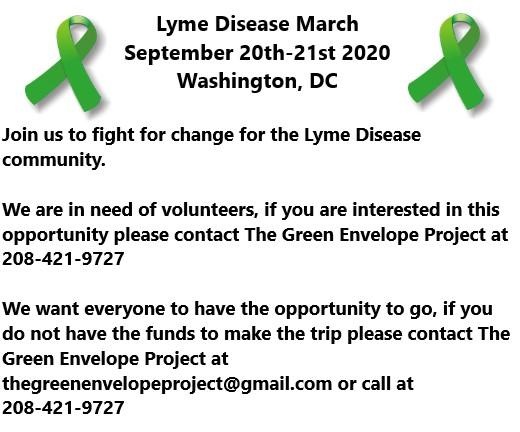
Lyme March Scheduled for Sept. 2020

 Draft guidelines for the diagnosis and treatment of Lyme disease were recently issued by the Infectious Disease Society of America (IDSA)–two really big, contentious issues.
And of course there are the disagreements of how the various organizations view these Lyme topics–I’ve often termed this the establishment vs. the advocates.
My guest today took a look at this in a recent two-part series in Forbes entitled “Lyme Wars”.
Joining me is the author and infectious disease physician, Judy Stone, MD.
Podcast: Play in new window | Download
___________________
https://madisonarealymesupportgroup.com/2019/08/07/the-lyme-wars-part-2-which-way-should-we-treat/ I disagree with the author on numerous points and present them in this link.
https://www.cbc.ca/news/canada/manitoba/tick-bourne-lyme-disease-service

Winter may be around the corner, but Manitoba health officials are already focused on treating a summer hazard — tick-borne illnesses like Lyme disease.
A “virtual clinic” of medical health officers focused on better diagnosing and treating tick-borne illnesses, first announced by the Manitoba government last June, is expected to be operating by early next year, says Dr. Richard Rusk, the province’s medical health officer for communicable disease control.
“If you have someone with multiple issues and symptoms and they don’t really come up with a clear diagnosis, then they are lost — so how do you look after this group?” said Rusk.
Symptoms, which typically appear from three to 30 days following the bite of an infected black-legged tick, can include fever and muscle aches, but if untreated, infection can spread to the joints, heart and nervous system, according to the province’s website.
Rusk says tick-borne illnesses can be difficult to diagnose, and the new collaborative program is meant to help primary physicians by connecting them with specialists.
“It often involves intense evaluations, which is why your average family physician won’t be able to do this,” he said.

“The team consists of an infectious disease specialist, a neurologist, an internal medicine specialist, a rheumatologist, a psychiatrist and physiatrist, so it’s a fairly high-level group of specialists,” said Rusk. A primary health care nurse and pharmacist will also be on the team.
Some patients who are already working with an internal medicine specialist are starting to be seen by the other medical experts as a trial run of the program. But software and administrative details are still being worked out before the official rollout of the virtual clinic.
“We’re looking to take in 10-12 patients a month, because it’s complex and each patient probably takes about two hours just with the internal medicine specialist, never mind the other experts,” says Rusk.
He says the Manitoba tick-borne collaborative care service will also be part of the Canadian Lyme Disease Research Network.
Dr. Kieran Moore is the Ontario medical health officer tasked with bringing together a cross-country network of university researchers, medical specialists, and patients to fill gaps when it comes to research, diagnosis, treatment and education.
“We’ve got a lot of catch-up on education on the clinical signs and symptoms, as well as testing reliability and treatment pathways,” says Moore, who is also a professor of family and emergency medicine at Queen’s University.
There are plans to include Manitobans in research efforts, but that is still two or three years away.
“We have to get protocols set in [Ontario] and then in Halifax, and then we will expand,” said Moore.
https://www.holtorfmed.com/mental-illness-hashimotos-disease/?
Imagine having all the symptoms of a major mental illness such as manic depression, paranoid schizophrenia, psychotic depression, or even a bipolar disorder. One day you wake up with overflowing physical energy, even feeling severely anxious, with a rapid heartbeat, profuse sweating, trembling hands, and diarrhea, and you can’t stop losing weight. Then soon enough, without warning, your energy plummets. You feel like a slug, are constipated, your hair starts falling out, you gain weight no matter how little you eat, and you are severely depressed. You may have difficulty swallowing, sound hoarse, and feel like you have swallowed something that wont go down. And then, suddenly, your old symptoms return, and you feel anxious, sweaty, trembling, and panicky. This cycle can repeat itself again and again.
While your symptoms resemble a mental health issue, they could be signs of Hashimoto’s thyroiditis, one cause of hypothyroidism. Hashimoto’s thyroiditis, also known as autoimmune thyroiditis or simply “Hashimoto’s, is caused by an autoimmune disorder. In this case, the body’s immune system sees the thyroid gland as a foreign body and begins to attack, damaging and killing thyroid cells along the way. As the cells are damaged or destroyed, they release their stored thyroid hormone, causing classic hyperthyroid symptoms such as anxiety, panic attacks, shaking hands, sweating, and a racing heart.
Each autoimmune attack causes more and more damage to the thyroid gland until, ultimately, the gland is no longer able to produce adequate thyroid hormones. Every cell in the body needs thyroid hormones, so a deficiency can wreak havoc on the entire system, causing depression, weight gain, severe fatigue, brain fog, memory loss, and even overall body aches.
And it happens much too often. A 1987 study found that as many as 15% of patients admitted to a psychiatric hospital for depression actually were suffering from some level of hypothyroidism.
Learn more about Hashimoto’s here.
At first, Hashimoto’s can produce little to no symptoms. But as the disease progresses, the body will cycle between hyperthyroid symptoms and hypothyroid symptoms, until ultimately the patient becomes permanently hypothyroid. Symptoms vary based on whether the thyroid is under attack or at rest, but can include:
Get the full list of thyroid disease symptoms here.
Thyroid hormone lab tests such as the TSH, Free T4, Free T3 and Reverse T3 can diagnose hypothyroidism or hyperthyroidism, but to get a clear picture of a potential autoimmune thyroid disease, you must check for increased antibodies that are specific to thyroid proteins. These include thyroid peroxidase (TPO) and antithyroglobulin; however, it’s important to know that these antibodies can be at normal levels and a patient still have hashimoto’s disease. It can also be useful to check levels of thyroid stimulating immunoglobulin (TSI), which can be seen in Graves’ disease, another autoimmune thyroid disorder.
Get a FREE downloadable thyroid panel lab slip here.
If lab tests or symptoms indicate Hashimoto’s, it is important to begin treatment as soon as possible to help avoid further damage to the thyroid gland. In addition to thyroid hormone replacement therapy, the following treatments options should be explored.
The violent swings of Hashimoto’s disease can be very frightening, not only for the patient who has the autoimmune disease, but also for friends and family who watch their loved one struggling, but with proper diagnosis and treatment, the symptoms of Hashimoto’s can be resolved.
At Holtorf Medical Group, our physicians are trained to provide you with cutting-edge testing and innovative treatments to properly diagnose and treat your autoimmune thyroid disease, optimize your health and improve your quality of life. If you have been diagnosed with Hashimoto’s, but aren’t getting the treatment you need or if you have symptoms associated with thyroid dysfunction, call us at 877-508-1177 to see how we can help you!
Resources
1. Kent Holtorf, MD. “Understanding Local Control of Thyroid Hormones: (Deiodinases Function and Activity).” https://www.nahypothyroidism.org/deiodinases/
2. Kent Holtorf, MD. “Thyroid Hormone Transport.” https://www.nahypothyroidism.org/thyroid-hormone-transport/
3. Kent Holtorf, MD. “Diagnosis of Hypothyroidism: Are we getting what we want from TSH testing?” https://www.nahypothyroidism.org/how-accurate-is-tsh-testing/
4. Kent Holtorf, MD. “Why Doesn’t My Endocrinologist Know All of This?” https://www.nahypothyroidism.org/why-doesnt-my-doctor-know-all-of-this/
5. Dana L. Mincer; Ishwarlal Jialal. “Hashimoto Thyroiditis.” https://www.ncbi.nlm.nih.gov/books/NBK459262/
6. LDN Trust. “Conditions that are helped by Low Dose Naltrexone (LDN).” https://www.ldnresearchtrust.org/conditions
After seeing 3 other doctors (over a 5 year period) for Hashimoto thyroid disease treatment, I finally found Dr. Holtorf (thank God!). I could write paragraphs on what I’d been through but the bottom line is that I finally found a doctor that is not only a good listener, compassionate & kind, but one who actually thinks “outside the box”.
For those of us who don’t respond in a conventional manner to medications, old school “by the book” endocrinologists have repeatedly patted us on the back & said, “Your TSH is fine”, just keep doing what you’re doing. In the meantime, I for one, was sleeping 16 hours a day, spent my life in a mind fog & was fatigued beyond belief (I even slept in my car during my lunchbreaks at work).
Dr.Holtorf immediately asked the right questions, patiently waiting through my confusion & tears, and made changes to my medication regime that truly turned things around for me.
I can’t say enough good things about him as a doctor & a caring person. – Ilene G.
_________________
**Comment**
Every Lyme/MSIDS patient I work with has messed up thyroid issues. In fact, one infected patient felt nearly well just by addressing the thyroid.
Notice the article talks about the importance of dealing with bacterial and viral infections. Often, when you deal with the infection(s), your many symptoms can just disappear; however, it’s important you partner with your ILADS-trained doctor to sleuth out your deficiencies and then supplement what your own body isn’t producing.
Most doctors are not privy to appropriate thyroid testing. Within this article there is a printable thyroid panel slip. The link will direct you to a great article explaining all the different elements in the panel as well as a downloadable slip you can take to your doctor. All of the required tests have a black X by them. I highly advise you to take advantage of this if you haven’t addressed your thyroid.
Also, please see another great read by Holtdorf on lies endocrinologists tell patients: https://madisonarealymesupportgroup.com/2019/10/26/5-thyroid-lies-your-endocrinologist-may-try-to-tell-you/ In the comment section I give a trick my doctor uses to determine if you need additional T3 as sometimes our bodies aren’t able to properly convert T4 into T3. Many feel this is a genetic issue. Conventional medicine states our bodies will do this naturally; however, according to this article, 15% of the population can’t convert. I’m one of them: https://www.healthcentral.com/slideshow/thyroid-patients-and-t3 T3 is important because it delivers oxygen and energy to your cells, tissues, glands, and organs. More than 12 studies have shown the benefit of adding T3 to T4.
Many patients upon adding T3 were able to:
https://globallymealliance.org/highlights-from-ilads-2019/?
By Jennifer Crystal
From November 1 to 3, I had the opportunity to attend the 20thannual International Lyme and Associated Diseases Society (ILADS) conference in Boston. Tick-borne disease can feel isolating for patients and caregivers, and for doctors who are trying to help them in areas where Lyme isn’t historically endemic. However, the conference assured me that the Lyme community is not only thriving, but making great strides on behalf of its most important members: patients like you and me.
In the coming months, I’ll be writing in-depth blog posts on specific topics covered at the conference. For now, I want to share my general takeaways:
Antibiotics have long been the standard course of treatment for Lyme and other tick-borne diseases (sometimes used in conjunction with other types of medications, including antimalarials for certain co-infections). We know unequivocally that antibiotics kill borrelia burgdorferi, the Lyme bacteria. In fact, Eva Sapi, Ph.D., Director of the Lyme Disease Program and Professor in the Biology and Environmental Science Department at the University of New Haven, showed images of Lyme spirochetes being treated with penicillin. First they wiggled, coiled, and fought the treatment, but eventually, they disappeared.
Despite the efficacy of antibiotics against Lyme, they have their limits, especially in patients with late-stage infections. Dr. Sapi’s research has demonstrated that Lyme bacteria can create biofilms (like a greasy buildup, similar to dental plaque) that form around the bacteria, acting as a barrier against antibiotics. Furthermore, some patients who receive antibiotic treatment still experience ongoing symptoms, or a relapse of symptoms, after finishing the standard antibiotic treatment protocol (known as Post Treatment Lyme Disease Syndrome). Therefore, researchers and doctors are exploring new methods of treatment. Leading Lyme expert Kenneth Liegner, M.D., a Board-certified internist with additional training in pathology and critical care medicine, said the solution is “not denial but design of more effective and less costly treatments.”
Based on research (funded by Global Lyme Alliance) by Kim Lewis, Ph.D., Director of the Antimicrobial Discovery Center at Northeastern University, and on work by Stanford University researchers, some LLMDs are trying the antimicrobial drug Disulfiram.More commonly known as Antabuse, this medication is used to treat alcoholism and has proved highly effective against Lyme disease. It may possibly undermine biofilms, and it also seems to help treat babesia. Dr. Liegner has published his experience with three cases in which he used Disulfiram. He and other doctors are seeing great success with it, with some patients enjoying enduring remission (feeling well for at least six months after treatment). However, there can be serious side effects that should be discussed with your LLMD, and there are still a lot of unanswered questions about the drug. My sense from speaking with doctors is that there will probably be at least another year or two of research before we have definitive answers on this drug, but early news is promising.
An antibacterial drug that also got a lot of buzz at ILADS was Dapsone. Richard Horowitz, MD, author of Why Can’t I Get Better: Solving the Mystery of Lyme and Chronic Disease and its sequel, is studying the effects of antibiotics and Dapsone both in combination and alone. He and Phyllis Freeman, Ph.D., Associate Professor of Biology and Curriculum Coordinator of Biology in the Department of Life and Physical Sciences at Fisk University, have published results of these studies in the International Journal of General Medicine. For further information, read this GLA press release on drugs and drug combinations that show success in treating Lyme.
Another alternative to antibiotics that is being studied is phage treatment.Phages are viruses that infect bacteria. In his talk, “Specific Phages as New Strategies for Diagnostics and Treatment,” Louis Teulieres, M.D., Ph.D., of the Department of Infection, Immunity, and Inflammation at the University of Leicester, said phages are used in molecular biology in many countries; one was found for borrelia in Sweden.
While it’s unlikely that we’ll be able to treat Lyme by injecting a live virus into the body, phages may be useful as a diagnostic tool. If phages don’t find bacteria, they die, so their ability to live is a good indicator of whether Lyme bacteria are present. Dr. Teulieres and his team are working on creating a phage-based diagnostic test.
Other researchers are working on biology-based diagnostic tools. James Collins, Ph.D., of the Institute for Medical Engineering at the Massachusetts Institute of Technology, who is associated with the Broad Institute, also of MIT, Harvard and The Wyss Institute, is looking at using human cells as programmable technology. His company Sherlock Biosciences is teaming with Sabeti Labs to create a paper-based diagnostic tool that can be used in a doctor’s office. This type of detection was used in diagnosing the Zika virus, and scientists are now looking at applying it to tick-borne diseases. While the project is still 12-18 months from initial clinical trials, it’s exciting to know that possibilities for better diagnostics are on the horizon.
As described in “The Lyme Wars” (New Yorker, 1 July 2013) the Lyme community is polarized, and even within each camp, there hasn’t always been harmony or good communication. In her talk,“One Health: Forming Collaborations that Transcend Disciplinary Boundaries,” Cheryl Stroud, D.V.M, Ph.D. said doctors and researchers can sometimes get stuck inside their respective professional “silos”. They do important work side by side but don’t have the opportunity to see or discuss what the other is doing despite proximity in the field. She encouraged conference attendees to “step out of [their] silos and see the big picture.” This is the mission of the One Health Commission, which Dr. Stroud chairs.
The Centers for Disease Control and Prevention defines One Health as “… a collaborative, multisectoral, and transdisciplinary approach—working at the local, regional, national, and global levels—with the goal of achieving optimal health outcomes recognizing the interconnection between people, animals, plants, and their shared environment.” As a veterinarian who sees a lot of tick-borne disease, Dr. Stroud feels she has important information to share with our Lyme doctors, and vice-versa. She encouraged LLMDs to broaden their intake questionnaires to include animal exposure (a patient’s dog may have been carrying a tick, or the patient may have bartonella henselae, also known as cat scratch fever).
This big-picture collaboration is something Kristen Honey, Ph.D., P.M.P. is working on as Vice-Chair of the Department of Health and Human Services (HHS) Tick-Borne Disease Working Group, established by the United States Congress in 2016. Through her role with HHS, Dr. Honey co-founded Lyme Innovation, whose mission is “to solve the critical prevention, diagnostic, treatment, and rehabilitation challenges in the Lyme disease field.” Dr. Honey stressed the importance of putting patients at the center of this problem solving, stating that “the lived experience of a patient or caregiver is equally as valuable as an MD with credentials. When we put the patient at the center, we get better outcomes.”
In December 2018, HHS’s Chief Technology Officer hosted the first-ever Lyme Innovation Roundtable, bringing together 80 Lyme leaders including patients, clinicians, researchers, caregivers, and policymakers. In the last year, Lyme Innovation has focused on creating patient-powered technology and innovation, including the Lyme Symptom Tracker app, co-created with Trial X and Global Lyme Alliance. Lyme Innovation helped bring the TICK (Ticks: Identify, Control and Knockout ) Act to the U.S. Congress. Recently renamed the Kay Hagan TICK Act bill in honor of Senator Kay Hagan (D-NC), who passed away in late October from complications of the tick-borne Powassan virus, the bill seeks to improve research, prevention, diagnostics, and treatment for tick-borne diseases, and includes a request for $100M for tick research. Just as the ILADS conference concluded, the Senate Health Committee voted unanimously to advance this legislation; it nows moves to the full Senate.
Moving forward, Dr. Honey notes the importance of collaboration between industry, non-profits, academia, patients, and patient advocates. I feel confident she will continue to lead the charge on bringing people together to effect positive change. She ended her talk by saying, “I look forward to co-creating solutions with you,” and later offered a smaller session, “Together, Transforming Lyme Anecdotes into Data and Action,” where she opened up a dialogue with attendees, asking what they most needed from the government (answers included funding and a standardized reporting protocol). Dr. Honey seems committed to creating innovation and finding funding that will help patients get and stay well.
Overall, I left the conference feeling incredibly hopeful. I first attended an ILADS conference in 2012, and I am so pleased with the progress that has been made in the interim. As Dr. Horowitz said,
“Researchers out there doing work on biofilms and persisters allow clinicians like me to make advances. We’re very close to a durable answer.”
 Jennifer Crystal is a writer and educator in Boston. Her memoir about her medical journey is forthcoming. Contact her at lymewarriorjennifercrystal@gmail.com
____________________
**Comment**
Please learn about Disulfiram before considering it. This $40 drug caused me to go into psychosis and probably cost me $20K overall: https://madisonarealymesupportgroup.com/2019/10/14/november-2019-lyme-support-meeting-oct-meeting-canceled-due-to-reaction-to-disulfiram/
https://madisonarealymesupportgroup.com/2019/10/15/disulfiram-psychosis-update/
https://madisonarealymesupportgroup.com/2019/10/27/disulfiram-psychosis-update-2/


Written
on November 14, 2019