Wisconsin Lyme Gala 2020


https://www.lymedisease.org/touched-by-lyme-bitten-makes-many-best-of-2019-book-lists/
By Dorothy Kupcha Leland
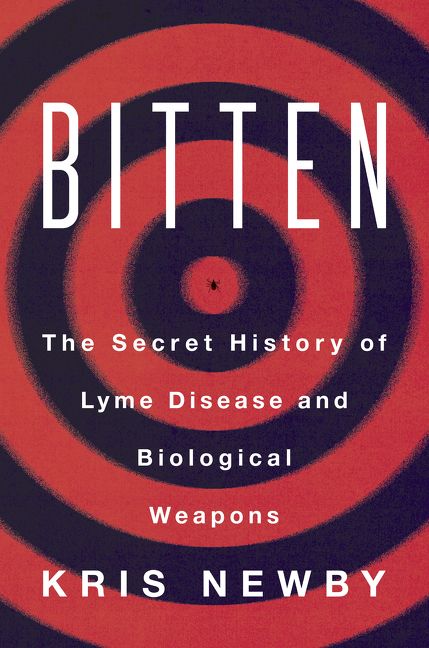
Bitten: The Secret History of Lyme Disease and Biological Weapons, by Kris Newby, got a lot of attention when published last May. Much of it came from the Lyme community, happy to see important questions being asked and seriously researched.Additional interest came from reporters and reviewers in the general press. Especially after Congressman Chris Smith spoke about it from the floor of the US House of Representatives.
Recently, a number of “Best of 2019” lists have brought new recognition to this important book.
Here’s a sampling:
“My favorite biomedical read of the year chronicled a quest to uncover whether tick-borne infections were weaponized by the U.S. government during the Cold War. This book has all the ingredients of a good science thriller, including a compelling personal backstory (author Kris Newby’s interest was sparked by her own experience with Lyme disease; Newby is also a science communicator at Stanford); poorly understood disease-causing microbes; a mysterious scientist conducting possibly-nefarious research; Swiss bank accounts and medical experiments on conscientious objectors.
“But the best thing about Bitten is that it has prompted action in the real world. Last summer, after the book hit the news, the U.S. House of Representatives boosted funding for Lyme disease research and passed an amendment to investigate past bioweaponization of ticks, including asking whether infected ticks were ever accidentally released into the wild.”
“It’s not cheating to put together Bitten by Kris Newby and Mosquito by Timothy C. Winegard in one Best Of, because they really belong side-by-side on your shelf. Newby’s book is about all the things that can bite you and maybe kill you. Winegard’s book is about one thing that bites and kills more humans than any other creature. How can you resist books like those?”
This is a website that curates non-fiction book recommendations. It puts “Bitten” as #1 on its list of “62 Best Public Health Books of All Time.”
STAT is a online news outlet that focuses on health and medicine. In June, it put Bitten as #8 on its list of The 23 best health and science books to read this summer.
Goodreads, a book recommendation website, also republished STAT’s list. Here’s what the STAT reviewer said:
“Bitten is a riveting narrative that digs into the origins of the Lyme disease epidemic. It connects many dots with compelling evidence and page-turning storytelling that point to the likelihood that a bio-weaponized tick program gone awry could have contributed to the more virulent forms of tick-borne illnesses that have been wreaking havoc on unwitting people for the past five decades. Doctors are not well-trained on tick-borne illness, diagnostics are inadequate, and there are no career tracks in the field other than a few courageous pioneers. Biotech is largely on the sidelines. Yet millions of people are being disabled. Perhaps this book will help stir some action. After all, we all are just one bite away from a nightmare illness.”
So, there you have it–from reviewers who don’t necessarily have a dog in this fight. I didn’t personally create a “Best of 2019” book list. But if I did, Bitten would certainly be on it. Here’s the review I wrote last May:
Is Lyme disease a bioweapons experiment gone bad?
If you haven’t yet done so, I suggest you make reading Bitten your New Year’s resolution for 2020.
TOUCHED BY LYME is written by Dorothy Kupcha Leland, LymeDisease.org’s Director of Communications. She is co-author of When Your Child Has Lyme Disease: A Parent’s Survival Guide. Contact her at dleland@lymedisease.org.
___________________
For more: https://madisonarealymesupportgroup.com/2019/05/31/interview-with-kris-newby-author-of-bitten/
https://madisonarealymesupportgroup.com/2019/05/27/medical-thriller-about-a-government-cover-up/

JAN 11, 2020 —
Most of us involved in this scandal are familiar with the faulty/misleading testing algorithm for Lyme disease as it is the root cause of unimaginable pain and suffering. Delayed diagnosis and treatment leads to serious health consequences.
Feel free to share the letter below and attachments to the uneducated public who are in denial that this couldn’t possible happen to them.
——— Original Message ———-
From: CARL TUTTLE <runagain@comcast.net>
To: tickbornedisease@hhs.gov
Cc: (82 Undisclosed recipients)
Date: January 11, 2020 at 11:54 AM
Subject: NH House Bill 490 and Serology for Lyme Disease
To: The Tick-Borne Disease Working Group,
Please see the letter below addressed to the New Hampshire Medical Society regarding House Bill 490.
In order to cut down on email size I have provided Dropbox storage links for the attachments listed in this message.
Carl Tuttle
Lyme Endemic Hudson, NH
Letter to the New Hampshire Medical Society:
———- Original Message ———-
From: CARL TUTTLE <runagain@comcast.net>
To: james.potter@nhms.org
Cc: (28 Undisclosed recipients)
Date: January 10, 2020 at 11:19 AM
Subject: NH House Bill 490 and Serology for Lyme Disease
Jan 10, 2019
New Hampshire Medical Society
7 North State Street
Concord, NH 03301-4018
ATTN: James G. Potter, CAE, Executive Vice President
Dear Mr. Potter,
I have reviewed the amended version of HB490 calling for a commission to study the role of clinical diagnosis and the limitations of serological diagnostic tests and I have to tell you that all Tuttle family members did not meet the CDC’s criteria for positive test results on the only FDA approved testing algorithm for Lyme disease (2 out of 3 IgM bands and 5 out of 10 IgGbands) and yet all of us were horribly ill.
The confusion over this has caused untold pain and suffering as delayed diagnosis will lead to dire health consequences. The uneducated PCP will see “Negative” on the lab report and inform the patient that he or she does not have Lyme disease.
Had we not met Dr. Sam Donta of BU School of Medicine (Currently a member of the Tick-Borne Disease Working group) who spent a career studying Lyme disease, none of us would have been treated.
This is a serious problem!
For your review, I have attached a copy of my 2009 letter addressed to Salim E. Kabawat, M.D. Medical Director of Quest Diagnostics outlining the problems with current serology. Nothing has changed.
In addition, I am attaching a copy of my wife’s Western blot showing only one single positive test band and no disclaimer.
I mean no disrespect Mr. Potter but what we have here in New Hampshire (and across the country) is a plague of ignorance and House Bill 490 is looking to address this.
Included with this correspondence is a copy of a 2009 tick study here in New Hampshire conducted by UMass Amherst and you will see in the town of Litchfield, 77% of the ticks tested are carrying tick borne disease. You or a loved one is a single tick bite away from experiencing this travesty.
Respectfully submitted,
Carl Tuttle
Lyme Endemic Hudson, NH
Attachments:
1. 2009 letter addressed to Salim E. Kabawat, M.D. Medical Director of Quest Diagnostics
https://www.dropbox.com/s/rot8mvqxd1ol9e2/June%2017%20Quest%20Diagnostics%20Letter.doc?dl=0
2. Sample Western blot
https://www.dropbox.com/s/ppus0unm0j2oiff/Western%20Blot.pdf?dl=0
3. UMass Amherst Tick Study
https://www.dropbox.com/s/kvxnp7tffoy4yas/NH%20Tick%20StudyText%20added.doc?dl=0
Cc: Tick-Borne Disease Working Group, Washington DC
Key quote: “These serologic tests cannot distinguish active infection, past infection, or reinfection.”
https://www.lymedisease.org/fries-congress-lyme-summary/

Advocates on behalf of patients with Lyme and other tick-borne diseases made some headway on Capitol Hill in 2019. Of course, much work still lies before us.
Bruce Fries is President of the Patient Centered Care Advocacy Group. He provides this summary of what transpired–and what may await us in 2020.
By Bruce Fries
The federal budget for Fiscal Year 2020 includes several important provisions promoted by Lyme disease advocates working with members of Congress. Here are highlights:
Many advocates and organizations worked together to get the increase in CDC’s Lyme disease funding and to get the TICK Act passed. Congressman Chris Smith of New Jersey and Senator Susan Collins of Maine were instrumental in making all of this happen.
The Patient Centered Care Advocacy Group focused on working for the increase in CDC Lyme funding. We coordinated the outreach of constituent advocates and advocacy leaders with the House and Senate Appropriations Committees, members of the House Lyme Disease Caucus, and several U.S. Senators.
We drafted a justification for the CDC Lyme funding increase and submitted public witness testimony to the House Appropriations Committee. The Lyme Disease Association and LymeDisease.org also submitted public witness testimony to support the funding request.
A key milestone was a March 25, 2019 conference call with House Appropriations Committee Chair Nita Lowey’s Legislative Director. Lowey had supported a similar increase in CDC’s Lyme funding several years before she became Committee Chair, so we were optimistic she would be receptive to our request. Her Legislative Director advised us on how to best format and communicate our request.
The justification that we submitted detailing how the increased funding should be spent included the following:
“… The $5 million increase we are requesting is needed to expand underfunded programs in the area of prevention to identify and validate prevention and control methods; for surveillance to develop alternate surveillance techniques such as from medical records; and to improve diagnostics, using new technologies that are more accurate than antibody testing, to improve early diagnosis and treatment.”
Complementing our work on the House side, Senators Richard Blumenthal of Connecticut and Kirsten Gillibrand of New York sent a joint letter to the Senate Appropriations Committee that matched our request to the House.
The House Appropriations Committee initially approved just a $1 million increase. New York Congressman Antonio Delgado submitted an amendment that increased it to $2 million. The Senate approved the $2 million increase in one chunk. The final bill was signed into law on December 20, 2019.
In the reports that accompanied the FY 2020 Labor-HHS appropriations bill, the House and Senate Appropriations Committees included directives on how the funding should be used, along with directives to improve accountability, transparency and performance.
The House report directs CDC to use the increased funding “to intensify CDC’s efforts to develop improved diagnostics and bolster critical prevention and surveillance networks.”
The Senate report links the increased funding to encouraging “CDC, in coordination with NINDS and NIMH, to include in their surveillance the long-term effects of Lyme disease.” The language also “directs CDC to support surveillance and prevention of Lyme disease and other high-consequence tick-borne diseases in endemic areas as well as in areas not yet considered endemic.”
While not legally binding, agencies are expected to comply with directives included in the report language for their appropriations bills.
Unfortunately, CDC and NIH have a history of ignoring congressional directives for Lyme disease. Therefore, advocates need to be diligent about monitoring compliance. Furthermore, advocates must keep members of Congress informed and engaged to ensure accountability and keep the spotlight on CDC and NIH performance in combating the Lyme epidemic.
Another major advance was publication of the NIH Strategic Plan for Tickborne Disease Research. This was followed by publication of a Notice of Special Interest: Advancing Research for Tickborne Diseases, which encourages applications to advance research activities relevant to the priorities identified in the Strategic Plan. These include:
It’s encouraging that NIH produced a comprehensive strategic plan that incorporated input from a wide variety of stakeholders. The follow-up Notice of Special Interest shows that NIH is starting to make Lyme disease a priority.
Unlike CDC’s budget, the NIH budget does not have a specific line item for Lyme disease. Money for Lyme is determined by which grants that NIH decides to fund. From FY 2018 to FY 2020, NIH spending for Lyme disease research averaged $29 million. This amount should increase significantly as more research recommended by the TBD Working Group and the NIH Strategic Plan gets approved.
On December 20, 2019, seven U.S. senators sent a letter to NIH National Institute of Allergy and Infectious Diseases ( NIAID) Director Anthony Fauci. It asks tough questions about NIH’s program for Lyme disease and asks for an estimate of the funding required to implement the NIH strategic plan for tick-borne diseases. The letter puts Fauci on notice that Congress will be scrutinizing the performance of his agency in combating this epidemic.
In addition to working with Lyme Caucus members to push Lyme funding and promote the TICK ACT, Congressman Smith reached out to the White House and top officials at CDC and NIH to urge them to make combating Lyme disease a priority.
Rep. Smith visited the White House in November 2019 to meet with President Trump and his domestic policy director, Joe Grogan. According to an article in the Washington Examiner, Congressman Smith raised the issue of Lyme disease with President Trump and reported that “He was very engaged, and it’s more than just words. The administration is doing it. It’s something Trump is personally involved with, personally concerned about.”
In a statement to the Asbury Park Press, Rep. Smith said, “The president has committed to doing a White House conference on tick-borne diseases.” In the same article, Rep. Smith said that CDC Director Robert Redfield and NIH/NIAID Director Anthony Fauci are ready to prioritize Lyme.
Support from Congress, key agency officials, and the White House is essential to gaining attention and funding for any major policy initiative. And within Congress, it’s essential to get both the House and Senate on board. It’s also critical that individuals and organizations with common goals who are lobbying for funding, legislation, or executive action communicate and coordinate with each other and present a united front.
The 116th session of Congress runs from January 3, 2019 to January 3, 2021. During the first half, the Lyme community’s unified efforts saw passage of the TICK Act as well as funding increases for CDC and DOD tick-borne disease programs.
A similar level of unity was shown when the Lyme community worked together during the 114th Congress to help pass the legislation that created the HHS Tick-Borne Disease Working Group. A key recommendation of the Working Group’s 2018 Report to Congress was for the NIH to develop a strategic plan for tick-borne diseases.
The Lyme community had a good year in terms of responsiveness, significant action, and winning increased funding by the federal government to address the epidemic of Lyme disease and associated tick-borne illnesses.
It’s encouraging to see a string of advances that build on each other and provide increased attention, momentum and resources for fighting this epidemic.
Progress should continue now that Congress, Executive Branch agencies, and the White House have made combating this epidemic a priority, and with the Lyme advocacy community continuing to work together.
Click here to read the appropriations report language: Appropriations Report Language for CDC and NIH
Bruce Fries, founder and president of the Patient Centered Care Advocacy Group, is based in the Washington DC area. He frequently walks the halls of Congress, in support of the Lyme community’s goals. He can be reached through his group’s Facebook page.


Written
on January 15, 2020