Archive for the ‘Lyme’ Category

Tick-Borne Spirochetes in Tick & Small Mammals – CA

https://www.ncbi.nlm.nih.gov/pubmed/31943036

2020 Jan 15. pii: tjz253. doi: 10.1093/jme/tjz253. [Epub ahead of print]

Circulation of Tick-Borne Spirochetes in Tick and Small Mammal Communities in Santa Barbara County, California, USA.

Abstract

A diversity of Borrelia burgdorferi sensu lato (Johnson, Schmid, Hyde, Steigerwalt & Brenner) (Spirochaetales: Spirochaetaceae) genomospecies, including the Lyme disease agent, Borrelia burgdorferi sensu stricto (s.s.), have been identified in the western United States. However, enzootic transmission of B. burgdorferi s.l. in small mammals and ticks is poorly characterized throughout much of the region. Here we report prevalence of B. burgdorferi s.l. in small mammal and tick communities in the understudied region of southern California.

We found B. burgdorferi s.l. in 1.5% of Ixodes species ticks and 3.6% of small mammals. Infection was uncommon (~0.3%) in Ixodes pacificus Cooley and Kohls (Acari: Ixodidae), the primary vector of the Lyme disease agent to humans in western North America, but a diversity of spirochetes-including Borrelia bissettiae, Borrelia californiensis, Borrelia americana, and B. burgdorferi s.s.-were identified circulating in Ixodes species ticks and their small mammal hosts.

Infection with B. burgdorferi s.l. is more common in coastal habitats, where a greater diversity of Ixodes species ticks are found feeding on small mammal hosts (four species when compared with only I. pacificus in other sampled habitats). This provides some preliminary evidence that in southern California, wetter coastal areas might be more favorable for enzootic transmission than hotter and drier climates. Infection patterns confirm that human transmission risk of B. burgdorferi s.s. is low in this region.

However, given evidence for local maintenance of B. burgdorferi s.l., more studies of enzootic transmission may be warranted, particularly in understudied regions where the tick vector of B. burgdorferi s.s. occurs.

_________________

**Comment**

Remember – they find ticks on beaches – it doesn’t get much hotter and drier than there.  I know dogs are picking up ticks in the sand dunes of Padre Island, TX – another inferno.  https://madisonarealymesupportgroup.com/2018/06/07/ticks-on-beaches/

Excerpt:

Rosenkranz explained, “Think about it, right now there’s a lot of seagulls and other birds flying and they can carry ticks. People who are walking their dogs they are still allowed to do that they can get a tick that falls off of a dog, it’s pretty common in that sense.”

When it comes to Assateague, ticks can actually fall off the ponies and latch on to you.

Kelly Taylor, an Assistant Public Information Officer at Assateague National Seashore said, “You know you come out, ticks can be on horses so you want to keep your distance from the horses. We always recommend school bus length is the safe length for you, the safe length for the horses.”


And remember, just because ticks are found anywhere in low numbers doesn’t mean they aren’t there and can’t infect you or your pets.

Why the Medical Community’s Perspective on Lyme Disease is Different From a Pathologist’s Perspective

Just a year ago I posted a short letter by microbiologist Tom Grier to governors and congressmen in Lyme endemic regions.  You can read it here:  https://madisonarealymesupportgroup.com/2019/08/25/open-letter-to-governors-congressmen-in-lyme-endemic-areas/  Today I post his lengthier letter explaining the state of affairs in simple lay-man’s terms that can be understood by all.  This is a wonderful resource for you to save and refer to when explaining the science behind this horribly mishandled 21st century plague.

LTR to Congress (Letter here)

Executive summary:

  1. Lyme disease is a collection of many species of bacteria, not just borrelia burgdorferi (Bb).
  2. Current testing uses only this one strain (B-31) therefore missing many cases. B-31 is not found in nature and is a created lab strain designed for cost, convenience, & consistency.
  3. Researchers are discovering approximately one new species a year to the existing 17 pathogenic borrelia species.
  4. There are numerous reasons patients are not testing positive on antibody testing such as: low infection load, different borrelia species, immune system ineffectiveness, borrelia quickly moves out of the blood stream and into  human cells.
  5. It can take less than a day for Lyme to get into the brain.
  6. Mouse models show spirochetes entering tissues within minutes.
  7. Some species of Borrelia settle in the brain where it is safe behind the blood brain barrier which prevents drugs from entering.
  8. Borrelia forms protective biofilms also impeding antimicrobials from working.
  9. Brain-autopsies on dementia patients almost always show Borrelia in amyloid plagues.  
  10. Borrelia infections can survive in a dormant state for decades.
  11. Regarding testing, each lab has a different cut off point for dilution.
  12. Independent researchers have found there are more false negatives than false positives.
  13. There are rife conflicts of interests within the CDC regarding Lyme testing as they own the patents.
  14. Borrelia Miyamotoi (Bm) can be transmitted in 20 minutes and autopies show it loves the human brain, and is associated with Alzheimer’s Dementia.
  15. Although Bm is similar to Bb, testing won’t pick it up.
  16. The CDC ignores the shortcomings of testing, the newer species of Borrelia, as well as Lyme-like diseases typically found in the South, and continues to use a one-size-fits-all approach.

I will add to this list the fact that the CDC besides only looking at one strain of borrelia, refuses to acknowledge coinfection involvement of other pathogens which research has shown to complicate cases making them more severe and of longer duration:  https://madisonarealymesupportgroup.com/2019/09/05/babesia-subverts-adaptive-immunity-and-enhances-lyme-disease-severity/

Nearly every patient I work with is coinfected with numerous pathogens yet the CDC/NIH/IDSA refuse to acknowledge this.  Researchers also are finding that ticks are also coinfected:  https://madisonarealymesupportgroup.com/2017/05/18/powassan-and-bb-infection-in-wisconsin-and-u-s-tick-populations/

https://madisonarealymesupportgroup.com/2019/07/28/coinfection-of-many-types-of-borrelia-rickettsia-babesia-bartonella-anaplasma-in-french-castor-bean-ticks/

https://madisonarealymesupportgroup.com/2019/04/26/three-strains-of-borrelia-other-pathogens-found-in-salivary-glands-of-ixodes-ticks-suggesting-quicker-transmission-time/ Another false notion is that ticks have a “grace period” in which they don’t seemingly transmit infections to humans.  This is asinine.  Ticks often feed partially and then drop off.  The pathogens are right in the salivary glands ready to be transmitted to the next unlucky host.

We’ve been sold a bill of lies and the mythology continues unabated.

Another Lyme Doc Under Fire

https://www.lymedisease.org/patients-rally-zackrison-virginia/

Patients rally to support Lyme doctor under fire from Virginia Board of Medicine

WLN Jan. Newsletter

WLN_At_A_Glance_January_2020

WLN-Logo-copy-300x84

Summary:

  • The Howard Young Foundation has raised $3.2 million of the $3.5 million goal for the Tick-Borne Center of Excellence in Woodruff, WI.
  • The center has seen 54 patients from the midwest & has a waitlist of 178 people.
  • The center is recruiting for a number of research studies.
  • You can purchase permethrin treated socks from WLN.

CDC Website Updated Today: Possibility of Mother to Fetus Transmission Of Lyme Disease

https://www.lymehope.ca/news-and-updates/cdc-website-updated-today-possibility-of-mother-to-fetus-transmission-of-lyme?

CDC Website Updated Today: Possibility of Mother to Fetus Transmission of Lyme Disease

1/31/2020

Picture

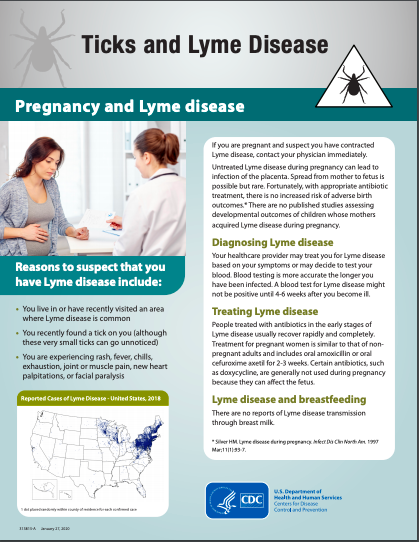
The CDC has updated their website today in three different spots to address the very important issue of maternal-fetal transmission of Lyme disease, from an infected mother to her fetus/baby.

The first update is in the Transmissionsection under ‘Are there other ways to get Lyme disease‘  which states:  ​

‘Untreated Lyme disease during pregnancy can lead to infection of the placenta. Spread from mother to fetus is possible but rare. Fortunately, with appropriate antibiotic treatment, there is no increased risk of adverse birth outcomes. There are no published studies assessing developmental outcomes of children whose mothers acquired Lyme disease during pregnancy.’
The second update is in the Lyme Disease FAQ under the question ‘I am pregnant and think I have Lyme disease, what should I do? which states:
‘If you are pregnant and suspect you have contracted Lyme disease, contact your physician immediately.  Untreated Lyme disease during pregnancy can lead to infection of the placenta. Spread from mother to fetus is possible but rare. Fortunately, with appropriate antibiotic treatment, there is no increased risk of adverse birth outcomes.* There are no published studies assessing developmental outcomes of children whose mothers acquired Lyme disease during pregnancy.’* Silver HM. Lyme disease during pregnancy . Infect Dis Clin North Am. 1997 Mar;11(1):93-7.
The third update is to the Pregnancy and Lyme Disease poster.

Clearly addressing the possibility of transmission from an infected mother to her baby is so important and we hope and trust this will open new doors for families who have expressed concern that their children were infected in-utero, so as to access medical treatment, support, follow-up and care.  This update also provides confirmation of the necessity for urgent, dedicated, scientific and medical research, in this area.

It is clear that the issue of maternal-fetal transmission of Lyme disease requires urgent research and a collective, multi-disciplinary, ‘all-hands on deck’ approach to address this alternate mode of transmission.

We are thankful for CDC leadership on this specific issue. Other countries around the world will take note.

It is time that ALL voices are heard, validated and acted upon. We can and must work together for the sake of our children and future generations.

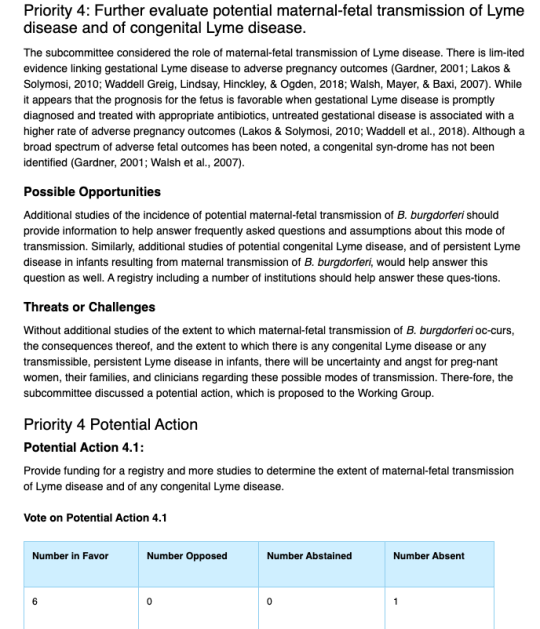
It is also important to note that the HHS Tick-Borne disease working group subcommittee Clinical Aspects of Lyme Disease, recently issued a report which also included a section:
image-233_orig
___________________
And, please remember, this is only about Lyme disease.  Most patients are infected with numerous pathogens which the CDC refuses to recognize.  Transmission studies on these pathogens hasn’t been done because they aren’t even considering them.  The effects of being infected with multiple things isn’t even on their radar, let alone being considered as an issue with maternal transmission.
They continue to tell us over and over ad nauseam that all of this is rare.