By Lisa Kilion
2020 is NOT my worst year.
“What are you talking about?” you ask. “You have something the rest of us don’t have–like a private island? A cure to COVID-19?”
Nearly everyone is stressed, distressed, depressed. It’s the year of not being able to breathe, from George Floyd to those suffering complications from COVID-19. It’s the year of feeling trapped in our homes, of existing in a dreamlike state of daily repetition.
And for us PANDAS/PANS and Lyme folks, trapped in our lives.
Yep. Trapped in our lives, just like any other year. Only this year, for the first time, the entire world has experienced a whopping scoop of our secret, isolated experiences. And guess what? They’re not savoring it.
2020 is hellish for many people, most especially the people who have lost someone dear or become ill themselves. And my condolences to you. Several of my friends lost parents this year, people who were older but not ready to die and to die alone. Several of my friends/family became quite ill.
Didn’t have to wait for 2020
The fact is, I didn’t have to wait until 2020 to have these horrid experiences.
Years ago, I lost someone dear to me–my happy, healthy child, when nearly overnight, their personality was gone and in its place a ticcing, depressed child with OCD.
And with this, my family lost even more–my kids lost much of their childhoods, my husband and I lost a normalcy of parenting, as well as outings, vacations, activities. After school football and soccer practices morphed into doctor appointments. Birthday parties morphed into therapy sessions.
Years ago, my own insidious, dormant case of Lyme flared under the stress of saving my child. So this isn’t my worst year, although 2020 is the year of:
- death
- illness
- prejudice
- isolation
- depression
- paranoia of others
- protecting ourselves against germs
- not trusting medical advice (hydroxychloroquine–yes or no?)
- government and social media censorship
- children being unable to attend school.
If you have a child with a medical illness like PANS/PANDAS/Lyme, then you’ve most likely experienced all of the above already. And I’ll bet this is not the the worst year of your life. I’ll also bet that you’re finding a way to cope.
So for those with P/P and Lyme, here are the boxes to fill in:
Illness?
Check.
Prejudice?
Check for some of us. And for some of us, being a different race or ethnicity makes it even more challenging to receive the proper medical and educational support for these diseases.
Isolation?
Well, sit back down for a long tale.
There is nothing like the isolation of a PANS family living in a world where there is no cure, where people judge your parenting (or your “behavior” if you have PANS yourself), where the social life of your kid is curtailed, never mind your own social life.
There is no isolation like the life of a PANS family when extended family does not understand what is happening, when mainstream doctors don’t believe you, when there is no one treatment and sometimes insurance companies don’t want to cover the costs of the treatments that exist.
There is isolation when your child is too ill to leave with a babysitter, or too at-risk to leave alone even when old enough to drive. There is isolation when one parenting figure must relinquish a job or career to care for the ill child.
Depression?
Us or our kids?
Our kids who are cut off from society, whether from PANS or Lyme or COVID-19, struggle to remain themselves. Our kids who suffer from brain inflammation are submerged in a new world of depression and sink so deeply that their memories of being happy float away like smoke rings. Whether it’s from COVID or PANS, the helplessness over our own situations is all too real.
Paranoia?
Don’t come near me.
Seriously, how many times has a PANDAS parent wondered if another kid in the class has strep? If the dog has strep? If your brother-in-law’s young cousin who came to the family party has a cold which can inflame your child’s brain? (Or, if I myself am carrying it?)
Paranoia is questioning whether you can share the fact that your child has chronic Lyme and is on a cocktail of antibiotics with an emergency room doctor. Paranoia is fearing the doctor who asks why you are using “alternative medicines” and claims that PANDAS isn’t real. It’s retreating into your own worried mind when you hear stories about other PANDAS parents being accused of Munchausen’s.
Paranoid much? Checkcheckcheckcheck.
Protecting ourselves against germs?
This means not showing up to family parties when you hear someone has a “slight” cold, wiping down surfaces (that action did NOT start in the year 2020, folks), imagining the air that others breathe out has a soft gray roundness to it, marking the bacteria. Wearing masks, prior to 2020.
Not trusting medical advice?
This was a hard one for me, as I was brought up to do whatever the doctor ordered (which did help me immensely when working with a LLMD or LLNP and a strict Lyme protocol).
How do you trust when the young doctor tells you that your child’s inability to control air hunger is caused by stress, and then you notice the lab report states your child is positive for Lyme, which the doctor then claims is a false positive?
How do you trust mainstream doctors after the PANDAS/Lyme doctor prescribes medications which completely eradicate the air hunger (caused by Babesia, for those who want to know). And that is only one example.
Media and government censorship?
Why don’t doctors believe in chronic Lyme, again? Why is the IDSA still against it when well over 700 peer-reviewed studies [showing the persistence of Lyme] have been conducted? Why does the government support the IDSA and spend more money on diseases that affect far fewer people? And don’t even go there when it comes to vaccines which children with immune issues are supposed to be exempt from (and protected by herd immunity).
Children unable to attend school?
PANDAS and Lyme can result in:
- separation anxiety
- inability to think or focus
- constant bathroom runs/ need to urinate
- decline in math ability
- blurriness which affects reading
- handwriting
- impulsivity
- emotional control
- sweats
- joint pains
- fatigue
- insomnia
Oh, we tried, years ago, for our child to connect with a class via a computer. But the world was not ready for it. And then 2020 happened and we went virtual overnight (I know, I’m a teacher and it’s been a job x 1,000). But it’s possible.
Checkmate.
So if this isn’t my worst year, what was?
Maybe it was the year my healthy, happy child became ill and no one could accurately diagnose the issue.
Maybe it was the year we HAD to get an attorney to deal with the school system and withdrew $10,000 from our now nearly extinguished savings account, to pay for said lawyer.
Maybe my worst year was when we had to weigh options for a child at risk–why is there a schism between medical and psychiatric support when it comes to hospitalization? What do you do when a medical issue causes severe depression? Why won’t anyone out there help?
Maybe my worst year was when my marriage was dragging along like a bottom feeder. (Note: we are much stronger and happier now.)
Maybe my worst year was when I discovered my other child had Lyme also. At the same time I discovered I did as well, and most likely gave it to my kids when pregnant.
Maybe my worst year was when I was too sick to take my daughter to the swimming class she begged for, when no one at my job knew that I could barely walk down the hall due to dizziness and fatigue, when I gave the best of me to my students and not to my own kids, when I’d collapse on my bed at home after work while my husband cooked dinner, only to listen as conversations drifted upstairs.
But….
But that was also the year I became involved with the Lyme Disease Challenge. That was the year I wrote many articles about PANDAS, PANS and Lyme. That was the year I continued to connect with others and to learn from these new communities. That was the year I understood on a deeper level the pain my kids endured. And that was the year, like all the other years, that I rubbed my child’s back until they fell asleep.
I have learned multiple lessons from these worst years
- A truly horrendous year does not mean that I am immune from more horrendous years. There’s no such thing as paying my dues. Life does not owe me a good year.
- Get it all out. Write. Cry. Weep over your laptop, sob beneath your sunglasses in the parking lot of supermarket, pound your pillows. Bicycle or run as hard as you can.
- Then, do something for someone else. Get out of yourself. Text a friend to check up on them. Sign up to advocate for Lyme, PANS, or anything else that needs your support.
- Connect. My husband and I have been cycling through this year. We have close friends who bicycle with us. I have a friend with whom I walk (socially distanced). I text with my colleagues, my cousins, my siblings. I’m not usually a fan of Zoom gatherings as I spend all day on Google Meets with my own students. Get on social media and respond with positivity and inspiration to someone else’s cry for help.
- Avoid social media except when you’re using it for a calculated reason–for me, that means joining writing groups, teaching groups and Lyme, PANS groups. But avoid negativity and posts that show off on FakeBook. It hurts to see kids achieving and fancy famiy vacations (not this year!) when we hang out in the jungle of medical mishigas [craziness].
- Set new goals. Maybe going to college directly from high school–with high honors–isn’t the path for everyone. Maybe the fact that my kid is willing to continue undergoing medical treatment is worthy of an award. Maybe getting through each day and smiling at a cashier is an achievement.
- Recognize character. There is much love, caring, resilience and perseverance among the parents in the PANS and Lyme support groups. We are on both sides of the street politically, yet we come together in our quest to save our children. As an adult, it is astonishing to see the strength of the love of so many parents.
- Exercise! Now this can be a hard one if you’re physically incapacitated or have young children or kids who cannot be left alone. When my husband was very ill, we got him an “under desk pedal exerciser.” Do ANYTHING! At my sickest, which wasn’t as sick as some who suffer from Lyme, I could manage only 14 miles on my bicycle, and that was with energy gels. I’d have to rest the day after. I’d have to rest after showering. Now exercise is my mindfulness activity; it’s one of my keys to mental health.
- Stay balanced. This one is hard. I’ve been trying to step back from the decisions that my teenagers make, since I have no control, focusing instead on presenting data and options and, lastly, bringing my focus back to myself and what I actually can do. I don’t have much control over my teens. I can show love. And impatience, sometimes. I can guide. I can teach through example. I can be my most-fulfilled self.
- Practice gratitude. I am thankful for our doctors, for certain individuals at the schools who have been extremely responsive and helpful. I am so grateful for my husband. And my doggies. Friends, both in and out of the PANDAS/LYME world. My bicycle. My computer. My hands, which now have arthritis from Lyme, but which still work for me. My legs, which are strong. My brain, which is back after floating with unicorns for a short while. And I’m grateful that my kids continue to fight and have turned into warm, creative people who can express themselves.
2020…
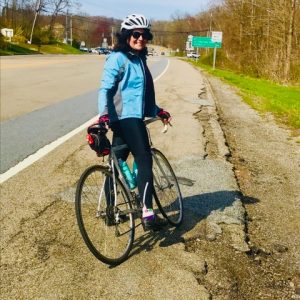 2020 is the year that I have bicycled more than 3,000 miles. It is the year that my oldest takes his disease seriously and pushes forward with treatment, submitting himself to monthly IVIGs that give him nausea and headaches. 2020 is the year that I am totally in love with my husband of 22 years, the year that my dogs are always happy to see me (that’s every year), my daughter becomes a social media genius who helps my son’s band get 100,000 views in one week.
My goal has been to reach beyond the trappings of PANS and Lyme–and now COVID-19 also–and find my life again. I’m out there, cycling, straight through frigid winter months as long as the ground isn’t coated in ice. I’m working on my writing, my novels, my dreams.
2020 is NOT my worst year, but I am forever changed by the worst years I have survived.
Lisa Kilion lives in New York. This post was originally published on her blog PANS Life.






Rapid Response:
Re: Tick bite
Dear Editor
Razai et al, in their consultation on tick bite, missed an important message to learners (1).
The most common infectious agents transmitted by Ixodes species ticks in North America that have the potential for co-infection with B burgdorferi are Anaplasma phagocytophilum, Babesia species, deer tick (Powassan) virus, Borrelia miyamotoi, and the Ehrlichia muris–like agent (2).
A phagocytophilum is transmitted by the same Ixodes ticks as B burgdorferi in the United States and causes fever, chills, headache, myalgia, and fatigue arising 1 to 3 weeks following tick exposure. Most cases are mild and self-limited. However, severe manifestations may include respiratory failure, adult respiratory distress syndrome, peripheral neuropathy, rhabdomyolysis, acute renal failure, pancreatitis, and coagulopathies.
It has been found that in Wisconsin, approximately 3% of I scapularis ticks examined were co-infected with B burgdorferi and A phagocytophilum (3). A similar study in 11,000 ticks in public parks of New York State’s Hudson Valley Region found that co-infection rates of nymphs and adults were 0.5% and 6.3%, respectively (4).
The frequency of humans with Lyme disease simultaneously co-infected with A phagocytophilum from various studies ranges from 2% to 10% (5,6). Similirly, Babesiosis is transmitted through the bite of infected I scapularis and I pacificus ticks. Most patients are asymptomatic or have mild, self-limited disease but may be complicated by renal failure, acute respiratory distress, and shock.
In a study of patients with Lyme disease from southern New England, approximately 10% were co-infected with babesiosis (7).
Unlike Lyme disease and Anaplasmosis, doxycycline is not an effective treatment of babesiosis and requires atovaquone and azithromycin or combination of clindamycin with quinine, making it imperitive to consider this diagnosis in mind in patients with tick bite.
Of the 3 species of Ehrlichia in United States, only E muris–like (EML) agent is transmitted by I scapularis is the vector of this emerging pathogen(8).
Possible co-infections should be considered in any patients who are diagnosed with tick bite or Lyme disease, especially those who have unexplained leukopenia, thrombocytopenia, or anemia, or who fail to respond to treatment for Lyme’s disease.
References:
1- Razai MS, Doerholt K, Galiza E, Oakeshott P. Tick bite. BMJ 2020;370:m3029
2- Caulfield AJ, Pritt BS. Lyme disease Coinfections in the United States. Clin Lab Med 2015;35:827–846.
3- Lee, X, Coyle DR, Johnson DK, et al. Prevalence of Borrelia burgdorferi and Anaplasma phagocytophilum in Ixodes scapularis (Acari: Ixodidae) nymphs collected in managed red pine forests in Wisconsin. J Med Entomol 2014;51:694-701.
4- Prusinski MA, Kokas JE, Hukey KT, et al. Prevalence of Borrelia burgdorferi (Spoirochets: Spirochaetaceae), Anaplasma phagocytophilum (Rickettsiales: Anaplasmataceae), and Babesia microti (Piroplasmida: Babesiidae) in Ixodes scapularis (Acari: Ixodidae) collected from recreational lands in the Hudson Valley Region, New York State. J Med Entomol 2014;51:226-36.
5- Horowitz HW, Aguero-Rosenfeld ME, Holmgren D, et al. Lyme disease and human granulocytic anaplasmosis coinfection: impact of case definition on coinfection rates and illness severity. Clin Infect Dis 2013;56;93-9.
6- Steere AC, McHugh G, Suarez C, et al. Prospective study of coinfection in patients with erythema migrans. Clin Infect Dis 2003;36:1078-81.
7- Krause PJ, Telford SR, Spielman A, et al. Concurrent Lyme disease and babesiosis – evidence for increased severity and duration of illness. JAMA 1996;275:1657-60.
8- Pritt BS, McFadden JD, Stromdah E, et al. Emergence of a novel Ehrlichia sp. agent
pathogenic for humans in the Midwestern United States. 6th International Meeting
on Rickettsiae and Rickettsial Diseases. Heraklion (Greece), June 5–7, 2011.
_______________________
**Comment**
This important letter to the editor highlights many contentious issues Lyme/MSIDS patients have to muddle through. From where I sit, I disagree with the author’s statements that these infections are ‘mild and self-limited’, but I deal with sick people – not healthy. If there’s one thing I DO know, it’s that these infections have been downplayed for far too long, and it’s been a real problem. Patients haven’t been taken seriously for over 40 years!
The consideration of coinfections; unfortunately, is not common in mainstream medicine regarding Lyme/MSIDS. They still treat this as a one germ disease with doxycycline curing it, when nothing could be further from the truth: https://madisonarealymesupportgroup.com/2018/10/30/study-shows-lyme-msids-patients-infected-with-many-pathogens-and-explains-why-we-are-so-sick/