Archive for the ‘Herbs’ Category

Master Herbalist and Friend Stephen Buhner Has Died & 2016 Interview

https://www.lymedisease.org/herbalist-and-healing-lyme-author-stephen-buhner-has-died/

Herbalist and “Healing Lyme” author Stephen Buhner has died

Stephen Harrod Buhner, a skilled herbalist and the author of many books about natural healing, has died, reportedly of pulmonary fibrosis.

In the Lyme disease community, he is probably best known for his book Healing Lyme: Natural Prevention and Treatment of Lyme Borreliosis and Its Co-infections.

A post on his Facebook page announced his passing like this:

There is a saying some places on the continent of Africa that says something like: When an old man dies, a library burns. It was a favorite among many of Stephen’s. An elder has died. Stephen died yesterday morning, December 8th around 9:30 am mountain time. He was in ceremony with friends and family. He was aware, conscious, present, open hearted and humorous. He was himself all the way through. And so very brave. Our hearts are heavy as they have ever been. We miss him terribly. He will be buried this morning in his beloved forest.

Five days earlier, the author made the following post on his Facebook page:

Regrettably, my body has taken a severe turn for the worst; it doesn’t look like it will be able correct. I spend most of the day sleeping; I am having seizures and mini-strokes now. Julie brings me back from them but it is getting harder and harder for her to do so. It’s only a few more days now. Sorry for this last long journey into night. I had hoped to find a different outcome.

Pulmonary fibrosis is not a kind disease and in many ways cancer is far more benevolent oddly enough. I have spent most of my time on the couch in front of the computer or about 20 feet away lying in bed, that is about all I can do and I have to have help to make it that far. I can no longer move on my own. Your very kind donations have allowed us to clear all our credit cards and buy a few expensive care items that we had hoped to have and which have helped immensely. You have helped us so much at the end; this has made more of a difference than you know and I can’t thank you deeply enough.

I am lucky enough to be buried deep in the Gila Forest in a place few people are aware of. luckily, New Mexico is still supportive of home and green burial. So it is just me and my beloved forest, right adjacent to the Aldo Leopold wilderness area which makes a lot of sense to me given my life work. The truth is that as I have grown older and more tired, I feel my connection to the land more deeply. I have been lucky enough to be buried in a handmade woolen shroud. One made with care and love, the deer buttons are quite lovely.

I did manage to finish my last book, Becoming Vegetalista. It will be out in a number of weeks. Only 500 or so; I did not get to see it in print. I left quite a number of signed stickers to be placed in some of the books though I don’t expect them to last long. I wish you all the best, safe travel in your lives.

Green blessings,

Stephen Harrod Buhner

According to its listing on Amazon, Becoming Vegetalista: Veriditas and the Journey to the Self, is the latest in a series that began with Sacred Plant Medicine, continued with the award-winning Lost Language of Plants, followed by The Secret Teachings of Plants, and most recently with Plant Intelligence and the Imaginal Realm.

________________

**Comment**

It is with a sad heart I post this.  Buhner was a friend to the suffering and to those who couldn’t afford doctors, or chose not to see them.  To this day when helping a fellow patient who can’t afford traditional medicine and doctors, utilizing Buhner’s books which explain how to use whole, bulk herbs is still the cheapest treatment available.  It takes diligence and tenacity but has helped many recover their health.

A patient recently sent me this 2016 interview with Buhner.  Per usual, it’s excellent information:  https://thetrek.co/lyme-disease-misconceptions-interview-stephen-harrod-buhner/

For more:

Hottest Lyme Disease Treatment Update 2022

https://www.treatlyme.net/guide/hottest-lyme-treatment-updates-2022  Video Here (Approx. 11 Min)

Hottest Lyme Disease Treatment Updates in 2022

Marty Ross MD on Top Lyme Treatment Updates of 2022

In the video in the link above Marty Ross MD describes the latest Lyme disease treatment updates in his integrative medicine practice. For more information about the topics discussed in the video article see the following resources:

Dr. Ross’s new book, Hacking Lyme Disease: An Action Guide to Wellness, will be released by early December 2022.

Disclaimer

The ideas and recommendations on this website and in this article are for informational purposes only. For more information about this, see the sitewide Terms & Conditions.

________________

**Comment**

Dr. Ross discusses peptides. These are not antimicrobials but help the body in fighting off infections and restoring the issues infections cause.  Ross as well as Dr. Holtdorf is evidently having a lot of success with them.

Ross also discusses biofilm busters such as lumbrokinase, which helps improve circulation, decrease muscle pain, and improve medicine delivery deep into tissues.  Those with hypercoagulation would also do well to check it out.  

A golden nugget he discussed was the finding that cryptolepis, a drug normally given for Babesia, also has action against Lyme (in vitro – or the lab, which may not transfer over to the human body or in vivo) This study also found that black walnut, Japanese knotweed, sweet wormwood, ccat’s claw, Cistus incanus, and Chinese skullcap at 1% extracts had good activity against Bb’s stationary phase compared to control antibiotics doxycycline and cefuroxime.

Important note: The minimum inibitory concentration (MIC) values of Artemisia annua, Juglans nigra, and Uncaria tomentosa were quite high for the growing phase of Bb, despite their strong activity against the non-growing stationary phase. On the other hand, the top two active herbs, Cryptolepis and Japanese Knotweed showed strong activity against both growing Bb and non-growing stationary phase.  In subculture studies, only 1% Cryptolepis extract caused complete eradication, while doxycycline and cefuroxime and other active herbs could not eradicate B. burgdorferi stationary phase cells as many spirochetes were visible after 21-day subculture.

Ross states both herbs are helpful for Bartonella as well as diflucan/fluconazole.  My LLMD had us pulse diflucan twice a week throughout our entire treatment (5 years).  I can say with experience we herxed on this drug, often.  It is a known anti-fungal; however, Dr. Hoffman (RIP) stated he believed it did far more than that, and I tend to agree having taken it.

In contrast, the study showed that Stevia rebaudiana, Andrographis paniculata, Grapefruit seed extract, colloidal silver, monolaurin, and antimicrobial peptide LL37 had little or no activity against stationary phase B. burgdorferi A few years ago all kinds of headlines came out that stevia cured Lyme. Nothing could be further from the truth.  Per usual, if something seems too good to be true, it usually is.

Dr. Klinghardt uses a sublingual form of Hyaluronic Acid to fool the cyst forms to open and become spirochetes so they can be killed by antimicrobials.  For more on Klinghardt’s treatment:  Klinghardt Lyme Protocol.

Hyaluronic Acid is a type of sugar molecule.  Many other Lyme literate doctors also use forms of sugar such as Stevia or Erythritol as “cyst busters,” in their treatment regimens.  Look for reputable sources of Erythritol as it is most commonly made with GMO cornstarch.

For more:

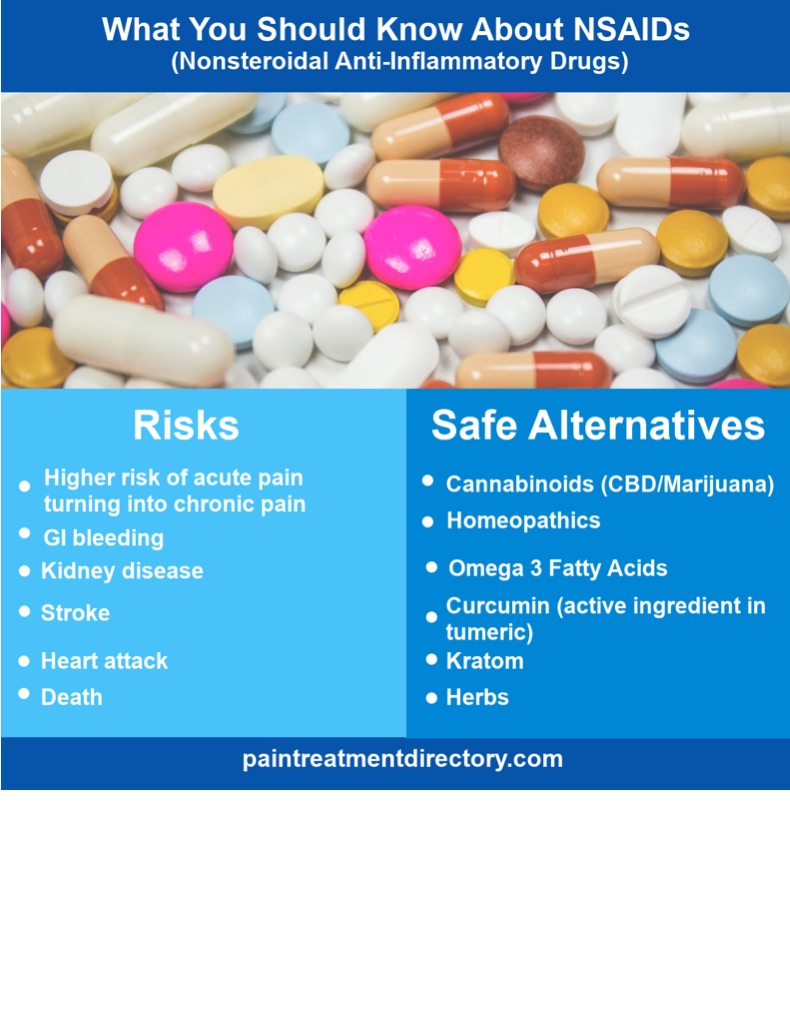
NSAIDs: Unsafe for Chronic Pain

https://www.paintreatmentdirectory.com/posts/nsaids-unsafe-for-chronic-pain

NSAIDs: Unsafe for Chronic Pain

NSAIDs: Unsafe for Chronic Pain

The Problem

If you take any of the following nonsteroidal anti-inflammatory drugs (NSAIDs) for pain relief you are putting your life at risk: aspirin, celecoxib (Celebrex), diclofenac (Cambia, Cataflam, Voltaren-XR, Zipsor, Zorvolex), ibuprofen (Motrin, Advil), indomethacin (Indocin), naproxen (Aleve, Anaprox, Naprelan, Naprosyn), oxaprozin (Daypro), piroxicam (Feldene). This may come as a shock to you. After all, these drugs have been around for decades and many are available over the counter.

It has long been known that NSAIDs increase the risk of potentially fatal stomach and intestinal adverse reactions including bleeding, ulcers, and perforation of the stomach or intestines. These events can occur at any time during treatment and without warning symptoms. Elderly patients are at greater risk for these adverse events. Aspirin alone causes over 3000 deaths annually in the United States.

NSAIDs, except for aspirin, increase the risk of a potentially fatal heart attack or stroke, according to an FDA advisory issued in July, 2015. The FDA warned that “those serious side effects can occur as early as the first few weeks of using an NSAID, and the risk might rise the longer people take NSAIDs”. “There is no period of use shown to be without risk,” says Judy Racoosin, M.D., M.P.H., deputy director of FDA’s Division of Anesthesia, Analgesia, and Addiction Products. People who already have cardiovascular disease, particularly those who recently had a heart attack or cardiac bypass surgery, are at greatest risk. However, “Everyone may be at risk – even people without an underlying risk for cardiovascular disease,” says Racoosin.

Heavy or long term use of NSAIDs can also cause kidney damage.

Unfortunately, another widely available over the counter pain reliever, acetaminophen (brand name Tylenol) also carries significant risks. If used long term at higher than recommended doses or in individuals whose liver function is compromised, acetaminophen can cause liver failure. Liver failure is fatal without a liver transplant. Acetaminophen is the most frequent cause of liver failure in the United States today.

The Solution

With prescription opioids becoming increasingly restricted due to concerns about addiction, as well as growing evidence that they may cause more pain over the long term, what can a chronic pain patient do?

Fortunately, there are many safe and effective natural treatments for chronic pain. Here are some things you can take for pain relief: medical marijuana, CBD oil, kratom (a Southeast Asian herb that the FDA and DEA are currently trying to ban based on false allegations that it is unsafe), wild lettuce, turmeric, omega 3 fatty acids, homeopathic remedies such as arnica, ruta or hypericum, magnesium, vitamin D3 and many other herbs and nutrients. Here are some things that you can do: acupuncture, biofeedback, chiropractic, EMF treatment, exercise, hypnotherapy, low level laser therapy, massage, nutritional therapy, physical therapy, psychotherapy and much more. Some combination of these treatments can not only reduce your pain, they just might heal the underlying problem and eliminate your pain for good. 

To find out more about safe alternatives for pain relief, visit the online Alternative Pain Treatment Directory

Check out our recommended pain relief products HERE

Check out our alternative pain treatment providers HERE

To continue receiving important information about pain treatment, sign up for our free e-newsletter HERE

___________________

**Comment**

Lyme/MSIDS patients often cope with intractable, grueling pain.  The stuff that stops you in your tracks & brings life to a grinding halt leaving you a shell of your former self.

I have found the following to be of great help:

For more: 

Why Chronic Lyme Treatment Fails – A Review With Strategies

https://www.treatlyme.net/guide/why-chronic-lyme-treatment-fails

Why Chronic Lyme Treatment Fails – A Review with Strategies

By Dr. Marty Ross

Why Lyme Disease Treatment Fails Image

About Fifteen Percent of People with Chronic Lyme

This article is about the reasons people remain ill with chronic Lyme disease even after taking one to two or even more years of herbal or prescription antibiotics. In my experience, this seems to be about 15 percent of people with chronic Lyme disease. The other 85 percent of people do have various degrees of recovery – most getting very well.

Lyme literate medical doctors (LLMDs) have very limited science to guide us about why treatment works or fails – and what the best treatment options are. The last United States National Institutes of Health funded human trials looking at treating Lyme were nearly 20 years ago. We do know from a study conducted by the MyLymeData project of LymeDisease.org that the best chance of recovery is provided by a year or more of antibiotics and working with an LLMD. You can read more about the MyLymeData studies, including those on alternative medicine outcomes versus antibiotic outcomes in What Works? Navigating Prescription & Alternative Medicine Lyme Treatments.

With the lack of human studies, most of the science I use to guide my treatment decisions comes from laboratory, non-human experiments. Fortunately, these experiments provide insights about herbal and prescription treatment options that can work in many. These experiments also provide a number of theories about what can work for treatment and why people do not recover even with long-term antibiotics.

How to Avoid Chronic Lyme Treatment Failure

Before I review the treatment failure theories, let’s discuss what steps you should take to have a successful Lyme recovery.

Kill Germs AND Correct All Body Wide Imbalances

Treating Lyme is complicated. The infection triggers an immune system cytokine reaction that affects most organs and systems of the body. In my experience, the great majority of people can recover if they address each of the steps in The Ross Lyme Support Protocol. This protocol is designed to kill Lyme and coinfection germs and to correct all of the sleep, immune system, detoxification, inflammation and hormonal imbalances created by Lyme. If your treatment did not work, but you only took herbal or prescription antibiotics alone, look at The Ross Lyme Support Protocol to see all of the areas you should have addressed that provide the best chance of recovery.

Find and Treat Mold Toxicity

Chronic mold toxicity looks just like chronic Lyme disease. Make sure you do not have this problem. And if you do – correct it. See Mold and Lyme Toxin Illness for more information.

Theories & Strategies About Lyme Treatment Failure

There are a number of theories why people remain ill even after getting rid of mold toxins and treating with a comprehensive regimen that kills germs and addresses all imbalances identified in The Ross Lyme Support Protocol. The reasons include:

  • Borrelia (Lyme) persisters
  • autoimmune disease triggered by the Lyme infection
  • disruption of a healthy gut microbiome
  • germ debris
  • limbic system brain holding of the illness
  • tissue damage from the infection
  • chronic inflammation and immune dysfunction
  • learned illness behavior and/or somatic disorder
Persisters

The Borrelia persisters theory is an in-vogue and relatively new idea about why treatments do not work. The idea is: under assault from antibiotics (RX or herbal) some of the Lyme germs go into a persister hibernation state. These persisters do not respond to regular antibiotics. We will have to see in time if addressing persisters does help to prevent or correct treatment failures. In my practice, all of my current treatments include antimicrobial approaches to address persisters.

For more information about persisters and how to address them see How to Treat Persister Lyme & Bartonella.

Autoimmune Disease

Through a process known as molecular mimicry, the immune system may attack tissues with protein and molecular parts that look just like parts of Lyme. At this time there is not a Lyme specific way to address this. But for some – using Low Dose Naltrexone (LDN) can regulate or reverse the autoimmune attack.

For more information about LDN see Low Dose Naltrexone (LDN) & Lyme.

Disruption of Healthy Gut Microbiome

Treating Lyme with herbal or prescription antibiotics disturbs the healthy balance of good germs and microbes in the gut. The germs that live in the intestines are called the gut microbiome. These include healthy bacteria, viruses, parasites, yeasts and fungae. To put the amount of microbes in perspective, over 90 percent of the genetic material in human bodies come from the microbes in the gut!

We allow these germs to live in us because they serve a purpose. Studies show these microbes regulate the immune system, signal healthy brain function, digest food, remove toxins and things we are allergic to and provide many other healthy body regulating functions.

The theory is antibiotics disturb the healthy gut microbiome leading to ongoing body-wide illness. It is not clear yet how best to address this issue or if the gut disruption really does cause ongoing illness.

One treatment option is to create a healthy gut microbiome using probiotics. Another one is to replace the dysfunctional microbiome through a stool transplant – also called fecal microbiota transplant (FMT). However, FMT is regulated by the US Food and Drug Administration (FDA). At present it is only allowed for treatment of C. difficile bacteria overgrowth in the intestines. And there has not been any research done about whether it could change the outcome of those with chronic Lyme disease.

Treating Lyme is about balancing risks and benefits. The benefit of using herbal and prescription antibiotics is decreasing or eliminating the Lyme or coinfection (like Bartonella or Babesia) germs leading to improved health. But the risk of doing so is disturbing the gut microbiome.

See Probiotic Strategies in Lyme Disease Treatment for information about probiotics and C. Difficile Diarrhea: Prevention & Treatment for more information about FMT.

Germ Debris

The immune system is supposed to break down and get rid of dead germs and their parts including DNA, RNA, proteins and fats. One theory why people remain ill is that the immune system does not get rid of all the borrelia germ debris. The debris triggers an ongoing immune inflammatory response. At this time there is not a treatment I am aware of for this possible problem.

Limbic System Brain Holding of The Illness

The limbic system is a part of the brain that regulates our emotional responses and behaviors. This includes fight-or-flight responses, fear, and survival behaviors like feeding the young and reproduction.

For some in Lyme the limbic system becomes overly reactive leading to a brain holding of illness. This causes some of the ongoing symptoms like pain or even fatigue. Much of this is unconscious.

There are a number of programs that can help reprogram the limbic system brain holding of the illness. Two of the more popular programs are the Gupta Program and Annie Hopper Dynamic Neural Retraining System. Many of my patients have found benefit from these practices. Short of doing these programs, developing a meditative mindfulness practice can help too. Counseling may also help to decrease emotional reactivity.

Tissue Damage

Another theory is Lyme and the immune reaction to it lead to ongoing tissue damage and injury even when the infection is gone or under control. This leads to pain, neurologic and brain dysfunction, mitochondria cell energy factory dysfunction and even immune dysfunction.

My current approach to repairing muskuloskeletal tissue injury and peripheral nerve injury is to use the peptide BPC-157. For brain injury I also add the peptide Cerebrolysin. See Repair & Restore with Peptides in Lyme Disease or Mold Toxin Illness for more information about peptides and BPC-157. For people with low energy I work to repair the mitochondria. See How to Fix Mitochondria & Get Energy in Lyme Disease.

Chronic Inflammation and Immune Dysfunction

Under this theory, Lyme infection sets off an ongoing immune inflammation reaction that takes on a life of its own – causing more inflammation and immune dysfunction. One reason this could happen is due to an imbalance between what is known as Th1 and Th2/Th17 parts of the immune system. Th1 is made up of immune cells that attack germs like T white blood cells and macrophages. Th1 is the immune system offense squad. Th2/Th17 is made up of B white blood cells that make antibodies, mast cells involved in allergies and histamine production, and immune barrier cells that line the mucous and skin membranes designed to keep germs out. Think of Th2/Th17 as the immune system defensive squad. If Th2 and Th17 get too active they release inflammatory cytokines that lead to many ongoing Lyme type symptoms and they can suppress Th1 and its germ fighting abilities.

In my practice I work with LDN I mentioned above to increase TReg cells that create balance between Th1 and Th2/Th17. Another option is to use the peptide TB4 Frag. For more information about these treatment options see Repair & Restore with Peptides in Lyme Disease or Mold Toxin Illness and Low Dose Naltrexone (LDN) & Lyme.

Learned Illness Behavior and/or Somatic Illness

These are two psychological conditions. I list them here to be thorough, but I am concerned that many non-LLMDs use these diagnoses to say Lyme disease is in a person’s head instead of acknowledging and treating them for a physical illness. In my experience, it is a rare person with chronic Lyme that has one of these conditions contributing to their illness. Counseling is helpful if one of these occurs.

Disclaimer

The ideas and recommendations on this website and in this article are for informational purposes only. For more information about this, review the sitewide Terms & Conditions.

References

  1. Bobe JR, Jutras BL, Horn EJ, et al. Recent Progress in Lyme Disease and Remaining Challenges. Front Med (Lausanne). 2021;8:666554. Published 2021 Aug 18. doi:10.3389/fmed.2021.666554 (View)
  2. Cabello FC, Embers ME, Newman SA, Godfrey HP. Borreliella burgdorferi Antimicrobial-Tolerant Persistence in Lyme Disease and Posttreatment Lyme Disease Syndromes. mBio. 2022;13(3):e0344021. doi:10.1128/mbio.03440-21 (View)
  3. Fallon BA, Sotsky J. Conquering Lyme Disease: Science Bridges the Great Divide. New York: Columbia University Press; 2018.
  4. Sanabria-Mazo JP, Montero-Marin J, Feliu-Soler A, et al. Mindfulness-Based Program Plus Amygdala and Insula Retraining (MAIR) for the Treatment of Women with Fibromyalgia: A Pilot Randomized Controlled Trial. J Clin Med. 2020;9(10):3246. Published 2020 Oct 11. doi:10.3390/jcm9103246 (View)

About the Author

Marty Ross, MD is a passionate Lyme disease educator and clinical expert. He helps Lyme sufferers and their physicians see what really works based on his review of the science and extensive real-world experience. Dr. Ross is licensed to practice medicine in Washington State (License: MD00033296) where he has treated thousands of Lyme disease patients in his Seattle practice. 

Marty Ross, MD is a graduate of Indiana University School of Medicine and Georgetown University Family Medicine Residency. He is a member of the International Lyme and Associated Disease Society (ILADS) and The Institute for Functional Medicine.

For more:

Tonight: “Lyme Brain & Fibro Fog” With Dr. Rawls

Join Dr. Bill Rawls for a LIVE WEBINAR + Q&A TONIGHT at 8pm EDT as he explains what causes the neurological symptoms and brain fog that often accompany chronic Lyme disease and fibromyalgia.

Dr. Rawls will also share natural remedies for long-lasting relief.

Some of the things discussed in this webinar will be:

  • Why cognitive symptoms like confusion, short-term memory loss, anxiety, anger, and depression are so common in chronic illness patients such as those with Lyme disease, fibromyalgia, and Long COVID
  • How microbes, inflammation, and immune dysfunction disrupt cognitive function
  • The best herbs and natural remedies for restoring and protecting brain health
  • Diet tips and other lifestyle factors that help ease symptoms
  • Numerous insights during the LIVE Q&A with Dr. Rawls

Join us, and bring your questions! Plus, we will announce a free gift and drawing for webinar attendees.

Reserve Your Seat Now »