Archive for the ‘Anaplasmosis’ Category

US Health Officials Warn a Lesser-Known Tick-Borne Infection is On The Up

https://www.iflscience.com/health-and-medicine/on-top-of-lyme-disease-a-lesserknown-tickborne-infection-is-on-the-up/

US Health Officials Warn A Lesser-Known Tick-Borne Infection Is On The Up

By Tom Hale

07 JUL 2021

A little-known and rare tick-borne disease is on the rise in the US. Known as anaplasmosis, the bacterial disease is spread to people by tick bites, primarily from the blacklegged tick (Ixodes scapularis) and the western blacklegged tick (Ixodes pacificus), two species associated with the better-known infection of Lyme disease. 

Health officials in New York’s Onondaga County recently reported an unexpected case of anaplasmosis in Central New York. They also explained that recent years have seen an uptick (excuse the pun) of cases of this once-rare disease in the area. While a total of three cases were reported in Onondaga County from 2015 to 2020, there have been six reported cases so far this year. 

“In New York state, the disease is spread by the blacklegged tick (Ixodes scapularis), which is the same type of tick that typically spreads Lyme disease,” Dr Indu Gupta, health commissioner of Onondaga County, said in a statement. “If we are diligent in practicing the same prevention measures we’ve learned to prevent Lyme disease, we are protecting ourselves from other tickborne diseases including anaplasmosis.” 

(See link for article)

____________________

**Comment**

The US Centers for Disease Control and Prevention (CDC) suggests a similar rise of anaplasmosis is being seen across the country.

The article states that if you see a rash, get to your doctor.  (Many never get a rash and are still infected)

I would state get to your doctor for ANY known tick-bite and request prophylactic treatment.

It is widely known and accepted that prompt diagnosis and treatment is crucial and if treatment is delayed, Anaplasmosis can cause severe illness involving:

  • respiratory failure
  • bleeding problems
  • organ failure
  • death

Treatment for Anaplasmosis is doxycycline which has the advantage of treating numerous tick borne illnesses such as:

  • Lyme (borrelia)
  • Ehrlichia, Anaplasma
  • Q Fever
  • Rocky Mountain Spotted Fever

ILADS states the downside is that Doxy causes significant sun sensitization, can be hard on the stomach, and the usual dosing may not reach therapeutic levels. 

Recent data suggests that treatment may not clear organisms in animals.

Doctors Warn CDC, “It’s Not All COVID” And Anchoring Bias is Causing Doctors To Miss Tick-Borne Infections

https://wwwnc.cdc.gov/eid/article/27/8/21-1107_article

Volume 27, Number 8—August 2021
Research Letter

COVID-19 and the Consequences of Anchoring Bias

Harold W. HorowitzComments to Author , Caren Behar, and Jeffrey Greene
Author affiliations: Weill Cornell Medicine, New York, New York, USA (H.W. Horowitz)New York-Presbyterian Brooklyn Methodist Hospital, Brooklyn, New York, USA (H.W. Horowitz)New York University Langone School of Medicine, New York (C. Behar, J. Greene)

Abstract

Suspicion of coronavirus disease in febrile patients might lead to anchoring bias, causing misdiagnosis of other infections for which epidemiologic risks are present. This bias has potentially severe consequences, illustrated by cases of human granulocytic anaplasmosis and Lyme disease in a pregnant woman and human granulocytic anaplasmosis in another person.

Coronavirus disease (COVID-19) took the United States by force during the first quarter of 2020, affecting the economy, societal norms, and the delivery of medical care (1,2). As fear of COVID-19 has spread, diagnosing COVID-19 in febrile persons has been prioritized, and patients may be presumed to have COVID-19 pending results of testing for severe acute respiratory syndrome coronavirus 2 (SARS-CoV-2). This mindset has had unintended consequences, including delaying of evaluations for other infectious diseases, potentially leading to adverse outcomes. We describe 2 cases that illustrate this point.

In the first case, a 35-year-old man left New York, New York, USA, to go hiking in Maryland during June 5–June 7, 2020. He experienced fever, body aches, and fatigue during June 10–13 that resolved but left him fatigued and weak. He was seen on June 19; laboratory results were unremarkable, but lymphopenia was detected. He tested negative for SARS-CoV-2 on June 19 and June 25 by PCR. On June 25, ELISA for Lyme disease was positive, and reflex to Western blot revealed IgM 41-kD, 39-kD, and 23-kD bands but no IgG bands. Fever up to 38°C recurred on June 22 and lasted until June 29; he also experienced persistent fatigue and myalgia. Further testing on July 6 revealed serologic results for Lyme similar to results from June 25 and Anaplasma phagocytophilum titers of IgM 1:320 and IgG 1:1260. Anaplasma PCR was negative on that date. He was treated with doxycycline for 10 days and recovered.

In the second case, a 31-year-old woman who was 6 months pregnant left New York at the end of May 2020 to rent a house in Ulster County, New York. On June 3, she removed a tick from her neck. On June 9, she experienced severe headaches and the next day had low-grade fever, chills, and body aches. She had no cough, shortness of breath, or sore throat. On June 10, she tested negative for SARS-CoV-2 by PCR. She continued to have extreme fatigue, myalgia, and low-grade fever. She was prescribed oseltamivir by her obstetrician on June 11. On June 14, she felt better. Repeat PCR testing for SARS-CoV-2 on June 15 was negative. She continued to improve until June 23, when she experienced recurrent fever up to 38.9°C, chills, and lethargy. She contacted her obstetrician and was told she had a presumptive diagnosis of COVID-19. On June 30, she saw her internist and underwent laboratory testing for tickborne illnesses; she was treated empirically with amoxicillin because of her risks for Lyme disease. PCR for A. phagocytophilum was positive, as was a second test on July 8. Serologic results for Lyme were positive for 41-kD, 39-kD, and 23-kD bands with no IgG bands. Platelets were 140,000 (previously 336,000), aspartate aminotransferase was 95, and alanine aminotransferase was 81. Several weeks later, studies revealed anaplasma IgM 1:256 and IgG 1:1,280. Lyme disease C6 antibody was positive. After discussion, the patient and her physicians chose not to treat for anaplasmosis because she was clinically improving. The patient has remained well, and the child was born healthy by normal spontaneous vaginal delivery.

COVID-19 has had devastating effects on the medical system and led to widespread changes in the practice of medicine. We believe that the imperative to rule out COVID-19 led to diagnostic anchoring bias in these cases. Such biases are among the most common in the heuristic decision-making process (3,4). Of note, in these 2 cases (case 1, human granulocytic anaplasmosis [HGA]; case 2, co-infection with Lyme disease and HGA), COVID-19 was ruled out without considering other diagnoses, even though the patients were visiting areas to which tickborne diseases are endemic. Given the incidence of such diseases in these areas and widespread attempts to educate healthcare providers about these diseases, failure to evaluate for tickborne infections would be difficult to imagine before COVID-19. Although both of these patients have done well, serious consequences to the fetus could have occurred if Lyme disease had gone undiagnosed and untreated (5). Although transmission of A. phagocytophilum during pregnancy has been reported (6) and treatment during pregnancy in a limited number of cases has possibly prevented transmission (7), in this instance the patient cleared the anaplasma without treatment, and the child was born disease-free. Clearance of infection without treatment has been reported in other studies, but we are unaware of cases describing the outcome of pregnancy in untreated women with acute HGA (8).

We appreciate the devastating effects that a missed COVID-19 diagnosis can have on a person, as well as the epidemiologic implications thereof. However, failing to diagnose tickborne illnesses and other infections also can have serious consequences. Healthcare providers must keep an open mind to diagnoses other than COVID-19 in febrile patients and not fall prey to misdiagnosis because of current pressures to evaluate for COVID-19.

Dr. Horowitz is clinical professor of medicine at Weill Cornell Medicine and chief of infectious diseases at New York-Presbyterian Brooklyn Methodist Hospital. He has been involved in clinical practice for the past 38 years, and his research has focused on immune-suppressed patients, tickborne diseases, and, more recently, antimicrobial stewardship and hospital-acquired infections.

References

  1. CDC. COVID-19 Response Team. Severe outcomes among patients with coronavirus disease 2019 (COVID-19)—United States, February 12–March 16, 2020. MMWR Morb Wkly Rep. 2020;69:343–6.
  2. Hollander  JECarr  BGVirtually Perfect? Telemedicine for Covid-19. N Engl J Med2020;382:167981DOIExternal LinkPubMedExternal Link
  3. Sapersnik  GRedelmeier  DRuff  CC, et a. Cognitive biases associated with medical decisions: a systematic review. BMC Med Inform Decis Mak2016;16:138DOIExternal LinkPubMedExternal Link
  4. Ogdie  ARReilly  JBPang  WGKeddem  SBarg  FKVon Feldt  JMet al. Seen through their eyes: residents’ reflections on the cognitive and contextual components of diagnostic errors in medicine. Acad Med2012;87:13617DOIExternal LinkPubMedExternal Link
  5. Waddell  LAGreig  JLindsay  LRHinckley  AFOgden  NHA systematic review on the impact of gestational Lyme disease in humans on the fetus and newborn. PLoS One2018;13:e0207067. DOIExternal LinkPubMedExternal Link
  6. Horowitz  HWKilchevski  EHaber  Set al. Brief report: Perinatal transmission of the human granulocytic ehrlichiosis agent. N Engl J Med1998;339:3758DOIExternal LinkPubMedExternal Link
  7. Dhand  ANadelman  RBAguero-Rosenfeld  MEHaddad  FStokes  DHorowitz  HWHuman granulocytic anaplasmosis in pregnancy: case series and review of literature. Clin Infect Dis2007;45:58993DOIExternal LinkPubMedExternal Link
  8. Bakken  JSHaller  IRiddell  DWalls  JJDumler  JSThe serological response of patients infected with the agent of human granulocytic ehrlichiosis. Clin Infect Dis2002;34:227DOIExternal LinkPubMedExternal Link

DOI: 10.3201/eid2708.211107

Original Publication Date: July 01, 2021

Tickborne Illnesses in Finland

https://www.lymedisease.org/ticks-finland-2/

TOUCHED BY LYME: Tick-borne illnesses in Finland

April 28, 2021

Guest blogger C.M. Rubin interviews two European scientists about the prevalence of Lyme disease and other tick-borne infections in Finland.

The Global Search for Education: Finland — Ticks

by C M Rubin as featured in the Huffington Post

Lyme disease is caused by a bacterium transmitted to humans via a tick bite. The CDC (Center for Disease Control) claims that Lyme Borreliosis is the most common and fastest growing infectious illness in the United States. The disease can cause a variety of flu-like symptoms such as fever, achy joints, fatigue and headache. Additionally, Anaplasmosis/Ehrlichiosis, Babesiosis, Rocky Mountain Spotted Fever, Bartonella, Tularemia, and more recently, Borrelia Miyamotoi (a distant relative of Lyme Borreliosis) are other recognized tick-borne infectious diseases in the United States.

Experts have been unable to agree for decades on whether a case definition called chronic Lyme disease exists. Yet, some Lyme victims, even after taking the standard treatment of antibiotics, continue to suffer from long-term and often serious health problems for years after they first contract the disease. Does chronic Lyme disease exist, or is the condition which some patients experience an autoimmune or nervous system response triggered by the infection, or indeed is it a bit of both? These are some of the major questions researchers are trying to figure out as they take on the enormous challenges of identifying better Lyme diagnostic tools and treatment plans for what is becoming a growing global public health crisis.

Today in The Global Search for Education, I take a look at tick-borne illnesses in Finland. I am joined by Docent Jarmo Oksi, Finland’s leading researcher in the field of Lyme disease, who is based at the University of Turku in Finland. In addition, I welcome Markku Kuusi, Chief Medical Officer from Finland’s National Institute for Health and Welfare.

2013-04-25-cmrubinworldticks1400.jpg“The weakness of the Finnish surveillance system is that we don’t collect any clinical information on patients, we only get notifications from laboratories.” — Markku Kuusi
What is the annual incidence of Lyme disease in Finland and in Europe at large?Jarmo: Laboratory reports on Lyme Borreliosis cases (based on positive serology) have doubled in 10 years and are now about 1,500. The estimated number of Lyme Borreliosis infection cases is about four times this number — i.e. estimated incidence in Finland is 5,000-6,000 annually (population 5.5 million), which is about 100 per 100,000 inhabitants per year. However there are areas in the Southwestern Archipelago with incidence of 1000 per 100,000 inhabitants per year.

Markku: Based on the National Infectious Disease Register, the incidence of Lyme disease in Finland has been about 30/100,000 during the past few years. In terms of the annual incidence in other Nordic countries, in Norway it has been about 6/100,000 and in Denmark, 1 – 2/100,000. It is hard to believe that there is such a difference in actual incidence, so that is why I believe the diagnostic criteria are truly different. The weakness of the Finnish surveillance system is that we don’t collect any clinical information on patients, we only get notifications from laboratories; so it is difficult to say whether the symptoms of our cases really are compatible with Lyme Borreliosis.

Would you comment on the annual incidence of any of the other tick-borne illnesses which are endemic in Finland in addition to Lyme.

Markku: Tick-borne Encephalitis (TBE) is another important tick-borne disease in Finland. The incidence has been particularly high on Aland Island and therefore TBE vaccination is included in the national immunization program. Before the vaccination program, the annual incidence was up to 100/100,000 population. Now it has decreased substantially. It seems that in other parts of Finland (apart from Aland Island), the incidence is increasing, and therefore other areas may also be included in the immunization program in the near future (for example, the Archipelago around the city of Turku).

Do you believe that chronic Lyme disease exists or that it is a misnomer for other diseases triggered by Lyme disease?

Markku: This is a difficult question. I think it is clear that some patients have a prolonged course of the disease which may last several months. The most experienced clinicians in Finland think that a continuing Borrelia infection is possible if the patient has not received adequate treatment for the illness, resulting in disseminated infection. Even after adequate treatment, some patients have symptoms due to immunological mechanisms, but it is very hard to say whether these symptoms are related to Borrelia infection or to some other causes.

2013-04-25-cmrubinworldlabra_182.JPG_3420500.jpg“The most experienced clinicians in Finland think that a continuing Borrelia infection is possible if the patient has not received adequate treatment for the illness, resulting in disseminated infection.”— Markku Kuusi
If you believe in chronic Lyme disease, what do you believe are the most effective ways to treat it?Jarmo: If you mean chronic infection, I think that this entity after standard antibiotic therapy is very very seldom (I see about one case in five years). However, if detected –e.g. with cultivation or PCR (the most specific way to detect), the treatment I give is individual antibiotic treatment — maybe double the length compared to the initial treatment.

What do you believe is the most effective way to treat symptoms triggered by the infection, e.g. chronic auto-immune reaction?

Jarmo: During the first months I wait for gradual improvement. If there is no improvement after six to 12 months, I then start low-dose corticosteroid treatment for a certain subset of patients. Some other subsets may get help from, for example, amitriptyline, which raises the threshold for pain sensation.

What tests currently available to the general public, other than the Western Blot test, do you believe provide a better degree of certainty?

Jarmo: PCR (and culture) are useful in some situations (culture only in research settings), but even PCR is not sensitive enough to detect all cases — e.g. in CSF (cerebrospinal fluid) of neuroborreliosis cases. Besides Western Blots, ELISA tests based on C6 peptide are generally good as confirmatory tests.

2013-04-25-cmrubinworld_P6Q5372.JPG_198500.jpg“We are currently enrolling patients into a study on neuroborreliosis: comparison of IV Ceftriaxone for 3 weeks vs. oral Doximycin for 4 weeks. Hopefully this study will give us new knowledge on markers of how to identify patients with reactive symptomatology triggered by Lyme neuroborreliosis.”— Jarmo Oksi
Are you aware of any other promising tests in development?Markku: Last year, a Finnish group reviewed the diagnostic tests in our country. It is my understanding that right now there are not unfortunately any new reliable tests available. So we shall have to wait awhile for them.

To what research do you believe scientists around the world must give priority in order to overcome the challenges the public faces with finding a cure for Lyme disease?

Markku: I think it is important to better understand the mechanism behind the sequelae of acute borreliosis. Therefore, we need more research on the immunology of the disease. In other words, how does the bacteria actually cause joint symptoms or neurologic symptoms. I think this will help us to develop better diagnostic tests and hopefully better drugs. I believe antibiotics are not the only solution.

What is the focus of your research and how does it relate to the challenges of identification and cure of Lyme disease and diseases triggered by Lyme?

Jarmo: We are currently enrolling patients into a study on neuroborreliosis: comparison of IV Ceftriaxone for three weeks vs. oral Doximycin for four weeks. Hopefully this study (with control CSF specimens) and long follow-ups of patients also will give us new knowledge on markers of how to identify patients with reactive symptomatology triggered by Lyme neuroborreliosis.

How can technology help us find a cure for Lyme disease faster?

Markku: This is not really a field in which I am knowledgeable, but I believe that better molecular and immunological methods may give possibilities for new diagnostics and for the development of new drugs. What I really hope is that there will be better and more specific laboratory tests for Lyme Borreliosis in the future. I think that one of the key issues is to harmonize the laboratory methods so that we can get a better understanding of the epidemiology of Lyme disease in Finland.

C M Rubin is a child and family health and education advocate.  She is the author of a number of award winning books as well as the widely read online series THE GLOBAL SEARCH FOR EDUCATION.

Follow C. M. Rubin on Twitter: www.twitter.com/@cmrubinworld

___________________

**Comment**

I disagree with two tenets in this paper:

  • Chronic Lyme is rare.  I personally, as well as my husband, and most I deal with have improved immensely or even reached remission with lengthy treatment utilizing numerous antimicrobials and other modalities.  As they say, “The proof is in the pudding.”  Lyme spirochetes have been found in the autopsied brain despite treatment.  There are also extensive global research showing the persistence of the organism in 700 peer-reviewed papers (as well as coinfections that often come with Lyme): Peer-Reviewed Evidence of Persistence of Lyme:MSIDS copy  Please keep in mind that everything is rigged against reporting chronic infection. Globally, doctors work under the CDC/IDSA’s myopic focus on the acute phase and frank denial of persistent infection.  It doesn’t surprise me at all that a Finnish researcher also cow-tows to this thinking.  It’s rampant.
  • That we need yet more research on the acute phase of Lyme.  Frankly, that’s about all we have.  We desperately need researchers to quit myopically focusing on this phase of the illness and study the thousands upon thousands with chronic/persistent symptoms who often do to not test positive on the abysmal CDC 2-tiered testing, which is rigged to not pick up chronic infection, and do not have the “classic” EM rash.  These two variables have kept the sickest patients from being studied.

Know Your Ticks

https://www.globallymealliance.org/tick-table/

Know your ticks

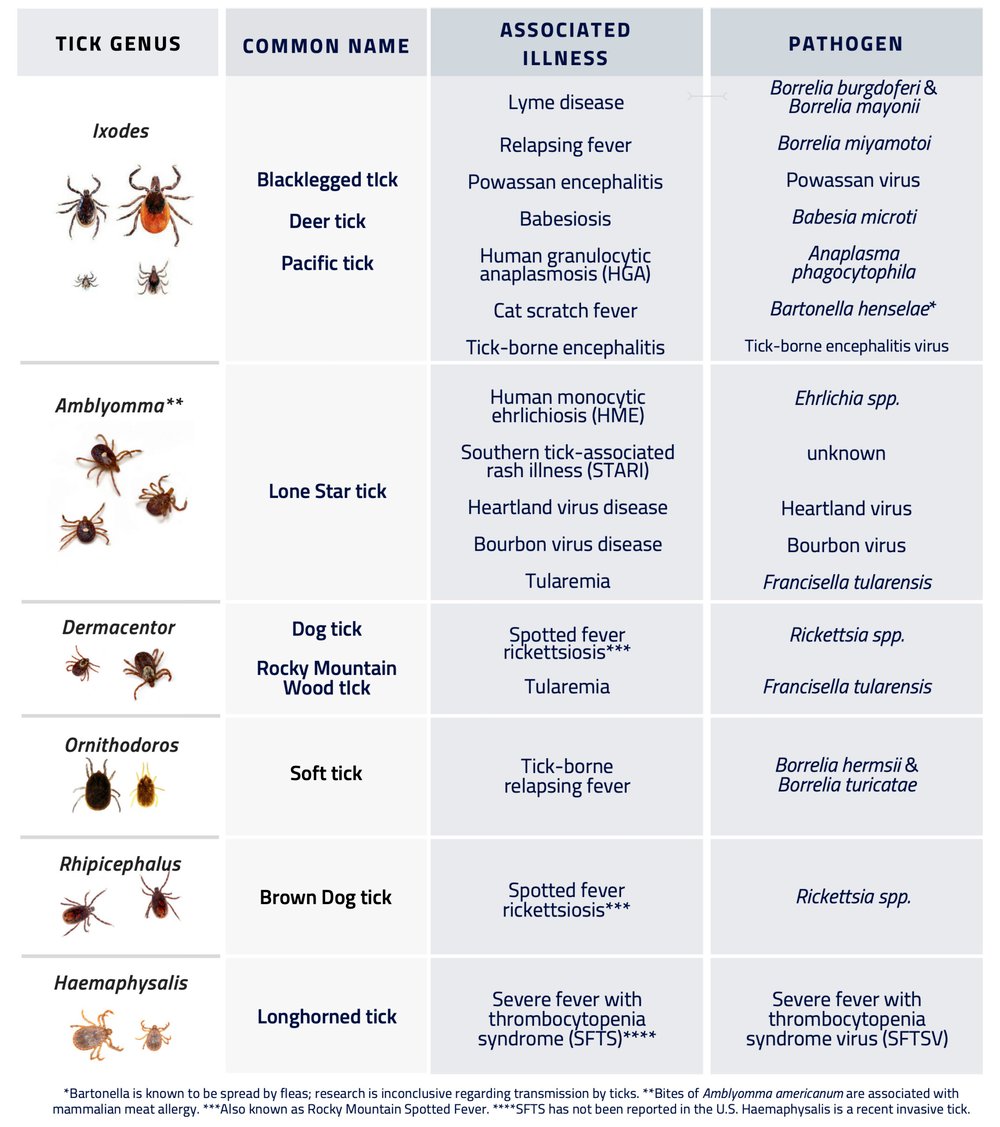
Easy to read table shows the most common ticks found in the U.S. that transmit pathogens to humans.
Note: only a partial list. To learn more about tick-bite prevention and how to be Tick AWARE, click here

Click here to download the Tick Table

Tick Table

For more:

Remember, in Wisconsin, ticks are found in every county in the state. Researchers are also finding them in bright, open, mowed lawns.

Statewide Passive Surveillance of Black Legged Ticks & Associated Pathogens in Maine

https://www.liebertpub.com/doi/full/10.1089/vbz.2020.2724#utm_source=ETOC&utm_medium=email&utm_campaign=vbz

Statewide Passive Surveillance of Ixodes scapularis and Associated Pathogens in Maine

Published Online:https://doi.org/10.1089/vbz.2020.2724

Abstract

The blacklegged tick, Ixodes scapularis, is the primary vector of multiple human pathogens, including the causative agents of Lyme disease, anaplasmosis, and babesiosis. Both I. scapularis and its associated pathogens have expanded their geographic range throughout the northeastern Unites States and into northern New England. Through this study, we present an updated distribution of I. scapularis in Maine and report the first statewide passive surveillance infection and coinfection prevalence of Borrelia burgdorferiAnaplasma phagocytophilum, and Babesia microti within the state’s I. scapularis population. In 2019, we collected 2016 ticks through a passive surveillance program, in which Maine residents submitted tick samples for identification and/or pathogen testing. We used a single multiplex quantitative PCR assay to detect tickborne pathogens in 1901 tick samples. At the state level, we found:

  • Bo. burgdorferi and A. phagocytophilum infection rates of adults (42.4%, 11.1%) were nearly double that of nymphs (26.9%, 6.7%)
  • B. microti prevalence was similar for both adults (6.5%) and nymphs (5.2%).
  • Spatially, we found an uneven distribution of both tick activity and pathogen prevalence, with both increasing on a north to south gradient.
  • We also noted a potential association between the ratio of adult to nymphal ticks and the incidence of tickborne disease in human populations, with counties that exhibit high rates of human disease also maintaining low adult to nymph ratios.
  • We detected Bo. burgdorferi in ticks from all counties, except Aroostook, although we only tested five samples from this county.
  • Excluding Aroostook, the county-level Bo. burgdorferi prevalence ranged from 30.0% (Piscataquis) to 50.0% (Franklin and Waldo) in adults and 0% (Piscataquis and Somerset) to 43.8% (Knox) in nymphs.
  • High disease incidence counties did not necessarily have higher prevalence rates within submitted ticks.
  • Knowledge of anaplasmosis is not as widespread as Lyme disease, which may lead to the underdiagnosis of this disease.
  • The sporadic distribution of B. microti is consistent with a pathogen that is colonizing a new location and has not yet reached an even spatial distribution (Diuk-Wasser et al. 2016).
  • B. microti is also thought to spread more quickly in areas where Bo. burgdorferi is prevalent due to an immune interaction in reservoir hosts such as white-footed mice (Peromyscus leucopus) or deer mice (P. maniculatus) (Dunn et al. 2014).
  • B. microti is likely to continue spreading throughout Maine.

____________________

**Comment**

It is interesting that researchers acknowledge that multiple infections occur due to an immune interaction yet severely ill patients are still viewed myopically to only have Lyme disease.  Our conflict-riddled public health ‘authorities’ continue to promote ancient mythology, deny persistent infection, and treat patients with a mono-therapy that has never been adequate.  Treating co-infections isn’t even on their radar.