Archive for the ‘Activism’ Category

Caring for a Child with Lyme Podcast

http://livingwithlyme.us/episode-34-caring-for-a-child-with-lyme-disease/

LWL_logo_final_centered_TM-2

Episode 34: Caring for a Child With Lyme Disease

August 22, 2018

Cindy Kennedy, FNP, talks with Dorothy Leland about her struggles to find the support she needed as the parent of a child with Lyme disease. Leland, an author, blogger, and vice president at LymeDisease.org, sheds light on how she became an advocate for her child.

Dorothy-Leland-pic-png-240x300
Dorothy Leland
Leland fell into the world of Lyme disease when her then-13-year-old daughter became mysteriously ill and disabled in 2005. Eventually, she figured out that her family was part of a growing yet invisible group of people grappling with a disease that is ignored by the government and the medical establishment.
Soon, she became a local support group leader in northern California and is now vice president of the national advocacy organization LymeDisease.org. She writes the blog “Touched by Lyme” and has a special interest in how Lyme disease affects the whole family — not just the person with the illness. She is co-author of the book, “When Your Child Has Lyme Disease: A Parent’s Survival Guide.”

EBV & Chronic Fatigue Connection Podcast – Dr. Rawls

 Aug. 2018, Approx 1 hour 20 Min.

The Epstein Barr Virus + Chronic Fatigue Connection with Dr. Bill Rawls

In this webinar replay, Dr. Bill Rawls shares his insights about the mysterious Epstein-Barr virus (EBV) and its close connection with chronic fatigue syndrome (CFS).

For more:  https://madisonarealymesupportgroup.com/2018/08/18/free-webinar-epstein-barr-chronic-fatigue-connection-dr-rawls/  (Other links found here)

EBV is ONE of nine herpes viruses.  Behind Mono, it is spread by contact with saliva and is highly contagious.  It infects immune cells like the White blood cells, B cells, T cells, NK cells and epithelial cells (linings).  Nearly everyone is infected but most are asymptomatic.  It does respond to antiviral therapy.  In my experience some patients with tick borne illness get better after anti-viral therapy.

____________________

**Comment**

Many with Lyme/MSIDS also struggle with chronic fatigue and/or EBV. In fact, people have been misdiagnosed with both but had Lyme/MSIDS. For more on EBV:
https://madisonarealymesupportgroup.com/2017/11/04/24514/
https://madisonarealymesupportgroup.com/2017/04/11/diagnosed-with-ebv-had-lyme/
https://madisonarealymesupportgroup.com/2018/04/25/ebv-protein-can-turn-on-genes-for-autoimmune-diseases/

Mayo Clinic Holds Teenager Hostage -Why We Need the Parental Rights Amendment

https://parentalrightsfoundation.org/

Here we go again.

Just when I started to think nothing would surprise me anymore, the Mayo Clinic in Minnesota held a teenager hostage a la Justina Pelletier, working to cut her parents out of the picture and take control of the girl’s healthcare for themselves.

According to a series of articles published by CNN, https://www.cnn.com/2018/08/13/health/mayo-clinic-escape-1-eprise/index.html 18-year-old high school senior Alyssa Gilderhus suffered a brain aneurism on Christmas, 2016. Her prognosis for survival was grim, “a 2% chance.” But through four brain surgeries over the next month, neurosurgeons at the Mayo Clinic literally saved her life.

Unfortunately, things took a turn for the worse when she was transferred to the rehabilitation unit on January 30. It wasn’t a medical relapse, though. Rather, the hospital’s treatment of and respect for Alyssa and her family took a nosedive.

It was Justina Pelletier all over again. Only this time, things would be different.

1. Difference One: Alyssa Gilderhus Is 18 Years Old, and a Legal Adult.
Justina Pelletier was only 14 for most of her 16-month ordeal. Before Boston Children’s could take power over Justina, they only had to wrench it away from her parents, something sadly too easy a thing to do. The hospital accused them of “medical neglect” and the state took it from there.

But to get power over Alyssa, the Mayo Clinic had to first wrest authority from the patient herself, and then away from her parents as next in line.

“From my 25 years of experience, a judge is going to say, ‘why isn’t the family the first and best choice here?’ and it had better be a good reason,” adjunct professor and Minneapolis attorney Robert McLeod is quoted as saying in part 2 of the CNN report.

2. Difference Two: Alyssa’a Parents Had the Pelletiers’ Experience to Learn From.
When Justina was taken by Boston Children’s, such a “medical kidnapping” was unheard of in the public eye. But today, such things rarely occur without someone mentioning Justina. In this case, friends of Alyssa’s parents told mom Amber Engebretson about the Pelletiers’ experience.

According to the CNN report, Amber reached out to Linda and Lou Pelletier by phone. They told her what to watch for if the hospital was trying to take over her daughter’s care. That night on Facebook Amber wrote, “OMG I am SICK. This is what is happening…. I am so scared.”

But recognizing what they were up against allowed Amber and husband Duane to go into action to save Alyssa from her prison.

3. Difference Three: Alyssa Escaped.
Once the state of Massachusetts took custody of Justina, they left her in the care of Boston Children’s hospital to be treated as the hospital thought best. Locked away in the psych ward, Justina languished under their abuse for more than a year.

Duane Engebretson was not about to watch Alyssa suffer the same fate. So on February 28, 2017, he managed to trick her “guard” nurses into letting him roll Alyssa’s wheelchair to the lobby to accommodate an elderly grandmother who couldn’t make it all the way to the room. Only the grandmother wasn’t in the lobby. They needed to meet her in the parking lot.

Only she wasn’t in the parking lot, either. But Alyssa’s mother was, and sped away as soon as her daughter was in the car.

The hospital security officer called the Police. Deputies searched for the family, who hid out on the road and got their daughter a second opinion at a South Dakota hospital. But eventually the police came to see the situation for what it was.

“That’s one doctor’s opinion against another, and that doesn’t have anything to do with law enforcement at all,” Chris Vasvick, a Martin County (Minnesota) deputy told CNN.

As it turns out, the hospital was trying to take guardianship of Alyssa. They had made attempts in multiple counties, but couldn’t get a judge to sign off on giving them—and not the parents—control. Had the Mato clinic doctors succeeded, Alyssa might still be in their “care.”

All About Parental Rights

As shocking as this story is, it isn’t a true parental rights case. Alyssa, as an adult, was being held illegally against her will, and from a legal standpoint her parents’ view has nothing to do with it. That they helped her escape provides good drama that would make a good movie. But it isn’t about parental rights.

On the other hand, the fact that this happens as frequently as it does, and that it is that much easier for the hospital if the patient is a child – that is all about parental rights, and demands a closer look.

By federal statistics, some 97% of all parents never abuse or neglect a child. So why is it so easy for a hospital to intrude into the parent-child relationship if a parent disagrees with what the doctors think a child needs?

The doctor is a professional, with certain knowledge and skills. Parents are wise to find the services of a good one when needed. But at the end of the day, “natural bonds of affection lead parents to act in the best interests of their child.” (Parham v. J.R., 442 U.S. 584 (1979), emphasis added)

Sadly, Alyssa’s story, like that of Justina, should serve as a warning to parents: know your doctor. Know your rights. Don’t ignore the red flags. Get that second opinion.

And continue to stand with us as we promote policies and model legislation to preserve the right of parents to make the best, most informed medical decisions for their children, without undue state—or medical—intrusion.

Sincerely,

Michael Ramey
Director of Communications & Research

_________________

**Comments**

Due to the polarization of Lyme/MSIDS, this could easily happen to a child with tick-borne illness.  I’m sure it’s happened already.  Don’t let it happen to you.  Learn about the Parental Rights Amendment and continue to stand up for your children.

For more:  https://madisonarealymesupportgroup.com/2017/04/20/why-we-need-the-parental-rights-amendment/

https://madisonarealymesupportgroup.com/2017/02/21/parental-rights-in-medical-settings/

https://madisonarealymesupportgroup.com/2018/04/05/pa-dentist-threatens-parents-for-not-scheduling-their-childs-dental-cleaning/

https://madisonarealymesupportgroup.com/2017/08/24/dutch-lyme-patients-accused-of-child-abuse/

https://madisonarealymesupportgroup.com/2017/06/30/child-with-lymemsidspans-told-by-doctors-she-made-it-all-up/

https://madisonarealymesupportgroup.com/2018/05/29/more-abuses-against-parental-rights/

https://madisonarealymesupportgroup.com/2017/10/12/parental-rights-come-from-the-state-says-law-professor-james-dwyer/  James Dwyer, law professor at the prestigious College of William and Mary, believes your parental rights come from the State. And what the State can give, the State can take away.

Aluminum in the Brain in Multiple Sclerosis: Regulatory and Funding Agencies Silent, Complicit

https://jameslyonsweiler.com/2018/08/18/aluminum-in-the-brain-in-multiple-sclerosis-regulatory-and-funding-agencies-silent-complicit/

By James Lyons Weiler in Cures August 18, 2018

https://jameslyonsweiler.com

MEDICAL SCIENCE proceeds along a hierarchy of evidence; often, patients are studied individually (case studies), or a small collection of patients are examined and characterized together (case series studies). Case series studies typically have smallish sample sizes and it is generally understood that larger studies will be necessary to determine more accurately the characteristics being studied.

In a new case series study, brain tissue from 14 donors with a diagnosis of MS was studied in a case series by Mold et al (2018) using transversely heated graphite furnace atomic absorption spectrometry. The study found high aluminum content (>10 ug/g dry weight) in all areas of the brain studied, with some areas exceeding 50 ug/g. They found aluminum both with cells and in the interstitium between cells. They found aluminum co-localised with structures known to be present in Secondary Progressive Multiple Sclerosis (SPMS) in the frontal cortex of one donor with SPMS.

There are a number of critical lines of evidence that make this fundamental finding critically important. Patients with MS have lower amounts of aluminum in their hair, suggesting depressed detoxification, and higher amounts are found in urine on chelation challenge testing (Fulgenzi et al., 2014). Chelation with EDTA is known to significantly reduce aluminum intoxication (Fulgenzi et al. 2014), and consumption of silica-rich mineral waters also increase urinary excretion of aluminum from patients with SPMS (Jones et al., 2017).

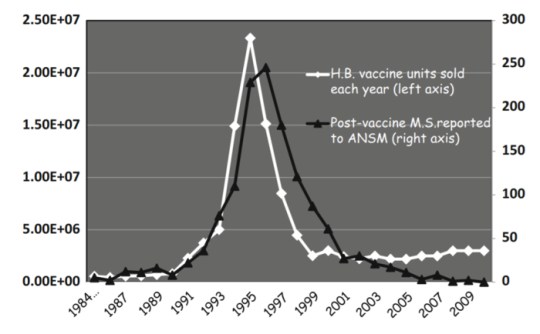
Extremely plausible direct mechanisms of the cause of MS from aluminum are known and animal studies routinely induced MS using aluminum hydroxide injections. So much evidence exists that points to aluminum as a source of strange new conditions of unknown causes, such as MMF and Gulf War Syndrome, one would think that calls to reconsider the use of aluminum in vaccines would be answered. The same team had previously found high amounts of aluminum in the brains of people with autism, and and in patients with Alzheimer’s disease. The latter result, while also important, is not surprising, as it has long been known that amyloid is part protein and part aluminum. Finally, when France brought on HepB vaccination, cases of MS following vaccination increased; when they stopped recommending the HepB vaccine, which contains aluminum hydroxide, the rate of HepB vaccine-associated MS cases dropped to near zero.

francems

Complicity

What is surprising is the lack of action on the part of the US FDA to put an end to the use of this dangerous metal in vaccines, and that the NIH is not funding more studies like this. NIH should fund studies to determine how to most safely remove aluminum from anyone exposed via vaccines; brain stem amyloidosis is a non-trivial concern. Approaches like ketogenic diet, silica-rich mineral waters, hyperbaric oxygen, EDTA, intranasal insulin and intranasal deferoxamine (to prevent brain stem amyloidosis) should all be tested in randomized clinical trails in clinical populations known to be afflicted with aluminum intoxication (autism, Alzheimer’s, MS).

What is also surprising is that the CDC and ACIP remain blithe to the morbidity and mortality their continued approval of vaccines that contain metals like aluminum and mercury. They make decisions on behalf of us all, and yet every member of ACIP with the exception of one military member has conflicts of interest with vaccine manufacturers. ACIP should review all of the literature on aluminum and make recommendations on how to phase it, and thimerosal, out of vaccines completely.

Further inaction on the part of these regulatory and funding agencies, and active denialism at this point will surely be seen by future generations as both callous disregard, and where conflicts of interest reside, complicity.

The study, conducted at the Keele University, was funded in part by the Children’s Medical Safety Research Institute.

References

Jones K et al. EBioMedicine. 2017 Urinary Excretion of Aluminium and Silicon in Secondary Progressive Multiple Sclerosis. 26:60-67. doi: 10.1016/j.ebiom.2017.10.028.

Fulgenzi A, Vietti D1, Ferrero ME. Aluminium involvement in neurotoxicity. Biomed Res Int. 2014;2014:758323. doi: 10.1155/2014/758323.

_______________

**Comment**

https://www.nationalmssociety.org/Symptoms-Diagnosis/Other-Conditions-to-Rule-Out/Lyme-Disease

Lyme disease can cause delayed neurologic symptoms similar to those seen in multiple sclerosis (MS) such as weakness, blurred vision caused by optic neuritis, dysesthesias (sensations of itching, burning, stabbing pain, or “pins and needles”), confusion and cognitive dysfunction, and fatigue. Lyme disease symptoms may also have a relapsing-remitting course. In addition, Lyme disease occasionally produces other abnormalities that are similar to those seen in MS, including positive findings on magnetic resonance imaging (MRI) scans of the brain and analysis of cerebrospinal fluid (CSF).

These similarities in symptoms and test results have led some people with MS to seek testing for the presence of antibodies to Borrelia, to determine if their neurologic symptoms are the result of Lyme disease or truly MS. The distinction is important because Lyme disease, especially when treated early, often responds to antibiotic therapy, whereas MS does not.

Studies examining Lyme disease & MS
Two studies have examined the overlap in diagnosis of MS and Lyme disease. The studies were conducted in parts of Long Island, New York, an area where Lyme disease is endemic, or regularly found.

In the first study, people who had Borrelia antibodies in their blood as well as a variety of neurologic symptoms considered to be “MS-like,” were evaluated with MRI, evoked potentials (EP) and CSF analysis, including a test for the presence of Borrelia antibodies in the spinal fluid.

While those with the MS-like illness had the highest incidence of abnormal MRIs and were the only ones among those studied to have abnormal EP and oligoclonal bands in their spinal fluid (indicating an abnormal immune response), they did not prove to have any Borrelia antibody in their spinal fluid.

The researchers concluded that the few patients with the MS-like symptoms probably had these symptoms due to MS and had also been exposed to the Borrelia bacterium.
A companion study looked for the presence of Borrelia antibodies in the blood of 100 people with the diagnosis of possible MS. Of 89 people who in fact turned out to have definite MS, only one had Borrelia antibodies. The researcher concluded that “…infection with Borrelia is infrequent in MS patients who live in an endemic area. Lyme disease is unlikely to be a significant factor in the differential diagnosis of MS.” Furthermore, the presence or antibodies to Borrelia does not prove that Borrelia is causing the neurological symptoms, only that there has been previous infection with the organism.

Just remember, “rare” is only “rare” if it isn’t you.


Our Battle Ongoing: Lyme Disease in Australia

 Approx 1 hour 30 min.

Our Battle Ongoing: Lyme Disease in Australia | Full Documentary

Directed by Andy Smith
Published on May 25, 2017

Our Battle Ongoing takes a look into the lives of Australians across the nation currently suffering from Lyme disease or a Lyme-like illness. Every individual has their own unique story as symptoms differ from person to person, but they are all united in a common cause of seeing recognition come to those suffering now and for the generations to come. With little to no help currently available, some have to take drastic measures in order to receive treatment. Our Battle Ongoing brings to light the tragedy of living with an invisible illness in Australia.

www.ourbattleongoing.com

_________________

**Comment**

The number of afflicted Australians is growing yearly just as it is worldwide.  To deny this pandemic is truly an “Emperor has no clothes” story.  You’ve got thousands of people with Lyme-like symptoms, most of who improve with appropriate treatment, but denial from the establishment.  For every patient who can high-tail it to Germany for treatment, you have 1,000 who can’t afford to.

Devastating.

While it is bad here in the U.S., it is truly abysmal in Australia.

Recently I posted this:  https://madisonarealymesupportgroup.com/2018/08/20/tick-borne-diseases-causing-autonomic-dysfunction/ and declared it a literal rap sheet for Lyme.  Please compare this article to the patients you see in this documentary.  They are identical.  

While I agree that Australia is a unique area with its own flora and fauna and pathogens, don’t kid yourself – migrating birds have no problem transiting ticks to and from Australia or anywhere else on the planet.  To say otherwise is burying your head in the sand.  Time to wake up and quit blaming the climate and look around at the integrated world in which we live with animals and humans moving in and out of areas with ticks on them on a daily basis.  For more on why the climate is NOT responsible for this pandemic:  https://madisonarealymesupportgroup.com/2018/08/13/study-shows-lyme-not-propelled-by-climate-change/

More on Lyme in Australia:  https://madisonarealymesupportgroup.com/2016/11/03/ld-not-in-australia-here-we-go-again/

https://madisonarealymesupportgroup.com/2017/09/19/tbis-in-australia/

https://madisonarealymesupportgroup.com/2018/08/08/an-invasive-new-tick-is-spreading-in-the-u-s/  Known in Australia as bush ticks and in New Zealand as cattle ticks, long-horned ticks can multiply rapidly and suck so much blood from a young animal that it dies. The ticks bloat up like fat raisins until their tiny legs are barely able to support them.  After a blood meal, females can lay hundreds of fertile eggs without mating.

https://madisonarealymesupportgroup.com/2018/08/02/12-scary-diseases-you-can-catch-at-the-beach-lyme-is-one-of-them/  Ticks have been found on the beach, in caves, underneath picnic benches, on rocks, have blown from trees into swimming pools, have blown onto my house by a lawn mower and ended up crawling up the interior basement walls.  Can we just say ticks can be virtually everywhere with the need for extreme diligence?

https://madisonarealymesupportgroup.com/2018/03/23/australian-lyme-disease-research-pilot-funded/  The study utilises a proprietary capture methodology that has not previously been employed in the detection of tickborne pathogens in Australia.

While the authorities don’t believe you, we do.