Archive for the ‘Activism’ Category

Lyme Disease Curriculum & Educational Activities

https://globallymealliance.org/education-awareness/curriculum-educational-activities/

LYME DISEASE CURRICULUM AND EDUCATIONAL ACTIVITIES

It’s Time to Be Lyme Alert

It’s Time to Be Lyme Alert is a fun, interactive curriculum designed by GLA in partnership with educators to be shared in the classroom, at camp and other youth-focused organizations. The curriculum, available in three age-group levels, includes a student workbook that outlines the objectives and key talking points, along with a supporting teachers’ guide.

Ideal activities for use in classrooms – Grades: K – 12:

  • Basic Science
  • Health Education
  • Health Science
  • Social/Emotional Learning (Grades: 9-12)

For Teachers

  • Teacher’s Guide: provides educational objectives, key talking points to help you guide students thru the activity.
  • Word games and other activities test student’s knowledge to assess their progress.
  • Student Workbooks (K-12): teaches students about Lyme disease, all about ticks, and tick prevention.
  • Learners earn a “Lyme Alert” certificate upon successful completion of activity.
  • Bonus! Learners can share their certificate with friends and family on Facebook and Twitter.

For Students

  • Learn important facts about ticks, Lyme disease, and tick prevention, in a fun, interactive comic format.
  • Learn the importance of showing empathy to fellow classmates who may be dealing with a chronic illness.
  • Earn a Lyme Alert Certificate upon completing the course. Students and parents can share their accomplishment on Twitter and Facebook.

*Disclaimer: Be Tick AWARE Prevention Kits are intended to provide tick bite protection practices. Global Lyme Alliance does not guarantee tick bite protection or tick-borne disease prevention when implementing this information. GLA recommends doing a daily full-body tick check.

ORDER NOW

Children are at the greatest risk for Lyme and other tick-borne diseases. Help teach kids how to protect themselves from a tick bite with a Be Tick AWARE Prevention Kit. Great for families, schools, camps, and other youth-based organizations.

Cat Scratch Disease: Vet Suffers Extreme Fatigue For a Decade After Catching Rare, Severe Case of Bartonella Infection (That Isn’t Rare)

https://www.newsweek.com/cat-scratch-disease-vet-suffers-extreme-fatigue-decade-after-catching-rare-severe-case-1444715

CAT SCRATCH DISEASE: VET SUFFERS EXTREME FATIGUE FOR A DECADE AFTER CATCHING RARE, SEVERE CASE OF BARTONELLA INFECTION

A vet has been left suffering with extreme fatigue for almost a decade, after she caught an infection from a cat scratch which caused symptoms so severe she thought she was going blind or had a brain tumor.

A flea-infested cat scratched Victoria Altoft, 41, from the county of Somerset in south west England, while she was at work in the fall of 2010, PA Real Life reported.

Weeks later, Altoft’s muscles and joints were in pain and she was hit by night sweats, leading her to assume she had the flu. She was “utterly exhausted” and took the uncharacteristic decision to take two weeks off work.

“I just couldn’t get out of bed,” she told PA Real Life. As time passed, her joints swelled up, which her doctor put down to post-viral inflammation.

But Altoft became worried when her vision started to blur. She went for an emergency eye appointment, and medics thought her symptoms could be caused by a brain tumor or the condition multiple sclerosis, which affects the central nervous system.

Tests revealed she was suffering a rare Bartonella infection, and doctors prescribed her with antibiotics: the treatment given to serious cases of the condition.

black cat kitten pet animal stock getty
Cat scratch disease can be passed on by infected pets. GETTY

The bacteria is carried by infected fleas which live on animals like cats or dogs. Lice and sandflies are also vectors of the Bartonella group of bacteria which can cause cat scratch disease, as well as Carrion’s disease (only found in the Andes Mountains), and trench fever (most often present in people who live in areas of poverty with poor sanitation).

In most people, cat scratch disease doesn’t require treatment and fades by itself in between two to four months. But severe cases require antibiotic treatment.

Symptoms materialize several days or weeks after the bacteria invades the body. After three to 10 days, a painless raised red spot might appear on the skin where the infection passed through the skin. Over time this may become filled with fluid, with a crust forming before it heals. The lymph nodes near the site of infection might become swollen, red and hot to the touch, and puss-filled. Other symptoms include a general feeling of illness, headache, fatigue, and fever and—less often—sore throat and weight loss.

It took a year for her sight to return to normal. Altoft told PA Real Life she still suffers from fatigue despite being scratched in 2010.

“To this day, it’s difficult to know exactly what the long-lasting effects of contracting Bartonella are, as there is so little research, but I know I’m not the same now as I was before it happened,” she said.

Altoft is working with the Big Flea project run by the University of Bristol and the pharmaceutical company MSD Animal Health, who are researching the parasites which affect dogs and cats in the U.K.

The vet urged pet owners to take flea infestations seriously as they can pose a serious threat to human health.

____________________

**Comment**

First off, Bartonella is NOT RARE.

Second, someone PLEASE cut the nails on that cat!

For many, many people Bartonella is NOT something that, “fades by itself in between two to four months.”

Bartonella is a particularly tenacious infection that can cause so many symptoms it boggles the mind. Couple it with Lyme disease and you are one sick dog. Throw in Babesia, and you are in bed for a long, long time.

https://madisonarealymesupportgroup.com/2019/04/24/human-bartonellosis-an-underappreciated-public-health-problem/Excerpt from full-text

KNOWN DISEASES CAUSED BY BARTONELLA INFECTIONS INCLUDE:
  • Carrion’s disease
  • cat-scratch disease
  • chronic lymphadenopathy
  • trench fever
  • chronic bacteraemia
  • culture-negative endocarditis
  • bacilliary angiomatosis
  • bacilliary peliosis
  • vasculitis
  • uveitis [1,2,4,6,7,9,10,11].
RECENTLY, BARTONELLA INFECTIONS HAVE BEEN LINKED TO MORE DIVERSE MANIFESTATIONS SUCH AS:
  • hallucinations
  • weight loss
  • muscle fatigue
  • partial paralysis
  • pediatric acute-onset neuropsychiatric syndrome (PANS)
  • other neurological manifestations [6,8,10].

Regarding vectors, it’s far more than fleas, lice, and sandflies:

Bartonella spp. are zoonotic pathogens transmitted from mammals to humans through a variety of insect vectors including the sand fly, cat fleas, and human body louse [4,5]. New evidence suggests that ticks, red ants, and spiders can also transmit Bartonella [15,16,17,18]. Bed bugs have been implicated in the transmission cycle of B. quintana and have been artificially infected [19]. B. quintana was found in bed bug feces for up to 18 days postinfection [19]. The diversity of newly discovered Bartonella species, the large number and ecologically diverse animal reservoir hosts, and the large spectrum of arthropod vectors that can transmit these bacteria among animals and humans are major causes for public health concern.

Regarding ticks….

3.3 Arachnids (Spiders &Ticks)

Over the last 10 years, the topic of ticks transmitting Bartonella species has been widely debated. Evidence exists to support the transmission of Bartonella through many different species of ticks.

Ixodid ticks, also known as hard ticks, appear to be the main type of tick associated with these bacteria. Tick cell lines have been used to show that Bartonella can replicate and survive within:

  • Amblyoma americanum (Lone Star Tick)
  • Rhipicephalus sanguineus (Brown Dog Tick)
  • Ixodes scapularis cells [77] (Deer Tick)

In California, questing ticks of

  • Ixodes pacificus (Western Black legged Tick)
  • Dermacentor occidentalis (Pacific Coast Tick)
  • Dermacentor variabilis (American Dog Tick)

were collected when in the adult and nymphal stages and tested for Bartonella by PCR for the citrate synthase gene. [78]. All types of ticks were found to contain Bartonella DNA, although in varying percentages and locations.These data alone do not prove that ticks can transmit Bartonella spp. Bacteria; however, the results do show Bartonella DNA occurring naturally in these wild ticks.

I know researchers are currently working on the link between Bartonella and cancer. Recently a young boy was diagnosed with schizophrenia but was found to have Bartonella:  https://madisonarealymesupportgroup.com/2019/03/24/cat-scratch-disease-caused-teens-schizophrenia-like-symptoms-report-says/

All you have to do is type “Bartonella” into the search bar on this website and let your fingers do the walking.  Bartonella is HUGE and quite common.

https://madisonarealymesupportgroup.com/2018/05/07/fox-news-bartonella-is-the-new-lyme-disease/

More on Bartonella: https://madisonarealymesupportgroup.com/2016/01/03/bartonella-treatment/

It’s a killer:  https://www.ncbi.nlm.nih.gov/pmc/articles/PMC3044516/#!po=1.02041

Look at the pictures of what it did to this woman:  https://madisonarealymesupportgroup.com/2019/05/28/woman-wakes-up-with-black-eye-swollen-face-after-cat-scratch-that-left-her-on-iv-drip-for-four-days/I assure you – this would not have faded on its own….

Lastly, Dr. Ericson has incredible imaging showing Bartonella surviving around tissues where a PIC line pumped antibiotics directly into the body:  https://madisonarealymesupportgroup.com/2019/02/27/advanced-imaging-found-bartonella-around-pic-line/

Trust me.  You don’t want this.


Six Days to Support Tick Research in Guam

https://experiment.com/projects/what-risks-do-ticks-confer-to-the-humans-and-animals-of-guam Go here to Support research

What risks do ticks confer to the humans and animals of Guam?

$2,011

Pledged
81% Funded, $2,500 Goal
6 Days Left

About This Project

There is an abundant population of ticks on Guam, which can cause devastating illness in animals. Many animals, with close interactions and overlapping environments with people, can serve as sentinels for human disease. The ticks of Guam are known to host at least eight pathogens, of which three are zoonotic. This is a threat to domestic animals, humans, and wildlife populations on Guam.


‘It Was a Terrifying 12 Hour’: 7-Year-Old Temporarily Paralyzed by Toxins From a Tick Bite

https://www.dailymail.co.uk/health/article-7176839/It-terrifying-12-hours-7-year-old-temporarily-paralyzed-toxins-tick-bite.html

‘It was a terrifying 12 hours’: 7-year-old temporarily paralyzed by toxins from a tick bite

  • Jenna Ganahl, seven, went to her first overnight summer camp in Colorado and came home with a few ticks in her hair 
  • Her mother, Heidi carefully plucked them out 
  • But part of one tick must have still been in the wound on her daughter’s scalp, where it transferred a neurotoxin to the littler girl
  • About 10 days after returning home, Jenna’s feet felt like they were ‘asleep’ 
  • She was diagnosed with the rare ‘tick paralysis’ that can cause a form of temporary paralysis in people bitten by female ticks carrying eggs 
  • The paralysis subsides after the tick is fully removed, and Jenna is now fine – though experts warn it will likely happen more as the globe warms  

A week-and-a-half after her first ever overnight summer camp, Jenna Ganahl, seven, couldn’t feel her legs.

It seemed at first like her legs had just gone to sleep, as everyone’s occasionally do if we sit too long, but the next morning, the little girl’s legs still didn’t seem to work.

Her mother, Heidi, was terrified and rushed her daughter to the doctor.

Heidi had no idea what could do such a thing to her energetic, healthy little girl, and never would have guess the diagnosis doctors ultimately gave them: tick paralysis. 

She’d had no idea that the few tiny parasites embedded in Jenna’s hair when she got back from camp could do such a thing, according to Heidi’s Facebook post.

And the physicians warned that Colorado’s unusually warm, wet summer could mean more kids are at risk for temporary paralysis.

Heidi Ganahl (left) plucked several ticks from her daughter, Jenna's (right) head after the seve-year-old got home from camp, but a tiny piece of one of the bugs left in the little girl's scalp caused her to develop rare, temporary tick paralysis

Heidi Ganahl (left) plucked several ticks from her daughter, Jenna’s (right) head after the seve-year-old got home from camp, but a tiny piece of one of the bugs left in the little girl’s scalp caused her to develop rare, temporary tick paralysis

The US is getting warmer and wetter as climate change alters our environment.

That’s good news for populations of deer, dog and blacklegged ticks, and bad for the people and pets they like to prey on.

Dealing with a tick bite is mostly just itchy and unpleasant as they have to be carefully plucked from the skin where they bury their heads to gorge themselves on the blood of mammals.

But as the number or ticks living and feeding in the US grows, so does the number of people sickened by the parasites.

In fact, in 2017, tickborne illnesses struck a record-shattering 59,349 people, according to the Centers for Disease Control and Prevention’s latest data.

Those diseases include the dreaded Lyme disease, Rocky Mountain spotted fever, Powassan virus, tularemia, and anaplasmosis/ehrlichiosis.

But one illness is caused not by a bacterial or viral species the ticks carry, but by a compound from the animal itself.

Ticks’ saliva contains a neurotoxin that can seep into the human bloodstream if you get bitten by a tick.

There are 40 species of the parasite that carry the immobilizing toxin, according to the American Lyme Disease Foundation.

Interestingly, the toxin seems to be present in a female tick that’s carrying eggs and reaches a human when she bites and attaches to a host to feed.   

But it’s a slow process.

Paralysis may not set in for five to seven days after the tick attaches, and it may not start as paralysis, but as fatigue, weakness, numbness and muscle pain.

Jenna had numbness, that feeling of her legs being ‘asleep.’

Her mother, Heidi, ‘had a bad feeling’ and took her to the doctor.

She told the the doctors about the ticks she’d found in Jenna’s hair after summer camp and that she’d plucked them out.

The saliva of female ticks carrying eggs (not pictured) may contain a paralyzing neurotoxin. If any little bit of the parasite is not removed carefully and cleanly, the toxins may continue to seep into the host body, causing paralysis in rare cases

The saliva of female ticks carrying eggs (not pictured) may contain a paralyzing neurotoxin. If any little bit of the parasite is not removed carefully and cleanly, the toxins may continue to seep into the host body, causing paralysis in rare cases

Jenna told her mother she had had enough of the woods for awhile after her encounter with the rare tickborne illlness

Jenna told her mother she had had enough of the woods for awhile after her encounter with the rare tickborne illlness

But after careful inspection, the doctors found a tiny fragment of a tick that had been left behind when Heidi had removed the bugs.

‘It was only caught because of the great docs (most CU School of Medicine) that recognized the similarities to two other cases in recent weeks there (it’s extremely rare so it was very abnormal to see 3 cases in 3 weeks),’ Heidi wrote on Facebook.

This tends to be the way of tick paralysis – it comes in periodic waves, likely when weather conditions are optimal for ticks to fertilize or lay their eggs.

‘It was a terrifying 12 hours as we waited to see if they were able to remove the tiny bit of tick left in her producing the toxin had been cleaned out of the wound (they didn’t see it),’ wrote Heidi.

‘The only fix is to get it out or things get very bad.’

In about 12 percent of untreated cases, the patients die.  But, fortunately, once the tick is removed the toxin stops flowing to the person and paralysis subsides.

‘She is ok!’ Jenna’s mother wrote.

‘Other than never wanting to go in the woods again.

‘I learned more about ticks than I ever wanted to know – the wet weather makes for a bad tick season, check your little ones often, if you find one remove them with tweezers and scrub the wound to clean it out thoroughly with soap and water to make sure you get it all, then watch for symptoms for 14 days. Take it seriously this year.’

_________________
**Comment**
Again, the climate has nothing to do with this. Ticks are marvelous ecoadaptors and will be the last species on the planet besides the IRS:  https://madisonarealymesupportgroup.com/2018/08/13/study-shows-lyme-not-propelled-by-climate-change/

“The climate change range expansion model is what the authorities have been using to rationalize how they have done nothing for more than thirty years. It’s a huge cover-up scheme that goes back to the 1980’s. The grandiose scheme was a nefarious plot to let doctors off the hook from having to deal with this debilitating disease. I caught onto it very quickly. Most people have been victims of it ever since.  This climate change ‘theory’ is all part of a well-planned scheme. Even the ticks are smarter than the people who’ve concocted this thing.  Climate change has nothing to do with tick movement. Blacklegged ticks are ecoadaptive, and tolerate wide temperature fluctuations…..It’s all a red herring to divert your attention.”- John Scott

It’s also a ruse to obtain research dollars.

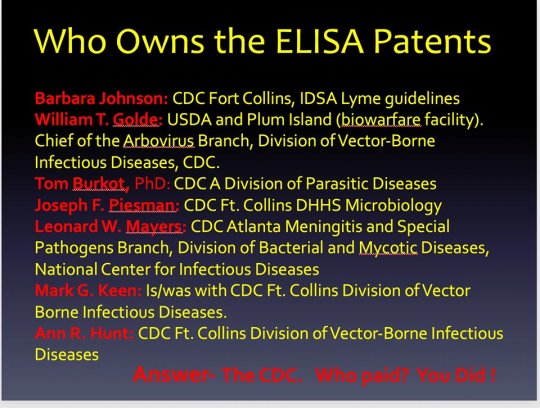
Who Owns the ELISA Patents…

64357008_10217935576008450_2638357839671721984_n

Credit: Tom Grier https://www.facebook.com/thomas.grier1

“I am Barbara Johnson. I am a biochemist by training and I am speaking today on behalf of the Centers for Disease Control and Prevention concerning serodiagnosis of Lyme disease. Specifically, my statement is in support of (the) IDSA recommendation in the guidelines to use two-tiered serology (an ELISA screening test followed by Western Blots if ELISA positive) to support the diagnosis of Lyme disease in patients who have manifestations other than acute erythema migrans.  – IDSA Lyme Disease Review Panel Hearing, July 30, 2009

For more dirty deeds done dirt cheap: ConflictReport