The Infectious Diseases Society of America (IDSA), American Academy of Neurology (AAN), and American College of Rheumatology (ACR) are now accepting comments on the “2019 Draft Guidelines for the Prevention, Diagnosis and Treatment of Lyme Disease.”
They are looking for feedback from not only physicians and healthcare professionals, but also individuals affected by Lyme disease, such as patients, care givers, patient organization members, advocates, and researchers. The drafts and comment form will be available for 45 days.
To view the draft guidelines, supplementary materials, and submit comments, please see below.
On page one, it is stated that these “guidelines” are not intended to replace doctor judgement and that adherence to the “guidelines” are voluntary. They also give a caveat that there is no assurance of accuracy & reliability within these “guidelines,” and that the authors are not liable for loss, damage, or claim.
Please read and send comments by August 10, 2019. This needs to be sent around the world.
Please, get this into hands that are affected by it.
Fibromyalgia is a complex pain disorder characterized by muscle pain, joint stiffness, and fatigue. It affects over ten million Americans, (4% of the population), primarily women. Although there is no known treatment that works for everyone, following a healthy diet by eliminating processed foods, caffeine, aspartame (artificial sweetener), food additives and nightshades may reduce the symptoms.
Fibromyalgia (FM) is a very real condition that affects millions of Americans and its symptoms include chronic widespread pain, fatigue, sleep disorders, joint pain, problems with cognitive functioning, migraines, IBS (irritable bowel syndrome), anxiety, depression, and environmental sensitivity – learn more about fibromyalgia symptoms here.
Unfortunately, FM is a condition rather than a specific illness and presents itself as an array of complex symptoms; believed to be caused by biological, psychological, and environmental factors and there is no specific universal treatment for the condition.
Sufferers of FM may be able to find some relief by following a healthy diet, which includes eliminating some foods while adding or increasing others. Kent Holtorf, M.D., Medical Director of the Holtorf Medical Group says,
“We’re at the point now where we know diet plays a role in this disease – it’s just the same diet for everybody. And not everybody is helped in the same way.”
However, there are a number of secondary health conditions such as gluten intolerance, gout (a form of arthritis), and restless leg syndrome that coexist with fibromyalgia causing an overlapping of symptoms or exacerbating the FM symptoms. Treating secondary conditions through dietary control may also bring some relief to the pain and fatigue brought on by fibromyalgia.
Foods to Avoid When You Have Fibromyalgia
Due to the nature of fibromyalgia that it is non-specific condition, these dietary guidelines may not be right for all FM sufferers but appear to make a difference for a significant number of those suffering.
1. Aspartame (NutraSweet)
Aspartame is classified as an excitotoxin, which stimulates NMDA pain receptors, which are already overly active with fibromyalgia.
2. Food additives including MSG (monosodium glutamine) and nitrates
MSG is an additive or flavor enhancer and nitrates are preservatives. Both are found in many processed foods and are also classified as an excitotoxin. Nitrates and MSG can often difficult to tolerate in people without fibromyalgia and are extremely difficult to tolerate in those who do.
3. Sugar, fructose, and simple carbohydrates
There is not clear evidence that cutting out simple carbohydrates will have an impact on fibromyalgia but it will reduce symptoms of chronic yeast infection, which may be a secondary condition contributing to the pain of fibromyalgia.
High fructose corn syrup, which is found in carbonated beverages, is prone to cause a metabolic reaction resulting in much more sugar pouring into the blood at a quicker rate. The quick rise is followed by a fast fall with can exacerbate the fatigue element of fibromyalgia.
4. Caffeine – including coffee, tea, colas, and chocolate
Caffeine does create a boost in energy; however, it is followed by a longer and deeper sedative effect. People with fibromyalgia already suffer from fatigue therefore amplifying the downside.
5. Yeast and gluten
Yeast and gluten are frequently found together, particularly in baked goods. Cutting both out can have equal benefit. Cutting yeast out of a diet may yield yeast fungus overgrowth, which may cause or exacerbate joint and muscle pain. Cutting gluten can improve digestive problems, stomach ailments, and fatigue associated with fibromyalgia.
6. Dairy
Dairy has been known to aggravate symptoms in some fibromyalgia sufferers but not all. If avoiding diary does not seem to relieve symptoms, then drinking skim milk provides calcium to build bones and protein to build muscle.
7. Nightshade Plants
Common nightshade plants include tomatoes, chili, bell peppers, potatoes, and eggplant. However, there are over 2,000 other varieties of “nightshades.” Edible nightshades can trigger flares on various types of arthritis and symptoms associated with fibromyalgia. If by eliminating nightshades there is no noticeable relief from symptoms of FM, then bring them back into your diet because these are some of the most nutritious vegetables.
Important Dietary Changes for Fibromyalgia Patients
Nutritionist, Samantha Heller, MS, RD, says, “When you body is healthier overall, you may be better able to cope with any disease, and better able to respond to even small changes you make.” A vegetarian diet consisting mostly of raw whole foods has shown to reduce symptoms caused by fibromyalgia. It also produces improvement of mitochondria dysfunction, which according to Holtorf, “This is the area of the cell where energy is made. Consequently, it’s necessary to have high levels of nutrients to get the mitochondria to work and for energy to by produced.”
Included in a healthy diet should be a high-quality vitamin supplement as well as supplements containing omega 3 fatty acids – we recommend HoltraCeuticals’ Ultra Omega – and eating “good fat” foods such as foods rich in fish oil, flax seed, walnuts, some fortified cereals and eggs. All of which have been show to have an impact on inflammation.
At Holtorf Medical Group, our physicians are trained to utilize cutting-edge testing and innovative treatments to uncover and address the underlying cause of fibromyalgia. Additionally, our Health and Nutrition Coach can work with you and your Holtorf physician to create a diet specifically for you! If you are experiencing symptoms of fibromyalgia, but aren’t getting the treatment you need, call us at 877-508-1177 to see how we can help you!
In this video I interview Jennifer Crystal who teaches creative writing in Massachusets and Vermont and writes a column at www.globallymealliance.com.
She has just finished a book called One Tick Stopped the Clock about her experiences with Lyme Disease.
As most people who have suffered with Lyme, Jennifer spent almost 10 years going through the wringer trying to figured out what was going on with her health. Jennifer popped up on my radar as I was doing some research on circadian rhythms and Lyme disease.
Latent infections that pop up randomly just scream circadian rhythms to me. I found a blog of hers detailing how changing the clocks would cause a relapse of her symptoms as she was battling with Lyme. Then I found another on how sticking to a schedule was part of her routine. Jennifer spent 8 years being misdiagnosed, but this story has a happy ending: She’s been in remission for 12 years. She didn’t find the magic pill we’re all hoping for, but what she found was a way to conquer Lyme disease following her own path.
We discuss what she did, the mindset she needed to find, and a little bit about how finding the right sleep doctor who clued her in to the importance of circadian rhythms got her to where she is today. Her experience is very relatable to anyone who has had a chronic condition, and I think many will get tremendous benefit from this interview and her book, coming soon.
Her book is meant to encourage people with any sort of adversity in life to find their way.
As a patient advocate, her hope is also to bring attention Lyme disease and the people affected by it.
Her sleep doctor in Great Barrington, MA is Ed O’Malley who runs a clinic focusing on holistic health. You can find info at: https://youroptimalnature.com Information on Neuroptimal, the neurofeedback program she did can be found here: https://neuroptimal.com
She is currently seeking representation for her second book, One Tick Stopped the Clock, a riveting memoir that explores questions of identity and belonging through the lens of a young person whose life has been involuntarily interrupted.
WHAT TO DO WHEN A LOVED ONE IS IN DENIAL ABOUT NEEDING HELP
Posted: February 2, 2017
When someone close to you is struggling it can be incredibly heartbreaking. Not only is it tough, but it can be even harder when that person is in denial. Unfortunately, there is a stigma associated with psychiatric illness. Your friend or loved ones could be worried that people may call them negative words or treat them differently. This prevents them from seeking help.
Treat all Problems Differently
Not all people suffering from being in denial have to do with drugs and alcohol. For instance, Dr. Daniel Amen knew a couple who had marital problems from the beginning of their marriage. The problems consisted of continuous toxic arguments and threatening to leave one another. When counseling was discussed, thoughts of embarrassment and financial excuses came to the surface from the husband. Eventually, the refusal and denial for counseling began affecting the children too.
Steps for Encouragement
Here are some suggestions to help people who are unaware of a problem or unwilling to get the help they need:
TRY USING A STRAIGHTFORWARD APPROACH:
Tell the person why their actions are concerning you.
GIVE THE LOVED ONE INFORMATION:
Good information can be very persuasive, especially if it is presented in a life-enhancing way.
PLANT CONTINUOUS SEEDS OF INFORMATION:
Remind them of good information and new articles from time-to-time. This spikes conversation and, when done in a non-abrasive way, can be beneficial.
PROTECT YOUR RELATIONSHIP TOGETHER:
Work on gaining that person’s trust and they will learn to be more receptive to your thoughts. Talk about life outside of their medical issues.
GIVE YOUR LOVED ONE NEW HOPE:
Many people who are struggling have already tried to get help and it either didn’t work or ended up making them worse. Inform your loved one of new brain technology where new treatment options could be more effective.
Enough is enough
If the person resists, you have to be able to give yourself a break and say enough is enough. If the relationship becomes negative and continuously toxic you should separate yourself. Separating yourself gets you away from the toxicity in the relationship. Also, by removing yourself from the situation, it can motivate people to change. Threatening to leave is not the first approach you should ever take. But eventually, it can definitely turn into the best approach.
Using Force Doesn’t Help
If your loved one doesn’t realize they need to change their habits, then don’t force them into a situation they are constantly resisting. The only time you can force people into treatment is when they are causing harm to themselves, others, or cannot care for themselves.
When is SPECT Brain Imaging the Answer?
At the Amen Clinics we order SPECT brain imaging studies on most of our patients when:
• We are considered someone’s “last hope”.
• We need to look into the details and see if there is something that can be identified that may have been overlooked by another professional.
• Your case is complicated, and you have not gotten better with previous treatments or providers. (In this case, a scan could be life-saving).
Keep in mind, a SPECT brain imaging study alone will not give an accurate diagnosis. However, it helps the clinicians understand the way your brain specifically functions. There are many factors that contribute to a diagnosis with a SPECT brain scan. These are a combination of clinical history, personal interviews, information from families, diagnostic checklists, SPECT studies, and other neuropsychological tests.
If your loved one is struggling and showing signs of being in denial, try planting a seed of information about breakthrough brain imaging. Contact Amen Clinics to schedule a visit, or call our Care Center at 855-474-1347.
________________
**Comment**
Although this article was written with only mental health in mind, many of the suggestions are also helpful for those you suspect are infected with Lyme/MSIDS, which can also have a psychological component to it.
I’m certainly no expert on any of this but I can tell you our experience:
I watched my husband languish for years. I read anything and everything I could get my hands on that would help explain his exhaustion, insomnia, pain, and personality changes. We considered chronic fatigue, diet, and things I can’t even remember. It wasn’t until I complained to a friend that I started to have hope. After listening to my husband’s symptoms, she said,
“That sounds like a page out of my book. I was just diagnosed with Lyme.”
Then I read everything I could on Lyme and even contacted local support groups, which ended up giving me the facts I needed to proceed.
Unfortunately, my husband would have none of it.
I remember trying to get him to a doctor. Nope. Wasn’t happening.
So, while I was convinced my husband had Lyme disease, he looked at me like I’d lost my mind, argued with me, and refused to do a thing.
What it took was falling down the steps.
You see he had secretly been crawling up and down the steps due to severe pain. When the entire family was out he decided to try walking normally down the steps which ended up with him flat on his back staring up at the ceiling trying to figure out if he had broken bones.
He finally accepted the fact he needed help.
I will say that people that get to this level need help from someone who is able to think logically and advocate for them. His mind was impaired, which is common with late-stage Lyme/MSIDS. He would have been fodder for mainstream doctors who are dismissing people left and right as having MUS (medically unexplained symptoms), and handing them an anti-depressant. https://madisonarealymesupportgroup.com/2019/06/11/dr-eugene-shapiro-medically-unexplained-symptoms/(Video of Dr. Shapiro urging the medical community to develop ways to prevent “healthcare-seeking behaviors” by parents who believed their children may have Lyme disease.)
Each of these articles demonstrates Lyme/MSIDS’s ability to change behavior.
My husband was more aggressive, given to outbursts, couldn’t handle any amount of stress, cried all the time, struggled with insecurity, had hallucinations & nightmares he couldn’t distinguish from reality, and continually worried and accused me of infidelity. At the time I took it all personally as I was uneducated about infectiously-driven psychiatric issues.
We were one of the fortunate ones in that we purposely went to an “out of the box” practitioner with an open mind. She still tested him with the abysmal 2-tiered CDC testing but when that came back negative, did an inflammation marker test which showed severe wide-spread inflammation. I’ll never forget her words:
By that point I had learned the horrific details of the way this has been handled by “authorities” and that we needed a practitioner trained by ILADS (International Lyme and Associated Diseases Society). By that time I had full-blown symptoms as well.
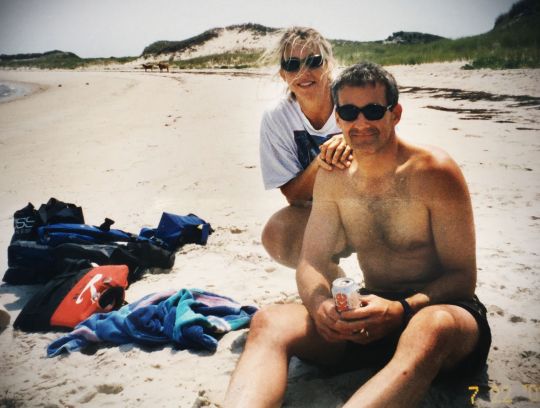
I opened a file drawer and pulled out 12.4 pounds of medical records organized in two large binders. Tucked inside the top binder’s front pocket was a grainy photo of my husband and me sitting on a misty beach on a small island near Martha’s Vineyard in Massachusetts. My husband, slim and fit, smiled at the camera, blissfully ignorant of what was about to happen. Our two sons, 10 and 12 years old, were just out of the camera’s range, playing in the surf. There was a date stamp burned into the lower right corner of the photo that said July 22, 2002.
This was our last day of perfect health.
Courtesy of Kris Newby
What followed was years of misery that started after my husband and I were bitten by unseen ticks. My tick had secretly buried itself at the back of my head, creating a chronically weeping lesion, a tick bite granuloma, that a year later would have to be surgically removed. My husband never figured out where he was bitten. Eventually, we both tested positive for Lyme disease bacteria and malaria-like Babesia parasites. While most tick-borne diseases can be cured with an early dose of inexpensive antimicrobial drugs, the delays in our treatment resulted in a chronic condition, and we joined the estimated 1 million to 3 million people in the US who suffer from persistent Lyme disease symptoms.
I was an engineer trained to solve complex problems and a science writer by profession, so as soon as I was diagnosed, I began reading everything I could about Lyme disease. It quickly became clear that there was a puzzling gap between how the medical establishment viewed the disease and how it was experienced by tick-bitten patients.
The academic researchers who wrote the clinical guidelines for Lyme disease said it was easy to diagnose, treat, and cure. Lyme patients insisted that the tests and symptom lists were inaccurate and that the recommended treatment — a short course of antibiotics — wasn’t curing the disease in all cases. In the face of all these contradictions, I started searching for answers, and along the way I produced a documentary and a book that explored these issues.
Bottom line: The tick-borne disease problem is much more serious and widespread than most people realize, with reported cases of Lyme disease tripling in the United States since the late 1990s. Based on more than a decade of research, I believe our medical system is structurally designed to marginalize and misdiagnose tick-borne disease patients.
The slide into a mysterious illness
A week after my husband and I returned to California from Martha’s Vineyard, we both experienced horrible flu-like symptoms. I was so weak, I had to crawl up to my second-floor bedroom. We went together to see the doctor on call at our community clinic. I told her about our Martha’s Vineyard vacation and suggested that we might have Lyme disease. She dismissed the idea and told us we probably had a virus and that we should come back if symptoms got worse. The next week, we returned to her office sicker than the week before. She still thought it was a virus, but she gave us a referral to see an infectious diseases specialist.
We couldn’t get an appointment with the specialist until December 5 — more than five months after leaving Martha’s Vineyard. During our 10-minute appointment, I told him about the Lyme problem on the island, but he wouldn’t test for it for reasons he didn’t explain. Instead, he tested us for parvovirus and gave us three weeks of a drug called iodoquinol to treat for possible intestinal parasites.
This drug gave us the first relief from symptoms since our vacation, but once the course ended, our symptoms returned more serious than ever, with waxing and waning combinations of exhaustion, brain fog, constipation, explosive diarrhea, head/neck/muscle aches, traveling nerve pain, twitches, blurry vision, light and sound sensitivity, loss of time/place/self, and the inability to read, write, or carry out the cognitive tasks required for daily living.
In January, I called the infectious diseases doctor in tears, begging for more antibiotics, but he refused, saying, “We can’t treat you based on a positive response to drugs.” Then he said he thought we were suffering from a “psychosomatic couples thing.”
I decided to look for another doctor. It was May — 10 months after our trip — before we could get an appointment with two infectious diseases doctors at a nearby academic medical center. They ordered an array of tests, including one for Lyme disease. All the tests came back negative except for my Lyme test. My husband’s Lyme test came back negative. The doctor said my test was a false positive and he was going to ignore it.The younger of the two doctors told us that the odds of us both getting Lyme disease would be like winning the lottery. Then the more senior doctor fired us as patients, saying that he didn’t have the tools to treat people like us.He recommended that we seek counseling for depression.
At this point, I was so incapacitated that I had to shut down my tech marketing business. My husband, a Silicon Valley engineer, went to work sick every day because we needed his employer health insurance. We realized that we might never recover. And in the middle of the night, our inflamed brains churned on one thought, never spoken aloud: What will happen to our boys?
With the first solid lead in our case in 10 months, a positive Lyme test, we found a reputable doctor who specialized in tick-borne diseases through a Lyme support group, and we started down the road to recovery.
The obstacles to getting diagnosed for Lyme disease
It took 10 doctors, a year, and $60,000 to finally diagnose our two serious tick-borne diseases. By then our microbial invaders were deeply entrenched in our brains and tissues. It took another six years of on-and-off antimicrobial treatments to return to health. Because of lost wages and medical expenses not covered by insurance, we burned through our savings and our sons’ college funds. We had to take out a home equity loan to make ends meet.
Yet I consider us among the lucky Lyme patients. Unlike many of the hundreds of patients I encountered during the filming and promotion of the Under Our Skin documentary, we were able to return to work. We’ve been doing well for years. My recent interviews show that even now, years after our ordeal and with Lyme cases increasing, patients still face obstacles in getting diagnosed.
Based on my book and film research, I believe that the root cause of the Lyme misdiagnosis problem is the persistent mythology that the disease is overdiagnosed and that the testing is accurate. The chief proponents of this point of view recently published “Lyme Disease in 2018,” a Viewpoint essay in the prestigious Journal of the American Medical Association. Throughout the essay, the authors minimize the impact of the Lyme problem, and in the abstract, they say
“there has not been a statistically significant increase in the number of reported cases of Lyme disease in the United States during the most recent 4 years (2013-2016) for which data are available.”
This is in stark contrast to the April 2019 statement on Lyme disease from the Centers for Disease Control and Prevention, which said Lyme is spreading rapidly into new geographical areas and that “Tickborne diseases increasingly threaten the health of people in the United States.” While most Lyme cases are concentrated in the northeastern and north central states, there are reported cases of Lyme in all 50 states today. In 2017, there were almost 60,000 cases of tick-borne diseases reported to the CDC.
The scientists at the CDC who study the spread of diseases now say, “Reported cases capture only a fraction of the overall number of people with tickborne illnesses.” The CDC is “unclear” on the reasons behind the rapid spread of ticks and related diseases, though they cite change in land use and climate patterns as important factors.
As we found out the hard way, ticks spread many other diseases, many of them deadly, and the symptoms of mixed tick-borne diseases — Rocky Mountain spotted fever, babesiosis, and Lyme disease, to name a few — are not well documented in the medical literature. Spotted fever can send people into a coma within 14 days. Babesiosis, a red blood cell infection, can be fatal for people with damaged or missing spleens. If Lyme disease is not treated promptly, it can lead to life-threatening cardiac manifestations and chronic neurological problems. In hindsight, it’s easy to see how our whack-a-mole mix of symptoms, especially the brain inflammation and pain, unmeasurable and invisible to physicians, made us seem like hypochondriacs.
Few physicians realize that the recommended two-tiered Lyme disease testing protocol is outdated and inaccurate. One 2007 study in the British Medical Journal found that the protocol missed “88 of every 200 patients with Lyme disease.” Another UK meta-analysis of Lyme test kits, published in the International Journal of General Medicine on November 18, 2016, concluded: “An important clinical implication of our conclusion that current Lyme testing lacks sensitivity is that many genuine cases of LB [Lyme borreliosis] may be underdiagnosed.”
Rather than measuring for the physical presence of the Lyme microbe, the commonly used tests rely on the measurement of a body’s antibody response to the microbe. So a Lyme-infected person might test negative in the first month of infection if their immune system hasn’t produced enough antibodies to be measured. Or, in my husband’s case, if the antibodies at the time of testing were tied up fighting Babesia, the Lyme antibody test might read negative. After his germ load was lowered by a short course of antibiotics, he tested antibody-positive for both of his tick-borne diseases.
A better approach to testing would be to screen blood for specific DNA markers of several tick-borne diseases in one run, but it will take time for these tests to move from the research labs to clinical use.
What to do if you’re bitten by a tick
People ask me what they should do to avoid what my husband and I went through. I tell them that prevention should always be a top priority: pulling socks up over pant legs, spraying repellent on clothing, and doing daily tick checks. Still, sometimes ticks, with skills honed over 120 million years of evolution, slip past those defenses.
Ticks are sewers of infection that can transmit multiple species of disease-carrying organisms into your bloodstream in a matter of hours (though your chances of getting Lyme disease are low if a tick is attached to you for 36 hours or less, according to the CDC). Once a tick taps into a blood vessel, it releases chemicals that suppress the immune system for a week or more, giving the germs a dangerous head start. So if you suspect you may have acquired a tick-borne disease, your number one goal should be to start treatment as soon as possible.
If you capture the tick that bit you, send it to a lab that will analyze it for its microbial hitchhikers. The Bay Area Lyme Foundation will test ticks for free using advanced techniques at the University of Northern Arizona. It’s not fast, but by sending in your tick, you are participating in a citizen science project to track the spread of ticks and associated diseases. Ask your doctor if you can start taking antibiotics while you wait for results. If you have a rash, take a picture of it next to a ruler so you can see if it expands over time, a sign that you have Lyme disease. Know that the testing on the tick is not foolproof — both positive and negative results can be misleading — so keep an eye out for symptoms no matter what the results are.
Find a doctor experienced in treating tick-borne diseases. If you had a brain tumor, you’d probably seek out a doctor with lots of experience treating that specific type of cancer. The best way to find physicians trained in treating complex tick-borne diseases is to contact the International Lyme and Associated Diseases Society, a nonprofit organization that can send you a list of practitioners in your area. Don’t waste valuable treatment time trying to convince an inexperienced physician that you’re really sick. Find an expert who knows which drugs are most effective for each of the tick co-infections and in what order to treat them.
Treatment for Lyme is too often delayed — but hope is on the horizon
As I was writing this story, I showed the 2002 beach photo to my husband and asked him what he thought of the couple in it, us, 17 years ago.
“Naive,” he said.
“If you could turn back time, would you do it?” I asked.
“Absolutely.”
Now that I’m on the other side of my tick-borne illnesses, I spend a lot of time thinking about how to help others avoid the ordeal that my family went through. Here I offer up my personal story as a burnt offering, a cautionary tale, in the hopes that others might avoid the mistakes we made.
The reasons behind the misinformation associated with tick-borne diseases are multifaceted and complex. One of the primary reasons Lyme disease has been ignored by the pharmaceutical industry, a force for good in other diseases, is that there’s no money in it — the cure is an early dose of off-patent, cheap antibiotics. While there’s a profit potential with a Lyme vaccine (one is in development in France), it offers no protection against other serious tick-borne diseases, so it may never be widely adopted. With no accurate diagnostics on the market, Lyme patients are often misdiagnosed with fibromyalgia, chronic fatigue, multiple sclerosis, or irritable bowel syndrome. So for pharma companies, the real money is in treating the daily symptoms of chronic Lyme disease — pain, depression, and inflammation — with lucrative blockbuster drugs.
There is no medical insurance reimbursement code for chronic Lyme disease. Medical insurance companies are under tremendous pressure to reduce costs, and labeling chronic Lyme as a “syndrome” rather than a legitimate disease gives them grounds to deny the expensive ongoing care costs of these very sick patients.
Bunny Woloszczak of Hurleyville, New York, places protest signs at the Capitol Reflecting Pool as part of a rally to foster awareness about Lyme disease May 19, 2016, in Washington, DC. Chip Somodevilla/Getty Images
A close examination of the backstory of Lyme disease shows other factors that have corrupted the foundational science of Lyme disease. In Under Our Skin, I explain how researchers’ financial interests in vaccines and test kits may have negatively influenced the original definition and diagnostic recommendations for Lyme disease. In my book Bitten, I explore evidence that suggests the initial Lyme outbreak was caused by a bioweapons release of an organism that was left out of scientific publications. This book, a call to action for researchers, asks the question,
“Could an unacknowledged human-engineered microbe be contributing to the confusing set of symptoms that tick-bit patients are experiencing today?”
This leaves us with a medical system that is structurally designed to delay treatment and do harm to tick-borne disease patients.
But there is hope on the horizon.
This year, the CDC announced that it will improve its passive system for tracking tick-borne diseases by funding a more coordinated national surveillance program. And there are a few companies and universities working on more accurate, faster diagnostics for all the tick-borne diseases. But these structural fixes won’t be done anytime soon.
In the meantime, the best advice I have to offer is to take charge of your health care. Do your research before you go to the clinic, and find a physician who will be open-minded about the real risks of tick-borne diseases. Realize that you might have to fight to be tested and to be treated with protocols that will restore your health.
So thankful for Kris Newby and all she’s done for the Lyme/MSIDS community.
Please note the horrific way she and her husband were treated by doctors.Unbelievable – except this story plays out again and again and again. Time for doctors to wake up and treat this with the attention it deserves.
Please note,
“A close examination of the backstory of Lyme disease shows other factors that have corrupted the foundational science of Lyme disease. In Under Our Skin, I explain how researchers’ financial interests in vaccines and test kits may have negatively influenced the original definition and diagnostic recommendations for Lyme disease. In my book Bitten, I explore evidence that suggests the initial Lyme outbreak was caused by a bioweapons release of an organism that was left out of scientific publications. This book, a call to action for researchers, asks the question,
‘Could an unacknowledged human-engineered microbe be contributing to the confusing set of symptoms that tick-bit patients are experiencing today?'”
YET…..
“The CDC is “unclear” on the reasons behind the rapid spread of ticks and related diseases, though they cite change in land use and climate patterns as important factors.”
Erroneous research by Ontario public officials completely ignores and dismisses previous published work and instead creates their own reality to show a gradual tick expansion northward due to supposed climate change.
The problem is tick populations already existed in those locations. Scott’s most telling statement for patients to be aware of regarding research on climate change and ticks is this theory would,
“explain to the public a reason for not tackling this serious health care issue earlier. The tick problem was programmed for the future. Thus, ill-founded statistical analyses culminated in fabricated erroneous data and, ultimately, resulted in a series of maps that turned out to be flawed science.”
Although conspiracy theorists have suggested — falsely — that Lyme disease was created in a U.S. military lab, it is true that in the years following World War II, the U.S. employed top German scientists who explored the tick’s potential in biological warfare for Nazi Germany. The researchers were investigating the tick’s ability to spread pathogens across wide areas with the potential to incapacitate entire populations.
Seventy-five years later, the tick timebomb is detonating on its own. Thanks to climate change, globalization, and other factors, ticks are not only proliferating but also becoming more malignant, more aggressive, and more likely to carry infection. A public health crisis is hiding in plain sight,
It’s far easier to blame the climate & land usage than it is to look inside government experiments gone awry.