Archive for April, 2019

NY TV Reporter Tells Her Own Lyme Disease Story

https://www.lymedisease.org/new-york-tv-reporter-tells-her-own-lyme-disease-story/

New York TV reporter tells her own Lyme disease story

https://www.localsyr.com/news/local-news/living-with-lyme-newschannel-9-reporter-nicole-sommavilla-opens-up-about-her-health-journey/1914141778

4 Min News Video here of Ms. Sommavilla’s story.  

____________________

**Comment**

Again, we need to keep sharing our stories until authorities listen and change things.  Another great example of a person who NEVER saw the tick or rash.  With all the people I work with – hardly anybody does, yet they make it sound as if it’s a prerequisite.  Please know the percentages seeing the rash very from 27-80% – hardly a sure thing:  https://madisonarealymesupportgroup.com/2019/02/22/why-mainstream-lyme-msids-research-remains-in-the-dark-ages/  And in the 1st ever patient group in Lyme, Connecticut, only a quarter had the rash.

Notice how severe this case is.  I assure you there are thousands more just like this that never got the proper diagnosis.

Thank God for doctors WHO USE THEIR GOD-GIVEN BRAINS!

For a wonderful 5-part series by NBC NY on Lyme/MSIDS:

https://madisonarealymesupportgroup.com/2017/10/24/lyme-wars-part-1-julias-story/

https://madisonarealymesupportgroup.com/2017/10/25/lyme-wars-part-2-kyra-overcomes-chronic-lyme-diagnosis/

https://madisonarealymesupportgroup.com/2017/10/26/lyme-wars-part-3/

https://madisonarealymesupportgroup.com/2017/10/27/lyme-wars-part-4/

https://madisonarealymesupportgroup.com/2017/10/28/lyme-wars-part-5-coinfections/


Neuro-Lyme is Like Hitting My Head Against a Fog Wall

https://www.lymedisease.org/starling-fog-wall/

Neuro-Lyme is like hitting my head against a fog wall

Eye Problems in Tick-borne Diseases Other Than Lyme

http://danielcameronmd.com/eye-problems-tick-borne-diseases-lyme/

EYE PROBLEMS IN TICK-BORNE DISEASES OTHER THAN LYME

“Why should an ophthalmologist have a good understanding of Lyme diagnosis and treatment?” asks Sathiamoorthi [1], from the Mayo Clinic, in an article published in the Current Opinion in Ophthalmology. “Vision-threatening ophthalmic manifestations are relatively common in Lyme disease (LD) and Rocky Mountain spotted fever.”

by Daniel J. Cameron, MD MPH

“Knowledge of systemic and ophthalmic manifestations combined with an understanding of the epidemiology of disease vectors is crucial for the diagnosis of tick-borne diseases,” she explains.

While manifestations may be present with LD and Rocky Mountain spotted fever, ocular involvement is rare in other tick-borne diseases such as babesiosis, tick-borne relapsing fever, Powassan encephalitis, ehrlichiosis, anaplasmosis, and Colorado tick fever, Sathiamoorthi points out.

However, the true prevalence of ocular involvement due to tick-borne illnesses is unknown. Limitations with testing can make it difficult to identify patients. “It is crucial to know who is appropriate to test in order to avoid false positive results.” If an individual has been symptomatic for only a short period of time, they “may not have detectable serum IgM antibodies to the causative organism because it takes time for this immune response to develop.”

It can also be difficult to determine the cause of the ocular complaints if there is evidence of more than one tick-borne illness.

“One case report [2] describes a patient with optic neuritis and orbital myositis who had serologic evidence of HME [Human Monocytic Ehrlichioisis], Borrelia burgdorferi, and Babesia,” cites Sathiamoorthi.

There are more than one species of ticks associated with ocular findings, as well. According to Sathiamoorthi, those include Ornithodoros genus, Dermacentor variabilis Ambylomma americanum, Ixodes scapularis, and Dermacentor andersonii.

Sathiamoorthi advises doctors to “carefully generate a reasonable differential based on clues in the medical and social history regarding exposures and risks.”

“Patients who are most likely to have ophthalmic Lyme disease,” explains Sathiamoorthi, “are those with ocular manifestations commonly associated with Lyme disease (i.e. Bells palsy, cranial nerve palsies and keratitis); tick exposure in Lyme endemic regions; other signs/symptoms of late Lyme disease (i.e. inflammatory arthritis, carditis, acrodermatitis chronica atrophicans rash, encephalopathy and meningitis); and negative syphilis testing.”

Read more on eye problems in tick-borne diseases in “A growing list of eye problems in Lyme disease.”

References:

1. Sathiamoorthi S, Smith WM. The eye and tick-borne disease in the United States. Curr Opin Ophthalmol. 2016;27(6):530-537.
2. Pendse S, Bilyk JR, Lee MS. The ticking time bomb. Surv Ophthalmol. 2006;51(3):274-279.


April – Lyme Prevention Month for Dogs: A Pet Owner’s Guide

https://www.avma.org/public/PetCare/Pages/lyme-disease.aspx

Lyme Disease: A Pet Owner’s Guide

Rolo_Small_250w
Rolo has Lyme disease, but thanks to early diagnosis and regular veterinary care, she lives a happy, healthy life with her family.
Lyme disease (Lyme borreliosis) is an illness that affects both animals and humans – what is known as a zoonotic disease – and is the most commonly reported vector-borne illness in the United States, according to the U.S. Centers for Disease Control and Prevention (CDC). Transmitted through tick bites, the disease can be difficult to detect and can cause serious and recurring health problems. Therefore, it is best to prevent infection by taking appropriate measures to prevent tick bites and, for dogs, possibly vaccinating against the disease.

The bacterium that causes Lyme disease – a worm-like, spiral-shaped bacterium called Borrelia burgdorferi  – is carried and transmitted primarily by the tiny black-legged tick known as the deer tick. Deer ticks are found in forests or grassy, wooded, marshy areas near rivers, lakes or oceans. People or animals may be bitten by deer ticks during outdoor activities such as hiking or camping, or even while spending time in their back yards. 

Named after numerous cases were identified in Lyme, Conn., in 1975, the disease has since been reported in humans and animals across the United States and around the world. Within the U.S., it appears primarily in specific areas including the southern New England states; eastern Mid-Atlantic states; the upper Midwest, particularly Wisconsin and Minnesota; and on the West Coast, particularly northern California. The CDC maintains a map detailing confirmed cases of Lyme disease throughout the years.

Lyme disease is a reportable disease – which  means that health care providers and laboratories that diagnose cases of laboratory-confirmed Lyme disease are required to report those cases to their local or state health departments, which in turn report the cases to the CDC.

How to prevent Lyme disease

The best way to protect pets from Lyme disease is to take preventive measures to reduce the chance of contracting the disease. Even during the last weeks of summer, it’s important to remember that pets and people are at greater risk of being infected with Lyme disease and other tick-borne diseases such as anaplasmosis, ehrlichiosis, or Rocky Mountain Spotted Fever.

People with pets should:

  • Use reliable tick-preventive products. Speak with your veterinarian about what tick preventive product is right for your pet.
  • Work with your veterinarian to decide whether to vaccinate your dog against Lyme disease. Your veterinarian’s advice may depend on where you live, your pet’s lifestyle and overall health, and other factors.
  • When possible, avoid areas where ticks might be found. These include tall grasses, marshes and wooded areas.
  • Check for ticks on both yourself and your animals once indoors.
  • Clear shrubbery next to homes.
  • Keep lawns well maintained.

As noted above, there are preventive Lyme disease vaccines available for dogs, but they aren’t necessarily recommended for every dog. Consult your veterinarian to see if the vaccination makes sense for your pets. If your veterinarian does recommend that your dog be vaccinated against Lyme disease, the typical protocol will involve an initial vaccination followed by a booster 2-4 weeks later and annual boosters after that.

Lyme disease in pets – symptoms and treatment

Pets infected with Lyme disease may not show any signs for 2-5 months. After that time, typical symptoms include:

  • Fever
  • Loss of appetite
  • Lameness
  • Joint swelling
  • Decreased activity

Recurrent lameness also is possible, and the involved extremity may be tender. Inflammation of the joint can last from days to weeks, and may migrate from one extremity to another.

Horses with Lyme disease can develop lameness, joint pain, neurologic disease, eye problems and dermatitis.

Symptomatically, Lyme disease can be difficult to distinguish from anaplasmosis because the signs of the diseases are very similar, and they occur in essentially the same areas of the country. Lyme disease is diagnosed through a blood test that shows whether an animal has been exposed to the bacterium.

Antibiotics usually provide effective treatment for Lyme disease. However, it’s important to follow your veterinarian’s advice regarding follow-up care after your pet has been diagnosed with and treated for the disease.

Lyme disease is not communicable from one animal to another, except through tick bites. However, if you have more than one pet and one is diagnosed with Lyme disease, your veterinarian might recommend testing for any other pets who may have been exposed to ticks at the same time. In fact, because people and their pets often can be found together outdoors as well as indoors, a Lyme disease diagnosis in any family member – whether human or non-human – should serve as a flag that all family members might consult their physicians and veterinarians, who can advise about further evaluation or testing.

It’s a “One Health” problem

Because people and their pets often spend time in the same environments where Lyme and other disease-transmitting ticks are found, the American Veterinary Medical Association (AVMA) and the American Academy of Pediatrics (AAP) are working together to offer advice to households with both children and pets. People who have been diagnosed with Lyme disease should consult their veterinarian to determine their pet’s risk based on the animal’s lifestyle and possible environmental exposures. Likewise, people whose animals have been diagnosed with Lyme disease may want to consult their physician about their own or their children’s risk if they have concerns that the animals and family members might have been exposed to similar environmental risks.
Thousands of cases of Lyme disease have been reported in humans and animals across the United States and around the world. By knowing about Lyme disease and how to prevent it, you can help keep all members of your family — human and animal — safe.

Lyme disease in people

In humans, often the earliest indication of infection is a “bullseye” rash at the site of the tick bite – so named because it resembles a target. As the infection develops, symptoms include fever, headache, fatigue, and muscle and joint pain. The disease can progress to cause chronic joint problems as well as heart and neurological problems. As with pets, Lyme disease is not contagious from one person to another.

There are many things people can do to avoid exposure to tick bites. These include:
  • Avoid areas where ticks are found
  • Cover arms, legs, head and feet when outdoors
  • Wearilight-colored clothing
  • Use insecticides
  • Checking for ticks once indoors.

The American Academy of Pediatrics has more information about Lyme disease in people.

Related information

More from other sources

_________________________
**Comment**
  1. Our dog’s case of Lyme disease was picked up on a yearly routine test. He was fine and didn’t show any signs of infection. Our vet insisted that he be treated with over a month’s worth of antibiotics. Meanwhile, my husband spiraled down the vortex of doom for years. No blood test would pick it up. He tested negative on the two-tiered CDC testing. Thankfully, a wise “out of the box” doctor tested him for inflammation which was off the charts high. She said, “The CDC says you don’t have Lyme, I say you do,” and she treated him with two antibiotics – of which he improved immediately. Shortly after, I developed symptoms but also tested negative with CDC testing. By this time, I contacted a Lyme support group and became educated on the polarization within the medical community and had the list of WI LLMD’s in hand. We’ve been in and out of treatment ever since, having spent over $150K out of pocket, but have our lives back.
  2. Throw the CDC maps in the garbage.  This is a pandemic and in every continent but the Antarctica.
  3. Far fewer are getting the EM rash than is touted:  https://madisonarealymesupportgroup.com/2019/02/21/lyme-disease-dont-wait-for-blood-tests-where-patients-have-bullseye-rash/ (read comment as well)
  4. Read up on the Lyme vaccine.  It caused Lyme-like symptoms in people and it’s done that to animals as well: https://www.dogsnaturallymagazine.com/lyme-vaccine-dogs/
  5. While authorities keep saying this can’t be transmitted person to person, Lida Mattman PhD has gone on record saying something entirely different and she studied spirochetes for decades: https://madisonarealymesupportgroup.com/2019/04/02/transmission-of-lyme-disease-lida-mattman-phd/
  6. There’s more than Lyme to worry about:  https://madisonarealymesupportgroup.com/2018/10/30/study-shows-lyme-msids-patients-infected-with-many-pathogens-and-explains-why-we-are-so-sick/
  7. For more on prevention:   https://madisonarealymesupportgroup.com/2019/04/12/tick-prevention-2019/

WLN Newsletter – April, 2019

At_a_Glance_Newsletter_4-16-19

Highlights

  • Recap of March WLN Lyme Workshop held in La Crosse. Over 60 from across the state attended!
  • Great article by WLN president Sherry Sievewright on  the importance of addressing microbes in Lyme/MSIDS treatment.
  • WI Lyme Walk for 2019 tabled.
  • Permethrin Pretreated Socks for sale to raise funds for WI doctor education.
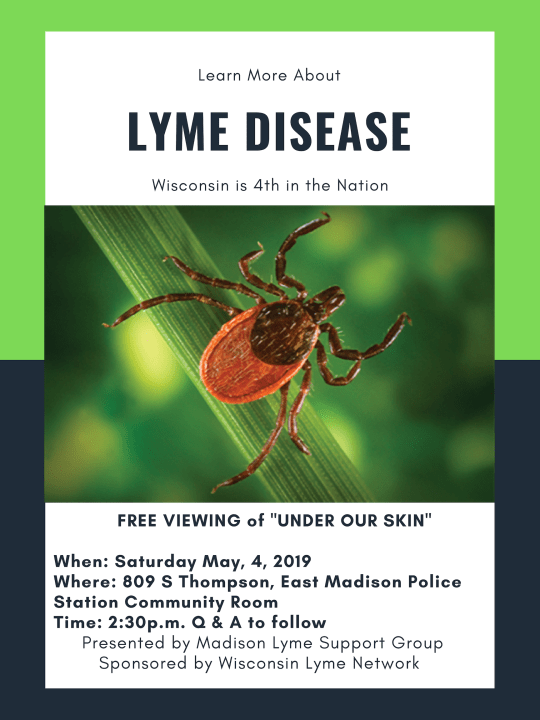
  • Upcoming Lyme Awareness Event in Madison:

Mark Jason Lim