https://www.public-health.uiowa.edu/news-items/study-links-food-allergy-to-autism-spectrum-disorder-in-children/

Study links food allergy to autism spectrum disorder in children

Published on June 15, 2018

Wei-Bao-130x182Assistant Professor Wei Bao of the Department of Epidemiology in the University of Iowa College of Public Health.

A new study from the University of Iowa finds that children with autism spectrum disorder (ASD) are more than twice as likely to suffer from a food allergy than children who do not have ASD.

Wei Bao, assistant professor of epidemiology at the UI College of Public Health and the study’s corresponding author, says the finding adds to a growing body of research that suggests immunological dysfunction as a possible risk factor for the development of ASD.

“It is possible that the immunologic disruptions may have processes beginning early in life, which then influence brain development and social functioning, leading to the development of ASD,” says Bao.

The study analyzed the health information of nearly 200,000 children gathered by the U.S. National Health Interview Survey (NHIS), an annual survey of American households conducted by the U.S. Centers for Disease Control and Prevention. The children were between the ages of 3 and 17 and the data were gathered between 1997 and 2016.

The study found that 11.25 percent of children reportedly diagnosed with ASD have a food allergy, significantly higher than the 4.25 percent of children who are not diagnosed with ASD and have a food allergy.

Bao says his study could not determine the causality of this relationship given its observational nature. But previous studies have suggested possible links—increased production of antibodies, immune system overreactions causing impaired brain function, neurodevelopmental abnormalities, and alterations in the gut biome. He says those connections warrant further investigation.

“We don’t know which comes first, food allergy or ASD,” says Bao, adding that another longitudinal follow-up study of children since birth would be needed to establish temporality.

He says previous studies on the association of allergic conditions with ASD have focused mainly on respiratory allergy and skin allergy, and those studies have yielded inconsistent and inconclusive results. The new study found 18.73 percent of children with ASD suffered from respiratory allergies, whereas only 12.08 percent of children without ASD had such allergies, and 16.81 percent of children with ASD had skin allergies, well above the 9.84 percent of children without ASD.

“This indicates there could be a shared mechanism linking different types of allergic conditions to ASD,” says Bao.

Bao says the study is limited in that the NHIS depends on respondents to voluntarily self-report health conditions, so the number of children with ASD or allergies may be misreported by those taking the survey. But he says the large number of respondents and ethnic and gender cross-representation of the survey are major strengths.

The study, “Association of Food Allergy and Other Allergic Conditions with Autism Spectrum Disorder in Children,” was published online in the June 8 issue of JAMA Network Open. The first author is Guifeng Xu, PhD candidate in the UI College of Public Health and graduate research assistant in the UI Roy J. and Lucille A. Carver College of Medicine. Additional co-authors include Linda G. Snetselaar, professor of epidemiology in the UI College of Public Health; Jin Jing, professor of maternal and child health at the Sun Yat-Sen University in China; Buyun Liu, postdoctoral researcher in the UI College of Public Health; and Lane Strathearn, professor of pediatrics in the Carver College of Medicine.

This story originally appeared in Iowa Now:  https://now.uiowa.edu/2018/06/ui-study-links-food-allergy-autism-spectrum-disorder-children

______________

For More:  https://madisonarealymesupportgroup.com/2018/06/15/canadian-data-more-autism-where-vaccine-coverage-is-highest/

https://madisonarealymesupportgroup.com/2017/09/19/autism-aluminum-adjuvant-link-corroborated/

https://madisonarealymesupportgroup.com/2018/06/01/immunoexcitotoxicity-as-the-central-mechanism-of-etiopathology-treatment-of-autism-spectrum-disorders-a-possible-role-of-fluoride-aluminum/

https://madisonarealymesupportgroup.com/2017/10/26/clinical-trial-shows-most-kids-with-autism-are-not-born-with-it/

https://madisonarealymesupportgroup.com/2018/06/25/success-of-blood-test-for-autism/
 

https://www.theverge.com/2018/6/25/17501618/fda-cannabis-drug-epidiolex-dea-scheduling-science

The FDA approved a pot-derived drug for seizures — will the DEA allow it to be sold?

Epidiolex is made from a chemical that comes from cannabis but doesn’t create a high

By Angela Chen, @chengela,  Jun 25, 2018,

For the first time, the US Food and Drug Administration has approved a drug made from cannabis. Epidiolex treats severe forms of childhood epilepsy — but the Drug Enforcement Administration will need to reclassify this form of cannabis before the drug can be put on the market.

For almost half a century, the DEA has classified cannabis as a Schedule I drug, along with heroin and LSD. (For context, cocaine and meth are Schedule II drugs.) Schedule I drugs are considered to have “no currently accepted medical use and a high potential for abuse.”  As a result, it is extremely difficult for scientists to research the substance and pharmaceutical companies aren’t allowed to use it.

But now the FDA has approved Epidiolex as a medical drug. Epidiolex contains cannabidiol, or CBD — a chemical that comes from the cannabis plant but does not have psychoactive effects — and is administered as an oil. According to DEA spokesperson Melvin Patterson, the administration had been considering reclassifying CBD and “the FDA’s findings on something like Epidiolex will weigh heavily on the decision-making process.”  Still, there’s no update on whether the approval will change the timeline of the proposed reclassification. The DEA could also reclassify CBD, but leave cannabis itself at Schedule I.

Epidiolex treats two forms of epilepsy, Dravet syndrome and Lennox-Gastaut syndrome, which rarely respond to treatment. It is manufactured by GW Pharmaceuticals and clinical trials have shown that kids taking Epidiolex had nearly 40 percent fewer seizures per month.

The scope of the drug is limited, and the approval is for “a single compound that comes from the plant and is approved for two very specific forms of epilepsy,” said Daniel Friedman, an associate professor of neurology at NYU Langone’s Comprehensive Epilepsy Center who co-authored a study investigating Epidiolex to treat Dravet syndrome. But doctors could prescribe it off-label for other forms of epilepsy, and FDA approval could be the domino effect that leads to DEA reclassification and a renaissance of cannabis research.

We have reached out to GW Pharmaceuticals for comment and will update the post if the company responds.

________________

For more on Cannabis:  https://madisonarealymesupportgroup.com/2018/06/14/caffeine-more-dangerous-than-cannabis/

https://madisonarealymesupportgroup.com/2015/05/19/marijuana-the-miracle-herb/

https://madisonarealymesupportgroup.com/2018/01/24/medical-marijuana-for-lyme-a-doctors-perspective/

https://madisonarealymesupportgroup.com/2017/10/05/marijuana-chronic-pain-q-a-with-dr-david-barton/

https://madisonarealymesupportgroup.com/2017/01/23/nasem-report-on-cannabis/

For a helpful website with all sorts of links and research showing how Cannabis can help alcoholism, the opioid epidemic, drug abuse, and more:  http://lecuanmmcpmcabpetitions.blogspot.com/2017/03/petition-requesting-inclusion-of-new_61.html

http://bmjopen.bmj.com/content/8/6/e021367

Obstacles to diagnosis and treatment of Lyme disease in the USA: a qualitative study

Annemarie G Hirsch1, Rachel J Herman2, Alison Rebman3, Katherine A Moon4, John Aucott3, Christopher Heaney4,5, Brian S Schwartz1,4

Abstract
Objective:   For many individuals with Lyme disease, prompt treatment leads to rapid resolution of infection. However, severe complications can occur if treatment is delayed. Our objective was to identify themes around belated diagnosis or treatment of Lyme disease using the General Model of Total Patient Delay (GMTPD).

Design: We conducted a qualitative interview study using indepth telephone interviews.

Setting: Participants were patients from a large, integrated health system in the state of Pennsylvania, USA.

Participants: There were 26 participants. Participants had to have a diagnosis of Lyme disease between 2014 and 2017 and a positive IgG western blot. We used a stratified purposeful sampling design to identify patients with and without late Lyme disease manifestations. To ensure variation in care experiences, we oversampled patients diagnosed outside of primary care.

Outcome measures:  We asked participants about their experience from first Lyme disease symptoms to treatment. We applied an iterative coding process to identify key themes and then synthesised codes into higher order codes representing the GMTPD stages: appraisal delay (symptom to recognition of illness); illness delay (inferring illness to deciding to seek help); behavioural delay (deciding to seek help to the act of seeking help); scheduling delay (seeking help to attending an appointment); and treatment delay (attending appointment to treatment).

Results:  Appraisal delay themes included symptom misattribution, intermittent symptoms and misperceptions about the necessity of a bull’s-eye rash. Health insurance status was a driver of illness and behavioural delays. Scheduling delay was not noted by participants, in part, because 10 of the 26 patients went to urgent care or emergency department settings. Misdiagnoses were more common in these settings, contributing to treatment delay.

Conclusion:  Our study identified potentially modifiable risk factors for belated treatment. Targeting these risk factors may minimise time to treatment and reduce the occurrence of preventable complications.

This is an open access article distributed in accordance with the Creative Commons Attribution Non Commercial (CC BY-NC 4.0) license, which permits others to distribute, remix, adapt, build upon this work non-commercially, and license their derivative works on different terms, provided the original work is properly cited and the use is non-commercial. 

_______________

**Comment**

Even though this was a very small sample size, and even though it had stringent criteria to participate (a positive test is like winning the lotto), it clearly shows obvious flaws in our medical system.

  • First, people are delaying seeing a doctor due to insurance.  We all know the earlier you treat the better the outcome and yet, insurance represents a HUGE obstacle.  If we want to move forward one of two things has to happen:  insurance needs to adapt a different policy on Lyme/MSIDS, and/or people need to be educated that it is far better to pay a minimal amount out of pocket if need be than thousands out of pocket later.
  • Second, intermittent symptoms are HALLMARK Lyme/MSIDS.  The fact people continue to hesitate means people are still not getting the memo.  https://www.dhs.wisconsin.gov/publications/p01735.pdf

Paragraph 1:  60% of untreated patients may develop intermittent bouts of arthritis

Paragraph 2:  These symptoms are typically intermittent

Paragraph 3:  Recurrent, intermittent attacks (weeks or months) of objective joint swelling in one or a few joints.

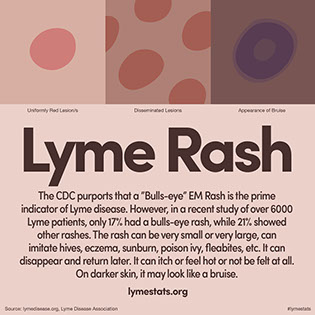
  • Third, the circulating information about a supposed “classic” bullseye rash will be the death of us all.  Remember, many never get it at all, yet it continues to rule diagnosis like an iron curtain.  Again, we must spread the word, and it must be acknowledged in the medical world that many never have a rash or they have a rash that doesn’t fit the strict criteria authorities have made up.

47_rash316x316

https://madisonarealymesupportgroup.com/2018/02/19/calling-all-doctors-please-become-educated-regarding-tick-borne-illness-heres-how/

https://madisonarealymesupportgroup.com/2018/02/22/new-lyme-cme-course-available-lyme-carditis-more-than-blocked-beats/

  • Fifth, doctors are STILL skeptical and are a huge part of the problem:  

https://madisonarealymesupportgroup.com/2018/06/26/report-lyme-disease-on-rise-but-doctors-remain-skeptical/

Not sure what to say to this other than they need more education on tick borne illness and they need open minds.  If ever there was a disease(s) that needs an open mind, it’s this one.  More and more is being discovered daily -much of it refuting long held doctrine, and frankly, much of the prior research needs to be redone as it was so completely biased and riddled with issues due to fraud and collusion of the researchers themselves.

To any health practitioner willing to learn:  https://madisonarealymesupportgroup.com/2018/06/06/lyme-education-for-healthcare-professionals/

https://madisonarealymesupportgroup.com/2018/02/19/calling-all-doctors-please-become-educated-regarding-tick-borne-illness-heres-how/

https://www.newsmax.com/t/newsmax/article/866576?section=health&keywords=lyme-disease-on-rise-misdiagnose-

Report: Lyme Disease on Rise But Doctors Remain Skeptical

New Clothing Offers Protection Against Ticks

(Stephen Chernin/Getty Images)

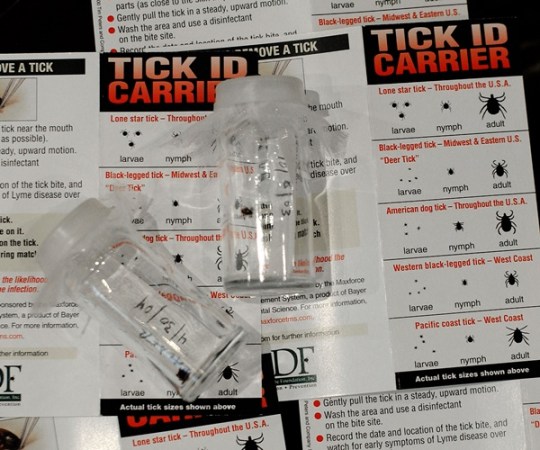
Ticks in small bottles rest on Tick ID Carrier information cards June 29, 2004 in New York City. The Centers for Disease Control (CDC) said the number of cases reported annually has more than doubled since 1991. Lyme disease was first diagnosed in the 1970s in patients around the town of Lyme, Conn. 

By Todd Beamon
Saturday, 16 Jun 2018

The federal government reports that cases of Lyme disease are on the rise, but many patients and researchers are finding that physicians are skeptical in diagnosing the deer tick-borne disease.

“It’s very serious,” Marina Makous, a family medicine doctor in Exton, Pennsylvania, told NBC News. She is a former fellow at the Neuroinflammatory Diseases Center at Columbia University’s Lyme and Tick-Borne Diseases Research Center.

“There is an underappreciation of the seriousness of this illness, especially when [physicians] don’t treat patients with Lyme disease on a daily basis,” she said.

The Centers for Disease Control and Prevention issued an updated warning last month that insect-borne diseases, especially those spread by ticks, are on the rise, having more than doubled from 2004 to 2016.

Warmer weather is an important cause of the increased cases reported to the agency, according to The New York Times.

“You can think of ticks as dirty needles,” Makous told NBC. “They carry multiple pathogens and can transmit other things that make it more difficult for the immune system to fight off Lyme disease.”

Lyme disease is caused by a spiral-shaped bacteria called Borelia burgdorferi. It is found in the saliva of the blacklegged tick, more commonly known as a deer tick.

The bacteria spreads rapidly and has complex survival mechanisms, according to the NBC report.

Though most physicians believe it can be eradicated with antibiotics, the bacteria has been shown to return after treatment in the blood and tissue of animals and humans.

Numerous patients say they live with chronic, persistent symptoms — and have had difficulty being diagnosed by their doctors.

“I’m one of the rare cases where you have an unequivocal diagnosis,” Porochista Khakpour, a New York writer and author, told NBC. “People have put that at less than 10 percent.”

After 12 years of trying to find out why she was having a range of physical ailments — from convulsions to debilitating fatigue — she learned in 2012 that she had Lyme disease after expensive blood tests from a private blood-testing company.

In her new book, “Sick: A Memoir,” Khakpour, 40, wrote that Lyme disease” is thought of as the disease of hypochondriacs and alarmists and rich people who have the money and time to go chasing the diagnosis.

Khakpour was bitten by a deer tick — and she is among the fewer than 50 percent of people with Lyme who do not remember being infected that way or seeing the famed “bulls-eye” rash typically associated with the disease.

She added that doctors often diagnosed her problems as psychiatric.

“But that didn’t explain to me why I would have fever, or why my body would be in convulsions, why I would develop these huge allergies,” Khakpour told NBC. “Then they’d say, ‘Well, the mind is very strong you know.'”

Makous called Lyme disease “the great imitator,” noting that initial treatments “may blunt the development of antibodies.”

Future tests could turn up negative, she added, though the bacteria may linger in the body.

“It’s a multi-systemic disease,” Makous explained. “There aren’t specific symptoms unique only to Lyme.

“It can look like stroke, like Alzheimer’s, like vasculitis, like neuropathy.“

Makous noted that singer-songwriter Kris Kristofferson’s Lyme disease was initially misdiagnosed as Alzheimer’s in 2016.

Psychiatric symptoms like depression and anxiety could also result from Lyme — and Makous said she has seen increased signs of suicide in such patients, along with facial weakness, headaches, sensory disturbances and cognitive problems.

Khakpour, however, worries that she may never get truly better, telling NBC that she has resigned herself to living with the long-term effects of Lyme disease.

“It never seems to go away,” she said, “the feeling that as much as I achieve or as strong as I can be, this disease is smarter.”

________________

For more:  

https://madisonarealymesupportgroup.com/2016/06/09/alzheimers-byproduct-of-infection/  (Link to Kris Kristofferson’s case.  Lyme treatment turned the Alzheimer’s completely around)

https://madisonarealymesupportgroup.com/2017/01/18/a-bug-for-alzheimers/

https://madisonarealymesupportgroup.com/2018/03/25/a-brief-history-of-neuroborreliosis-research-dementia-an-inside-look-at-two-researchers/

https://madisonarealymesupportgroup.com/2017/06/10/the-coming-pandemic-of-lyme-dementia/

Psychological symptoms:  https://madisonarealymesupportgroup.com/2015/10/18/psychiatric-lymemsids/

https://madisonarealymesupportgroup.com/2018/05/19/panic-attacks-may-be-lyme-msids/

https://madisonarealymesupportgroup.com/2018/03/07/obsessive-compulsive-symptoms-in-adults-with-ld/

My only beef is the repeated mantra that warmer weather is to blame for increased infection rates.  That’s pure conjecture and many disagree with that premise: https://madisonarealymesupportgroup.com/2017/08/14/canadian-tick-expert-climate-change-is-not-behind-lyme-disease/


http://www.foxnews.com/health/2018/06/25/womans-home-infested-with-ticks-after-85-are-found-on-family-dog.html

Woman’s home infested with ticks after 85 are found on family dog

By Daniel Sheridan | SWNS 

1529937269569

The family’s dog, Justin, had to be sedated so that vets could remove 85 ticks from his skin. (SWNS)

A mom in England claims her home became infested with blood-sucking ticks after she took her dog for a walk.

Kimberley Whitehead‎, 37, discovered a tick burrowing in her leg last weekend after she went walking with her terrier named Justin.

Within days of the discovery, her dog and home were riddled with the parasites, which can cause Lyme disease.

Whitehead, who works as an Electricity North West manager, was forced to temporarily move her young daughter out of her home as a precautionary measure.

She is now appealing for other walkers in the area to be aware of the potential risks and be on the lookout for ticks.

“It’s been quite a traumatic week for both our family and our dog, Justin,” Whitehead said. “After discovering a tick burrowing into my leg …. we checked the dog to find nothing.”

“Within just days, the dog and the house where riddled with them,” she said. “We’ve had to get pest control in and today Justin had 85 removed from him under sedation at the vet. It is quite frightening just how quickly this escalated.”

1529937322672Whitehead, pictured with her daughter, found a tick burrowed in her leg and is being treated for Lyme disease. (SWNS)

“We are now both being treated for Lyme disease, a frightening thought, but I am warning other pet owners to check your pet for ticks,” Whitehead said. “The unusual warm weather seems to have brought them out in force.”

“We normally walk around the Laund clough / woods and the disused railway lines in Baxenden, Accrington,” she said. “Please be alert and make sure you brush yourself and pet down before entering your home.”

Whitehead said she has used the experience to educate herself and has warned others to use treatment for both fleas and ticks.

“This week has been an education but wish I knew more about it beforehand, so please take the time to know the facts on how to remove them and what to look for,” she said. “More importantly don’t just use treatment for fleas but ticks too.”

Whitehead and her dog are now receiving treatment for Lyme disease and face an anxious three-month wait to see if they have been infected.

________________

For more prevention tips:  https://madisonarealymesupportgroup.com/2017/05/11/tick-prevention-and-removal-2017/

https://madisonarealymesupportgroup.com/2018/05/27/study-conforms-permethrin-causes-ticks-to-drop-off-clothing/

https://madisonarealymesupportgroup.com/2018/04/03/fire-good-news-for-tick-reduction/