https://dermagicexpress.blogspot.com/2018/07/congenital-transmission-of-erythema.html?m=1

July 22, 2018

CONGENITAL TRANSMISSION OF ERYTHEMA MIGRANS OR LYME DISEASE, MYTH OR REALITY ?

AUTHORS

1.) Dr. Lapenta, J Medic Surgeon, Specialty Dermatology, 24 years of exercise. Highly trained in the field of research; University of Carabobo, Venezuela. CEO DERMAGIC EXPRESS. www.dermagicexpress.blogspot.com

2.) Dr. Lapenta, JM. Medic Surgeon. University of Carabobo. Diplomat in Facial Aesthetics Occupational Medicine and Prehospital Auxiliary. Resident Doctor Ambulatorio Del Norte Maracay Aragua State. COO DERMAGIC EXPRESS.  www.dermagicexpress.blogspot.com

ABSTRACT

Lyme disease or Erythema Migrans, described many years ago, and previously known under the name of Lyme Juvenile Arthritis, is produced by a spirochete transmitted by the bite of a family tick. Ixodidade, Ixodes scapularis and many others; discovered by the scientist Willy Burgdorfer in the year of 1981, being named Borrelia Burgorferi, in honor of its discoverer. Apart from the numerous cutaneous and organic manifestations attributed to Borrelia, it is nowadays discussed in the scientific field if it is capable of crossing the placenta and causing fetal damage. In this review we will show you that this biological agent, as in syphilis, produced by Treponema Pallidum, another spirochete, crosses the placenta and can produce serious consequences to the fetus, including death.

Key words: Lyme disease, Borrelia burgdorferi, congenital lyme, fetal damage and pregnancy

MAIN OBJECTIVE

The main objective of this work is to demonstrate that Lyme disease and their biological agent, spirochete Borrelia Burgdorferi, is not only an illness with cutaneous manifestations. It can cross the placenta during pregnancy and produce fetal damage that in severe cases can cause death in newborns.

SECONDARY OBJECTIVES.

1.) Describe the clinical manifestations in children born from positive Lyme mothers who did not receive treatment in pregnancy, or in those who received treatment with resistance to it.

2.) Alert the World community that there is indeed transplacental transmission of Borrelia Burgdorferi in pregnant Lyme positive women and if there is not adequate treated in time, both the mother and fetus can present clinical symptoms ranging from mild, to severe, even stillbirth.

3.) To call attention to the World Health Organization so that in the revision of the international codes of diseases (ICD-11), this year 2018, the code “Congenital Lyme” be  included in them.

INTRODUCTION

The Center for Disease Control and Prevention (CDC) affirms in its website that the pregnant woman Lyme positive when making her treatment, the child will be born healthy and recommends for this, the use of the antibiotic amoxicillin or cefuroxime, because doxycycline, which is the antibiotic of choice, can cause damage to the developing fetus. [1]

Other antibiotics recommended by the CDC are the macrolides azithromycin, clarithromycin or erythromycin in case of allergy or intolerance to those previously mentioned. [2]

The CDC itself recognizes that Lyme disease and its causative agent Borrelia Burgdorferi can cross the placenta and cause stillbirths. [1-2]

The question here is what would happen if the Borrelia species, as in some cases, is resistant to amoxicillin or another antibiotic, or the antibiotic to which Borrelia is sensitive cannot be indicated because it would harm the fetus? And beyond, if the patient does not receive the treatment by omission or carelessness? [3]

As we said previously the Borrelia Burgdorferi was discovered by Willy Burgdorfer in the year 1981, and just two (2) year later, in 1983 the first study was published by Shirts SR, and Brown MS, Bobitt Jr, where it is suspected that this spirochete can cross the placenta. [4]

After this study others began to appear, who definitely showed that this spirochete is able to cross the placenta and cause fetal damage, of which we will present in chronological order the most important and confirm the above said.

CHRONOLOGICAL EVOLUTION

1983

The first suspicion described that ante partum fever may be caused by the Borrelia Burgdorferi species, was made in 1983 in two febrile pregnant women in the third-trimester. The two newborn survived, but the scientists suggested the establishment of early laboratory tests to identify the causative agent and the establishment of a rapid treatment to avoid future complications in the pregnant and the fetus. [4]

1985

Really, the first study describing the maternal-fetal transmission of Lyme disease, Borrelia Burgdorferi was published in 1985 by Schlesinger PA, Duray PH, Burke BA, Steere AC, and Stillman MT., Where they describe a case of a pregnant woman who acquired Lyme Borreliosis and did not receive treatment with antibiotics. The child was born at 35 weeks of pregnancy and died of congenital heart disease the first week of life. The autopsy revealed the Borrelia Burgdorferi spirochete in the spleen, kidneys and bone marrow. [5]

1986-1989

In the year 1986, MacDonald A, describes 4 cases of abortions in pregnant women who tested positive for Lyme, and in whose fetuses the Borrelia Burgdorferi was found in their tissues. This same author does another work in 1989 about Lyme disease and its implications for the fetus and describes side effects such as fetal death, hydrocephalus, cardiovascular abnormalities, neonatal respiratory distress, hyperbilirubinemia, intrauterine growth retardation, cortical blindness, sudden death syndrome of the infant and maternal toxemia of pregnancy, and raises the similarity of these with neonatal syphilis. [6-7].

1987

Later, the same Willy Burgdorfer the discoverer of the Borrelia Burgdorferi, together with Dr. Alan Mc Donald and Jorge Benach PhD, published in year 1987 (31 years ago) a work where they relate this disease with children born dead associated in pregnant Lyme positive.

Among the highlights the description of congenital malformations, fetal death, cardiac anomalies and alert the scientific community to investigate exposure during the first trimester of pregnancy in the presence of Borrelia Burgdorferi; and in this cases to determine if cardiac organogenesis is complete by the end of the first trimester of pregnancy. They also recommend starting treatment with Penicillin at the same dose of syphilis in those cases of pregnant women who show signs and early symptoms of the disease. [8]

1988-2012

In these 24 years a total of more than 80 papers were published where Lyme disease is effectively related to pregnancy with fetal damage, studies done in the countries: United States, Canada, Hungary, Germany, Italy, Switzerland, Africa, Turkey, Czech Republic, Poland and Belgrade former Yugoslavia, and others [10-52]

Another study that is worth noting is that carried out by the updated MEDLINE database for the year of July 2012, the last revision of November 2012 of 88 journal articles from the PUBMED database, which we summarize in this way

Maternal-fetal transmission of Lyme disease (Findings):

1.) Mothers with active Lyme disease, treated: 14.6% of pregnancies resulted in sequel (a morbid condition following or occurring as a consequence of having Lyme).

2.) Mothers with active Lyme disease not treated: 66.7% of pregnancies resulted in sequel.

3.) Positive Lyme mothers, the treatment is unknown: 30.3% resulted in sequel.

4.) Specific adverse results included:

– Cardiac 22.7%,

– Neurological 15.2%,

– Orthopedic 12.1%,

– Ophthalmologic 4.5%,

– Genitourinary 10.6%,

– Miscellaneous anomalies 12.1%. [53]

Now we will put a summary of the most frequent clinical manifestations described in a study of more than 100 children born to mothers with LYME positive disease, conducted in the year 2005.

COMMON SIGNS AND SYMPTOMS IN LYME POSITIVE CHILDREN:

1.) Low grade fever: 59% -60%
2.) Fatigue and lack of resistance: 72%
3.) Nocturnal sweating: 23%
4.) Pale, dark circle under the eyes: 42%
5.) Abdominal pain: 20-29%
6.) Diarrhea or constipation: 32%
7.) Nausea: 23%
8.) Cardiac anomalies: 23%: palpitations / PVC, heart murmur, mitral valve prolapse.
9.) Orthopedic disorders: sensitivity (55%), pain (69%) spasms and generalized muscle pain (69%), rigidity and / or retarded motion (23%).
10.) Respiratory infections of the superior tract and otitis: 40%
11.) Arthritic disorders and painful joints: 6% -50-%
12.) Neurological disorders:
A- Headaches: 50%
B-) Irritability: 54%.
C-) Bad memory: 39%
13.) Delay in development: 18%
14.) Seizure disorder: 11%
15.) Vertigo: 30%
16.) Tic disorders: 14%
17.) Involuntary athetoid movements: 9%.
18.) Earning disorders and humor changes: 80%
A-) Cognitive speaking: 27%
B-) Speech delay: 21%
C-) Reading-writing problems: 19%
D.) Problems of vocal articulation: 17%.
E-) Auditory / visual processing problems: 13%
F-) Word selection problems: 12%
G-) Dyslexia: 8%
19.) Suicidal thoughts: 7%
20.) Anxiety: 21%
21.) Anger or rage: 23%
22.) Aggression or violence: 13%
23.) Irritability: 54% -80%
24.) Emotional disorders: 13%
25.) Depression: 13%
26.) Hyperactivity: 36%
27.) Photophobia: 40-43%
28.) Gastroesophageal reflux with vomiting and coughing: 40%
29.) Secondary eruptions: 23%
30.) Other eruptions: 45%
31.) Cavernous haemangioma: 30%
32.) Ocular problems: posterior cataracts, myopia, stigmatism, conjunctive erythema (Lyme eyes), optical nerve atrophy and / of uveitis: 30%
33.) Sensitivity of skin and noise (hyperacuity): 36-40%
46.) Autism: (9%). [41]

2013-2018

In recent years the number of cases of Lyme disease has increased notably in North America, Europe, Asia and Africa; in the United States and Canada, it is the most commonly transmitted vector-borne disease reported today [54-62].

For the year 2017 the World Health Organization (WHO) in charge of “coding” diseases through the ICD-10 (International Classification of Diseases year 2.017), had not yet included and recognized the code “Congenital Lyme”. It is expected for this year 2018 that all codes of Lyme disease will be recognized by this organization. [63-68]

You can read this classification and codes here:  UNDERSTANDIG THE LYME DISEASE CLASSIFICATION AND CODES. [69]

CONCLUSIONS

1.) Lyme disease is caused by the bite of a tick transmitted by the Borrelia Burgdorferi spirochete, discovered by Willy Burgdorfer in the year 1981. Initially, skin, joint and cardiac manifestations were described in those affected, but not in pregnant women or the fetus.

2.) Two years later, in 1983, was described the suspicion of infection in pregnant women, and in 1985 it was found the first clinical manifestations in pregnant women and fetuses, highlighting congenital malformations and fetal death.

3.) We demonstrate scientifically that definitely Lyme disease, in addition to its multiple organic manifestations, its causative agent Borrelia Burgdorferi, crosses the placenta and reaches the fetus in pregnant women, producing the side effects already described.

4.) All pregnant women living in endemic areas of Lyme disease should take the tests to rule out Borreliosis of pregnancy, to establish immediate treatment in case of being positive.

5.) In addition to establishing adequate treatment, we alert the population to defend against the bite of possibly infected ticks.

6.) We urge the World Health Organization to recognize all the codes and classification of Lyme disease in ICD-11 (International Classification of Diseases year 2.018).

ACKNOWLEDGMENTS

To the community of patients affected by Lyme disease.

To the organizations that fight for the recognition of this pathology as a public health problem World.

__________________

**Comment**

The Lyme community owes a debt of gratitude to the doctors Lapenta.  You will see many of their articles on my website as they have painstakingly combed through the research and condensed it for laypeople to clearly see the ramifications of Lyme and other tick borne illnesses.

This article makes plain that Lyme can be passed congenitally to infants.

For more on pregnancy with Lyme:

https://madisonarealymesupportgroup.com/2018/06/19/33-years-of-documentation-of-maternal-child-transmission-of-lyme-disease-and-congenital-lyme-borreliosis-a-review/

https://madisonarealymesupportgroup.com/2018/02/26/transplacental-transmission-fetal-damage-with-lyme-disease/

https://madisonarealymesupportgroup.com/2018/05/24/new-berlin-mom-given-life-altering-lyme-disease-diagnoses-after-pregnancy/

https://madisonarealymesupportgroup.com/2017/10/15/pregnancy-in-lyme-dr-ann-corson/


Chicago Banner

Conference Registration Open!

Please join us for the International Lyme and Associated Diseases Society (ILADS) 19th Annual Conference. This year’s conference will be held on November 1-4, 2018, at the Sheraton Grand Chicago in downtown Chicago, IL. ILADS is delighted to meet in the Midwest for the first time.


The conference theme is Tick-Borne Diseases and the Immune System.

Thursday, November 1, 2018

  • Lyme Fundamentals
  • Experimental Treatments for Tick-Borne Diseases
  • Social – Theatrical performance about Lyme disease plus a demonstration of Hand Pans with a reception sponsored by IGeneX. Guests of registrants are welcome to attend this event.

ILADS Committee meetings also will be held.

On Thursday evening, November 1, 2018, IGeneX is sponsoring our theater event  featuring A BEAUTIFUL DANCE OF LIFE & DEATH, a true story of surviving Lyme disease.  The play is written by Erin R Hartnett, directed by Nicholas Collett, and performed by Sam Wright and Meredith Lindsay.  A reception follows the performance, which will feature ILADS own Dayna Wolfe, MD, who will be demonstrating Hand Pans to raise funds for ILADEF.  Come by to see what this is all about. Never heard of Hand Pans?  https://www.youtube.com/watch?v=6oremFnbgO0. Tickets are available for yourself and guests; space is limited.

We again are offering the Lyme Fundamentals course for practitioners who want to brush up their clinical skills and for those who are new to treating Lyme disease. This one-day track gives specific step-by-step guidance with ample opportunity to ask questions of the expert faculty. CME credits will be offered for this track. This session is for medical professionals only. There are a limited number of grants available to reimburse the registration fee for first time attending professionals.

We also are offering a day-long track called Experimental Treatments for Tick-Borne Diseases, which will look at promising new treatment options for Lyme patients. (Due to the evolving treatment modalities discussed, no CME will be given for this track.)

The Scientific Conference on Friday, November 2, 2018, through Sunday, November 4, 2018, will include the following:

  • Plenary Sessions – mornings Friday through Sunday
  • Breakout Sessions – Friday and Saturday afternoons
  • Poster Sessions – Friday morning through Sunday morning
  • Pioneer in Lyme Award Dinner – Friday evening social event honoring Kenneth B. Liegner, MD
  • Annual Members’ meeting Saturday late afternoon

The Scientific Conference schedule will extend from Friday morning to Sunday noon. Course Director Mualla McManus, PharmD, and her committee have planned a series of provocative lectures which will help you develop insights on the role of the immune system in the treatment of tick-borne diseases. Highly-regarded researchers and clinicians will share cutting-edge information during the plenary sessions and more topic-specific breakout sessions. CME will be offered for the entire Scientific Conference. We expect this conference to sell out, so please register as soon as possible and book your room at our conference hotel at our conference rate.

Chicago Conference Information:  www.ilads.org/ilads-conference/chicago-2018/
2018 ILADEF Pioneer Award Dinner:  https://customer274405b6f.portal.membersuite.com/events/ViewEvent.aspx?

The Pioneer in Lyme Award dinner (on Friday, November 2nd) will honor the lifetime achievement of Kenneth B. Liegner, MD, a past Board member of ILADS. Dr. Liegner is well known in the medical community for his intellectual vigor and personalized treatment protocols. Please join us for an elegant dinner featuring midwestern-inspired fare. The Jazz Ensemble, AS IS, will also provide entertainment.

rsz_ken2
Kenneth Liegner, MD, is a board-certified Internist with additional training in Pathology and Critical Care Medicine, practicing in Pawling, New York.  He has been actively involved in the diagnosis and treatment of Lyme disease and related disorders since 1988.  He has published articles on Lyme disease in peer-reviewed scientific journals and has presented poster abstracts and talks at national and international conferences on Lyme and other tick-borne diseases.  He has cared for many persons seriously ill with chronic and neurologic Lyme disease.  His work has focused on the serious morbidity and (occasional) mortality that can eventuate from this aspect of the illness.  He has emphasized the urgent need for the widespread clinical availability of improved methods of diagnostic testing and for the development of improved methods of treatment for Lyme disease in all its stages.  He holds the first U.S. patent issued proposing the application of acaricide to deer for area-wide control of deer-tick populations as a means of reducing the incidence of Lyme disease.  ILADEF invites you to join us for this prestigious event where you will have the opportunity to engage with some of the world’s leading Lyme disease researchers and clinicians as we join together to honor Dr. Liegner and address the number one vector-borne epidemic worldwide.

More on Liegner:  https://madisonarealymesupportgroup.com/2017/03/09/remember-vicki-logan/

50+ exhibitors will be on-site from Thursday morning through Sunday noon, showcasing products and services relevant to medical professionals who treat tick-borne diseases.

 Approx. 4 Min.

Exploring the Controversial Concept of Chronic Lyme Disease

Contagion_Live
Published on Jul 20, 2018

Samuel Shor, MD, FACP, (past ILADS president) explores the controversial concept of chronic Lyme disease and the role of antibiotic stewardship in treatment programs.

To see the controversy in action:

 Approx. 8 Min.
Contagion_Live
Published on Aug 21, 2017

Lyme Disease: Theories for Longer-Term Manifestations

Panelists Peter L. Salgo, MD; Leonard Sigal, MD; Samuel Shor, MD, FACP; Robert C. Bransfield, MD, DLFAPA; and Patricia V. Smith outline potential theories for longer-term clinical manifestations that have a less clear-cut link to Lyme disease

Proof of borrelia persistence:  https://madisonarealymesupportgroup.com/2015/09/19/proof-of-borrelia-persistence/

https://madisonarealymesupportgroup.com/2017/08/18/drexel-prof-lyme-persists/

https://madisonarealymesupportgroup.com/2018/04/17/persistent-borrelia-infection-in-patients-with-ongoing-symptoms-of-lyme-disease/   (More links within article)

http://norvect.no/230-peer-reviewed-studies-show-evidence-of-persistent-lyme-disease/

https://www.ilads.org/wp-content/uploads/2018/07/CLDList-ILADS.pdf

https://madisonarealymesupportgroup.com/2016/08/09/dr-paul-duray-research-fellowship-foundation-some-great-research-being-done-on-lyme-disease/   The work of Dr. Elizabeth Burgess DVM PhD in 1990 showed that dogs infected with LD were transmitting and infecting female dogs through sexual transmission, proof in humans is lacking. Pathologist Alan McDonald found B. burgdorferi and B. mayonii in the testicle and brain of a man who had been treated nearly continuously on antibiotics for the last seven years of his life. Grier states the case for sexual transmission is stronger than ever.

https://madisonarealymesupportgroup.com/2018/06/19/33-years-of-documentation-of-maternal-child-transmission-of-lyme-disease-and-congenital-lyme-borreliosis-a-review/

https://madisonarealymesupportgroup.com/2018/06/28/the-science-isnt-settled-on-chronic-lyme/

This recent study shows dead Lyme debris causes inflammation:

https://madisonarealymesupportgroup.com/2018/07/17/study-shows-dead-lyme-debris-persists-in-cns-despite-antibiotics-and-causes-inflammation/

_______________

Two points for consideration:

  • “The absence of evidence is not the evidence of absence”
  • Would you deny antibiotic treatment to those suffering with chronic tuberculosis, chlamydia, or bladder infections?

https://www.lymedisease.org/touchedbylyme-why-we-care-lyme-vaccine/

TOUCHED BY LYME: Why we care so strongly about a potential vaccine

by Dorothy Kupcha Leland

I was recently contacted by a reporter for a national news organization. She was blunt: why is your organization so opposed to a vaccine for Lyme disease?

Note, she didn’t say “what is your organization’s opinion about it?” or “are you opposed to it?” She re-stated several versions of this basic question: “why would an organization that is supposed to help Lyme patients be opposed to a vaccine that would protect people from Lyme disease?”

Sigh.

On the fast track

This comes as the French company Valneva SE is preparing for Phase 2 trials of its proposed Lyme vaccine, VLA-15. It has received fast-track designation from the FDA, which is a way of expediting the development of new drugs that are deemed to be especially needed.

It also comes on the heels of plenty of news coverage framing any discussion of a Lyme vaccine like this: A Lyme vaccine—any Lyme vaccine—is automatically a good thing. Anybody who raises any questions about it is a wicked “anti-vaxxer.” After all, look what those terrible people did to LYMErix.”

So, let me clarify a few points for the record.

LymeDisease.org is not “anti-vaccine.” Rather, we think important questions should be answered about the last Lyme vaccine before a new one is approved.

Safety first

Plain and simple, we care about safety. The last vaccine, LYMErix, was introduced in 1998 and withdrawn from the market in 2002, after a number of serious problems cropped up.

Among them:

  • Over 1000 adverse events related to LYMErix were reported to the FDA, including death, strokes, musculoskeletal effects and neurologic effects.
  • Over 400 people who felt they had been injured by the vaccine were preparing a class-action lawsuit against the manufacturer
  • The last vaccine was not very effective. It required three doses given over the span of a year, to achieve less than 80% effectiveness.
  • Furthermore, it was unclear whether booster shots would be required.
Osp A

According to Valneva, VLA15 targets outer surface protein A (Osp A) of Borrelia, and

“the anticipated safety profile is expected to be similar to other vaccines using the same technology.”

Guess what? LYMErix was also based on Osp A. And its safety issues have never been appropriately addressed.

Here’s our bottom line: we want these concerns investigated and resolved before any new Lyme vaccine comes on the market.

Co-infections

There’s another matter as well. It’s becoming ever clearer that tick-borne diseases include many strains of Borrelia (not just Borrelia burgdorferi—what might be considered “classic” Lyme) along with other pathogens such as Babesia, Anaplasma/Ehrlichia, and Powassan virus.

An Osp A vaccine won’t do diddly-squat for co-infections.

Thus, we’re also concerned that a vaccine that only targets classic Lyme will give a false sense of security to those who receive it.

The market for a Lyme vaccine is projected to be between $800 million to $900 million a year.

I would think a company that stands to make that kind of money would cross their t’s and dot their i’s, in preparing the way for their product.

Yet, the manufacturers have not been forthright about safety issues with the previous vaccine. Nor have they reached out to the Lyme community in connection with this new one.

Here’s a thought: Valneva, why don’t you change your approach, starting right now? Answer our questions. See if you can allay our fears. It’s the right thing to do.

TOUCHED BY LYME is written by Dorothy Kupcha Leland, LymeDisease.org’s Vice-president and Director of Communications. She is co-author of When Your Child Has Lyme Disease: A Parent’s Survival Guide. Contact her at dleland@lymedisease.org .

________________

**Comment**

Unfortunately, this infantile attack ploy against anyone who raises ANY questions about ANY vaccine is occurring as I write this sentence.  It blows my mind how any professional gets away with name calling and bullying those questioning the safety of vaccines.

After all, much vaccine fraud has been uncovered recently, not to mention conflicts of interest.

Not to mention the fact only 1% of vaccine injuries are reported,  of which independent researchers have stated the reporting system is “utterly inadequate,” and the CDC has even further thwarted the reporting process.

More on the Lyme vaccine:

https://www.lymedisease.org/lymepolicywonk-costs-75billion/

LYMEPOLICYWONK: Lyme disease costs may exceed $75 billion per year

By Lorraine Johnson

I recently submitted a projected cost of illness analysis for Lyme disease to the federal Tick-Borne Diseases Working Group. My full comments are here:  https://www.hhs.gov/ash/advisory-committees/tickbornedisease/meetings/2018-07-24/written-public-comment/index.html

The conclusion is that the number of people with chronic Lyme disease likely ranges between 1 and 3 million and the annual cost—for chronic Lyme disease alone—may top $75 billion a year.

The cost is based on a study by Dr. Xinzhi Zhang, an epidemiologist who works for the Centers for Diseases Control. (Not to be confused with Dr. Ying Zhang at Johns Hopkins.)[1]

The number of people estimated to have chronic Lyme disease is based on studies of treatment failure rates for both early and late Lyme disease. Treatment failure rates range from 35% to 50%.[2-6]

Studies that show lower treatment failure rates are based on ideal diagnosis with prompt antibiotic treatment of 20 days or more, and they gauge treatment success by “objective” criteria—like resolution of a rash caused by Lyme disease.

In contrast, patients measure treatment success by whether they are restored to health—and that is the measure that we used.

Let me first give you the big picture, then I’ll drill down into the details.

chart-1-1

The annual cost of a disease depends on how many people have it and how much it costs to treat it per year. Sounds easy enough, but there are no official counts on the number of people with late/chronic Lyme disease.

The number of people with late or chronic Lyme disease depends on how many people contract Lyme disease annually and how many of those get well or die. The CDC estimates that 300,000 cases of Lyme disease occur each year and we will work with that.[7]

(Bear in mind, though, that a recent Wall Street Journal article suggests that these numbers undercount cases in “low-incidence” states by as much as 50 times. [8])

If 300,000 people contract Lyme disease each year, how many remain ill and for how long? That depends in part on whether they are diagnosed and treated early or late.

A study by Hirsch out of Johns Hopkins suggests that as many at 40% of Lyme patients are not diagnosed early. An earlier study by Aucott found that even with early diagnosis and treatment, roughly 35% developed new-onset fatigue, 20% widespread pain, and 45% neurocognitive difficulties at six months after treatment.[6]

Of course, treatment failure rates are higher for those diagnosed late and for those with the persistent form of the disease. Treatment failure estimates in those with late/chronic Lyme disease range from 34-53% using broad demographic data with follow-up periods extending out to 4.5 years.[2, 3, 5, 9]

These estimates of treatment failure rates associated with early and late Lyme disease suggest that the prevalence range of persistent or chronic Lyme disease is between 35-50% of those who contract Lyme disease.

Once a patient has chronic Lyme disease, the question becomes “how long does it last?” The majority of patients in our published survey of over 3,000 reported that they had been ill for 10 or more years.[10] We did not ask how much longer than 10 years and so many may have been sick 15, 20 years, or more. Some might remain ill for the rest of their lives.

The last piece of information you need to determine the annual cost of chronic Lyme disease is a good estimate of the cost of the illness. For this, we turned to the CDC and an analysis conducted by Dr. Xinzhi Zhang.

His CDC study in 2002 estimated the total cost of Lyme disease at $203 million, based on the estimate of Lyme cases at that time–approximately 24,000 surveillance cases a year.

However, in 2013, the CDC dramatically increased the number of cases of estimated Lyme disease cases per year to over 300,000. That drove the annual cost of Lyme disease to exceed $3.1 billion. (See: Annual Lyme costs now top $3.1 billion–It’s time to wake up!)  https://www.lymedisease.org/lymepolicywonk-annual-lyme-costs-now-top-3-1-billion-its-time-to-wake-up-2/  The increased cost reflected the CDC’s revision of case numbers from 30,000 to 300,000 and adjustments for inflation.

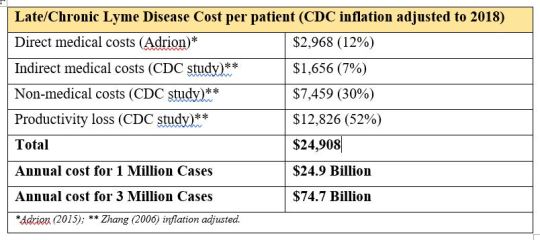
As it should, the CDC study estimate reflects the full societal cost of Lyme disease. This includes direct medical costs, indirect medical costs (additional medication costs), non-medical costs (e.g. travel), and loss of productivity from patients who take time from work due to illness.

The CDC study also considered both early and late/chronic Lyme disease. The direct medical costs were obtained from insurance billing information. The remaining costs were determined through patient surveys.

One of the things they found was that loss of work productivity and non-medical costs were a huge amount (over 85%) of the cost of late Lyme disease. That’s because this disease really takes a toll on patients. Many patients are unable to work entirely and others have to cut back their work hours or change the nature of their work because of the disease.[10]

Compared to the loss of work productivity in patients with chronic Lyme disease, the cost of treatment is chump change!

As I noted, the costs in the CDC study were adjusted to reflect inflation and the CDC’s revised 300,000 case estimate. But remember, the CDC study also used medical claims data for the direct medical costs. These are outdated.

Fortunately, a recent study out of Johns Hopkins by Adrion and Aucott reviewed an enormous insurance claims data base (47 million patients) and found that Lyme disease is associated with $2,968 higher total health care costs and 87% more outpatient visits over a 12 month period. [11]

Many of these early Lyme patients (63%) developed symptoms commonly associated with late/chronic Lyme disease, such as debilitating fatigue, memory loss, pain, musculoskeletal symptoms, or peripheral neuropathy.

These patients incurred $3,798 total direct medical costs associated with Lyme disease and had 66% more healthcare visits, and 89% more emergency room visits over a 12-month period.

When we combine Adrion’s direct medical costs for early Lyme disease with the CDC’s inflation-adjusted indirect medical costs, non-medical costs and loss of work productivity for late/chronic Lyme disease, the total annual cost per person is about $25,000 ($24,909). See the table below.

At 1 million cases of chronic Lyme disease, the annual cost is roughly $25 billion and at 3 million cases of chronic Lyme disease, the annual cost is about $75 billion.

chart-chart

The same analysis can be done for early Lyme disease. Adrion’s study reported that the direct medical costs per year could be as high as $1.3 billion, using a CDC estimate of 440,000 cases per year. (CDC estimates range from 240,000 cases a year to 440,000 cases a year.)[11]

By combining these direct medical costs with the CDC’s other illness-related costs (adjusted for inflation), the total for early Lyme disease is roughly $1.11 billion based on 300,000 cases per year.

chart-chart

The annual cost of Lyme disease is becoming clearer, as our understanding of the number of cases and associated costs for early Lyme disease and late Lyme disease improves.

Today, the combined cost of early and late/chronic Lyme disease is between $26.1 billion and $76.6 billion dollars a year. The cost of late/chronic Lyme disease is the major component of these costs. The costs will continue to grow exponentially because they are driven by the following factors:

  • Too many patients are not diagnosed and treated early, when treatments are more effective;
  • Treatment failure rates for early Lyme disease are too high; and
  • Treatment failure rates for late Lyme disease are too high.

Until we address these issues in earnest, patients will continue to suffer unnecessarily and the societal costs of Lyme disease will continue to soar.

Lorraine Johnson, JD, MBA, is the Chief Executive Officer of LymeDisease.org. You can contact her at lbjohnson@lymedisease.org. On Twitter, follow her @lymepolicywonk. If you have not signed up for our patient-centered big data project, MyLymeData, please register now.

References

  1. Zhang, X., et al., Economic impact of Lyme disease. Emerg Infect Dis, 2006. 12(4): p. 653-60.
  2. Treib, J., et al., Clinical and serologic follow-up in patients with neuroborreliosis. Neurology, 1998. 51(5): p. 1489-91.
  3. Shadick, N.A., et al., Musculoskeletal and neurologic outcomes in patients with previously treated Lyme disease. Ann Intern Med, 1999. 131(12): p. 919-26.
  4. Shadick, N.A., et al. The long-term clinical outcomes of Lyme disease. A population-based retrospective cohort study. Ann Intern Med, 1994. 121, 560-7.
  5. Asch, E.S., et al., Lyme disease: an infectious and postinfectious syndrome. J Rheumatol, 1994. 21(3): p. 454-61.
  6. Aucott, J.N., et al., Post-treatment Lyme disease syndrome symptomatology and the impact on life functioning: is there something here? Qual Life Res, 2013. 22(1): p. 75-84.
  7. Centers for Disease Control and Prevention. CDC provides estimate of Americans diagnosed with Lyme disease each year. Press Release 2013; Available from: http://www.cdc.gov/media/releases/2013/p0819-lyme-disease.html.
  8. McGinty, J., Lyme Disease: An Even Bigger Threat Than You Think A look at why cases of the tick-borne illness are undercounted, in Wall Street Journal. June 22, 2018.
  9. Shadick, N.A., et al., The long-term clinical outcomes of Lyme disease. A population-based retrospective cohort study. Ann Intern Med, 1994. 121(8): p. 560-7.
  10. Johnson, L., et al. Severity of chronic Lyme disease compared to other chronic conditions: a quality of life survey. PeerJ, 2014. 2, e322 DOI: 10.7717/peerj.322.
  11. Adrion, E.R., et al., Health care costs, utilization and patterns of care following Lyme disease. PLoS ONE, 2015. 10(2): p. e0116767.

________________

**Comment**

Besides the staggering financial cost to this 21st century plague, this paper, based on estimates of treatment failure rates associated with early and late Lyme, estimates that 35-50% of those who contract Lyme will develop persistent or chronic disease.

Let that sink in.

And in the Hopkins study found 63% developed late/chronic Lyme symptoms.

For some time I’ve been rankled by the repeated CDC statement that only 10-20% of patents go on to develop chronic symptoms.  This mantra in turn is then repeated by everyone else.

While still an estimate, I’d say 35 to over 60% is a tad higher than 10-20%, wouldn’t you?  It also better reflects the patient group I deal with on a daily basis.  I can tell you this – it’s a far greater number than imagined and is only going to worsen.

Time for every number on the CDC website to be adjusted.

For more:  https://madisonarealymesupportgroup.com/2018/02/24/one-million-predicted-to-get-lyme-in-2018-in-the-u-s/

https://madisonarealymesupportgroup.com/2018/06/28/the-science-isnt-settled-on-chronic-lyme/

https://madisonarealymesupportgroup.com/2018/05/26/diagnosis-at-the-center-of-the-lyme-wars/

https://madisonarealymesupportgroup.com/2018/04/13/chronic-lyme-post-mortem-study-needed-to-end-the-lyme-wars/

https://madisonarealymesupportgroup.com/2018/05/29/ld-on-the-rise-an-expert-explains-why-i-give-rebuttal/