https://www.wakingtimes.com/2018/06/28/the-facts-about-candida-overgrowth-and-how-to-overcome-it/

The Facts About Candida Overgrowth and How to Overcome It

June 28, 2018
candida overgrowth

Anna Hunt, Staff Writer
Waking Times

Candida is an essential fungus, a form of yeast, that lives in the human body. You can find it in the mouth and the intestines. Although it is normal to have some of this fungus in the body, candida can also invade the body beyond what is acceptable. This is called candida overgrowth, and it can have some detrimental health effects.

Candida Overgrowth

Having too much candida in the body can result in several health problems. This includes all types of digestive issues because too much candida can break down the walls of the intestines. In addition, candida overgrowth may cause problems such as depression, lack of energy, and a whole lot of annoying ailments.

When the production of candida in the body is out of control, it can manifest the following problems:

  • Allergies, sensitivities and intolerance to anything or any place that’s damp or moldy.
  • Hay fever and asthma.
  • Higher sensitivity to typical allergens, such as perfumes, smoke, odors, pets, dust, molds, pollen, and other airborne substances.
  • Athletes’ foot or fungus growth on other parts of the body.
  • Low body temperature, resulting on cold hands and feet.
  • Cold-like symptoms, including excessive mucus, as well as flu-like symptoms.
  • Digestive problems, such as constipation, abdominal bloating or pain, acid reflux, and gas.
  • Ringing in the ears (tinnitus), ear infections, ear aches, and abnormal wax build-up.
  • Fatigue, chronic fatigue and general feeling of being drained of energy.
  • Swollen salivary glands, dryness in the mouth, and swollen lymph nodes.
  • Dry or itchy scalp, dandruff, scalp sores, and hair loss.
  • Headaches, migraines, brain fog, and dizziness.
  • Fungal infections of the skin or nails.
  • Joint stiffness, swelling or pain.
  • Lack of appetite.
  • Nasal congestion, postnasal drip, sinus inflammation or infections.
  • Muscle aches and pains, including numbness and tingling, as well as lack of strength and coordination.
  • Dry skin, acne, hives, itching skin, and rashes, including eczema and psoriasis.
  • Sleep problems, such as frequent waking up and restless sleep, as well as insomnia.

FREE ONLINE EVENT: The Candida Summit – register today

The sad part is that candida overgrowth may be easily mistaken for other illnesses. Therefore, medical professionals often treat the symptoms of candida overgrowth, and not the actual problem of candida.

Why Does Candida Get Out of Control?

One of the biggest culprits in candida overgrowth are antibiotics. These medications wipe out all bacteria, including beneficial bacteria in the digestive system. On the other hand, antibiotics do not affect candida, because it is a fungus. As a result, taking antibiotics can create an imbalance in the body.

Now, if the immune system is strong, it can usually handle the effects of candida overgrowth. Unfortunately, many people have a weakened immune system because the typical western diet lacks the nutrients necessary to maintain strong immune function.

The standard diet consists of lots of carbohydrates, hydrogenated oils, trans-fats, sugar, white flour products, and processed foods. In addition, food growers often treat live foods with pesticides and herbicides. As well, they grow these foods in nutrient-depleted soil and radiate them to extend shelf-live.

Consequently, mainstream food choices do not give us the nutrients and healthy probiotic properties necessary to maintain a healthy immune system. As a result, when candida overgrowth happens, the body frequently starts to break down.

Some other factors that may contribute to candida population growing beyond what is healthy are:

  • A diet high in sugar and refined carbohydrates,
  • Drinking too much alcohol, and
  • A stressful lifestyle.

Simple Home Test

The best way to know for sure if you have candida overgrowth is to see a holistic practitioner. However, you can try the following test at home:

  1. Make sure you conduct this test first thing in the morning, before you eat or drink anything.
  2. Fill a glass with room-temperature, filtered water.
  3. Work up some saliva and spit it into the glass of water.
  4. Wait 30 minutes (you may need to wait up to 60 minutes) and check the saliva. If you see string traveling down into the water from the saliva, or if cloudy saliva has sunk to the bottom of the glass, you may have a candida problem.
What You Should Do to Help with Candida Overgrowth

There is a process that you can follow to control candida overgrowth. The important thing is that you execute the following five steps simultaneously:

1. Eliminate sugary foods that feed candida.

These include foods with sweeteners such as honey and fructose. In addition, you may want to limit the intake of fruits because they are high in sugar.

When buying processed meats, always read the ingredients because many contain sugar. In fact, read the ingredients list for all processed foods. You’ll be surprised just how many contain sweeteners. Of course, don’t forget that alcohol and many drinks, like a chai latte and coffee drinks, also have lots of sugar.

2. Strengthen your immune system.

This requires a healthy diet, high in lean proteins, good fats and low carbohydrates. All the foods you eat should be fresh and as natural as possible. This means limit processed foods so you eat fewer additives, heavy metals, pesticides and other food industry chemicals.

Another step in supporting a healthy immune system is to supplement with essential vitamins and minerals. The best way to understand what supplements you need is to ask your healthcare practitioner to administer a blood test. Some typical supplements that typically help fortify the immune system are:

  • Chlorella, a whole food that has many vitamins and minerals. It helps the body purge heavy metals and pesticides.
  • Vitamin C, one of the biggest immune system boosters. Since we get lots of Vitamin C from fruit, you are more likely to be Vitamin C deficient when limiting fruit intake to eliminate sugar from your diet. Vegetables rich in Vitamin C include kale, spinach, and broccoli.
  • Vitamin E, a powerful antioxidant that helps the body fight off infection. Foods rich in vitamin E include nuts, seeds and spinach.

3. Kill off candida overgrowth.

The most effective way to start getting rid of excess candida is to fortify your diet with anti-fungal foods. These include the following:

  • Raw garlic, which contains Sulfur compounds with anti-fungal properties. Fresh garlic is most potent, especially if you first crush it and wait about 10 minutes before consuming it. Of course, you can eat the garlic with a meal to conceal the taste. Just keep it raw.
  • Raw unfiltered apple cider vinegar, preferably Bragg brand. It is best to dilute 1 tablespoon of apple cider vinegar in a glass of room temperature water. Then, drink 30-60 minutes before a meal.
  • Olive leaf extract, which contains a phenolic compound with antiviral and anti-fungal properties.
  • Pau d’arco, which is sold as a tea or as a capsule supplement.

Remember that taking too many supplements can be a strain on the liver, so always check with your healthcare provider if you plan to take several supplements at one time. The ideal way to supplement is to eat a large variety of organic raw vegetables.

4. Introduce more good bacteria into the digestive system.

It is essential that you re-establish the balance of candida and good bacteria in your body. The best way to do this is by eating foods rich in probiotics, or “friendly” bacteria. These are also called probiotics.

Probiotics are present in foods such as yogurt, sauerkraut, kimchi and kombucha. The best way to get high quality probiotics into your system is to make fermented vegetables at home. Probiotic drinks are also very easy to make at home.

As well, you can buy probiotic supplements with a minimum of 50 billion CFUs (colony forming units). If possible, purchase probiotic supplements that require refrigeration.

5. Stay calm and expect the best results from your healing process.

When your body is already compromised, the last thing you need is stress. Stress on its own can make all the other previous four steps ineffective. In fact, it may have been a culprit in candida overgrowth in the first place.

It is important to utilize several stress relieving techniques during your healing process to help you stay calm. These include exercise, meditation and yoga. Also, don’t forget to have some fun!

Another important aspect of staying stress-free is to take it easy on yourself. Do your best following the steps above, and always be patient and kind to yourself.

Finally, having the right mindset is just as important as following a healthy diet. If you believe that your self-care efforts will pay off in improved health, then that will be your end result. There is a reason why the placebo effect works! The mind is one of the most powerful healing tools, so don’t forget to use it.

About the Author
Anna Hunt is writer, yoga instructor, mother of three, and lover of healthy food. She’s the founder of Awareness Junkie, an online community paving the way for better health and personal transformation. She’s also the co-editor at Waking Times, where she writes about optimal health and wellness. Anna spent 6 years in Costa Rica as a teacher of Hatha and therapeutic yoga. She now teaches at Asheville Yoga Center and is pursuing her Yoga Therapy certification. During her free time, you’ll find her on the mat or in the kitchen, creating new kid-friendly superfood recipes.

Sources: 

mindbodygreen.com
nourishedmagazine.com
thecandidadiet.com
preventdisease.com

This article (The Facts About Candida Overgrowth and How to Overcome It) was originally created and published by Waking Times and is published here under a Creative Commonslicense with attribution to Anna Hunt and WakingTimes.com. It may be re-posted freely with proper attribution, author bio, and this copyright statement.

Disclaimer: This article is not intended to provide medical advice, diagnosis or treatment. Views expressed here do not necessarily reflect those of Waking Times or its staff.

Jen Springer, 2016

3 Reasons You Can’t Get Rid Of Candida Yeast : HCL, estrogen, thyroid.
  1. The first thing most people miss is restoring the pH to the proper level in the stomach. pH of 2-4. If you don’t get to that level your stomach doesn’t catalyze the pancreas to make enzymes, the gallbladder to make bile, and the proper growth of acid loving good bacteria: acidophilus. Betaine HCL is what you need before any other supplements. SIBO is caused by low stomach HCL. Low good bacteria is from low stomach HCL. The right pH needs to be first before anything else.
  2. Estrogen dominance / imbalance. Many people have estrogen higher than testosterone and progesterone. Even excess environmental estrogenic toxins. This causes high insulin and blood sugar levels. High blood sugar is YEAST FOOD!!! Yeast loves sugar. You be come a puffy loaf of bread.
  3. The thyroid!!! The candida likes to grow when the body is not operating at 98.6. When the body is low, like 97.5, the body can’t cook off the pathogens and keep them in check.
________________________________________
In my search for answers I found this:
This chiropractor resolved her candida with this treatment:
  • 1 drop clove essential oil mixed with olive or coconut oil in a capsule in the am and pm (so twice a day)  
  • Increase to a maximum dose of 6 drops of clove in oil per capsule twice a day
  • Use for 14 days then take a break for a week or two
  • It might take a few cycles to resolve
  • She noticed a “yeast dump” on day 8 of the first cycle
  • Clove oil is supposedly 75% more effective than Nystatin
  • Make sure you use reputable sources for all ingredients
Please work with your medical practitioner on all treatment suggestions.

For more:  https://madisonarealymesupportgroup.com/2018/08/02/can-these-essential-oils-help-lyme-patients-overcome-chronic-candida/

https://madisonarealymesupportgroup.com/2018/07/16/understanding-candida-overgrowth-natural-solutions-for-yeast-infection/

https://madisonarealymesupportgroup.com/2018/07/05/candid-signs-you-have-it-what-to-do-the-candida-summit-online-free-july-9-15-2018/

https://madisonarealymesupportgroup.com/2014/10/17/candida-the-chameleon/


https://www.healthnutnews.com/glaxosmithkline-acquiring-a-300-million-stake-in-genetic-testing-company-23andme/

GlaxoSmithKline acquiring a $300 million stake in genetic-testing company 23andMe

Thanks to a $300 million payout to 23andMe, GlaxoSmithKline will soon have access to hundreds of thousands of people’s DNA. And there’s one reason: money. “On Wednesday, the genetic testing company announced it was entering a partnership with pharmaceutical giant GlaxoSmithKline (GSK) to develop new drugs and therapies. As part of the collaboration, the company will allow GSK to peek at the (voluntarily shared) genetic data of millions of people who have taken 23andMe’s DNA home testing kits.” 1 (Don’t think for one second that this won’t eventually become a privacy issue in the courts.)

Glaxo and Silicon Valley’s 23andMe said they will “tap genetic data to find new drug targets and better select patients for clinical studies”2 and the four-year collaboration deal will grant GSK exclusive rights to drugs developed with the help of 23andMe’s data.

23andMe CEO and co-founder Anne Wojcicki said,

“By working with GSK, we believe we will accelerate the development of breakthroughs. Our genetic research—powered by millions of customers who have agreed to contribute—combined with GSK’s expertise in drug discovery and development, gives us the best chance for success.”3

Customer payouts?

Part of what the company asks of its customers is permission to share their genetic data with outside sources for research purposes, and this is no different. And even if they had originally opted in, customers will be allowed to opt out.

But with the potential monetary windfall, shouldn’t the customers get a piece of the action too? Some ethics experts are certainly advocating for that:

“It’s one thing for NIH to ask people to donate their genome sequences for the higher good,” Peter Pitts, president of the Center for Medicine in the Public Interest, told NBC News. “But when two for-profit companies enter into an agreement where the jewel in the crown is your gene sequence and you are actually paying for the privilege of participating, I think that’s upside-down.” 4

However, as 23andMe uses and “shares its customers’ genetic data after it has been pooled together and stripped of any information that would allow anyone to trace back its origins to a single person,”5 that seems unlikely. Even though recently they asked customers for “added permission to share their individual genetic and self-reported data with outside sources for research,”6 it’s still unlikely that either company will share any of their profits with the very people whose data has made their profits possible. (Keep this in mind, even though 23andMe says your data is stripped of information that would prevent identification, it cannot provide a “100 percent guarantee that your data will be safe in the event of a breach.” 7)

Potential Insurance Woes

There are also concerns among experts about data leaks from genetic testing companies like 23andMe that might allow insurance companies to screen out people with risky or less than ideal genes. And they already have FDA permission to “explicitly market tests that promise to inform customers of their genetic risk for up to ten different diseases and conditions” and this last March they got approval for “a test that can tell people about their risk for breast cancer, based on the BRCA1 and BRCA2 gene.”8

Again, 23andMe has promised it will never intentionally share any “sensitive information” but I trust that about as much as I trust Snopes to be the arbiter of truth. And the company is already selling off other forms of data (like survey results) so it certainly seems plausible.

(Topic starts at 1:20)
The partnership between GSK and 23andMe will initially focus on an experimental treatment targeting a protein shown to increase the risk of developing Parkinson’s, thanks to 23andMe’s data on Parkinson’s patients, and should be able to get to the clinical trial phase much faster than if GSK had to find patients on their own. Something the pharma company sees as critical to their future strategy.


Hal Barron, a former executive from the biotech firm Genentech, is leading a new strategy that will focus on the immune system, genetics and investment in advanced technologies. Speaking about the new partnership he said,“The idea of pursuing genetically validated targets provides us with an opportunity to have a significantly higher probability of success. It also helps with pace. We’ll be able to do programs faster. So it will help with two or three of the biggest challenges facing our industry.”9

In just over a decade, 23andMe has grown from a mere seller of DNA kits into one of the world’s largest genetic databases. You can bet we will be watching this partnership closely.

Sources and References
  1. Gizmodo, July 26, 2018.
  2. Fortune, July 25, 2018.
  3. Gizmodo, July 26, 2018.
  4. Gizmodo, July 26, 2018.
  5. Gizmodo, July 26, 2018.
  6. Gizmodo, July 26, 2018.
  7. Gizmodo, July 26, 2018.
  8. Gizmodo, July 26, 2018.
  9. Fortune, July 25, 2018.


  Approx 30 Min.

LYMEPOLICYWONK: Presentation at MyLymeData2018

Wondering if medical marijuana is effective at controlling the pain associated with Lyme disease? How other patients are treating their fatigue and insomnia? Which treatments have the most side effects?

Watch the presentation from MyLymeData2018 conference to find out.

With over 11,000 participants enrolled, the MyLymeData project is already giving us the answers to the fundamental questions that sick patients want to know. It collects information about the actual experience of Lyme patients–their symptoms, their treatments, what has helped and what hasn’t. This helps researchers target what’s most important–and helps us all learn from each other.

If you are already a member of MyLymeData, we thank you for your continued partnership. If you have Lyme or have had it at any time in the past, please join and help us communicate to academic researchers, scientists and policy makers. We look forward to continuing this vital research.

Lorraine Johnson, JD, MBA, is the Chief Executive Officer of LymeDisease.org. You can contact her at lbjohnson@lymedisease.org. On Twitter, follow her @lymepolicywonk. If you have not signed up for our patient-centered big data project, MyLymeData, please register now.

https://www.lymedisease.org/lymepolicywonk-mylymedata2018/

________________

If you haven’t joined MyLymeData, I encourage you to do so.  The information gathered is the first of its kind and is often the ONLY information gathered on those affected chronically/persistently.  You can also access direct information on the most effective treatments according to patients.  

If you want to skip to the latest info go to 15:20.  Johnson admits that the patient group is by and large those chronically affected.

For example, 60% who took the survey were diagnosed with a coinfection.

An article by The Center for Public Integrity,  https://www.publicintegrity.org/2018/08/06/21999/disease-bearing-ticks-head-north-weak-government-response-threatens-public-health states, “As Disease-bearing Ticks Head North, Weak Government Response Threatens Public Health.”

Now that’s something we can both agree upon.

What I completely and unequivocally disagree with is this statement:

 “The CDC says rising temperatures are partly to blame for the tripling of mosquito-, tick- and flea-borne illnesses from 2004 to 2016, but Maine’s governor, a climate skeptic, is tying health officials’ hands.”

This statement is called gunny-sacking which by definition means that rather than focusing on an important key point with basis in truth, you lump a bunch of unrelated issues together, some of which are true and some of which are unsubstantiated or even false, and whallop folks over the head, hoping they won’t notice inconsistencies.

“The climate change range expansion model has been used to rationalize how they have done nothing for more than thirty years.  It’s a huge cover-up scheme that goes back to the 1980’s.”  Scott says, “even the ticks are smarter than the people who have concocted this thing.”

Those are pretty bold statements coming from an infected tick expert.

BTW:  for those of you new to this crazy world, ticks have been found on beaches, in caves, underneath picnic benches, on rocks, on birds and other animals, blown into swimming pools, falling off trees, and I’ve found them climbing my walls:  https://madisonarealymesupportgroup.com/2018/06/07/where-ticks-are-and-what-they-carry-science-conversation-with-dr-cameron/,  https://madisonarealymesupportgroup.com/2017/07/13/tv-anchor-speaks-out-about-lyme-disease/.  I’m sure they’ve been found just about everywhere.  If you like Stephen King, here’s a goodie for bed-time reading:  https://madisonarealymesupportgroup.com/2017/07/30/ticks-found-on-eyeball-buttocks-and-penis/

If there’s one thing I’ve learned on this journey from hell it’s that those who are infected have a vested interest in getting down to the bottom of things.  They are more open minded, search harder, and do not blindly swallow past research.  They frankly, NEED answers for themselves.  It’s far more than just a job with a paycheck for them.  It’s also important to point out the obvious fact that being an independent researcher, Scott doesn’t answer to the people paying the bills.  So if “inconvenient” facts are discovered, he feels no pressure to hide the information.  I wish this could be said of others doing work in the Lyme/MSIDS area.

  • Fourth, and perhaps most importantly, the lumping together of Maine’s governor being a climate skeptic tying officials’ hands, is the worst gunny-sacking of all.  Let me be clear:  not swallowing the climate change propaganda does not mean you don’t care about controlling insects and lessening human suffering!  

Have we really devolved to infantile name-calling?

The real quote that says it all is:

“It’s disheartening for folks who work in climate and health. When politics come into play they feel beat down a little.”
—Chelsea Gridley-Smith, National Association of City and County Health Officials

OK, now we are getting somewhere.  Bottom line – someone feels put down.

Translation:  someone didn’t get some money – typically in the form of a grant.

And, if we are talking politics, they are clearly on the side of the climate changers.  It is used as a cat call for researchers seeking grant money despite inconclusive results.  The media, similarly to the vaccine issue, is clearly biased and promoting climate change.  Period.  Gone are the days where journalists just print the facts.  They now feel compelled to tell you how to think as well.

But, we have to ask ourselves, how is this article going to affect real research that needs to be done for Lyme/MSIDS patients?

For one, if a person takes this article at face value it will make you think that climate change research is what’s important and this “climate change skeptic” from Maine is stopping that from happening…when nothing could be further from the truth.

A tick experts claims they’ve been doing climate change research regarding ticks and Lyme for years and have ZIPPO to show for it.  Patients aren’t helped one iota.

Do we really need more climate change research or do we need more research on how to  properly test, treat, and help patients who have been suffering and have been ignored for over 40 years?  Of course we need to research how to stop ticks from transmitting disease but….

How is climate data going to help any of this?

You can show all the EM rashes you want.  You can quote disgruntled employees who feel “beat down a little,” you can state it’s all being hog-tied by a climate change skeptic, you can show maps of ticks marching North, and you can even show cute crayon-colored pictures by children, but some of us out here are on to you.  

In the end – it’s all about money.

What it isn’t about is patient care.

Let me be clear:  the federal government’s failing to prioritize Lyme/MSIDS research has NADDA to do with climate change.

Don’t be duped.  Don’t swallow the bait.  Think for yourself.

For a great read:  https://edberry.com/blog/climate-physics/agw-hypothesis/climate-change-emperors-have-no-clothes/?  “According to the scientific method, it is impossible to prove a theory is right. But climate alarmists ignore the scientific method and simply BELIEVE their theory is right. They don’t have time for any stinkin’ proof they are wrong.

This post is “stinkin’ proof” they are wrong. Yes, Virginia, it IS possible to prove a theory is wrong.”

And remember – above all – it’s important to question things and to seek out answers for yourself.  Often, the answers you find will fly in the face of accepted public opinion.

It’s your life.

Live it with conviction.

https://www.nytimes.com/2018/08/06/health/asian-long-horned-tick.html?smid=fb-nytimes&smtyp=cur

An Invasive New Tick Is Spreading in the U.S.

By Donald G. McNeil Jr.
Aug. 6, 2018

For the first time in 50 years, a new tick species has arrived in the United States — one that in its Asian home range carries fearsome diseases.

The Asian long-horned tick, Haemaphysalis longicornis, is spreading rapidly along the Eastern Seaboard. It has been found in seven states and in the heavily populated suburbs of New York City.

At the moment, public health experts say they are concerned, but not alarmed.

Although domestic American ticks are a growing menace and transmit a dozen pathogens, no long-horned ticks here have yet been found with any human diseases. In Asia, however, the species carries a virus that kills 15 percent of its victims.

For now, the new arrivals are considered a greater threat to livestock.

Known in Australia as bush ticks and in New Zealand as cattle ticks, long-horned ticks can multiply rapidly and suck so much blood from a young animal that it dies. The ticks bloat up like fat raisins until their tiny legs are barely able to support them.
After a blood meal, females can lay hundreds of fertile eggs without mating.

“One tick can crank out females in fairly large numbers,” said Thomas Yuill, a retired pathobiologist at the University of Wisconsin, Madison, who was one of the first to raise alarms about the invaders.

The first long-horned tick was found last summer in western New Jersey. This summer they were collected in public parks and a golf course in Bergen, Essex and Middlesex counties in New Jersey, and in wooded and grassy areas of New York’s Westchester County.

They were reported in Pennsylvania for the first time last week, and have been sighted in Arkansas, North Carolina, Virginia and West Virginia.

They were found feeding on horses, dogs, deer, a calf, a sheep and an opossum. They do bite humans, but it is not clear how often.

People should use the same precautions they do against domestic ticks, experts said, such as using repellents and checking for ticks after walking through woods or tall grass.

Tadhgh Rainey, an entomologist at the public health department of Hunterdon County, N.J., found the first long-horned ticks in the country last August, when a woman who had been shearing her pet Icelandic sheep came to his department with ticks on her hands and wrists.

“I thought she’d have a few,” Mr. Rainey said in an interview. “But she was covered in them, easily over 1,000 on her pants alone.”

Most were young nymphs about the size of dust specks.

“She had a change of clothes in her car, so we put her clothes in the freezer to kill them,” Mr. Rainey recalled.

The ticks didn’t match any North American pests, and initially he could not identify them. The woman’s 12-year-old sheep was penned alone and had never traveled, so where they came from remained a mystery.

A month later the woman called again to see if he had figured out what they were, and Mr. Rainey drove out to see the animal for himself.

“A minute after we entered the paddock, even before I touched the sheep, I was covered in ticks,” he said.

The sheep was weak from blood loss, so he gave the owner some insecticidal livestock wash. The grass around the paddock was later cut and the area sprayed in an effort to eliminate the outbreak.

Andrea Egizi, an entomologist at Rutgers University, finally identified the longhorns by DNA analysis. Her lab has now tested more than 100 specimens found in New York and New Jersey.

Thus far, Dr. Egizi said, none have any of the pathogens causing the six diseases she screens for: Lyme disease, relapsing fever, babesiosis, anaplasmosis and two varieties of erlichiosis.

The Centers for Disease Control and Prevention lab in Fort Collins, Colo., has screened about 100 long-horned ticks for three dangerous viruses — Powassan, Heartland and Bourbon — and all came up negative, said Ben Beard, the agency’s deputy director of vector-borne diseases.

The lab now has 10 live long-horned ticks and is feeding them to create a colony, Dr. Beard said. That will take about a year, and then researchers can determine whether they can transmit Rocky Mountain spotted fever and other diseases.

In East Asia, long-horned ticks do carry pathogens related to Lyme and others found in North America. But the biggest threat is a phlebovirus that causes S.F.T.S., for severe fever with thrombocytopenia syndrome. (Thrombocytopenia means abnormally low levels of platelets, which help the blood clot; a severe drop triggers internal bleeding and organ failure.)

The syndrome has an overall fatality rate of about 15 percent, said Terry A. Klein, an entomologist working with the American military in South Korea. But S.F.T.S. is more lethal to people aged 60 or older, killing half of them.

However, the syndrome is not found in Australia or New Zealand, earlier stops for the long-horned ticks as they spread from Asia. In those countries, they cause babesiosis and theileriosis in cattle but are mostly “of nuisance value” to humans, said Dr. David Thomson, a veterinarian in Queensland, Australia.

It’s not clear that the S.F.T.S. virus, which is related to the Heartland virus found in a number of American states, could get established in this country, because its transmission cycle is unknown — it may need more than one host.

(Although West Nile virus, for example, is transmitted to humans by mosquitoes, they first get it from birds, because humans do not build up enough of the virus to pass on.)

It’s not known when or how long-horned ticks reached the United States, nor why the species is spreading so fast now.

They bite birds, but Mr. Rainey said he suspected they originally arrived on a large animal. As far back as 1960, he said, the ticks were found on a horse held in quarantine.

One collected in 2013, Dr. Beard said, was misidentified until recently as a rabbit tick, which is also in the Haemaphysalis genus.

In theory, just one female could have produced all the long-horned ticks spreading in the country through asexual reproduction. But Dr. Egizi said she has found three mitochondrial DNA lineages, meaning at least three females arrived.

Although experts said having a new invader is unsettling, they worry more about deer ticks, lone star ticks and other established species whose ranges are growing as winters get warmer.

Cases of the illnesses they transmit — everything from Lyme disease to alpha-gal syndrome, an allergy to red meat — are rapidly increasing. Even in Asia, only about 1 percent of long-horned ticks have the S.F.T.S. virus; in parts of this country, 25 percent of deer ticks carry Lyme disease.

“The jury’s still out on how big a threat this is,” Dr. Beard said. “But we think it’s a very important question to address.”

_______________

**Comment**

Now in 5 states (Pennsylvania, Arkansas, North Carolina, Virginia and West Virginia) the Long-horned tick is responsible for SFTS in Asia.  It is also associated with spotted fever rickettsioses, Anaplasma, Ehrlichia, and Borrelia, the causative agent of Lyme Disease in other parts of the world.

Why they continue to downplay this is truly a head scratcher.  But then they’ve been downplaying all things tick related for decades.

https://madisonarealymesupportgroup.com/2018/03/07/tick-bites-tick-hyperparasitism/

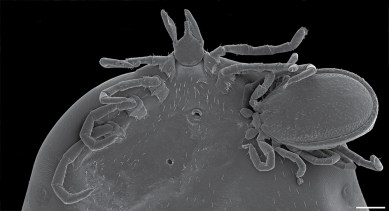
If a picture’s worth 1,000 words look at this one:

Ixodes-angustus-hyperparasitism

A scanning electron micrograph shows an engorged female Ixodes angustus tick with a male I. angustus attached to its underside in typical feeding mode—a case of hyperparasitism presumed uncommon in the species. (Image originally published in Durden et al 2018, Journal of Medical Entomology)