https://www.lymedisease.org/personalized-lyme-disease-treatment/

By Lorraine Johnson

LYMEPOLICYWONK: “Super responders” are key to personalized Lyme disease treatment

I’m excited to report that the first study using information from MyLymeData has just been published in the medical journal Healthcare.

Using patient-reported outcome data from 3,900 people enrolled in MyLymeData, we looked at how individual patients vary in their response to treatment. Finding out who responds well to which treatments—and then learning more about those people—is an important step towards developing personalized Lyme disease treatment.

Treatment studies of patients with late/chronic Lyme disease usually take an average of how people have responded to treatment. But guess what? The average Lyme patient isn’t average! Some people improve a lot with treatment, some improve a little bit, and some people don’t improve at all. A few may even get worse.

Super responders

However, if we can identify the “super responders”—the ones who did particularly well—and take a closer look at them, we may be able to learn things that can help other patients in a similar situation. This can help drive the development of personalized Lyme disease treatment.

For lots of diseases, such as tuberculosis, pulmonary disease, and cancer, scientists are now identifying high treatment responders, but our study is the first to use this approach in Lyme disease.

The reason it hasn’t been done before in Lyme disease is because identifying how different groups of patients respond to treatment requires large samples. The largest trial funded by the National Institute of Health for patients with chronic Lyme disease enrolled just 129 people—way too small a group to look at individual treatment variation.

So instead, they lumped all of the treatment responses together—the good, the bad and the ugly—and said how patients responded “on average.” On average, there wasn’t much improvement from treatment.

But treatment averages don’t tell the whole story. A famous mathematician, Des MacHale, explains it this way: The average person has one testicle and one breast. And we all know how ridiculous that is. You can’t average a male and a female like that and get any meaningful information.

It’s the same thing when you measure patient treatment response in Lyme disease. If one person gets better and the other gets worse after treatment, you can say that on average, treatment did nothing. However, for the patient who got better, it made a world of difference. Yet, when we use an average to calculate treatment response, the favorable response of one patient is cancelled out by the negative response of another.

A better approach looks at variations in how different patients respond. Most Lyme disease patients already know this. Some patients get better, others get worse, and some don’t change with treatment. Treatment response variation is lost when individual responses are averaged.

In our study, we included close to 4,000 patients, a large enough sample to look at variations in treatment response. Here’s what we found. Most patients (52%) responded positively to antibiotic treatment and some—roughly a third—responded very well to treatment. These patients said that they felt moderately to a very great deal better after taking antibiotics. Very few said that they felt worse after taking antibiotics (only 12%).
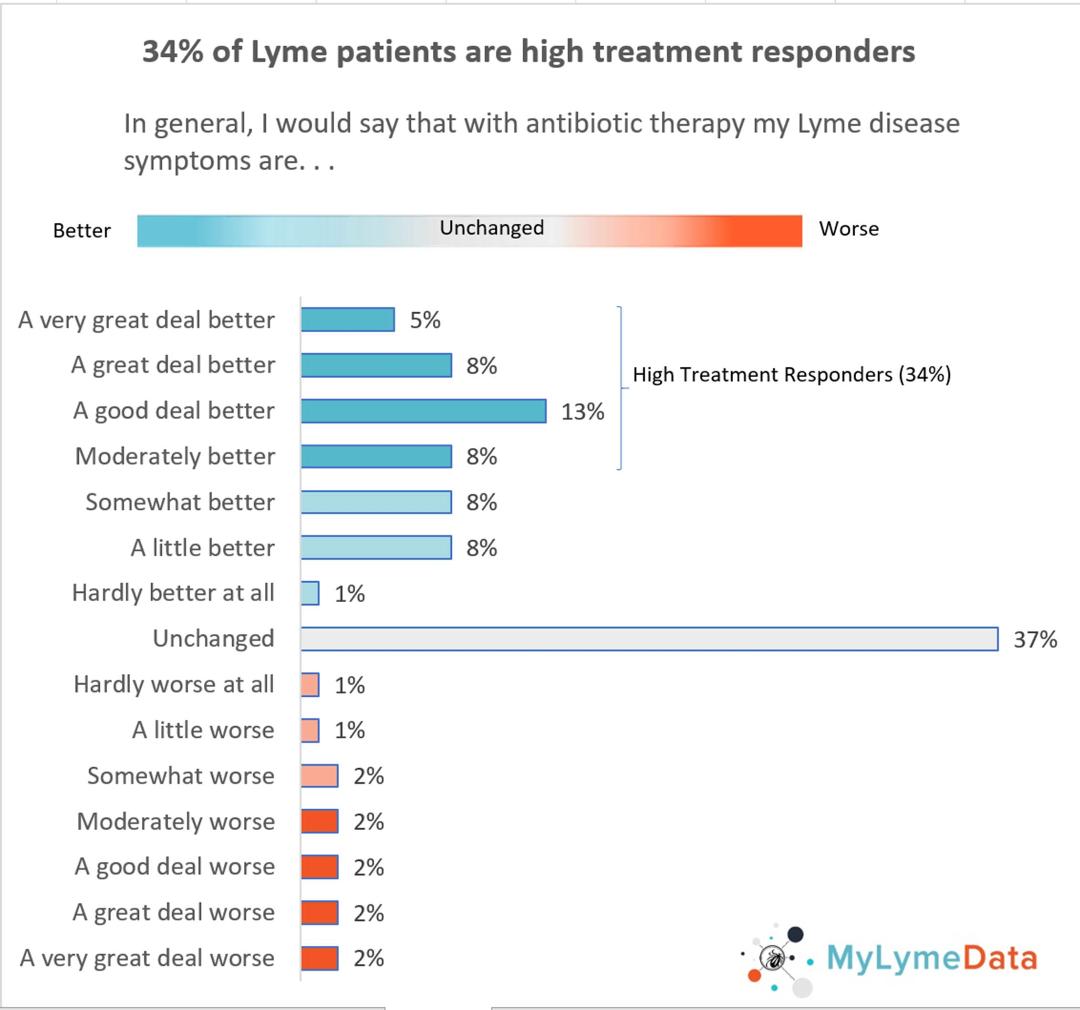
If I were a patient with chronic Lyme disease—which I was by the way–I would want to know that roughly a third of those in the sample were “high treatment responders”—meaning that they reported that after taking antibiotics their symptoms improved moderately to a very great deal. This is the type of information that patients want to know and that is why we conducted this study.

This is the first of many studies to be published using the data from MyLymeData.  So stay tuned! And if you are not enrolled in MyLymeData—I encourage you to stop what you are doing and sign up now. It is only by having patients pool their data that we will make progress in this disease.

Here is a short video I recorded explaining more about the study’s results.

Click here to read the full study.

Click here to enroll in MyLymeData.

Lorraine Johnson, JD, MBA, is the Chief Executive Officer of LymeDisease.org. You can contact her at lbjohnson@lymedisease.org. On Twitter, follow her @lymepolicywonk. If you have not signed up for our patient-centered big data project, MyLymeData, please register now.

_________________

**Comment**

If you haven’t enrolled in this Bigdata research, please do.

The more people who do this, the more information we will have to look at.

Since the largest NIH study was done in 2008, EIGHT YEARS AGO, you’d think researchers & doctors would be a bit open-minded.  Can you imagine basing cancer or AIDS treatments on EIGHT YEAR OLD STUDIES?  https://www.niaid.nih.gov/diseases-conditions/chronic-lyme-disease.  Another, done in 2003 (15 years ago) only looked at 28 days of IV antibiotic compared to placebo in 55 patients, hardly a representative sample, and what’s 28 days of IV abx going to do with a persistent pathogen typically coupled with other pathogens making cases extremely complex?

No, The Cabal has run the research in a biased and skewed manner for over 40 years.  Time for a change.

Interestingly, an IDSA founder disagreed with their stance and used high powered antibiotics quite successfully:  https://madisonarealymesupportgroup.com/2017/07/09/idsa-founder-used-potent-iv-antibiotics-for-chronic-lyme/ 51 difficult cases are represented.


https://www.etonline.com/rhony-star-ramona-singer-opens-up-about-sisters-devastating-battle-with-lyme-disease-111058

‘RHONY’ Star Ramona Singer Opens Up About Sister’s Devastating Battle With Lyme Disease

By

Syed Kazmi


It was three decades ago when Ramona Singer first heard about Lyme disease, puzzled about what the mysterious illness was after a partner mentioned the term. Little did the Real Housewives of New York City star realize how much the disease would impact her in years to come, which would see her witness several close friends battle the disease and go on a “rampage” to find the best doctors after learning her own sister had the potentially fatal, tick-borne illness.

“I was involved with a man who’s a doctor and he volunteered at the first Lyme disease clinic at Lenox Hill maybe 30 years ago and when he first told me I said, ‘What do you mean, Lyme disease!?” Singer recalls to ET. “Then his sister started complaining about not feeling well and being fatigued — he thought she was just being a hypochondriac, then found out she had Lyme!”

Singer was later distraught to find out her own younger sister had the debilitating illness, which causes flu-like symptoms, rashes, joint and muscle pain and limb weakness. With celebrity sufferers including Avril Lavigne and Shania Twain, the disease has increased 25-fold since national surveillance began in 1982, and the common diagnostic test is inaccurate more than half the time.

While Singer is generally private about her sister’s identity and scary health battle, she’s sharing some details of the ordeal for the first time, telling how following the diagnosis, she immediately sprang into action, setting about on a mission to find the best help she could for her loved one.

“She was complaining about all kinds of pain eight years ago, to the point where she was having problems walking,” Singer, 61, shares. “We finally come to our own conclusion that this must be Lyme disease, then she was tested for it. I’ve become a maven since then. I’m aggressive, so I started calling all my friends saying, ‘My sister has Lyme disease, who do you know? Who can I call?’ I was on a rampage to find the best doctor because even once you’re diagnosed, some doctors don’t know how to treat it or can’t be bothered treating it.”

“It’s incredible in this day and age how ignorant people are and the tests aren’t always foolproof,” adds Singer, who recalls talking to one sufferer who was experiencing near-psychotic episodes due to the disease reaching his brain, yet kept getting told by doctors he was mentally ill before finally being diagnosed with Lyme disease. “It’s just a really scary disease and it’s not black-and-white.”

Thanks to being detected early, Singer’s sister, now in her fifties, was able to take a 30-day course of antibiotics and make a full recovery, something the family feels eternally “blessed” about. However, several other loved ones have meanwhile been diagnosed with the illness, which is more common in East Coast areas, with one of Singer’s pals still struggling to overcome it.

One of the most gut-wrenching parts of watching those close to her suffer has been seeing how it restricts their ability to live a normal day-to-day life and witnessing the effects the disease can have on a person’s mental health.

“They just have no energy,” says Singer, who has a 23-year-old daughter, Avery. “Life is about having your health — health is everything, and if you’re waking up in the morning and feeling bedridden, you don’t want to go and meet your friends for lunch or work out. Life is about embracing your passions, whether it’s work, family or friends and this disease inhibits people’s lifestyles.”

“It also causes depression,” Singer adds. “When you’re not feeling well or you have a bad cold for a week, you get depressed because you can’t do anything.”

Singer notes how difficult it is for newly diagnosed patients to find resources, the right healthcare specialists and not “feel alone out there,” so she has become an avid supporter of the Global Lyme Alliance, which works towards conquering Lyme disease and other tick-borne disease and helps connect patients with the best doctors.

On Thursday, Singer will attend the organization’s 4th Annual New York Gala at Cipriani 42nd Street, as an honorary speaker for the event, where Younger star Sutton Foster will perform and equestrian Erin Walker (wife of golf champ Jimmy Walker) will serve as the honored guest.

Last year’s gala honored Matchbox Twenty frontman Rob Thomas’ wife, Marisol, who has been battling the disease for 15 years, with Thomas previously telling ET that Lyme disease has been “like a weird alien inhabited my wife.”

Other key supporters of the Global Lyme Alliance include Singer’s fellow Housewives franchise star and Lyme patient, Yolanda Hadid, whom she rubbed shoulders with at last year’s event. “She’s very fortunate as she has lovely children who support her tremendously and I know she has made great strides, but it took a toll on her life, her marriage and on her relationships,” Singer says. “But she has gotten through it and she’s definitely an inspiration.”

Beyond the event, Singer is keeping busy, currently selling the four-bedroom apartment which has been her family home for the last 20 years and preparing to launch her Ageless by Ramona skincare line in the spring.

Then of course there’s another season of RHONY!

With season 11 filming underway, Singer hints she’ll be back for more drama. Season 10’s dramatic finale and reunion show saw her embroiled in further drama with Bethenny Frankel, who refused to support Singer’s business ventures, failing to show up to a pre-launch event for Ageless by Ramona.

“You know, as women, we all have a camaraderie with each other — we fight with passion and we make up with passion, so that’s why the show is still relatable 11 years later,” Singer says about the conflict. “It’s like friendships, right … you have ebbs and flows, highs and lows!”


https://www.eonline.com/news/978405/avril-lavigne-on-lyme-disease-battle-i-was-in-bed-for-f-king-two-years?

(Go to link for video.  Approx. 1 Min)
Avril Lavigne is opening up about her battle with Lyme disease.
The 34-year-old singer gets candid about her health, career and more in a new interview for her Billboard cover story, during which she reveals she was in bed for two years amid her Lyme disease battle. The Grammy nominee was on tour in 2014 when she started to feel fatigued and achy, which led her to ask,

“What the f–k is wrong with me?”

When the tour came to an end, one of Lavigne’s friends realized she might have Lyme disease. According to Billboard, she was encouraged to call Canadian music producer David Foster‘s then-wife Yolanda Hadid, who had also been battling Lyme disease. Hadid ended up giving Lavigne the contact information for a Lyme specialist.

Avril Lavigne, Billboard

David Needleman


“I was in bed for f–king two years,” Lavigne tells Billboard. “It’s a bug — a spirochete — so you take these antibiotics, and they start killing it.”

“But it’s a smart bug: It morphs into a cystic form, so you have to take other antibiotics at the same time,” Lavinge continues. “It went undiagnosed for so long that I was kind of f–ked.”

The Billboard interview also states that Lavigne was in bed with her mother one night during her battle, barely able to breathe, when she started to pray.

Avril Lavigne, Billboard

David Needleman


“I had accepted that I was dying,” she tells the outlet. “And I felt in that moment like I was underwater and drowning, and I was trying to come up to gasp for air. And literally under my breath, I was like, ‘God, help me keep my head above the water.'”

That became the inspiration for her song “Head Above Water,” which she released last month after about a five-year hiatus. The singer worked on the song with her ex, Chad Kroeger, who she calls “great” and who also worked on more songs with Lavigne for her upcoming album.

“The silver lining of it is that I’ve really had the time to be able to just be present, instead of being, like, a machine: studio, tour, studio, tour,” she says. “This is the first break I’ve ever taken since I was 15.”

To read more from Lavigne’s interview, pick up a copy of Billboard, on newsstands Friday.

https://www.usmagazine.com/celebrity-news/news/yolanda-hadid-im-not-feeling-good-again-after-brief-lyme-disease-remission/?platform=hootsuite

Yolanda Hadid Reveals She’s ‘Not Feeling Good’ Again After ‘One Year of Remission’ From Lyme Disease

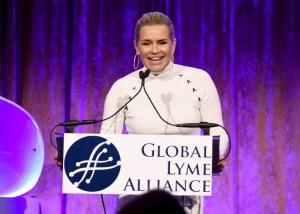
The fight continues. Yolanda Hadid revealed during her speech at the Global Lyme Alliance Gala in New York City on Thursday, October 11, that she is struggling with her Lyme disease battle again after one year of remission.
lyme disease
Yolanda Hadid speaks onstage during the Global Lyme Alliance Fourth Annual New York City Gala. Dave Kotinsky/Getty Images

“What keeps me getting up every morning is my two children that also have had Lyme disease,” the 54-year-old began, referring to her model daughter Bella Hadid and son Anwar Hadid. (She is also mother of model Gigi Hadid). “Quite often, I just went to get on with my life and pretend the whole nightmare never happened. I got sick in 2000. We’re now in 2018. I had one year of remission.”

The Real Housewives of Beverly Hills alum then explained she is not quite “back where [she] started” with her illness, but she is also no longer “feeling good.”

“[I’m] just wanting to crawl in a hole and wait for it all to pass, but I also understand the higher purpose of my journey is to continue to bring awareness to this awful disease until the change is made,” Yolanda told the crowd, which included fellow Housewives Luann de Lesseps, Dorinda Medley, Sonja Morgan, Tinsley Mortimer and honored guest Ramona Singer. 

lyme disease
Ramona Singer, Luann de Lesseps, Tinsley Mortimer, Yolanda Hadid, and Dorinda Medley attend the Global Lyme Alliance Fourth Annual New York City Gala. Rob Kim/Getty Images

“What keeps me awake at night is not my journey the journey of my children and so many children in the world that don’t get the proper treatments that they deserve,” she continued. “Living in today’s world is hard enough as a healthy child. It’s time that we all put an end to this. If I die next week, next month, next year — this is the most, the greatest cause I have ever fought for.”

She concluded:

“Even today, I have been in treatment all day. I feel like s—t. I showed up because this has to change.”

Yolanda has been very vocal about her struggles with Lyme disease over the years, documenting her ups and downs on RHOBH for four seasons and telling her story in her 2017 memoir, Believe Me: My Battle with the Invisible Disability of Lyme Disease.


GLA Video on Lyme

Approx. 4.5 Min

This video premiered at the 2018 Global Lyme Alliance New York Gala. Watch GLA leadership and GLA-funded researchers, among others, share insights into the problem of Lyme disease and what GLA is doing to solve it.

__________________

**Comment**

Lots of great info here.  Correcting Senator Blumenthal, Lyme is not an epidemic, it’s a literal pandemic.

Also, there are reasons the map showing Lyme isn’t entirely blacked out:  1)  The CDC maps are notoriously faulty 2) We are only talking about Lyme (borrelia) 3) There are many other pathogens involved in this nightmare that need to be factored in as well and recognized by main-stream medicine, surveillance, researchers, and the media.  These pathogens singularly are serious but when coupled with Lyme are deadly.

Throw these maps out!  Historically maps have been used against seriously ill patients for decades.  They have been denied diagnosis and treatment due to a piece of paper.

This tick border thing is a man-made constructed paradigm that has never been accurate, but it’s fit the CDC/NIH/IDSA narrative. http://steveclarknd.com/wp-content/uploads/2013/11/The-Confounding-Debate-Over-Lyme-Disease-in-the-South-DiscoverMagazine.com_.pdf (go to page 6 and read about Speilman’s maps which are faulty but have ruled like the Iron Curtain.)

https://madisonarealymesupportgroup.com/2018/08/13/study-shows-lyme-not-propelled-by-climate-change/  According to independent Canadian tick researcher, John Scott, Ticks and Lyme are NOT propelled by climate change but by migratory birds and other reservoirs who do not refer to maps in their travels!

For more:  https://madisonarealymesupportgroup.com/2017/08/24/canine-maps-better-than-the-cdcs-in-predicting-lyme-disease/

https://madisonarealymesupportgroup.com/2017/08/05/cdc-maps-for-lyme-disease-not-accurate/

https://madisonarealymesupportgroup.com/2017/07/01/one-tick-bite-could-put-you-at-risk-for-at-least-6-different-diseases/