https://www.linkedin.com/pulse/corruption-human-rights-violations-against-lyme-now-luche-thayer/
Corruption and Human Rights Violations Against Lyme Doctors, Scientists and Parents Now on United Nations Record
 Published on June 12, 2018
Jenna Luche-Thayer
consulting Senior Advisor – US Government, United Nations, non-profits, corporate social responsibility programs
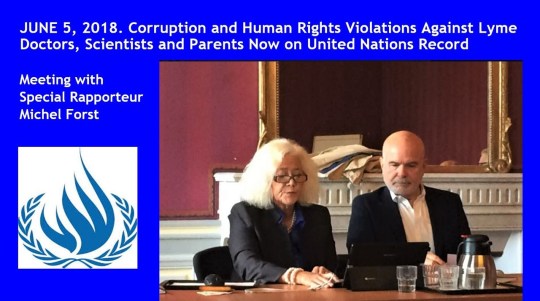
The 2018 Report ‘The Situation of the Human Rights Defenders of Lyme and Relapsing Fever Borreliosis Patients’ was submitted to Special Rapporteur Michel Forst and to Special Rapporteur Dr. Dainius Puras of the United Nations in March 2018. This resulted in a meeting between United Nations Human Rights Council Special Rapporteur Forst and medical professionals, scientists, human rights experts and advocates on June 5, 2018 in Geneva, Switzerland.
FOR IMMEDIATE RELEASE – June 12, 2018. The United Nations (UN) Special Rapporteur for Human Rights Defenders, Michel Forst, heard presentations on multiple countries from the all voluntary Ad Hoc Committee for Health Equity in ICD11 Borreliosis Codes, whose global members are dedicated to addressing the borreliosis pandemic.
Jenna Luché-Thayer, Director of the Ad Hoc Committee, gave an overview from the 2018 Report ‘The Situation of the Human Rights Defenders of Lyme and Relapsing Fever Borreliosis Patients’ that was followed by representatives sharing cases from their countries. She started by contrasting scenarios where the public recognition of human rights issues differs. For example, most people recognize the devotion to human rights of the journalist who goes into a war zone to find and share the truth of innocent people brutalized by war crimes and the risks taken by the persons who organize to free children from international sex trafficking. These defenders of human rights can be easily identified because they are working to address situations we all can recognize as horrific.
In contrast, the healthcare systems across the globe are largely recognized as flawed but not intentionally horrendous. However, increasing numbers of scholarly publications have documented how these healthcare systems have become quietly corrupted and this has led to a global healthcare situation wherein “criminal activities have become normalized”, according to Dr. Dainius Pūras, the UN Special Rapporteur on the right to health.
The defenders of Lyme and relapsing fever borreliosis patients include medical professionals, doctors, scientists, patients and advocates fighting for the health human rights of this patient group. The Report shows how many of these defenders are routinely defamed, their freedoms to associate and speak restricted, and their livelihoods are threatened. It also shows how parental rights of parents of severely ill children are routinely violated by State Actors.
According to the October 24, 2017 presentation to the UN General Assembly by Dainius Pūras, “In many countries, health is among the most corrupt sectors; this has significant implications for equality and non-discrimination.”
This second Report by the Ad Hoc Committee supports his findings. It details how financial motivations shared among a faction in a medical society, their associates, State Actors and insurers have contributed to a global situation whereby doctors, scientists and parents are attacked because they defend these patients’ rights to health, bodily integrity and life. It is not uncommon for these defenders’ reputations, livelihoods and finances to be ruined — doctors lose their licenses, scientists lose access to research monies and parental rights are violated when ill children under treatment that meet internationally accepted standards are seized from their homes.
Jenna Luché-Thayer, a human rights expert with 33 years of experience in 42 nations reported how the case definition of Lyme borreliosis (LB) was changed by colluding US State Actors and certain members of the Infectious Disease Society of America (IDSA)’ and that the timing of these changes concurred with the launch of a failed Lyme vaccine, promotion of an unreliable, yet profitable diagnostic test system and the unwillingness of US insurers to cover the chronic or persistent form of the disease as they moved into the ‘managed care’ model.
She noted how the revised LB case definition removed most references to the debilitating symptoms, disabling and potentially fatal complications, persistence and severity of the disease and the unreliable diagnostic technologies. She also noted that contrary to the case definition, over 200 patents — held by IDSA members, State Actors and associates — reflect these serious and life-threatening complications, persistence of the disease and how the infection is often missed by the unreliable serology diagnostic technology.
Luché-Thayer detailed how the current situation of these human rights defenders and this patient group shows violations of articles found in eleven international and/or regional human rights treatises and conventions.
She stated that it appears the corruption started in the early 1990s is reflected in the 2006 IDSA Guidelines that have been promoted globally and also appears to have shaped the World Health Organization’s (WHO) International Classification of Diseases (ICD) codes for the disease.
She stated the Report shows how this corruption appears to be globally organized across institutions such as the Association of Medical Microbiology and Infectious Diseases of Canada, European Union Concerted Action on Lyme Borreliosis (currently defunct) European Society of Clinical Microbiology and Infectious Diseases’ Study Group for Lyme Borreliosis (ESGBOR) and State Actors and is driving unnecessary suffering, death and bankruptcy among this patient group.
The former Senior Advisor to the United Nations and U.S. government asked, “There is universal agreement that prisoners have a right to medical care. Precisely what is the difference between a ‘prisoner of war’ and ‘an eight-year-old boy’ being denied medically necessary antimicrobial care? Seizing the business of a political opposition party leader is prohibited. Precisely what is the difference between ‘seizing the businesses from a political opposition party leader’ and a medical board with members representing one medical society ‘closing down the business of a medical doctor that belongs to a competing medical society’?”
Jim Wilson, President of CanLyme, and Jennifer Kravis, co-founder of LymeHope, lawyer and mother of a daughter with tick borne diseases, testified about the situation in Canada. Only two percent of all Canadian doctors have ever been under investigation by their respective provincial Colleges of Physicians and Surgeons whereas nearly 100 percent of the doctors who diagnose and treat LB clinically have either been harassed by their respective provincial Colleges of Physicians and Surgeons to the point they gave up their medical licenses, or were forced to stop seeing Lyme patients.
Dr. Kenneth Liegner (USA) spoke about how he used to cooperate with the US Centers for Disease Control and Prevention and detected the Lyme infection in the spinal fluid of his patient, Vicki Logan, despite prior antibiotic treatment. Early on, her private health insurer covered extended intravenous antibiotic treatment which improved her condition. Later, when in a nursing home and under Medicaid, her intravenous antibiotic treatment was suspended. While Liegner sought mechanisms for Medicaid reimbursement, Vicki experienced grand mal seizures and was transferred to a local hospital where Liegner did not have privileges. There she was found to have low blood pressure, her condition was not investigated and her family was persuaded to support a ‘do not resuscitate’ order. She subsequently died. An autopsy revealed ongoing neurologic Lyme disease and an acute heart attack that was neither diagnosed nor treated. Her case exemplifies the discrimination persons with Lyme experience.
Special Rapporteur Forst also heard of how many of Liegner’s colleagues were bullied into silence or submission; many of them losing their licenses or going bankrupt because of legal costs to fight the allegations made by insurance companies and supported by certain IDSA members. For example, defender Dr. Joseph Burrascano anticipated his own attacks in his 1993 Senate testimony on the apparent corruption and the unethical obstruction to diagnostics and care experienced by this patient group. Liegner also made a point of saying ‘it was not patients who made these allegations’.
French Professor Christian Perronne is an internationally renowned Infectious and Tropical Diseases specialist with over 300 scientific publications and has played an advisory role to WHO. Perronne told the Special Rapporteur how, following his 2016 presentation on LB at France’s Academy National of Medicine, he was publicly called a “terrorist” by former the President of the Academy, Professor Marc Gentilini.
The Ad Hoc Committee recognizes there are other patient groups and defenders’ experiencing similar human rights violations, and with the increasing corruption found in the health sector globally, these violations are trending across more groups. Emeritus Professor Malcolm Hooper (UK) testified how the defenders of an estimated 15-30 million people with Myalgic Encephalomyelitis diagnosis (also known as ‘chronic fatigue syndrome’) are similarly attacked and discredited. He shared how the guidelines for ME treatment also appear to be riddled with conflicts of interests, fraudulent science and harm patients’ health and obstruct their access to disability payments.
While in Geneva, Dutch social scientist and human rights researcher Huib Kraaijeveld and other Ad Hoc Committee members discussed these matters with officials from the Dutch Ministry of Health and Embassy. Ad Hoc members including Dr. Anne Fierlafijn (Belgium), retired senior engineer Michael Cook (UK), biologist Dr. Barbaros Çetin (Turkey), media expert Torben Thomsen (Denmark), human rights expert Dr. Astrid Stuckelberger (Switzerland), psychiatrist Dr. Ursula Talib (Switzerland), scientist Dr. Mualla McManus (Australia) and advocate Theresa Denham (USA) also met with an array of internationally recognized human rights leaders and advisors, documentary film makers, and a number of persons in the Swiss medical system and UN personnel with personal experience of Lyme.
To note, the WHO’s ICD codes for Lyme borreliosis are still inadequate and outdated. When Ad Hoc member Stuckelberger contacted WHO to set a meeting to discuss the LB codes, she received written communications stating that ‘WHO has no person for Lyme borreliosis’– one of the fastest growing vector borne diseases in the world and officially ranked by the European Union as one of the top public health threats in Europe. These inadequate codes may be why in West Africa many persons misdiagnosed with debilitating drug resistant malaria were eventually found to be suffering from borreliosis infection.
According to Ad Hoc Committee founder Luché-Thayer, “This global all-voluntary organization will continue to document the human rights violations and corruption surrounding this borreliosis pandemic; we are committed to addressing these self-serving, financially-motivated threats to global health.”
………………………………………………………. # # # ………………………………………………………………
Contact: Jenna Luché-Thayer at jennaluche@gmail.com
______________
For Vicki Logan’s story: https://madisonarealymesupportgroup.com/2017/03/09/remember-vicki-logan/
More on the fraud, corruption, and collusion of the CDC and IDSA: https://madisonarealymesupportgroup.com/2017/11/15/lyme-patients-file-lawsuit-against-idsa-and-insurers-over-treatment-denials/
https://madisonarealymesupportgroup.com/2017/09/25/speaking-of-fake-science-fifty-seven-million-anti-trust-lawsuit-against-cdc-lyme-tests/
https://madisonarealymesupportgroup.com/2016/11/29/spider-attacks-cdc/
https://madisonarealymesupportgroup.com/2018/04/06/cdcs-troubling-lack-of-research-ethics/
https://madisonarealymesupportgroup.com/2017/10/06/remembering-dr-masters-the-rebel-for-lyme-patients-who-took-on-the-cdc-single-handedly/ Masters went over the charts with a fine tooth comb and found huge CDC errors. Another contentious point was the arbitrary cut off date imposed by the CDC which did not pick up serious late-stage symptoms. Another was the CDC’s rejection of many positive blood tests performed in its own lab, as well as other lab work showing “motile spirochetes” in nearly 5% of lone star nymphs. Long story short, after numerous revisions, Masters could never sign onto the bastardized study. The CDC had purposely tossed out data and manipulated the results. The CDC essentially tried blackmailing Masters into signing off on the study before they would let him see the final draft. Refusing the bait, he published a letter of objection in the Journal of Infectious Diseases as well as an article of his own in Missouri Medicine which showed Missouri patients met the CDC surveillance definition for LD and growing evidence that lone star ticks were infected with an unidentified spirochete causing identical symptoms of LD in patients. When the CDC study came out they unbelievably attributed the rashes they labeled STARI to an allergy to tick saliva! In the acknowledgment section of the paper where dozens of folks were thanked, they completely omitted the man who made it all possible – Dr. Ed Masters. RIP – we will never forget you.
Another example of how insurance companies hide behind the corrupt CDC guidelines: https://madisonarealymesupportgroup.com/2018/02/14/another-lyme-patient-denied-health-benefits-files-lawsuit/