Archive for the ‘Treatment’ Category

“Super responders” Are Key to Personalized Lyme Disease Treatment

https://www.lymedisease.org/personalized-lyme-disease-treatment/

By Lorraine Johnson

LYMEPOLICYWONK: “Super responders” are key to personalized Lyme disease treatment

I’m excited to report that the first study using information from MyLymeData has just been published in the medical journal Healthcare.

Using patient-reported outcome data from 3,900 people enrolled in MyLymeData, we looked at how individual patients vary in their response to treatment. Finding out who responds well to which treatments—and then learning more about those people—is an important step towards developing personalized Lyme disease treatment.

Treatment studies of patients with late/chronic Lyme disease usually take an average of how people have responded to treatment. But guess what? The average Lyme patient isn’t average! Some people improve a lot with treatment, some improve a little bit, and some people don’t improve at all. A few may even get worse.

Super responders

However, if we can identify the “super responders”—the ones who did particularly well—and take a closer look at them, we may be able to learn things that can help other patients in a similar situation. This can help drive the development of personalized Lyme disease treatment.

For lots of diseases, such as tuberculosis, pulmonary disease, and cancer, scientists are now identifying high treatment responders, but our study is the first to use this approach in Lyme disease.

The reason it hasn’t been done before in Lyme disease is because identifying how different groups of patients respond to treatment requires large samples. The largest trial funded by the National Institute of Health for patients with chronic Lyme disease enrolled just 129 people—way too small a group to look at individual treatment variation.

So instead, they lumped all of the treatment responses together—the good, the bad and the ugly—and said how patients responded “on average.” On average, there wasn’t much improvement from treatment.

But treatment averages don’t tell the whole story. A famous mathematician, Des MacHale, explains it this way: The average person has one testicle and one breast. And we all know how ridiculous that is. You can’t average a male and a female like that and get any meaningful information.

It’s the same thing when you measure patient treatment response in Lyme disease. If one person gets better and the other gets worse after treatment, you can say that on average, treatment did nothing. However, for the patient who got better, it made a world of difference. Yet, when we use an average to calculate treatment response, the favorable response of one patient is cancelled out by the negative response of another.

A better approach looks at variations in how different patients respond. Most Lyme disease patients already know this. Some patients get better, others get worse, and some don’t change with treatment. Treatment response variation is lost when individual responses are averaged.

In our study, we included close to 4,000 patients, a large enough sample to look at variations in treatment response. Here’s what we found. Most patients (52%) responded positively to antibiotic treatment and some—roughly a third—responded very well to treatment. These patients said that they felt moderately to a very great deal better after taking antibiotics. Very few said that they felt worse after taking antibiotics (only 12%).
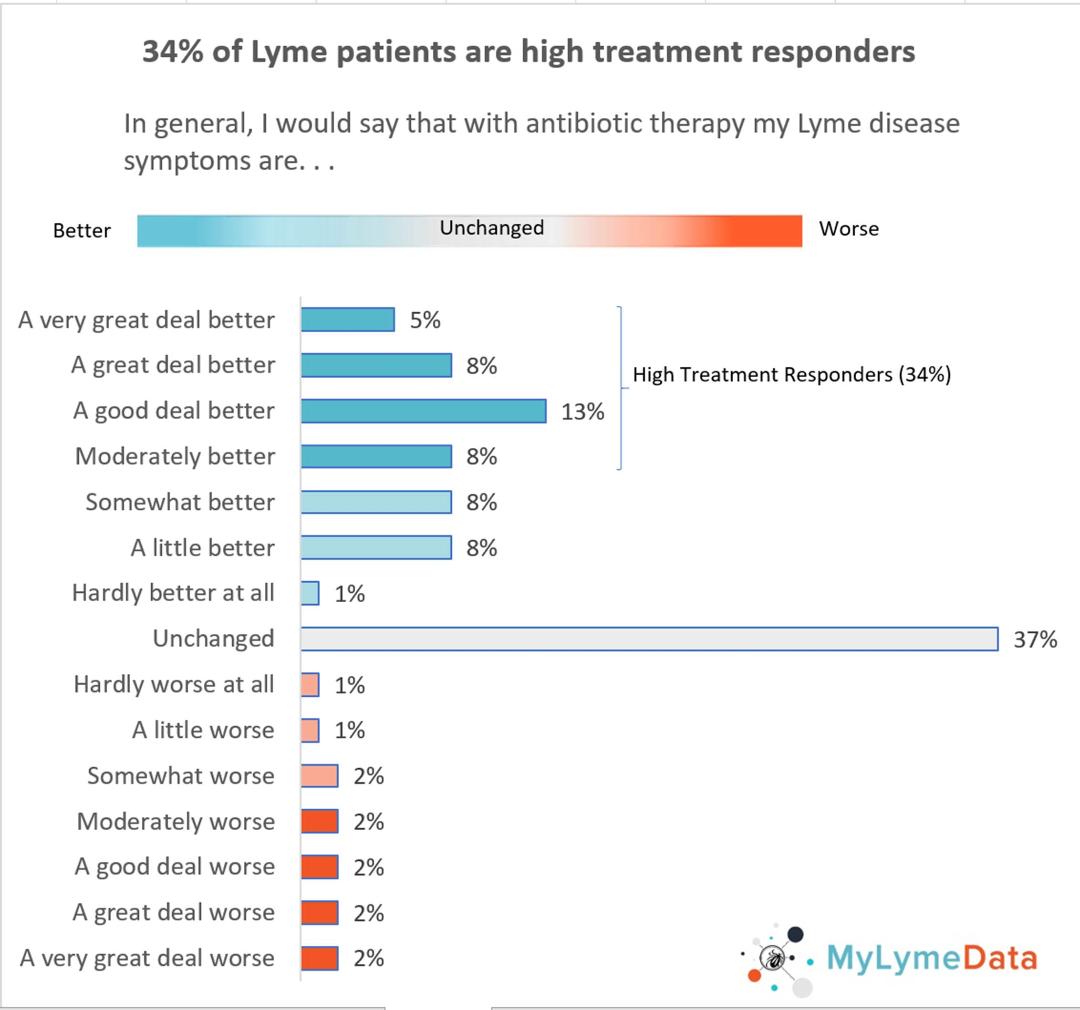
If I were a patient with chronic Lyme disease—which I was by the way–I would want to know that roughly a third of those in the sample were “high treatment responders”—meaning that they reported that after taking antibiotics their symptoms improved moderately to a very great deal. This is the type of information that patients want to know and that is why we conducted this study.

This is the first of many studies to be published using the data from MyLymeData.  So stay tuned! And if you are not enrolled in MyLymeData—I encourage you to stop what you are doing and sign up now. It is only by having patients pool their data that we will make progress in this disease.

Here is a short video I recorded explaining more about the study’s results.

Click here to read the full study.

Click here to enroll in MyLymeData.

Lorraine Johnson, JD, MBA, is the Chief Executive Officer of LymeDisease.org. You can contact her at lbjohnson@lymedisease.org. On Twitter, follow her @lymepolicywonk. If you have not signed up for our patient-centered big data project, MyLymeData, please register now.

_________________

**Comment**

If you haven’t enrolled in this Bigdata research, please do.

The more people who do this, the more information we will have to look at.

Since the largest NIH study was done in 2008, EIGHT YEARS AGO, you’d think researchers & doctors would be a bit open-minded.  Can you imagine basing cancer or AIDS treatments on EIGHT YEAR OLD STUDIES?  https://www.niaid.nih.gov/diseases-conditions/chronic-lyme-disease.  Another, done in 2003 (15 years ago) only looked at 28 days of IV antibiotic compared to placebo in 55 patients, hardly a representative sample, and what’s 28 days of IV abx going to do with a persistent pathogen typically coupled with other pathogens making cases extremely complex?

No, The Cabal has run the research in a biased and skewed manner for over 40 years.  Time for a change.

Interestingly, an IDSA founder disagreed with their stance and used high powered antibiotics quite successfully:  https://madisonarealymesupportgroup.com/2017/07/09/idsa-founder-used-potent-iv-antibiotics-for-chronic-lyme/ 51 difficult cases are represented.



Removing the Mask of Average Treatment Effects in Chronic Lyme Disease Research Using Big Data & Subgroup Analysis

https://www.mdpi.com/2227-9032/6/4/124

Healthcare 2018, 6(4), 124; https://doi.org/10.3390/healthcare6040124

Removing the Mask of Average Treatment Effects in Chronic Lyme Disease Research Using Big Data and Subgroup Analysis

1MyLymeData, Chico, CA 95927, USA
2Analytic Designers LLC., Bethesda, MD 20817, USA
3Paul G. Allen School of Computer Science and Engineering, University of Washington, Seattle, WA 98195, USA
Author to whom correspondence should be addressed.
Received: 4 September 2018 / Revised: 9 October 2018 / Accepted: 9 October 2018 / Published: 12 October 2018
Full-Text   |   PDF [1495 KB, uploaded 12 October 2018]

Abstract

Lyme disease is caused by the bacteria borrelia burgdorferi and is spread primarily through the bite of a tick. There is considerable uncertainty in the medical community regarding the best approach to treating patients with Lyme disease who do not respond fully to short-term antibiotic therapy. These patients have persistent Lyme disease symptoms resulting from lack of treatment, under-treatment, or lack of response to their antibiotic treatment protocol. In the past, treatment trials have used small restrictive samples and relied on average treatment effects as their measure of success and produced conflicting results. To provide individualized care, clinicians need information that reflects their patient population. Today, we have the ability to analyze large data bases, including patient registries, that reflect the broader range of patients more typically seen in clinical practice. This allows us to examine treatment variation within the sample and identify groups of patients that are most responsive to treatment. Using patient-reported outcome data from the MyLymeData online patient registry, we show that sub-group analysis techniques can unmask valuable information that is hidden if averages alone are used. In our analysis, this approach revealed treatment effectiveness for up to a third of patients with Lyme disease. This study is important because it can help open the door to more individualized patient care using patient-centered outcomes and real-world evidence. View Full-Text

___________________
**Comment**
Great work here.  We need to start the coinfection discussion; however, as Lyme is just one beast of many and the involvement of other pathogens muddies the water considerably and needs addressing.  Many, many patients WILL NOT improve on a Lyme only treatment.


Ehrlichiosis Masquerading as Thrombotic Thrombocytopenia Purpura

https://www.ncbi.nlm.nih.gov/m/pubmed/30279260/

Ehrlichiosis masquerading as thrombotic thrombocytopenic purpura.

Chen D, et al. BMJ Case Rep. 2018.

Abstract

Ehrlichiosis is a rare tickborne illness that can manifest from an asymptomatic, self-limiting disease to a severe presentation with encephalopathy and renal failure. Ehrlichiosis is diagnosed largely based on patient history with confirmatory tests including peripheral blood smear, serology and PCR. Empiric treatment is warranted in patients with suspected tick bites as a delay in treatment can result in multiorgan failure. We discuss a case of ehrlichiosis that presented with the classic pentad of thrombotic thrombocytopenic purpura (TTP). A history of a tick bite was elicited and intravenous doxycycline 100 mg two times a day was initiated. Tick panel results revealed a positive Ehrlichia chaffeensis IgG and IgM titres, consistent with human monocytic ehrlichiosis. Autoimmune workup and antibodies to Borrelia burgdorferi were negative, and ADAMTS13 activity assay results were inconsistent with TTP. The patient completed 14 days of intravenous doxycycline and had an uneventful recovery.

PMID

30279260 [ – in process]

__________________________
**Comment**
Thrombotic Thrombocytopenic Purpura (TTP) causes tiny blood clots throughout your body.  This can block blood vessels and impede blood flow.  The clots can use up too many platelets which in turn can inhibit clot formation when you need it.
Symptoms include:
  • Purplish bruises (purpura) from no obvious cause
  • tiny red or purple spots that look like a rash
  • skin may turn yellowish (jaundice)
  • skin may look pale
  • fever
  • fatigue
  • confusion
  • weakness
  • headache
  • In very serious cases, a stroke, major internal bleeding, or a coma can occur
Warning!
In May 2017, an article in the CDC “Emerging Infectious Diseases” Journal, warns that ehrlichiosis infections are being “grossly underreported” in the U.S. with as many as 97-99% of infections going unrecognized. They are projecting that the actual number of annual cases could go as high as 1/2 the number of Lyme disease cases—which would mean we may already have over 150,000 cases of ehrlichiosis annually. (3)
Rickettsiae and Ehrlichia belong to a broad group of bacteria that can be spread by a tick bite. These infections can be transmitted alone or at the same time as Lyme disease and are commonly known as co-infections.


The Ehrlichia (E) group includes: (5, 6, 7, 8,)

  • chaffeensis: the cause of human monocytic ehrlichiosis (HME)
  • ewingii
  • muris-like (EML)

Symptoms
While some cases of ehrlichiosis are mild, the disease can be severe or fatal if not treated correctly, even in previously healthy people. Severe symptoms of ehrlichiosis may include difficulty breathing, respiratory failure, bleeding disorders, kidney or heart failure.

Because Ehrlichia infect white blood cells (the cells that fight infection), and mitochondria (the powerhouse of the human cell) the consequences of untreated infection may have long-lasting effects.(9) I often wonder if undiagnosed Ehrlichiosis isn’t responsible for some portion of the millions of people with the mysterious illness known as “Myalgic Encephalomyelitis” or “Chronic Fatigue Syndrome”.

Other symptoms of ehrlichiosis can include:

  • Fever/chills and headache (majority of cases)
  • Fatigue/malaise (over two-thirds of cases)
  • Muscle/joint pain (25% – 50%)
  • Nausea, vomiting and/or diarrhea (25% – 50%)
  • Cough (25% – 50%)
  • Confusion or brain fog (50% of children, less common in adults)
  • Lymphadenopathy (47% – 56% of children, less common in adults)
  • Red eyes (occasionally)
  • Rash (approximately 60% of children and 30% of adults)

Diagnosis And Treatment
Like other tick-borne diseases, diagnostic blood tests will frequently be false-negative during the first weeks of illness. And like other tick-borne diseases, treatment is most effective if started early. For this reason, healthcare providers must use their best clinical judgement and treat patients based upon early symptoms alone.

According to the CDC website: “The diagnosis of ehrlichiosis must be made based on clinical signs and symptoms, and can later be confirmed using specialized confirmatory laboratory tests. Treatment should never be delayed pending the receipt of laboratory test results, or be withheld on the basis of an initial negative laboratory result.”

The CDC goes on to say: “Doxycycline is the first line treatment for adults and children of all ages and should be initiated immediately whenever ehrlichiosis is suspected.” (10)

Patients who are treated early may recover quickly on outpatient medication, while those who experience a more severe illness may require intravenous antibiotics, prolonged hospitalization or intensive care.

Got Mold?

Upcoming Toxic Mold Summit FREE and online.  From Jan. 28-Feb 3, 2019.

Register here:  https://toxicmoldproject.com/?idev_id=10581&idev_username=betterhealthguy&utm_source=10581

Also

Dr. Neil Nathan’s New Book:  Toxic:  Heal Your Body from Mold Toxicity, Lyme Disease, Multiple Chemical Sensitivities, and Chronic Environmental Illness.

Toxic book

_________________________________________________________________________________________________

Podcast:  Life After Mold with Dr. Lauren Tessier

Lauren Tessier, ND is a Naturopathic Physician licensed in the state of Vermont. She received her Bachelors in Premedical Sciences and Health Psychology from Massachusetts College of Pharmacy in Boston and later became a Naturopathic Physician at Bastyr University in Kenmore, Washington.

Her practice, Life After Mold, uses a patient-centered approach to help recover those that are suffering from mold-related illness.  She combines naturopathic, functional, and integrative medicine to address the entire person.  She is a Shoemaker Certified Physician specializing in the treatment of Chronic Inflammatory Response Syndrome (CIRS) which results from exposure to water-damaged buildings.

In 2011, Hurricane Irene created an unimaginable flood in Waterbury, Vermont, and she was unprepared for what she would see next in her practice.  Patients were ill with unexplained rashes, allergies that did not respond to treatment, fatigue, breathing difficulties, neurological complaints, headaches, nausea, and immune system dysfunction.  When her normal approaches no longer worked for these patients, she dove deep into mold-related illness.

Her practice is dedicated to helping those suffering with mold, biotoxin, and mycotoxin associated illness resulting from water-damaged buildings. As time passed, she came to the belief that the environment plays a role in all chronic illness.  Environmental illness includes mold, heavy metals, glyphosate exposure, chronic infections such as Lyme disease, Multiple Chemical Sensitivity, and Mast Cell Activation Syndrome.  Dr. Tessier is an Executive Board Member of the International Society for Environmentally Acquired Illness (ISEAI) which aims to advance medical knowledge surrounding environmentally acquired illness.

Key Takeaways

  • What are some of the environmental factors that may predispose an environment to water-damage and the potential for mold illness?
  • What are some of the illness-creating substances that are found in a water-damaged building?
  • What are common symptoms of CIRS?
  • Are there basic screening tests that can be performed of an environment before investing in an IEP?
  • How important are the HLA haplotypes in CIRS?
  • Is there clinical value in urinary mycotoxin testing?
  • Can molds encountered in a water-damaged building lead to colonization within the body?
  • When considering binders, what is absorption vs. adsorbtion?
  • Why is bile flow important and how might it be supported?
  • What options might help reducing inflammation in those with CIRS?
  • Are there downsides of exogenous glutathione supplementation?
  • How important is eradicating MARCoNS in CIRS?
  • How might VIP and Synapsin be helpful in those with CIRS?
  • What triggers Mast Cell Activation Syndrome (MCAS) and how might it be addressed?
  • When someone feels significantly worse, what rescue items might help to move through a detox or Herxheimer reaction?
  • Is there a role for limbic system retraining in CIRS?

Connect:  http://lifeaftermold.com

In the same vein, here’s another Podcast titled:

Create Your Healthy Home with May Dooley, MS, MA, CMC

In this episode, you will learn about Bau Biologie, or Building Biology, and how to evaluate and improve the health of the external environment in order to improve overall health.

May Dooley, MS, MA, CMC (Council-certified Microbial Consultant) is a former middle school science teacher who loves to educate and empower people with information to improve their environment – and thus, their lives.  She has been an environmental consultant for more than 24 years helping people make their home environment healthier.

She leads her clients through the basic steps to assess and create a healthy home which includes air quality, water quality, and reduced exposure to other stressors that may impact health such as electromagnetic fields.  Her inspections are interactive, and her clients learn how to measure EMFs, reduce body voltage in their bed, use a laser particle counter to evaluate their vacuum cleaner, and to take samples to explore for mold.  She even brings along her microscope and looks at the samples in your home.  Once she has evaluated an environment using the principles of Bau Biologie, she provides an easy-to-understand series of steps to improve the environment.

Key Takeaways

  • Why might culture plate air sampling be a better option than spore trap testing?
  • What are the pros and cons of the ERMI?
  • What is the CAP ERMI?
  • What role do microbial VOCs play in the health of an environment?
  • How often can mold issues be remediated?
  • How is a microscope helpful in exploring the potential for mold?
  • When moving to a new environment, what testing should be done to validate the environment is safe?
  • What belongings can be brought from a moldy environment to a new environment?
  • What can be used to address small amounts of visible mold?
  • What vacuum cleaners are ideal?
  • What are the 5 different types of EMFs and their sources?
  • What is body voltage and how is it measured?
  • What is grounding and how should it be done?
  • Why should the bed have no metal materials?
  • What light bulbs might be best?

Connect: http://createyourhealthyhome.com
http://moldcontrolonabudget.com

Disclaimer

The content of this show is for informational purposes only and is not intended to diagnose, treat, or cure any illness or medical condition. Nothing in today’s discussion is meant to serve as medical advice or as information to facilitate self-treatment. As always, please discuss any potential health-related decisions with your own personal medical authority.

________________

For more:  https://madisonarealymesupportgroup.com/2018/05/15/watch-the-documentary-moldy-for-free-for-a-limited-time/

https://madisonarealymesupportgroup.com/2018/03/13/are-mold-mycotoxins-compromising-your-recovery/

https://madisonarealymesupportgroup.com/2017/11/08/house-making-you-sick-mold-lyme-msids/

https://madisonarealymesupportgroup.com/2018/02/24/top-3-lyme-detox-myths-busted-dr-rawls/


Babesia Found in Patient With Persistent Symptoms Following Lyme Treatment

https://www.ncbi.nlm.nih.gov/m/pubmed/30262525/

Diagnosis of a tick-borne coinfection in a patient with persistent symptoms following treatment for Lyme disease.

Hoversten K, et al. BMJ Case Rep. 2018.

Abstract

A 67-year-old woman presented with 5 days of myalgias and fevers on completion of a 21-day course of amoxicillin for Lyme disease (Borrelia burgdorferi infection). She was found to have profound thrombocytopenia, as well as new anaemia and leucopenia. Workup revealed Babesia microti as the causative agent of her symptoms. The patient quickly improved after appropriate antimicrobial therapy directed against babesiosis was started. This case illustrates the importance of basic microbiology, including epidemiology and common vectors, when creating a differential diagnosis. Because the Ixodes scapularis tick can harbour and transmit multiple parasites simultaneously, the possibility of coinfection should be considered in any patient not responding to appropriate initial medical therapy.

________________

**Comment**

Expect a lot more articles like this.  

Word is finally getting out that Lyme is just the Rock Star we all know by name but there are a lot of wanna be’s right behind him that haven’t made the news.  Research still hasn’t been done showing the synergistic effects of all of this together on the human body.  

To date, ticks can transmit 18 and counting pathogens – ALL as devastating as Lyme:  https://madisonarealymesupportgroup.com/2017/07/01/one-tick-bite-could-put-you-at-risk-for-at-least-6-different-diseases/

Lyme alone is a formidable foe that shape shifts to avoid treatment and the immune system that persists for many despite treatment.

Throw in Babesia, Bartonella, Mycoplasma, viruses, Nematodes (parasitic worms), and stuff not even named yet and a scary but telling picture begins to emerge.

More on Babesia:  https://madisonarealymesupportgroup.com/2016/01/16/babesia-treatment/

Please note that Dr. Horowitiz, a prominent Lyme literate doctor (LLMD) recommends 9 months to a year of solid treatment for Babesia.  He’s finding it to be particularly tenacious.

https://madisonarealymesupportgroup.com/2018/06/08/two-cases-of-babesia/  (They typically blame “severe” cases on a compromised immune system like a missing spleen but here we see someone as healthy as a horse all of a sudden develop shock and near respiratory failure).  If you have Lyme & Babesia &/or any other coinfection, your immune system is severely compromised.

https://madisonarealymesupportgroup.com/2018/07/02/splenic-rupture-from-babesiosis-an-emerging-concern-a-systematic-review-of-current-literature/

https://madisonarealymesupportgroup.com/2018/02/20/babesia-and-heart-issues/

https://madisonarealymesupportgroup.com/2018/10/06/case-of-recurrent-fever-multiple-splenic-infarcts-why-short-treatment-duration-often-doesnt-work-for-babesia/

https://madisonarealymesupportgroup.com/2018/06/03/heart-problems-tick-borne-disease/

https://madisonarealymesupportgroup.com/2018/05/31/widespread-babesiosis-in-canada/

https://madisonarealymesupportgroup.com/2018/03/22/what-is-air-hunger-anyway/