Archive for the ‘Transmission’ Category

Detection & Transstadial Passage of Babesia Species and Borrelia Burgdorferi Sensu Lato in Ticks Collected From Avian and Mammalian Hosts in Canada

Detection and Transstadial Passage of Babesia Species and Borrelia burgdorferi Sensu Lato in Ticks Collected from Avian and Mammalian Hosts in Canada 

John D. Scott 1,*, Kerry L. Clark 2, Nikki M. Coble 2 and Taylor R. Ballantyne

Received: 24 October 2019; Accepted: 26 November 2019; Published: 2 December 2019 

Abstract: Lyme disease and human babesiosis are the most common tick-borne zoonoses in the Temperate Zone of North America. The number of infected patients has continued to rise globally, and these zoonoses pose a major healthcare threat. This tick-host-pathogen study was conducted to test for infectious microbes associated with Lyme disease and human babesiosis in Canada. Using the flagellin (flaB) gene, three members of the Borrelia burgdorferi sensu lato (Bbsl) complex were detected, namely a Borrelia lanei-like spirochete, Borrelia burgdorferi sensu stricto (Bbss), and a distinct strain that may represent a separate Bbsl genospecies. This novel Bbsl strain was detected in a mouse tick, Ixodes muris, collected from a House Wren, Troglodytes aedon, in Quebec during the southward fall migration. The presence of Bbsl in bird-feeding larvae of I. muris suggests reservoir competency in three passerines (i.e., Common Yellowthroat, House Wren, Magnolia Warbler). Based on the 18S ribosomal RNA (rRNA) gene, three Babesia species (i.e., Babesia divergens-like, Babesia microti, Babesia odocoilei) were detected in field-collected ticks. Not only was B. odocoilei found in songbird-derived ticks, this piroplasm was apparent in adult questing blacklegged ticks, Ixodes scapularis, in southern Canada. By allowing live, engorged ticks to molt, we confirm the transstadial passage of Bbsl in I. muris and B. odocoilei in I. scapularis. Bbss and Babesia microti were detected concurrently in a groundhog tick, Ixodes cookei, in Western Ontario. In Alberta, a winter tick, Dermacentor albipictus, which was collected from a moose, Alces alces, tested positive for Bbss. Notably, a B. divergens-like piroplasm was detected in a rabbit tick, Haemaphysalis leporispalustris, collected from an eastern cottontail in southern Manitoba; this Babesia species is a first-time discovery in Canada. This rabbit tick was also co-infected with Borrelia lanei-like spirochetes, which constitutes a first in Canada. Overall, five ticks were concurrently infected with Babesia and Bbsl pathogens and, after the molt, could potentially co-infect humans.

Notably, we provide the first authentic report of I. scapularis ticks co-infected with Bbsl and B. odocoilei in Canada.

The full extent of infectious microorganisms transmitted to humans by ticks is not fully elucidated, and clinicians need to be aware of the complexity of these tick-transmitted enzootic agents on human health. Diagnosis and treatment must be administered by those with accredited medical training in tick-borne zoonosis. 

Full article: Scott et al., 2019, Babesia spp. and Borrelia spp., Canada

© 2019 by the authors. Licensee MDPI, Basel, Switzerland. This article is an open access article distributed under the terms and conditions of the Creative Commons Attribution (CC BY) license (http://creativecommons.org/licenses/by/4.0/). 

_________________

**Comment**

Transstadial passage is the ability of an infection to pass from one one developmental stage of an organism to another, e.g.,from the larval to the nymph stage or from the nymph to the adult:  https://medical-dictionary.thefreedictionary.com/transstadial

In this report the authors confirm the transstadial passage of Bbsl in I. muris and B. odocoilei in I. scapularis (black legged deer tick).

According to the following 2000 article, Ixodes muris is also capable of transmitting Lyme disease:  https://bioone.org/journals/Journal-of-Medical-Entomology/volume-37/issue-5/0022-2585-37.5.766/Vector-Competence-of-Ixodes-muris-Acari–Ixodidae-for-Borrelia/10.1603/0022-2585-37.5.766.short

Also, the following 2014 article states, “early studies revealed a higher ratio of presumed nonpathogenic B. odocolei to B. microti in areas where these species co-exist.”  https://wwwnc.cdc.gov/eid/article/20/10/13-0938_article

I think it would be folly to presume anything, and the potential of B. odocoilei to be of concern to human health is relevant. In my opinion, far too much as been presumed about the ability of various ticks to transmit disease, the time it takes to transmit, as well as the ability of numerous strains of pathogens to be of human health concern.

A few things are for sure: more and more is coming out on the coinfection of ticks, that there are many strains and variations of these pathogens to be concerned with, and that current testing is abysmal in picking much of this up.  These issues are some of the factors as to why people remain ill.  Mainstream medicine must awaken from its coma to embrace the complexity of all of this or patients will continue to suffer.



Tick-born Parasite Found in Scottish Sheep in UK First

https://www.bbc.com/news/uk-scotland-50491068

Tick-borne parasite found in Scottish sheep in UK first

20 November 2019
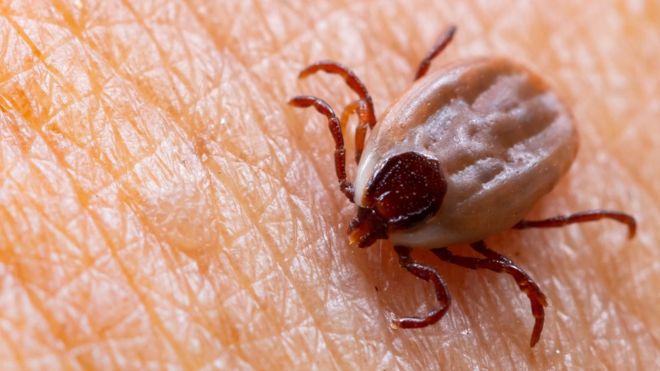
A tick on human skinImage copyrightGETTY IMAGES
Image captionThe tick-borne parasite causes a disease called babesiosis

An exotic and potentially deadly tick-borne parasite has been found in the UK for the first time.

A study conducted by the University of Glasgow found the parasite in sheep in the north east of Scotland.

This is the first time the organism, called Babesia venatorum, has ever been found in sheep anywhere in the world.

The parasite causes a disease called babesiosis which is recognised as an emerging infection in human health.

It has been extensively recorded in China and in Europe with two human infections confirmed in Italy in the last 20 years.

Babesiosis is treatable in most cases, although this depends on rapid and accurate diagnosis.

The European Centre for Disease Prevention and Control said infected people may get symptoms such as flu and jaundice but severe cases can lead to death.

Scientists believed the risk of people contracting this infection however is believed to be low.

‘A new risk’

Researchers targeted areas where tick-borne viruses had been previously detected and collected blood from sheep, cattle and deer.

Scientists believed the parasite could have travelled to the north east of Scotland via migrating birds from Scandinavian countries.

__________________

For more:  https://madisonarealymesupportgroup.com/category/babesia-treatment/

https://madisonarealymesupportgroup.com/2019/11/27/ticks-removed-from-humans-in-northwestern-italy-30-had-babesia/

Migrating birds are transporting ticks all over the place. https://madisonarealymesupportgroup.com/2019/03/09/danish-study-shows-migrating-birds-are-spreading-ticks-their-pathogens-including-places-without-sustainable-tick-populations/

https://madisonarealymesupportgroup.com/2018/11/07/ticks-on-the-move-due-to-migrating-birds-and-photoperiod-not-climate-change/

Ticks Removed From Humans in Northwestern Italy – 30% Had Babesia

https://www.sciencedirect.com/science/article/pii/S2405939019301212

Survey on tick-borne pathogens in ticks removed from humans in Northwestern Italy

Highlights

Ticks have a considerable importance for public health.

Few data are present about ticks collected from humans.

128 ticks from 92 patients were analysed.

Almost 30% of the analysed tick pools were positive for Babesia spp.

The zoonotic species Babesia venatorum was the most prevalent species observed.

Abstract

Ticks are able to transmit several pathogens to the host while feeding, and thus are considered the most important vectors of infectious agents together with mosquitos. The global incidence of tick-borne diseases (TBDs) is rising, due to increased interactions between pathogens, hosts and vectors, linked to global changes. Given that information about the prevalence of tick-borne pathogens in ticks removed from humans in Italy are scarce, the aim of the present study was to identify the species of ticks biting humans in Northwestern Italy and tick-borne pathogens they harbour. An overall number of 128 ticks from 92 patients were collected from April to October 2018, almost 98% of which belonging to the Ixodes ricinus species. Molecular analysis showed the presence of Babesia spp. in 29 out of 93 analysed tick pools, with a Minimum Infection Rate (MIR) of 31.18% (29/93; CI95% 22.67–41.19%), while 1 out of 93 pools tested positive for SFG Rickettsiae (MIR = 1.08%; CI95% 0.19–5.84%). No samples tested positive for A. phagocytophilum and Borrelia spp. Sequencing revealed the presence of Babesia venatorum (28 pools), Theileria buffeli/orientalis complex (1 pool) and Rickettsia monacensis. Among these, B. venatorum and R. monacensis are zoonotic pathogens able to cause from moderate to severe infections in humans. These data highlight the importance of passive surveillance to assess the epidemiology of TBDs that pose a threat to human health.

__________________

**Comment**

Ixodes ricinus or the Castor Bean tick, sheep tick, or deer tick is considered a European hard-bodied tick; however, please note that migrating birds are transporting ticks all over the place.  https://madisonarealymesupportgroup.com/2019/03/09/danish-study-shows-migrating-birds-are-spreading-ticks-their-pathogens-including-places-without-sustainable-tick-populations/

https://madisonarealymesupportgroup.com/2018/11/07/ticks-on-the-move-due-to-migrating-birds-and-photoperiod-not-climate-change/

https://madisonarealymesupportgroup.com/2019/07/28/coinfection-of-many-types-of-borrelia-rickettsia-babesia-bartonella-anaplasma-in-french-castor-bean-ticks/Excerpt:

It transmits numerous pathogens of medical and veterinary importance including Borrelia burgdorferi s.l. causing Lyme borreliosis, tick-borne encephalitis virus, Anaplasma phagocytophilum causing human granulocytic ehrlichiosis, Francisella tularensis causing Tularaemia, Rickettsia helvetica and Rickettsia monacensis, Babesia divergens and Babesia microti responsible for Babesiosis, Louping ill virus and Tribec virus.

The fact that 30% of ticks had Babesia should cause all doctors to pause and consider.


New Bartonella Species Found in Tick From Senegal

https://www.ncbi.nlm.nih.gov/pmc/articles/PMC6839013/

. 2019 Nov; 32: 100596.
Published online 2019 Aug 27. doi: 10.1016/j.nmni.2019.100596
PMCID: PMC6839013
PMID: 31719993

Bartonella massiliensis sp. nov., a new bacterial species isolated from an Ornithodoros sonrai tick from Senegal

Introduction

Bartonella is the monotypic genus of the family Bartonellaceae among Alphaproteobacteria . Bartonella species are fastidious Gram-negative, slightly curved rod bacteria characterized by a small cell size (0.5–0.6 × 1.0 μm) . They are facultative intracellular bacteria with a unique intraerythrocyte lifestyle. Currently the Bartonella genus includes 35 validly published species and three subspecies , . Bartonella species usually colonize the intestine of the arthropod vector or the bloodstream of the mammalian host , . In addition, our understanding of the involvement of these microorganisms in human diseases continues to grow, as does the range of clinical manifestations , . At least 13 Bartonella species are responsible for human diseases, including B. bacilliformis, B. quintana and B. henselae, which cause Carrión disease, trench fever and cat-scratch disease respectively. Bartonella species are also associated with chronic bacteraemia and/or endocarditis, bacillary angiomatosis, peliosis hepatis, prolonged fever of unknown origin, retinitis, uveitis and myocarditis in humans . Other mammalian species that may host Bartonella species include dogs, coyotes, foxes, cattle, deer, elk, bats and many rodent species , , .

Here we present the description of Bartonella massiliensis strain OS09T (= CSURB624T = DSM 23169), a new species of the genus Bartonella isolated from a soft tick, Ornithodoros sonrai, including its complete annotated genome.

________________

For more:  https://madisonarealymesupportgroup.com/2016/01/03/bartonella-treatment/


Do You Know Your Sandflies?

Today I posted an article of a U.S. patient who had an enlarged spleen, skin lesions, and anemia. Blood testing did not reveal bartonellosis, but the spleen was eventually removed and tissue tests revealed the presence of Bartonella bacilliformis. This is a species of Bartonella that is primarily transmitted by sand flies in South America. The patient, it turns out, had visited South America three years earlier.  https://madisonarealymesupportgroup.com/2019/11/26/bartonellosis-a-hidden-cause-of-splenomegaly/

Worldwide travel opens the door to insects and pathogens you may not find at home. It’s important to keep track of symptoms & connect them to any travel, making sure to tell your doctor.

The following article shows the various sandflies which look a bit like mosquitoes.  Please note they are found in the Southern U.S. as well.

http://entnemdept.ufl.edu/creatures/misc/flies/Lutzomyia_shannoni.htm  Full Article Here with pictures

Phlebotomine sand flies are of considerable public health importance because of their ability to transmit several viral, bacterial, and protozoal disease-causing organisms of humans and other animals.

Lutzomyia shannoni Dyar is a proven vector of vesicular stomatitis virus and a suspected vector of visceral leishmaniasis and sand fly fever in Florida. It is one of the more thoroughly studied species of phlebotomine sand flies in North America.

In the United States, it has been found through the southern states from Florida to Louisiana plus Arkansas, Tennessee, South and North Carolina. This species has been found as far north as Maryland and Delaware.

At least 60 species in the Old World genus Phlebotomus or New World genus Lutzomyia are vectors of several vertebrate pathogens, including a group of parasitic flagellate protozoa, Leishmania spp., which may cause cutaneous, visceral or muco-cutaneous Leishmaniasis; the bacterium, Bartonella bacilliformis causing Oroya fever; and several arboviruses causing sand fly fever and vesicular stomatitis (Lane 1993).

University of Florida Entomology & Nematology