Archive for the ‘Ticks’ Category

Bm in Manitoba 2011-2014

https://doi.org/10.9778/cmajo.20170070

Human seroprevalence of Borrelia miyamotoi in Manitoba, Canada, in 2011-2014: a cross-sectional study


Background: Hard tick-borne relapsing fever caused by Borrelia miyamotoi has been reported in Russia, the Netherlands, Germany, Japan and the northeastern and upper midwestern United States. We sought to investigate the presence of B. miyamotoi infection in humans in Manitoba, Canada.


Methods: Two hundred fifty sera collected from residents of Manitoba with suspected Lyme disease between 2011 and 2014 were tested for Borrelia burgdorferi antibody using a C6 peptide enzyme-linked immunosorbent assay (ELISA) followed by Western blot. Residual sera were then anonymized, stored at -80°C and subsequently thawed and tested for B. miyamotoi antibody using a 2-step glycerosphosphodiester phosphodiesterase-based ELISA and Western blot assay.


Results: Twenty-four of the 250 (9.6%) sera tested positive for B. miyamotoi immunoglobulin G. Participants who were B. miyamotoi seropositive were predominantly male (54%) and younger on average than those who were seronegative (32 and 44 yr of age, respectively). Participants who were seropositive for B. burgdorferiwere significantly more likely to be B. miyamotoi seropositive than those who were B. burgdorferi seronegative (20.3% v. 6.6%, respectively, odds ratio 3.6, 95% confidence interval 1.5-8.5).


Interpretation: This initial report of human B. miyamotoi infection in Canada should raise awareness of hard tick-borne relapsing fever among clinicians and residents of areas in Canada and western North America where Lyme disease is endemic.
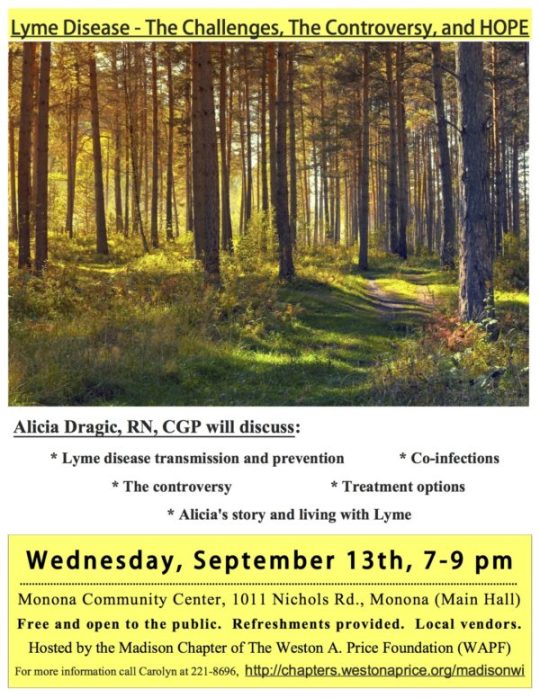
 

Lyme Talk Tomorrow Night in Monona

http://chapters.westonaprice.org/madisonwi/meeting-topics/

Lyme-1-600x776

Current Topic:

Lyme Disease – The Challenges, The Controversy, and HOPE – Sept. 13th, 7 pm

* Watch prior meeting topics on the: WAPF Madison youtube channel

Future Topics:

Oct. 11 – Dr. Steven Wilke, Chiropractor
Nov. 8 – Holistic Approach to Fat and Cardiovascular Health – Katy Wallace, ND
Dec. 13 – Holiday Party
Jan. 10 – Kefir – Bill Lensmire
Soy in the Diet of Humans & Animals
Nourishing Our Children DVD
Heart Disease / Cholesterol / Statins
High Lysine / Low Arginine Diet
Soil Health – Symphony of the Soil – film screening
Epigenetics
Cookware
Growing Cities film screening
Natural Parenting
Natural Birth Options
Our Immune System and Vaccines
Drinking Water
Chronic Pain
Autoimmune Diseases
Fat-Soluble Vitamins and Minerals

Your Idea For a Topic and/or a Speaker!
If you want more information, or have a suggestion for a future meeting topic, please email us: wapfmadison@gmail.com


New Borrelia Strain (lanei) Discovered – Named after Dr. Lane

http://ijs.microbiologyresearch.org/content/journal/ijsem/10.1099/ijsem.0.002214

Borrelia lanei sp. nov. extends the diversity of Borrelia species in California

The diversity of Borrelia species discovered in California appears to be particularly high. A divergent group of Borrelia strains collected from Ixodes ticks in California was described by Postic and co-workers and designated ‘genomospecies 2’ (Postic D, Garnier M, Baranton G. Int J Med Microbiol2007;297:263–271; Postic D, Ras NM, Lane RS, Hendson M, Baranton G. J Clin Microbiol1998;36:3497–3504). We performed multilocus sequence analysis (MLSA) using eight housekeeping loci (clpA, clpX, nifS, pepX, pyrG, recG, rplB and uvrA) on 12 strains of this Borrelia genospecies to confirm that these strains form a distinct group within the Borrelia burgdorferi s. l. complex (Margos G, Hojgaard A, Lane RS, Cornet M, Fingerle V et al. Ticks Tick Borne Dis 2010;1:151–158). Phylogenetic and genetic distance analyses based on sequences of the MLSA housekeeping genes corroborated the distinctness of this group; genetic distances to all other members of the B. burgdorferi s.l. complex were 96 % or lower. We propose the name Borrelia lanei sp. nov. for this genospecies in honor of Professor Robert S. Lane, University of California Berkeley, for his contributions to Borrelia and tick research. The type strain for Borrelia lanei sp. nov., strain CA28-91, has been deposited to two culture collections (=DSM 17992=CIP 109135).

———————————————————————————————–

**Comment**

Congrats to Dr. Lane for this borrelia strain discovery.  Lane is also a member of the newly formed Tick Research to Eliminate Diseases:  Scientist Coalition (TRED):  https://madisonarealymesupportgroup.com/2017/04/12/announcing-tred-tick-research-to-eliminate-diseases-scientist-coalition/

This could also explain why California Lyme patients are discarded like yesterday’s trash.  They very probably have these yet to be discovered strains of borrelia that no CDC two tiered test is going to pick up in a trillion years.

Much work needs to be done not only in discovering these strains but also the other pathogens involved that make our cases much more complex than the average GP understands.  These factors could well explain why we aren’t testing positively and why we are not getting better with the mono therapy of doxycycline.

Spinal Meningitis From Tick Bite

http://www.ibtimes.com/woman-contracts-spinal-meningitis-deer-tick-bite-2584949  

BY  ON 08/31/17 AT 1:41 PM

A Staten Island woman contracted spinal meningitis from a tick bite, making her one of seven people diagnosed with tick-borne diseases this summer. Lawmakers renewed attempts to acquire state and federal resources for disease prevention, reported WABC Wednesday.

Dee Vandenburg was bitten by a deer tick and unknowingly contracted Lyme disease, which went undiagnosed for four months and developed into spinal meningitis, reported WCBSWednesday.

Vandenburg spent about two weeks in the hospital and had an IV port inserted in her arm to provide her with her daily doses of antibiotics.

“It’s the most excruciating pain I’ve ever had in my life,” Vandenburg said to WCBS.

The deer population in Staten Island increased 9,000 percent in 9 years, according to silive.comin April. Deer have heavily populated Wolfe’s Pond Park, a wooded area near Vandenburg’s place of residence where deer live and breed. Last year, the city began a $2 million sterilization program.

“We have deer that walk down our street like they own it. They’re beautiful, but they’re not so pretty anymore,” Vandenburg said.

Republican Representative Dan Donovan of Staten Island introduced a new bill Wednesday for an initiative to track deer ticks nationwide. It would allow people to send photos of ticks they pull off their bodies to experts at the Centers for Disease Control and Prevention. His plan shared similarities with one proposed by the New York State Health Department, a public website to provide people access to tick collection and testing results.

“It will allow individuals to send images and basic information to a disease professional, and that professional would respond within 72 hours with information about the type of tick and the risk of what they may incur from that tick bite,” Donovan said.

The professional would also tell you what questions to ask a doctor regarding the suspected tick exposure.

“This is an issue that’s become a bigger public health problem and it’s the type of issue that is so important to be proactive for our community,” Donovan said. “We are known as the borough of parks, but just be aware of the risks and take precautions. Check yourself for ticks.”

**Comment**

The video found on the same page as this article is a completely different story about a fungal meningitis outbreak caused by contaminated steroids.  The two stories have nothing to do with each other other than they are both saddening.  https://www.usnews.com/news/business/articles/2017-06-26/pharmacy-head-to-be-sentenced-in-deadly-meningitis-outbreak

Yolanda Hadid On Lyme in People Magazine

http://people.com/tv/what-is-lyme-disease/

What is Lyme Disease? Everything You Need to Know About the Tick-Borne Infection That Yolanda Hadid Is Battling
BY EMILY STROHM

//players.brightcove.net/416418724/default_default/index.html?videoId=5157110597001“>//players.brightcove.net/416418724/default_default/index.html?videoId=5157110597001  Video here

POSTED ON AUGUST 23, 2017
In this week’s issue of PEOPLE, former Real Housewives of Beverly Hills star Yolanda Hadid opens up about her battle with late-stage Lyme disease, and how the illness drove her to contemplate suicide. But what is the mysterious illness?

Lyme disease is a potentially debilitating infection caused by bacteria called Borrelia burgdorferi, and is transmitted through the bite of an infected blacklegged tick.

“For some people, Lyme is easily treated but for others this disease is devastating,” says Linda Giampa, executive director of the Bay Area Lyme Foundation. The CDC has also documented cases in which Lyme has been fatal. (See link for article)

For more on Hadid’s struggle with Lyme, check out her new memoir – Believe Me: My Battle with the Invisibility of Lyme Disease – which comes out Sept. 12.