Archive for the ‘Ticks’ Category

New Borrelia Strain (lanei) Discovered – Named after Dr. Lane

http://ijs.microbiologyresearch.org/content/journal/ijsem/10.1099/ijsem.0.002214

Borrelia lanei sp. nov. extends the diversity of Borrelia species in California

The diversity of Borrelia species discovered in California appears to be particularly high. A divergent group of Borrelia strains collected from Ixodes ticks in California was described by Postic and co-workers and designated ‘genomospecies 2’ (Postic D, Garnier M, Baranton G. Int J Med Microbiol2007;297:263–271; Postic D, Ras NM, Lane RS, Hendson M, Baranton G. J Clin Microbiol1998;36:3497–3504). We performed multilocus sequence analysis (MLSA) using eight housekeeping loci (clpA, clpX, nifS, pepX, pyrG, recG, rplB and uvrA) on 12 strains of this Borrelia genospecies to confirm that these strains form a distinct group within the Borrelia burgdorferi s. l. complex (Margos G, Hojgaard A, Lane RS, Cornet M, Fingerle V et al. Ticks Tick Borne Dis 2010;1:151–158). Phylogenetic and genetic distance analyses based on sequences of the MLSA housekeeping genes corroborated the distinctness of this group; genetic distances to all other members of the B. burgdorferi s.l. complex were 96 % or lower. We propose the name Borrelia lanei sp. nov. for this genospecies in honor of Professor Robert S. Lane, University of California Berkeley, for his contributions to Borrelia and tick research. The type strain for Borrelia lanei sp. nov., strain CA28-91, has been deposited to two culture collections (=DSM 17992=CIP 109135).

———————————————————————————————–

**Comment**

Congrats to Dr. Lane for this borrelia strain discovery.  Lane is also a member of the newly formed Tick Research to Eliminate Diseases:  Scientist Coalition (TRED):  https://madisonarealymesupportgroup.com/2017/04/12/announcing-tred-tick-research-to-eliminate-diseases-scientist-coalition/

This could also explain why California Lyme patients are discarded like yesterday’s trash.  They very probably have these yet to be discovered strains of borrelia that no CDC two tiered test is going to pick up in a trillion years.

Much work needs to be done not only in discovering these strains but also the other pathogens involved that make our cases much more complex than the average GP understands.  These factors could well explain why we aren’t testing positively and why we are not getting better with the mono therapy of doxycycline.

Spinal Meningitis From Tick Bite

http://www.ibtimes.com/woman-contracts-spinal-meningitis-deer-tick-bite-2584949  

BY  ON 08/31/17 AT 1:41 PM

A Staten Island woman contracted spinal meningitis from a tick bite, making her one of seven people diagnosed with tick-borne diseases this summer. Lawmakers renewed attempts to acquire state and federal resources for disease prevention, reported WABC Wednesday.

Dee Vandenburg was bitten by a deer tick and unknowingly contracted Lyme disease, which went undiagnosed for four months and developed into spinal meningitis, reported WCBSWednesday.

Vandenburg spent about two weeks in the hospital and had an IV port inserted in her arm to provide her with her daily doses of antibiotics.

“It’s the most excruciating pain I’ve ever had in my life,” Vandenburg said to WCBS.

The deer population in Staten Island increased 9,000 percent in 9 years, according to silive.comin April. Deer have heavily populated Wolfe’s Pond Park, a wooded area near Vandenburg’s place of residence where deer live and breed. Last year, the city began a $2 million sterilization program.

“We have deer that walk down our street like they own it. They’re beautiful, but they’re not so pretty anymore,” Vandenburg said.

Republican Representative Dan Donovan of Staten Island introduced a new bill Wednesday for an initiative to track deer ticks nationwide. It would allow people to send photos of ticks they pull off their bodies to experts at the Centers for Disease Control and Prevention. His plan shared similarities with one proposed by the New York State Health Department, a public website to provide people access to tick collection and testing results.

“It will allow individuals to send images and basic information to a disease professional, and that professional would respond within 72 hours with information about the type of tick and the risk of what they may incur from that tick bite,” Donovan said.

The professional would also tell you what questions to ask a doctor regarding the suspected tick exposure.

“This is an issue that’s become a bigger public health problem and it’s the type of issue that is so important to be proactive for our community,” Donovan said. “We are known as the borough of parks, but just be aware of the risks and take precautions. Check yourself for ticks.”

**Comment**

The video found on the same page as this article is a completely different story about a fungal meningitis outbreak caused by contaminated steroids.  The two stories have nothing to do with each other other than they are both saddening.  https://www.usnews.com/news/business/articles/2017-06-26/pharmacy-head-to-be-sentenced-in-deadly-meningitis-outbreak

Yolanda Hadid On Lyme in People Magazine

http://people.com/tv/what-is-lyme-disease/

What is Lyme Disease? Everything You Need to Know About the Tick-Borne Infection That Yolanda Hadid Is Battling
BY EMILY STROHM

//players.brightcove.net/416418724/default_default/index.html?videoId=5157110597001“>//players.brightcove.net/416418724/default_default/index.html?videoId=5157110597001  Video here

POSTED ON AUGUST 23, 2017
In this week’s issue of PEOPLE, former Real Housewives of Beverly Hills star Yolanda Hadid opens up about her battle with late-stage Lyme disease, and how the illness drove her to contemplate suicide. But what is the mysterious illness?

Lyme disease is a potentially debilitating infection caused by bacteria called Borrelia burgdorferi, and is transmitted through the bite of an infected blacklegged tick.

“For some people, Lyme is easily treated but for others this disease is devastating,” says Linda Giampa, executive director of the Bay Area Lyme Foundation. The CDC has also documented cases in which Lyme has been fatal. (See link for article)

For more on Hadid’s struggle with Lyme, check out her new memoir – Believe Me: My Battle with the Invisibility of Lyme Disease – which comes out Sept. 12.

Sleeper Cells: The Stringent Response and Persistence in the Borreliella Burgdorferi Enzootic Cycle

Environ Microbiol. 2017 Aug 24. doi: 10.1111/1462-2920.13897. [Epub ahead of print]

Sleeper cells: The stringent response and persistence in the Borreliella (Borrelia) burgdorferi enzootic cycle.

Cabello FC1, Godfrey HP2, Bugrysheva J1,3, Newman SA4.

Abstract

Infections with tick-transmitted Borreliella (Borrelia) burgdorferi, the cause of Lyme disease, represent an increasingly large public health problem in North America and Europe. The ability of these spirochetes to maintain themselves for extended periods of time in their tick vectors and vertebrate reservoirs is crucial for continuance of the enzootic cycle as well as for the increasing exposure of humans to them. The stringent response mediated by the alarmone (p)ppGpp has been determined to be a master regulator in B. burgdorferi. It modulates the expression of identified and unidentified open reading frames needed to deal with and overcome the many nutritional stresses and other challenges faced by the spirochete in ticks and animal reservoirs. The metabolic and morphologic changes resulting from activation of the stringent response in B. burgdorferi may also be involved in the recently described non-genetic phenotypic phenomenon of tolerance to otherwise lethal doses of antimicrobials and to other antimicrobial activities. It may thus constitute a linchpin in multiple aspects of infections with Lyme disease borrelia, providing a link between the micro-ecological challenges of its enzootic life-cycle and long-term residence in the tissues of its animal reservoirs, with the evolutionary side-effect of potential persistence in incidental human hosts.

—————————————————————————————————————————————–

**Comment**

The idea of sleeper/persistent cells in Lyme and other TBI’s is nothing new to those actively treating patients.  It’s just a matter of time before enough people in power positions acknowledge it.  Also, it needs to be understood that those infected with Lyme often have numerous pathogens that don’t respond well to the mono therapy of Doxycycline and is one reason outcomes are not good.

For more on persistent infection:  https://madisonarealymesupportgroup.com/2017/05/10/chronic-lyme-disease-a-case-definition-at-last/

https://madisonarealymesupportgroup.com/2017/08/18/drexel-prof-lyme-persists/

https://madisonarealymesupportgroup.com/2016/12/21/dr-zhang-on-persisters/


Canine Maps – Better Than the CDC’s in Predicting Lyme Disease

https://www.lymedisease.org/lymepolicywonk-canine-maps-cdc/  by Lorraine Johnson, JD, MBA

LYMEPOLICYWONK: Canine maps predict Lyme disease risk better than the CDC does.

Dogs are considered a good gauge of the exposure of their human owners to infected ticks because they usually share the same environment and visit the same outdoor areas.  In other words, canines are considered to be sentinel indicators of Lyme disease risk for humans. Not all dogs who test positive for Lyme antibodies are ill. However, they have been exposed to the Lyme disease bacteria.

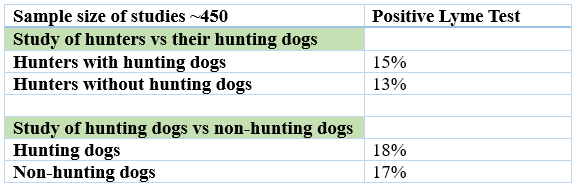
A combination of studies out of the Netherlands found that hunters and their hunting dogs had tested positive for Lyme disease at similar rates (17% hunting dogs vs. 15% hunters.)

However, the same study found that pet ownership itself did not increase risk, but that exposure was the primary factor: “Only 12% of the seropositive hunters had hunting dogs which were also seropositive. Moreover, hunters without dog ownership showed no significantly lower rates of seropositivity.”
Unlike people, dogs are routinely screened for Lyme disease and other common co-infections by their vets. IDEXX has tracked Lyme disease and other tick-borne diseases in canines for years by collecting data from veterinarians who test dogs at annual check-ups.

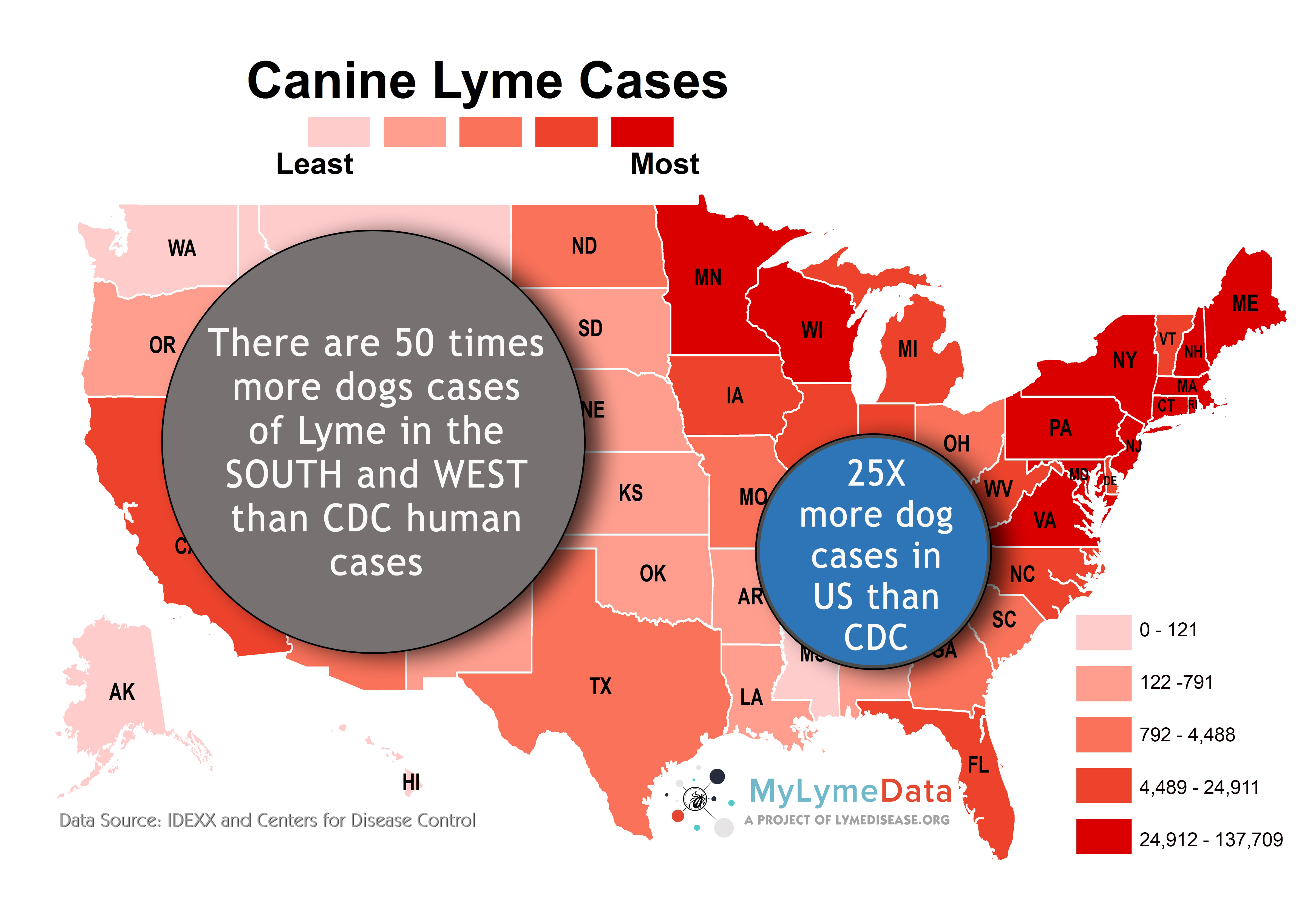
Between 2011 and 2015, IDEXX collected nearly 12 million Lyme disease test results from US veterinarians on a county-by-county basis. The data indicates that Lyme disease is present in abundance in every state in the US.

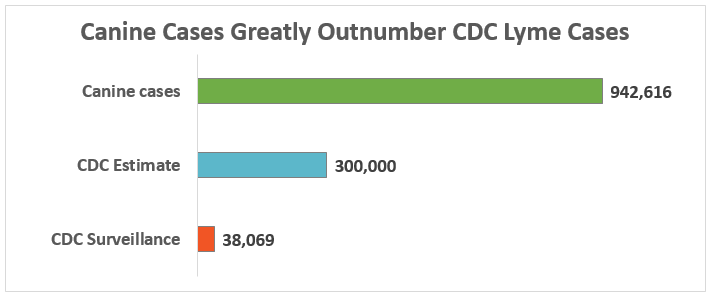
The number of canine positive test reports is vastly greater than the number of human cases reported by the Centers for Disease Control (CDC). There are close to one million canine positive test results annually in the US, compared to 38,069 cases included in CDC surveillance reports.

This means that there are roughly 25 times more canine cases than CDC surveillance cases. Even taking into account the fact that the CDC acknowledges that surveillance reports significantly underestimate the real incidence of Lyme disease by a factor of 10, the discrepancy is extraordinary. As the chart below reflects, canine cases are still more than three times the number of CDC estimated cases (300,000).
The discrepancy between CDC and canine cases is even more pronounced in the western and southern states. In the West and the South, there are 104,104 cases in dogs annually, compared to 2,342 CDC-reported cases. In other words, there are roughly 50 times more canine cases than CDC surveillance cases.
Michael Yabsley, a parasitologist at the University of Georgia, and Christopher McMahan, an assistant professor of mathematical sciences at Clemson University, have used the IDEXX canine data to develop a risk forecast map for the predicted Lyme disease prevalence — the percentage of dogs who are likely to test positive — by county in each of the 48 contiguous states.  Yabsley explains the predictive relationship:

“Dogs really are the canary in the coal mine for human infection. Our research team has evidence that the relationship between canine disease and human disease is strong. Because dogs are being tested for exposure during annual exams, these data are available on a national scale, something that is difficult to get when studying the ticks and environment directly.”

Aside from indicating environmental exposure risk, the data illustrates that people who own pets need to be aware that they face the same exposure when walking their animals or when their animals return home from outdoors carrying ticks.  Hence, preventative measures for pets—such as using appropriate tick and flea collars—are essential health matters for both people and their pets to avoid exposure.

LymeDisease.org believes that the IDEXX maps, which track Lyme disease as well as other tick-borne diseases such as ehrlichiosis and anaplasmosis, are the most accurate reflection of exposure. You can type in your zip code in the top right corner to assess your riskhere.

For example, in my zip code alone in Los Angeles, 626 cases of canine Lyme disease have been identified. (There are more than 3,500 zip codes in Los Angeles county.) That’s substantially more than the CDC reports for Californiaas a STATE for the last five years (2010-2015).

If you are interested in more information, check out the LymeSci blog on the predictive mapping of canine risk.

The LYME POLICY WONK blog is written by Lorraine Johnson, JD, MBA, who is the Chief Executive Officer of LymeDisease.org. You can contact her at lbjohnson@lymedisease.org. On Twitter, follow her @lymepolicywonk.  If you have not signed up for our patient-centered big data project, MyLymeData, please register now.

Fantastic, informative article and so true.  My dog got better treatment than we did.  The tests for animals are much more accurate and veterinarians completely understand the seriousness of TBI’s (tick borne illness) unlike human doctors.  Our vet had NO TROUBLE treating my dog for over a month even though HE HAD NO SYMPTOMS.  Compare that attitude with the reality of multitudes of humans being continually turned away because of arbitrary reasons such as a lack of an EM rash, a map that demonstrating a lack of ticks or infected ticks on that geographical region, not enough time passed before accepted dogma of transmission, and so many other reasons.
For more on Pets and TBI’s: