This study examined the phenomenology and clinical characteristics of obsessive compulsive symptoms (OCS) in adults diagnosed with Lyme disease.
Method
Participants were 147 adults aged 18–82 years (M = 43.81, SD = 12.98) who reported having been diagnosed with Lyme disease. Participants were recruited from online support groups for individuals with Lyme disease, and completed an online questionnaire about their experience of OCS, Lyme disease characteristics, and the temporal relationship between these symptoms.
Results
OCS were common, with 84% endorsing clinically significant symptoms, 26% of which endorsed symptoms onset during the six months following their Lyme disease diagnosis and another 51% believed their symptoms were temporally related. Despite the common occurrence of OCS, only 44% of these participants self-identified these symptoms as problematic. Greater frequency of Lyme disease symptoms and disease-related impairment was related to greater OCS. In the majority of cases, symptom onset was gradual, and responded well to psychological and pharmacological treatment. Around half of participants (51%) reported at least some improvement in OCS following antibiotic treatment.
Conclusions
This study highlights the common co-occurrence of OCS in patients with Lyme disease. It is unclear whether OCS are due to the direct physiological effects of Lyme disease or associated immunologic response, a psychological response to illness, a functional somatic syndrome, or some combination of these.
______________
**Comment**
OCS with Lyme/MSIDS is maddening. I remember it well. The good news is it, along with a plethora of other maddening symptoms decline or abate altogether with proper treatment.
At least now you know those OCS symptoms are due to being infected!
The U.S. Food and Drug Administration (FDA) is advising caution before prescribing the antibiotic clarithromycin (Biaxin) to patients with heart disease because of a potential increased risk of heart problems or death that can occur years later. Our recommendation is based on our review of the results of a 10-year follow-up study1 of patients with coronary heart disease from a large clinical trial2 that first observed this safety issue.
As a result, we have added a new warning about this increased risk of death in patients with heart disease, and advised prescribers to consider using other antibiotics in such patients. We have also added the study results to the clarithromycin drug labels. As part of FDA’s usual ongoing safety monitoring of drugs, we are continuing to monitor safety reports in patients taking clarithromycin.
Health care professionals should be aware of these significant risks and weigh the benefits and risks of clarithromycin before prescribing it to any patient, particularly in patients with heart disease and even for short periods, and consider using other available antibiotics. Advise patients with heart disease of the signs and symptoms of cardiovascular problems, regardless of the medical condition for which you are treating them with clarithromycin.
Patients should tell your health care professionals if you have heart disease, especially when you are being prescribed an antibiotic to treat an infection. Talk to them about the benefits and risks of clarithromycin and any alternative treatments. Do not stop taking your heart disease medicine or antibiotic without first talking to your health care professionals. Doing so could be harmful without your health care professionals’ direct supervision. Seek medical attention immediately if you experience symptoms of a heart attack or stroke, such as chest pain, shortness of breath or trouble breathing, pain or weakness in one part or side of your body, or slurred speech.
Like other antibiotics, clarithromycin is used to treat many types of infections affecting the skin, ears, sinuses, lungs, and other parts of the body, including Mycobacterium avium complex (MAC) infection, a type of lung infection that often affects people with human immunodeficiency virus (HIV). Clarithromycin is not approved to treat heart disease. The drug has been used for more than 25 years, and is sold under the brand name Biaxin and as generics by many different drug companies. It works by stopping the growth of bacteria. Without treatment, some infections can spread and lead to serious health problems.
The large clinical trial, called the CLARICOR trial2, observed an unexpected increase in deaths among patients with coronary heart disease who received a two-week course of clarithromycin that became apparent after patients had been followed for one year or longer. There is no clear explanation for how clarithromycin would lead to more deaths than placebo.Some observational studies also found an increase in deaths or other serious heart-related problems, while others did not. All the studies had limitations in how they were designed. Of the six observational studies published to date in patients with or without coronary artery disease, two found evidence of long-term risks from clarithromycin3,4, and four did not5,6,7,8. Overall, results from the prospective, placebo-controlled CLARICOR trial provide the strongest evidence of the increase in risk compared to the observational study results. Based on these studies, we were unable to determine why the risk of death is greater for patients with heart disease.
Furthermore, there are no prospective, randomized, and controlled trials with prespecified long-term safety outcome measures following clarithromycin treatment in patients who do not have heart disease. Because we currently do not have study information in these patients, and observational studies have shown different results, we cannot determine whether results of the CLARICOR trial can be applied to patients who do not have heart disease.
We previously communicated about this safety issue in December 2005, before the 10-year follow-up results were available for CLARICOR.
We urge health care professionals and patients to report side effects involving clarithromycin and other drugs to the FDA MedWatch program, using the information in the “Contact FDA” box at the bottom of the page.
Biaxin is a common drug used for Lyme/MSIDS. Please notice an admission is even made that the studies had design limitations as well as the fact that two studies found evidence while four did not.
As always, patients and their doctors must weigh the risks vs benefits with any treatment plan. While there are other drugs besides Biaxin, it works really well for some. Make sure to have a conversation with your doctor about this.
It is somewhat amazing to me that this study on sexual transmission of Lyme: https://f1000research.com/articles/3-309/v3 was declined by two referees but approved by two referees,yet we hear not a word of this study. It is my firm belief people are being infected sexually with TBI’s (Tick borne illness) as this is being written.
A scanning electron micrograph shows an engorged female Ixodes angustus tick with a male I. angustus attached to its underside in typical feeding mode—a case of hyperparasitism presumed uncommon in the species. (Image originally published in Durden et al 2018, Journal of Medical Entomology)
Tick Bites Tick: A Rare Case of Hard-Tick Hyperparasitism
Sometimes, parasites get a little taste of their own medicine.
Last August, a tick specimen submitted to the Alaska Department of Fish and Game offered a surprising look at hyperparasitic behavior among the species Ixodes angustus. After examination under a scanning electron microscope (SEM), researchers shared their findings in a new report in the Journal of Medical Entomology.
The image above shows the hyperparasitism, caught in the act: A large, engorged female I. angustus tick, which had been removed from a squirrel, shown with its own hitchhiker, a male I. angustus attached to its underside in typical feeding mode—with his palps splayed outside of her exoskeleton and his feeding apparatus (hypostome and chelicerae) inserted.
Lance A. Durden, Ph.D., professor at Georgia Southern University and lead author on the report, says he had never seen such a case of hyperparasitism in hard ticks (family Ixodidae), though it is more common in soft ticks (family Argasidae).
“Engorged soft ticks can be besieged by unfed individuals who opportunistically drive their mouthparts into the fed individual to steal part of the bloodmeal,” he says.
But that’s not all that is notable about the specimen. Also visible in the image is another scar (lower, left of center) that Durden and colleagues say was likely caused by another male tick feeding on the female in the same way. And—yes, there’s more—when the specimen was originally submitted, there was another male attached, mating with the female. (It fell off in the course of preparing the specimen for SEM imaging.)
Ixodes angustus is a nidicolous, or nest-dwelling, species, meaning it can progress through its entire life cycle within the nest or burrow of its host (e.g., mouse, vole, etc.), and males are rarely found on hosts. It has been presumed that mating typically occurs in the nest, but nine males of I. angustus have been collected on hosts in the course of the Alaska Department of Fish and Game’s tick survey since 2010, and nearly all had been found mating with females. Their findings suggest mating outside the nest and hyperparasitism in I. angustus may both be more common than previously thought.
“Male ticks that were infected with a pathogen or parasite—(such as Lyme disease spirochetes or Babesia protozoans—previously during their life cycle, by feeding on an infected host, could transmit these pathogens to female ticks during hyperparasitism.Female ticks could then transfer these pathogens or parasites to their progeny by transovarial transmission,” Durden says. “Although we don’t know yet if pathogen or parasite transmission occurs between I. angustus ticks by these mechanisms, if it does occur, this could have epidemiological significance by amplifying the number of infected ticks.”
______________
**Comment**
Great article pointing out what all of us in Lyme-land already know: there’s so much we don’t know.
Hyperparasitism needs to be studied as it would certainly help explain the high infection rates out here.
I’ve said it before and I’ll say it again, we need researchers to start at ground zero with all things Lyme/MSIDS, pretty much ignoring previous work so that they can be objective in their analysis. Too much for far too long has been “presumed.”
You know what they say……assuming makes an ass out of u and me.
Morgellons Disease is Not a Delusion, Says New Study
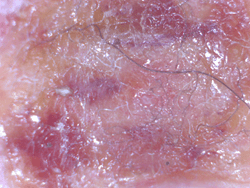
Embedded cutaneous blue and white filaments @ 50X magnification.
Charles E. Holman Morgellons Disease Foundation announces a new study that shows Morgellons disease is not a delusion. Review of medical literature exposes flaws in delusional description.
“This paper shows that most studies of Morgellons disease are appreciably flawed, and the disease does not meet criteria for a delusional disorder in accordance with the guidelines of the APA,” said Casey-Holman.
When does a “delusion” become reality? That question is addressed in the review paper entitled “History of Morgellons Disease: From Delusion to Definition” written by microbiologist Marianne Middelveen from Calgary, Canada, together with nurse practitioner Melissa Fesler and internist Raphael Stricker, MD from Union Square Medical Associates in San Francisco, CA.
Morgellons disease is a bizarre skin condition associated with tickborne disease. It is characterized by disfiguring skin lesions containing multicolored filaments, often accompanied by fatigue, joint and muscle pain and neurological problems. Morgellons disease is a controversial topic in medicine. The controversy surrounding this dermatological condition is explored in the February 2018 report published in the prestigious medical journal Clinical Cosmetic and Investigational Dermatology (https://doi.org/10.2147/CCID.S152343).
“This paper compares the evidence of an infectious etiology for Morgellons disease to the evidence that it is a purely delusional illness,” says Cindy Casey-Holman, director of the Charles E. Holman Morgellons Disease Foundation (CEHMDF) of Austin, TX. To be diagnosed with a delusional disorder according to the guidelines of the American Psychiatric Association (APA), a patient’s symptoms must meet specific criteria. “This paper shows that most studies of Morgellons disease are appreciably flawed, and the disease does not meet criteria for a delusional disorder in accordance with the guidelines of the APA,” said Casey-Holman.
The CEHMDF has funded a number of research studies illuminating the origin of the colorful skin filaments and showing that Morgellons pathology is the result of an infection. Some mainstream medical practitioners claim that the microscopic colorful fibers are self-implanted textile fibers, or that patients think they are infested by bugs or worms. In fact the fibers found in Morgellons skin lesions are not textile fibers, nor are they bugs or worms. They are human biofibers composed of the proteins collagen and keratin and produced by skin cells. While the blue coloration is caused by melanin pigmentation, the cause of red coloration remains a mystery.
“Many doctors are reluctant to accept evidence that challenges the status quo,” says Casey-Holman. “We need doctors to objectively examine all the evidence, so that patients can get treated for the underlying infection.”
“Morgellons is not a mystery. A plausible explanation is supported by scientific evidence. The fibers are human structural proteins,” explains Fesler. “It results from an aberrant response to the presence of tickborne pathogens.” The study also highlights the presence of brain scan lesions in some Morgellons patients, confirming the non-delusional nature of the disease.
Morgellons skin lesions are associated with Lyme disease and other tickborne illnesses.
“To treat the skin condition one must first treat the underlying infection,” says Dr. Stricker. Several laboratories have detected live Lyme bacteria directly in Morgellons skin tissue provided that the correct detection methods are used. “As more laboratories confirm detection of pathogens from Morgellons patients, the evidence becomes more difficult to ignore,” states Middelveen. “Eventually this association will be recognized in mainstream medicine.”
About the Charles E. Holman Morgellons Disease Foundation: The Charles E. Holman Morgellons Disease Foundation, based in Austin, TX, is a 501(c) (3) nonprofit organization committed to advocacy and philanthropy in the battle against Morgellons disease. Director, Cindy Casey-Holman, RN, leads the foundation, named for her husband, Charles E. Holman, a pioneer in the fight against Morgellons disease. Currently there is no public funding and very limited private funding to support research for this disease, and the CEHMDF is the recognized authority and primary funding source for Morgellons disease medical/scientific research. Donations are tax deductible in the US. To learn more about Morgellons disease go to:http://www.MorgellonsDisease.org
Contact information: http://www.thecehf.org/contact.html
Morgellons disease – Video Abstract ID 152343 presented by Melissa C Fesler
History of Morgellons disease: from delusion to definition
Published 9 February 2018 Volume 2018:11 Pages 71—90
Marianne J Middelveen,1 Melissa C Fesler,2 Raphael B Stricker2
Abstract:
Morgellons disease (MD) is a skin condition characterized by the presence of multicolored filaments that lie under, are embedded in, or project from skin. Although the condition may have a longer history, disease matching the above description was first reported in the US in 2002. Since that time, the condition that we know as MD has become a polemic topic. Because individuals afflicted with the disease may have crawling or stinging sensations and sometimes believe they have an insect or parasite infestation, most medical practitioners consider MD a purely delusional disorder. Clinical studies supporting the hypothesis that MD is exclusively delusional in origin have considerable methodological flaws and often neglect the fact that mental disorders can result from underlying somatic illness. In contrast, rigorous experimental investigations show that this skin affliction results from a physiological response to the presence of an infectious agent. Recent studies from that point of view show an association between MD and spirochetal infection in humans, cattle, and dogs. These investigations have determined that the cutaneous filaments are not implanted textile fibers, but are composed of the cellular proteins keratin and collagen and result from overproduction of these filaments in response to spirochetal infection. Further studies of the genetics, pathogenesis, and treatment of MD are warranted.
A healthy patient presented with painful skin lesions on the anterior surface of her legs.Erythema nodosum was diagnosed but all the usual causes were ruled out. The finding of bilateral enlarged axillary lymph nodes with necrosis and granulomas led to the diagnosis of Bartonella infection, an unusual cause of erythema nodosum. Imaging also revealed splenomegaly and small para-aortic lymph nodes.Up to one quarter of the patients with cat-scratch disease present atypically, a considerably higher prevalence than previously reported. A comprehensive review of the literature (PubMed, since inception, all languages) revealed a remarkable array of unusual presentations which are summarised and briefly discussed.
_____________
**Comment**
Thankful for this work showing atypical presentations. Mark my words, we are going to see more and more of this…..


 Embedded cutaneous blue and white filaments @ 50X magnification.
