Archive for the ‘research’ Category

Mosquito Spit Alone May Significantly Alter Your Immune System for Days After a Bite

http://www.newsweek.com/mosquito-spit-alone-may-significantly-alter-your-immune-system-days-after-bite-932675?utm_source=engageim  By Aristos Georgiou, 5/18/18

MOSQUITO SPIT ALONE MAY SIGNIFICANTLY ALTER YOUR IMMUNE SYSTEM FOR DAYS AFTER A BITE

blob:http://www.newsweek.com/2562375e-c0c4-4bc3-9f79-15498c0465ba (News video here)

When mosquitoes bite you, hundreds of different proteins present in their saliva enter your bloodstream, in addition to any pathogens they may be carrying.

Some of these proteins help the mosquito to suck blood from you. But they may also have more wide-ranging effects, increasing the severity of any diseases that the mosquitos are carrying by causing a significant immune response that can last for days after a bite, according to new research.

In a new study, published in the journal PLOS Neglected Tropical Diseases, scientists from Baylor College of Medicine examined the effects of mosquito bites on human immune cells. To do this they bioengineered mice using human stem cells, which effectively gave the rodents some features of a human immune system. These features included a complete set of human white blood cells, including the so-called ‘T cells’ that fight disease.

The mice were bitten by mosquitoes uninfected with any pathogens in a lab environment. Afterwards, the scientists analyzed any change in the functioning of the humanized immune cells.

They found that the mosquito spit alone produced an immune response involving more types of cells and lasting far longer than expected. In fact, the scientists detected immune cells traveling to the site of the bite up to seven days after it occurred. Furthermore, the immune response was observed in various tissue types, including the blood, skin and bone marrow.

“The biological significance of these changes remains to be determined, but it might explain how some pathogens, such as viruses, can spread through the body in these cells, replicate to higher extents, and even remain in some tissues for far longer than detected in blood,” the researchers wrote in the study.

Previous studies have also indicated that some properties of a mosquito bite, including its saliva, may exacerbate diseases that the insects carry.

For example, mouse experiments have shown that infections caused by a mosquito bite are often more severe than those caused by injecting the same parasite with a needle. However, whether or not the results of previous studies looking into this issue would translate to humans is an open question, as the experiments used bioengineered mice that provide a less accurate model of our immune system in comparison to the mice used in the latest study.

Mosquitoes and the pathogens they transmit are a growing public health concern. Around the world, 750,000 people die every year from mosquito-borne diseases—including malaria, dengue, West Nile, Zika and chikungunya.

Treatment options are often limited for these diseases and their incidence is only expected to rise in the next few decades, as the host ranges of multiple mosquito species increase due to climate change.

“Understanding how mosquito saliva interacts with the human immune system not only helps us understand mechanisms of disease pathogenesis but also could provide possibilities for treatments,” the researchers wrote in the study.

“If we know which mosquito saliva components enhance pathogenesis of diseases, we could create a human vaccine to counteract these effects for multiple infections,” they said.

______________

**Comment**

What does this mean for Lyme/MSIDS patients?  According to this study, mosquitoes carry Lyme disease (borrelia):  https://madisonarealymesupportgroup.com/2016/07/23/german-study-finds-borrelia-in-mosquitos/

Here is an excellent read by Dr. Sponaugle on the study:  https://sponauglewellness.com/lyme-study-how-borrelia-bacteria-is-transmitted-from-mosquitoes-to-humans/  He explains that the fact mosquitoes bite quickly makes some question their ability to transmit Bb; however, Sponaugle states, “Mosquitoes might have the equipment after all to enable Borrelia spirochetes the ability to survive for the durations necessary to be viable vectors of Lyme disease.”

Reading this current information on the various proteins & other pathogens present in their saliva altering human immune systems certainly screams for more intense study of the potential not only of spreading Bb but of amplifying all pathogens in the mosquito as well as the human.  The combination of tick and mosquito transmission would certainly help explain the far-ranging (world-wide) transmission rates of Lyme/MSIDS.  And, what about the other coinfections?  Much must be done with clear, unbiased studies starting at ground zero.

We need transmission studies more than we need climate studies.  People are dying out here.

For more:  https://madisonarealymesupportgroup.com/2017/08/14/canadian-tick-expert-climate-change-is-not-behind-lyme-disease/

https://madisonarealymesupportgroup.com/2017/07/08/global-warming-numbers-fudged/

GMO mosquitoes:  https://madisonarealymesupportgroup.com/2015/12/28/frankinbugs/

Wolbachia as a biocontrol:  https://madisonarealymesupportgroup.com/2018/02/12/wolbachia-laced-mosquitoes-being-released-why-lyme-msids-patients-might-be-negatively-affected/  Ticks carry worms and transmit them to humans.  Here’s what’s scary about Wolbachia: “Dogs treated for heart worm (D. immitis) have trouble due to the heart worm medication causing Wolbachia to be released into the blood and tissues causing severe Inflammation in pulmonary artery endothelium which may form thrombi and interstitial inflammation. Wolbachia also activates pro inflammatory cytokines.”  Nobody’s talking about what this could do to humans – particularly humans with worms.

GMO Mice:  https://madisonarealymesupportgroup.com/2016/06/21/first-frankenbugs-now-frankinmice/

Regarding tick eradication, controlled burns are 78-98% effective, yet are not huge money makers and isn’t garnering support.  It’s up to We the People to spread the truth:  https://madisonarealymesupportgroup.com/2018/04/03/fire-good-news-for-tick-reduction/
Panic Attacks May be Lyme/MSIDS

I normally post current studies but this one from 2000 grabbed me as so many Lyme/MSIDS patients suffer with panic attacks, anxiety, and PTSD.  It’s also interesting to note that this symptom completely abated with appropriate “intensive doses of appropriate antimicrobial meds.”  This of course reveals the unrecognized fact that patients are often contending with far more than just Lyme (borrelia) and require different medications.  It also reveals that there can be an underlying infectious cause to things doctors consider to be psychological.  Lyme/MSIDS patients are often misdiagnosed as having mental disorders and are given drugs that actually suppress their immune systems further and allow the pathogens a perfect opportunity to worsen.  All the doxy in the world isn’t going to touch Babesia which requires anti-malarial drugs.  Please read my comment at the end of the Abstract.

_________________

https://www.ncbi.nlm.nih.gov/m/pubmed/15990495/

Panic attacks may reveal previously unsuspected chronic disseminated lyme disease.

Sherr VT. J Psychiatr Pract. 2000.

Abstract

The author describes the histories of three patients with panic-like episodes that turned out to be related to underlying, previously unsuspected tick-borne diseases. Each woman experienced symptoms that are not usual in panic disorder but are typical of neurological Lyme disease, including exquisite sensitivity to light, touch, and sounds, joint pain often in combination with cognitive changes including mental fogginess and loss of recent memory, and some degree of bizarre, shifting, and often excruciating neurological pain. Because these symptoms are atypical of primary panic disorder, they were very helpful in alerting the clinician to suspect an underlying physical illness. In each case, the results of testing revealed positive hallmarks of disseminated Lyme and other tick-borne diseases, including Lyme borreliosis caused by the spirochete, Borrelia burgdorferi, babesiosis, and ehrlichiosis.

Since beginning treatment with intensive doses of appropriate antimicrobial medications for their tick-borne infections, all three patients have become free of panic attacks. Treatment of their infections by a specialist in Lyme disease allowed one of the women to discontinue anti-anxiety medication completely and another to reduce the dose of medication to occasional use only. The third patient is no longer anxious but her depression is resolving more slowly despite the ongoing use of an antidepressant. Two of the patients have also needed ongoing medication for pain and other symptoms of late-stage, neurological Lyme disease.

__________________

Since testing is so abysmal, it is far more helpful to print out and check off symptom lists.  Take these lists with you to your doctor appointments:

https://madisonarealymesupportgroup.com/wp-content/uploads/2016/01/symptomlist.pdf

https://madisonarealymesupportgroup.com/2011/09/25/the-babesia-checklist-copyrighted-2011-james-schaller-md-mar-version-20/ (Circle symptoms you have)

https://madisonarealymesupportgroup.com/2011/09/25/the-bartonella-checklist-copyrighted-2011-james-schaller-md-version-11/ (Circle symptoms you have)

https://madisonarealymesupportgroup.com/2016/02/07/mycoplasma-treatment/  Read up on Mycoplasma as it is often a player and requires thoughtful treatment.

Treatment for Ehrlichiosis is fairly straight forward with doxycycline and normally that is a front-line med LLMD’s use for Lyme, so the good news is that you will lower the Lyme infection & deal with Ehrlichiosis at the same time.  The caveat for Lyme is the fact it is pleomorphic and requires far more than just doxy.  Please read this to understand the nuances of treating borrelia (Lyme):  https://madisonarealymesupportgroup.com/2016/02/13/lyme-disease-treatment/

https://madisonarealymesupportgroup.com/2015/12/06/tips-for-newbies/

https://madisonarealymesupportgroup.com/2015/08/15/herxheimer-die-off-reaction-explained/

https://madisonarealymesupportgroup.com/2015/10/18/psychiatric-lymemsids/  The symptoms that can and often are a part of the Lyme/MSIDS picture are unbelievable and thankfully more and more is coming out on how devastating this illness is mentally.  I highly encourage you to get to a local support group to be around folks who understand.  Having camaraderie during this dark valley can be extremely helpful.  https://rawlsmd.com/lyme-support?


Ticks From U.S. Cats: Patterns of Infestation & Infection With Pathogens

https://www.sciencedirect.com/science/article/pii/S0304401718301596?via%3Dihub

Ticks from cats in the United States: patterns of infestation and infection with pathogens

Under a Creative Commons license
open access

Highlights

•

Tick infestations were documented on 332 cats from 18 states in the United States.

•

Adult and immature stages of Ixodes, Amblyomma, and Dermacentor were recovered.

•

Molecular assays documented infection with at least one pathogen in 17.1% of ticks.

•

One in 5 cats with ticks spent ≤30% time outdoors; 10 were reportedly indoor only.

•

Results show cats at risk of tick infestation and exposure to tick-borne pathogens.

Abstract

Ticks are an important but under recognized parasitic threat to cats in many areas of the United States. To characterize the species and stages of ticks most commonly recovered from cats and determine the prevalence of disease agents in the ticks, we conducted a survey of ticks removed from cats at veterinary practices in 18 states from April 2016 – June 2017.

A total of 796 ticks were submitted from 332 cats from 41 different veterinary practices. A single tick was submitted from the majority of cats, with a mean infestation intensity of 2.4 (range 1–46). The most common tick was Ixodes scapularis, accounting for 422/796 (53.0%) ticks submitted, followed by Amblyomma americanum (224/796; 28.1%) and Dermacentor variabilis (131/796; 16.5%); a few I. pacificus, I. banksi, D. occidentalis, A. maculatum, Rhipicephalus sanguineus, and Otobius megnini were also submitted.

A majority of ticks were adults (593/796; 74.5%); females predominated in all adult tick submissions including I. scapularis (277/327; 84.7% female), A. americanum(66/128; 51.6% female), and D. variabilis (75/126; 59.5% female). Immature ticks included 186 nymphs and 17 larvae and were primarily I. scapularis and A. americanum.

Adult I. scapularis were most reported to be attached to the dorsal head and neck; A. americanum to the abdomen and perianal region; and D. variabilis to the back and ear. Ticks were collected in every month; the largest number of submissions were in May and June (42.5% of ticks) and October and November (35.9% of ticks). Adults of I. scapularis were most commonly submitted October through December, A. americanum March through June, and D. variabilis May through July.

Cats with ticks were predominantly male (58.8%) and altered (76.2%), and most reportedly spent >30% of time outdoors, although 64/294 (21.8%) for which lifestyle estimates were provided were reported to live primarily (≤30% of time outside; n = 54) or entirely (100%; n = 10) indoors.

Assay of ticks removed from cats revealed I. scapularis were infected with Borrelia burgdorferi (25.7%) and Anaplasma phagocytophilum(4.4%); A. americanum were infected with Ehrlichia chaffeensis (1.3%); and D. variabilis were infected with spotted fever group Rickettsia spp. (3.1%). No ticks in this study tested positive for Cytauxzoon felis.

Pet cats, including those that live primarily indoors, are at risk of tick infestation, potentially exposed to tick-borne disease agents, and would benefit from routine tick control.

_______________

**Comment**

Some interesting points:

  1. Ticks were found on cats year-round
  2. The majority of ticks were ADULTS
  3. This study points out we need to essentially throw out the idea you can only get a tick bite in the spring and fall.  It also points out that adult ticks are to be taken just as seriously as nymphs.
  4. According to the study, molecular assays were used and the following pathogens found.  It says nothing of Bartonella, which is unfortunate.  We really need to determine why so many humans are infected with it.

Table 4. Pathogens detected in adult ticks recovered from cats.

Tick Pathogen % positive (No. positive/No. tested)
Ixodes scapularis Anaplasma phagocytophilum 4.4% (12/272)
Borrelia burgdorferi 25.7% (70/272)
Amblyomma americanum Cytauxzoon felis 0% (0/121)
Ehrlichia chaffeensis 1.7% (2/121)
Ehrlichia ewingii 0% (0/121)
Dermacentor variabilis Cytauxzoon felis 0% (0/123)
Rickettsia spp. 3.1% (4/123)

Tick & Mosquito-borne Diseases: Trends in the U.S.

https://www.gideononline.com/2018/05/04/tick-and-mosquito-borne-diseases-trends-in-the-united-states/

May 4th 2018

TICK AND MOSQUITO-BORNE DISEASES: TRENDS IN THE UNITED STATES

The following data are abstracted from Gideon and the Gideon e-book series. [1] Charts were created using an interactive tool driven by over 30,000 base graphs in the program. [2]

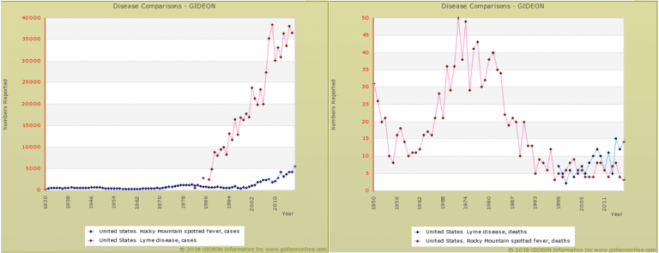
Chart 1 contrasts trends for reported incidence of Lyme disease and Rocky Mountain spotted fever (RMSF). Note that while rates of Lyme disease in 2016 are 15-fold those reported in 1987, those of RMSF increased by a factor of seven. The number of fatal cases for both diseases have remained similar in recent years (i.e., the relative case-fatality rate of Lyme disease has decreased)

LymeSF-768x295

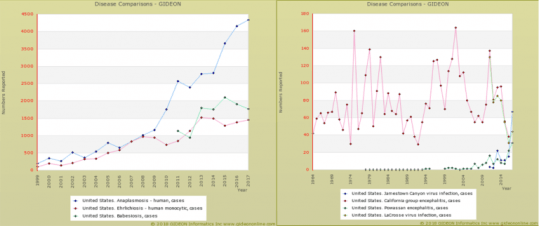
Chart 2 summarizes incidence data for a variety of tick-borne and mosquito-borne infections. Note that rates of Ehrlichiosis, Anaplasmosis, Babesiosis, Jamestown Canyon virus infection and Powassan encephalitis have increased since the year 2000. The incidence of LaCrosse encephalitis has decreased, while that of California encephalitis is largely unchanged.

MiscArbo-768x322

Charts 3 and 4 demonstrate that incidence and reported deaths for Western equine encephalitis, Eastern equine encephalitis, St. Louis encephalitis and West Nile fever have changed little in recent years.

Enceph-768x296

References:

Berger S. Infectious Diseases of the United States, 2018. 1,254 pages, 510 graphs, 16,672 references. Gideon e-books, https://www.gideononline.com/ebooks/country/infectious-diseases-of-the-united-states/
Gideon e-Gideon multi-graph tool, https://www.gideononline.com/cases/multi-graphs/

Rheumatological Presentation of Bartonella Koehlerae & Henselae: A Case Report – Chiropractors Please Read!

https://journals.lww.com/mdjournal/Fulltext/2018/04270/Rheumatological_presentation_of_Bartonella.32.aspx

Rheumatological presentation of Bartonella koehlerae and Bartonella henselae bacteremias: A case report

Mozayeni, Bobak, Robert, MDa; Maggi, Ricardo, Guillermo, PhDb; Bradley, Julie, Meredith, BSb; Breitschwerdt, Edward, Bealmear, DVMb,*

Medicine: April 2018 – Volume 97 – Issue 17 – p e0465
doi: 10.1097/MD.0000000000010465
Research Article: Clinical Case Report

Abstract

Introduction: Systemic Bartonella spp. infections are being increasingly reported in association with complex medical presentations. Individuals with frequent arthropod exposures or animal contact appear to be at risk for acquiring long standing infections with Bartonella spp.

Case report: This case report describes infections with Bartonella koehlerae and Bartonella henselae in a female veterinarian whose symptoms were predominantly rheumatologic in nature. Infection was confirmed by serology, polymerase chain reaction (PCR), enrichment blood culture, and DNA sequencing of amplified B koehlerae and B henselae DNA. Long-term medical management with antibiotics was required to achieve elimination of these infections and was accompanied by resolution of the patient’s symptoms. Interestingly, the patient experienced substantial improvement in the acquired joint hypermobility mimicking Ehlers–Danlos Syndrome (EDS) type III.

Conclusion: To facilitate early and directed medical interventions, systemic bartonellosis should potentially be considered as a differential diagnosis in patients with incalcitrant rheumatological symptoms and frequent arthropod exposures or extensive animal contact.

____________

**Comment**

Bartonella isn’t even on most GP’s radars regarding tick borne illness, and in fact many deny ticks can even transmit it, yet here we see that those with arthropod exposure and/or animal contact need to consider it.  Isn’t that just about everyone under the sun?

You need to know this for yourself, friends and family.  Educate the doctors!

This poor female veterinarian was put on clindamycin & rifampin but had to discontinue after becoming pregnant.  She had a thousand symptoms:  axillary lymphadenopathy from cat scratch disease (CSD) at 12 years of age, a tibial sesamoid bone fracture, plantar fasciitis, generalized muscle/joint pain, muscle weakness, headaches, tingling, and fatigue, cervical lymph node enlargement, extremity edema, ligamentous laxity, tenosynovitis, shoulder and elbow subluxations, elbow joint crepitus, progressively worsening joint hypermobility (Beighton score 7/9), multiple joint subluxations daily, and breast cysts, meeting criteria for benign classification.

Please note the joint popping with each articulation and continual joint subluxation issue.  

Chiropractors need to be told about this.  Please educate!  Send them this article.

I too had this bizarre popping of the joints with a lot of instability in the knees.  Treatment completely ameliorated this issue so treatment is primo important.

For more on Bartonella:  https://madisonarealymesupportgroup.com/2016/01/03/bartonella-treatment/

https://madisonarealymesupportgroup.com/2018/05/07/fox-news-bartonella-is-the-new-lyme-disease/  (Tons more links on Bart after this article)