Archive for the ‘research’ Category

Bartonella Found in Dogs After Infection With Rickettsia

https://www.ncbi.nlm.nih.gov/pubmed/31891215/

2019 Dec 31. doi: 10.1111/jvim.15675. [Epub ahead of print]

Detection of Bartonella spp. in dogs after infection with Rickettsia rickettsii.

Abstract

BACKGROUND:

Dynamics of infection by Bartonella and Rickettsia species, which are epidemiologically associated in dogs, have not been explored in a controlled setting.

OBJECTIVES:

Describe an outbreak investigation of occult Bartonella spp. infection among a group of dogs, discovered after experimentally induced Rickettsia rickettsii (Rr) infection.

ANIMALS:

Six apparently healthy purpose-bred Beagles obtained from a commercial vendor.

METHODS:

Retrospective and prospective study. Dogs were serially tested for Bartonella spp. and Rr using serology, culture, and PCR, over 3 study phases: 3 months before inoculation with Rr (retrospective), 6 weeks after inoculation with Rr (retrospective), and 8 months of follow-up (prospective).

RESULTS:

Before Rr infection, 1 dog was Bartonella henselae (Bh) immunofluorescent antibody assay (IFA) seroreactive and 1 was Rickettsia spp. IFA seroreactive. After inoculation with Rr, all dogs developed mild Rocky Mountain spotted fever compatible with low-dose Rr infection, seroconverted to Rickettsia spp. within 4-11 days, and recovered within 1 week. When 1 dog developed ear tip vasculitis with intra-lesional Bh, an investigation of Bartonella spp. infection was undertaken. All dogs had seroconverted to 1-3 Bartonella spp. between 7 and 18 days after Rr inoculation. Between 4 and 8 months after Rr inoculation, Bh DNA was amplified from multiple tissues from 2 dogs, and Bartonella vinsonii subsp. berkhoffii (Bvb) DNA was amplified from 4 of 5 dogs’ oral swabs.

CONCLUSIONS AND CLINICAL IMPORTANCE:

Vector-borne disease exposure was demonstrated in research dogs from a commercial vendor. Despite limitations, our results support the possibilities of recrudescence (reappearance) of chronic subclinical Bartonella spp. infection after Rr infection and horizontal direct-contact transmission between dogs.

_________________

**Comment**

Bartonella isn’t even on most GP’s radar, yet patients with tick-borne illness often have it.  This dog study shows how Bartonella can be chronic, subclinical, and reactivated by other pathogens.  Subclinical can mean a few things – either the patient appears asymptomatic (without symptoms) or it isn’t picked up on testing or both.

This issue highlights an important field of study that’s begging to be done.

Does a tick bite lower the immune system so that what was a subclinical issue now triggers an active infection?  It makes sense that a tick bite would do this, as vaccines have been shown to do this. Vaccines are designed to lower the immune system so the body mounts an immune response and creates antibodies to whatever is in the vaccine.

Dr. Burrascano, a highly experienced Lyme literate doctor, found that multiple tick bites caused greater disease severity:  https://madisonarealymesupportgroup.com/2019/02/22/why-mainstream-lyme-msids-research-remains-in-the-dark-ages/

Others have found that vaccines have reactivated dormant infections:  https://madisonarealymesupportgroup.com/2016/04/24/gardasil-and-bartonella/

Excerpt:

There is further damning evidence that Gardasil can produce life-threatening reactions in those who have been close to a cat, fleas, or ticks, since many of these animals are infected with Bartonella, Babesia, or Lyme (borrelia). Also, since many MSIDS patients (multi systemic infectious disease syndrome) also struggle with viruses such as Mono or active EBV, a cytokine storm can resultwith mucus being over manufactured in lungs and airways and well as wide-spread inflammation.

Asymptomatic girls after receiving Gardasil activated dormant Bartonella which was confirmed by testing.

https://madisonarealymesupportgroup.com/2017/12/02/scottish-doctor-gives-insight-on-lyme-msids/

Excerpt:

He has started treating Lyme Borreliosis patients 20 years ago in the USA and during the last 5 years in Ireland. He has also successfully treated a number of young women who fell ill after their HPV vaccination, which seems to have stimulated a latent Lyme infection to reactivate.

Here, we clearly see that vaccines caused active infection in previously asymptomatic patients.  It makes complete logical sense that a tick bite would do the same, yet mainstream medicine hasn’t a clue and continues to treat this as a simple disease requiring 21 days of doxycycline.

There are pressing answers needed by doctors and patients yet current research seems hell-bent on focusing on climate change.

More climate data will not help patients or doctors one iota.

Russian Journals Retract More Than 800 Papers After ‘Bombshell’ Investigation

https://www.sciencemag.org/news/2020/01/russian-journals-retract-more-800-papers-after-bombshell-investigation

The Russian Academy of Sciences is trying to improve ethical standards in publishing.  ISTOCK.COM/MORDOLFF

Russian journals retract more than 800 papers after ‘bombshell’ investigation

___________________

**Comment**

I assure you, this is happening in the U.S. as well. In fact, I recall a highly unethical article in the MMWR intended to frighten doctors from using IV antibiotics for Lyme patients:  https://madisonarealymesupportgroup.com/2017/06/21/ilads-rebuttal-to-mmwr-article/

Excerpt:

According to Dorothy Leland of Lymedisease.org, the lead author, CDC’s Christina Nelson, essentially trolled for case studies to support her pre-determined conclusions by contacting the Infectious Disease Association of California, and possibly other states, asking doctors to provide examples of misdiagnosed people with chronic Lyme and/or had adverse effects due to treatment of chronic Lyme.  The fact she could only conjure up 5 caseswhen there are nearly 400,000 new cases of LD each year.

She even dangled a carrot by giving them co-authorship.  https://www.lymedisease.org/touchedbylyme-cdc-ignores-ethics/

So right here, we have a perfect example of people being given co-authorship and all they did was provide biased examples of misdiagnosed people with chronic Lyme and/or had adverse effects due to treatment of chronic Lyme.

This type of biased research is rife with Lyme/MSIDS and must stop.

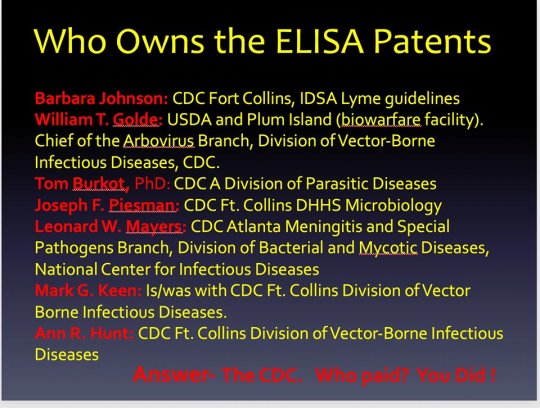
According to investigative journalist Mary Beth Pfeiffer, research on Lyme/MSIDS is owned by a Cabal:  https://madisonarealymesupportgroup.com/2017/01/13/lyme-science-owned-by-good-ol-boys/

And many of these folks have patents on everything from test kits to vaccines:

https://madisonarealymesupportgroup.com/2019/06/28/who-owns-the-elisa-patents/

ConflictReport

Another glaring issue in the research world is the continuing fixation on the acute phase of the disease with perhaps up to 60% of patients struggle with chronic illness:  https://madisonarealymesupportgroup.com/2019/02/25/medical-stalemate-what-causes-continuing-symptoms-after-lyme-treatment/, as well as the continuing fixation on the moniker of climate change when research has shown ticks are oblivious to weather:  https://madisonarealymesupportgroup.com/2018/11/07/ticks-on-the-move-due-to-migrating-birds-and-photoperiod-not-climate-change/

There are many, many issues that need serious study yet the research world refuses to touch them and continues to do biased work with a preconceived outcome to the demise of extremely sick patients.


Vitamin D Increases Protection Against Infection, New Model Suggests

https://medicalxpress.com/news/2019-12-vitamin-d-infection.html

Vitamin D increases protection against infection, new model suggests

Vitamin D increases protection against infection, new model suggests

Oregon State University researchers have led the development of a new model for studying vitamin D’s role in infection prevention, and tests using the model suggest that vitamin D treatment can dramatically reduce the number of disease-causing bacteria in skin wounds.

In addition to shedding light on potential, the study is important because it established a new way to probe the mechanisms through which D regulates an important antimicrobial peptide in the body.

Findings were published in the Journal of Steroid Biochemistry and Molecular Biology.

Vitamin D, which is fat-soluble and present in very few foods—including the flesh of fatty fish, beef liver, cheese and egg yolks—promotes calcium absorption in the gut and is needed for bone growth. Vitamin D, manufactured by the body when triggered by sunlight, is also important for , neuromuscular function, and reduction of inflammation.

OSU scientist Adrian Gombart and collaborators have been probing the vitamin’s role in combating infection, with past studies involving loading wound dressings and sutures with vitamin D.

The current study examines the bioactive form of vitamin D’s role in promoting the body’s production of the cathelicidin antimicrobial peptide, typically abbreviated to CAMP. A peptide is a compound consisting of two or more amino acids linked in a chain, and CAMP is made by and cells that provide a barrier against infection, such as skin and gut cells.

The gene that codes for CAMP is present in humans and other primates. Other mammals including mice have a similar gene, Camp, but vitamin D does not trigger it.

To study how vitamin D and CAMP work together to help thwart infection, Gombart and his research team developed a line of mice that carry the CAMP gene but not Camp. They bred mice engineered to carry human CAMP to mice with their Camp gene knocked out, resulting in mice with an antimicrobial peptide gene regulated by the bioactive form of vitamin D.

The scientists believe the novel model will be useful as research into vitamin D-induced expression of CAMP progresses, involving diseases caused by microorganisms and also conditions that are “non-pathogenic,” such as .

In this study, researchers showed that the with the human CAMP gene had increased resistance to gut infections, and that staph infections on their skin could be successfully treated with the bioactive form of the vitamin.

“Vitamin D3 regulates the expression of the CAMP, and Staphylococcus aureus is an important human pathogen that causes skin infections,” said Gombart, professor of biochemistry and biophysics in OSU’s College of Science and a principal investigator at the university’s Linus Pauling Institute. “With our mouse model, we showed that treating a skin wound infected with S. aureus with the bioactive form of vitamin D significantly reduced the number of bacteria in the wound.”

The finding, Gombart said, suggests vitamin D can be used to increase protection against infection via increased CAMP levels.

Lyme Disease Prevalence: Does Sex Matter?

https://www.lymedisease.org/lyme-disease-prevalence-gender-bias/

Gender bias is now a widely recognized problem in research. Sometimes this happens because women haven’t been studied in the first place. Even when they have been included in the research, their results may not be analyzed separately from those of men. Because of this, we don’t know much about how women differ from men in how they contract a disease, are diagnosed, or respond to treatment.

Is this an issue in Lyme disease? Are women more likely to get Lyme disease, more difficult to diagnose, or more prone to treatment failure? We decided to launch a research study using data from the MyLymeData patient registry. To kick off the study, we asked Dr. Raphael Stricker to explain how males and females with Lyme disease might differ. His video presentation is included below.

Lyme Disease Gender Differences

Dr. Stricker identified four major areas in Lyme disease where males and females are not alike:

  • Women may attract more ticks and have more atypical Lyme rashes than men (Josek 2019).
  • Commercial two-tier Lyme testing favors men over women, because men have more positive ELISA tests and more positive Western blots (Feder 1992, Rebman 2015, Schwarzwalder 2010).
  • Women have an exaggerated response to Borrelia infection, with more inflammatory and inhibitory cytokines than men. This may promote the evolution of chronic Lyme disease. (Jarefors 2006).
  • Women may have a higher treatment failure rate.

Lyme Tests Are Biased To Detect More Males

The CDC Western blot criteria requires that 5 of 10 bands react for a lab test to be considered positive. A study by Feder, showed that men tend to have 6 positive bands, while women have only 4 positive bands. These women will not test positive for Lyme disease or receive the timely diagnosis and treatment needed to get well (Stricker, Johnson 2009).

Lyme Disease Prevalence — Almost Twice As Many Females As Males

According to the CDC, most reported surveillance cases are male—58% males vs 42% females. The CDC statistics also show a bimodal distribution of Lyme disease — with children and adults over 50 reporting the most cases. Both of these assumptions have recently been called into question by other big data studies.

For example, FAIR Health, one of the largest insurance claims data bases, recently released a report on Lyme disease that shows more insurance claim lines with Lyme disease diagnoses were submitted for females than males and females do not have a bimodal age distribution. In fact, between the ages of 23-50, there were almost twice as many females as males with Lyme disease. (FAIR Health 2019).

Lyme Disease Prevalence - for some ages (23-50), there were almost twice as many females as males with Lyme disease

Atypical Presentation of Lyme Neuroborreliosis Related Meningitis & Radiculitis

https://www.ncbi.nlm.nih.gov/pubmed/31871602/

2019 Dec 2;11(4):8318. doi: 10.4081/ni.2019.8318. eCollection 2019 Nov 29.

Atypical presentation of Lyme neuroborreliosis related meningitis and radiculitis.

Abstract

Lyme disease related central and peripheral nervous system manifestations can occur in isolation or together. Radiculitis or inflammation of the nerve root can be seen 3-5% of the time in acute neuroborreliosis affecting the PNS with a typical presentation and meningitis affecting the CNS is usually seen 1% of the time. The appropriate diagnosis and management of neuroborelliosis can be challenging and require meticulous medical approaches. Herein we present a unique case of Lyme disease with neurologic manifestations including both radiculitis and meningitis due to its atypical and challenging clinical presentation and management with updated literature review.

_______________

**Comment**

I assure you, Meningitis and Radiculitis are NOT atypical with Lyme. The problem is many cases just do not get into the literature for a variety of reasons. Again, to get into research studies they often mandate an EM rash and a positive on testing, which is like winning the lottery.

https://madisonarealymesupportgroup.com/2017/09/06/spinal-meningitis-from-tick-bite/

Meningitis is an inflammation (swelling) of the protective membranes covering the brain and spinal cord. A bacterial (such as Lyme) or viral infection of the fluid surrounding the brain and spinal cord usually causes the swelling. However, injuries, cancer, certain drugs, and other types of infections also can cause meningitis.  https://www.cdc.gov/meningitis/index.html  This link also states that parasites, fungus, and amoebas can cause it (all of which can play a part in tick-borne illness).

Radiculitis may occur with Lyme disease as infection causes a localized inflammatory reaction in the root of a nerve or somewhere along the nerve itself.  https://lymediseaseguide.net/lyme-disease-neuropathy-prognosis-treatment

Ironically, this 2017 states both can be presentations of Lyme:  https://n.neurology.org/content/88/16_Supplement/P1.311

Excerpt:  Classic symptoms of Lyme neuroborreliosis include radiculoneuritis, cranial nerve abnormalities, and meningitis. Without a higher clinical suspicion for Lyme disease or other concomitant signs or symptoms, the diagnosis can be easily missed…..Lyme disease is well-known to have symptoms of radiculitis and should be considered in the assessment of cervical pain. A typical early syndrome due to neuroborreliosis has been characterized as a triad of the symptoms mentioned above including radicular pain, cranial or peripheral paresis, and lymphocytic meningitis and is called “Bannwarths syndrome” (Bannwarth, 1941).

And here we see a cluster of Bannwarth cases right here in Wisconsin and Minnesota:  https://madisonarealymesupportgroup.com/2018/02/07/cluster-of-lyme-cases-manifesting-as-bannwarth-syndrome/