Archive for the ‘research’ Category

Potential Treatment For Lyme Disease Kills Bacteria That May Cause Lingering Symptoms, Study Finds (In a Petri Dish & Mice)

http://med.stanford.edu/news/all-news/2020/03/potential-treatment-for-lingering-lyme-disease.html

Potential treatment for Lyme disease kills bacteria that may cause lingering symptoms, study finds

Screening thousands of drugs, Stanford scientists determined that in mice, azlocillin, an antibiotic approved by the Food and Drug Administration, eliminated the bacteria that causes Lyme disease.

By TRACIE WHITE, a science writer in the Office of Communications. Email her at tracie.white@stanford.e

MAR 12, 2020

For decades, the routine treatment for Lyme disease has been standard antibiotics, which usually kill off the infection. But for up to 20% of people with the tick-borne illness, the antibiotics don’t work, and lingering symptoms of muscle pain, fatigue and cognitive impairment can continue for years — sometimes indefinitely.

A new Stanford Medicine study in lab dishes and mice provides evidence that the drug azlocillin completely kills off the disease-causing bacteria Borrelia burgdorferi at the onset of the illness. The study suggests it could also be effective for treating patients infected with drug-tolerant bacteria that may cause lingering symptoms.

“This compound is just amazing,” said Jayakumar Rajadas, PhD, assistant professor of medicine and director of the Biomaterials and Advanced Drug Delivery Laboratory at the Stanford School of Medicine. “It clears the infection without a lot of side effects. We are hoping to repurpose it as an oral treatment for Lyme disease.” Rajadas is the senior author of the study, which was published online March 2 in Scientific Reports. The lead author is research associate Venkata Raveendra Pothineni, PhD.

“We have been screening potential drugs for six years,” Pothineni said. “We’ve screened almost 8,000 chemical compounds. We have tested 50 molecules in the dish. The most effective and safest molecules were tested in animal models. Along the way, I’ve met many people suffering with this horrible, lingering disease. Our main goal is to find the best compound for treating patients and stop this disease.”

Hunting for alternative drug

Frustrated by the lack of treatment options for Lyme disease patients with lingering symptoms, Rajadas and his team began hunting for a better alternative in 2011. In 2016, they published a study in Drug Design, Development and Therapy that listed 20 chemical compounds, from about 4,000, that were most effective at killing the infection in mice. All 20 had been approved by the Food and Drug Administration for various uses. One, for instance, is used to treat alcohol abuse disorder.


In this most recent study, azlocillin, one of the top-20 contenders, was shown to eclipse a total of 7,450 compounds because it is more effective in killing B. burgdorferi and causes fewer side effects. Lyme disease affects more than 300,000 people annually, according to the Centers for Disease Control and Prevention. It can affect various organs, including the brain, skin, heart, joints and nervous system, and cause heart problems and arthritis if untreated. Symptoms include fever, headaches, chills, and muscle and joint pain.

Traditional antibiotics, such as doxycycline, are effective as an early course of treatment for the infection in the majority of patients, but it remains unclear why these drugs fail to treat 10% to 20% of patients, Rajadas said.

“Some researchers think this may be due to drug-tolerant bacteria living in the body and continuing to cause disease,” said Rajadas, who is also a member of the Lyme Disease Working Group at Stanford. “Others believe it’s an immune disorder caused by bacteria during the first exposure, which causes a perpetual inflammation condition. Whatever the cause, the pain for patients is still very real.”

Azlocillin comes out on top

The drug, which is not on the market, was tested in mouse models of Lyme disease at seven-day, 14-day and 21-day intervals and found to eliminate the infection. For the first time, azlocillinwas also shown to be effective in killing drug-tolerant forms of B. burgdorferi in lab dishes, indicating that it may work as a therapy for lingering symptoms of Lyme disease.

Pothineni and Rajadas have patented the compound for the treatment of Lyme disease and are working with a company to develop an oral form of the drug. Researchers plan to conduct a clinical trial. 

Rajadas is also a professor of bioengineering and therapeutic sciences at the University of California-San Francisco.

Other Stanford co-authors are Hari-Hara S. K. Potula, PhD, senior research scientist; postdoctoral scholars Aditya Ambati, PhD, and Venkata Mallajosyula, PhD; senior research scientist Mohammed Inayathullah, PhD; and intern Mohamed Sohail Ahmed.

A researcher at Loyola College in India also contributed to the work.

The study was funded by the Bay Area Lyme Foundation and Laurel STEM Fund.


Those who go on to experience lingering symptoms are 40-60% of all patients:  https://madisonarealymesupportgroup.com/2019/02/25/medical-stalemate-what-causes-continuing-symptoms-after-lyme-treatment/ We keep being told it’s only 10-20% when that group only includes those diagnosed and treated early.  It doesn’t and shouldn’t included a larger group of 30-40% who are diagnosed and treated late.  Add the two groups and you have up to 60% going on with chronic symptoms.  That’s a big deal and should warrant much more attention than it’s currently getting.
The study mentions –
  • disulfiram:  Excerpt:  An interesting drug candidate identified in the study was the alcohol dehydrogenase inhibitor, disulfiram. Though the drug is used as a treatment of alcohol abuse, recently its anticancer potential has also been discovered. It has been known to make complexes with metal ions and cause the disruption of the proteasome, leading to death of the cancer cells. Similarly, the metabolites of the drug molecule have been known to significantly inhibit the growth of a number of bacterial species, including the biofilm-forming Pseudomonas aeruginosa.62 The drug molecule has a good bioavailability, and it passes the blood–brain barrier to show its effect in the central nervous system. Though most of the studies are concerned to the use of the drug molecule in alcoholism yet, being a safe, FDA-approved molecule, the drug can be repurposed for its antibacterial potential.  Study here:  https://flightpath.bio/wp-content/uploads/2020/02/liegner.pdf
  • azlocillin and cefataxime:   Excerpt:  As we observe that azlocillin sodium and cefotaxime acid show low MIC values, we studied time kill studies to determine the rate of antimicrobial activity. In our observation, both azlocillin sodium and cefotaxime acid reduced Borrelia no 3-log10-unit (99.9%) between 48 hours and 72 hours at concentrations 2.5 μM and 5 μM, respectively.  Study here:  https://flightpath.bio/wp-content/uploads/2020/03/s41598-020-59600-4.pdf
Azlocillin is currently only available overseas and in IV form but a company called Flightpath biosciences https://flightpath.bio/pipeline/ is working on an oral formulation and says it has demonstrated in vivo efficacy in mice. This could be a good alternative to Disulfiram as it doesn’t carry some of the risks associated with DSF and doesn’t require a whole lifestyle change.
From their website:

Azlocillin was approved as Azlin® by the FDA on September 3rd, 1982 as a semisynthetic broad spectrum penicillin antibiotic to treat Pseudomonas aeruginosa via intravenous administration. Commercially, the drug was safe and well tolerated and had a limited side effect profile, with warnings and contraindications related only to a patient history of penicillin sensitivities.

In laboratory plate experiments, our scientific team demonstrated that azlocillin significantly inhibited the growth of drug-tolerant Borrelia burgdorferi (Bb) bacteria in a manner far better than doxycycline (the standard of care).

Azlocillin also reduced Lyme disease related inflammation in mice infected with Bb for seven days, compared to the saline control, telismartin, and doxycycline. Upon completion of additional pharmacokinetic and efficacy studies in animals at Tulane University, we hope to advance FP-101 into clinical trials in acute and PTLDS indications in the near future.  https://flightpath.bio/pipeline/

Almost Half of Deer Ticks Carry Lyme Disease: New Study

https://www.pennlive.com/life/2020/03/almost-half-of-deer-ticks-carry-lyme-disease-new-study.html

Almost half of deer ticks carry Lyme disease: New study

Blacklegged/deer tick

The blacklegged ticks, Ixodes pacificus (depicted here), and I. scapularis, are known vectors for the zoonotic spirochetal bacteria, Borrelia burgdorferi, which is the pathogen responsible for causing Lyme disease. The ticks, inoculated with the bacterium when they bite infected mice, squirrels and other small animals, subsequently pass the pathogens to their human victims when they obtain a blood meal. Here, you are looking at a dorsal view of a female I. pacificus hard tick. (Courtesy of CDC/ James Gathany; William L. Nicholson, Ph.D.)

Nearly half of more than 2,000 deer ticks collected last year for a new study in Connecticut were infected with Lyme disease.

Of 2,068 deer ticks tested at the Center for Vector Biology and Zoonotic Diseases at the Connecticut Agricultural Experiment Station in New Haven, Connecticut, 46 percent carry the Lyme disease pathogen Borrelia burgdorferi.

About 13 percent also carried the human disease-causing pathogen Babesia microti, which causes babesia, a life-threatening infection of the red blood cells in humans.

Researchers found that 9 percent of the adult ticks carried Anaplasma phagocytophilum, which causes anaplasmosis, which is marked by fever, headache, chills and muscle aches; 2 percent carried Borrelia miyamotoi, which cause hard tick relapsing fever, bacterial infection that can cause recurring bouts of fever, headache, muscle and joint aches and nausea; and 1 percent carried Powassan virus, which can cause Powassan encephalitis, which produces symptoms of fever, headache, vomiting and weakness, and can lead to encephalitis) meningitis.

The ticks were gathered in the first year of a new federally funded Connecticut-wide surveillance program for ticks and associated tick-borne diseases.

More than 2,500 ticks were collected throughout spring, summer and fall 2019 from 40 publicly accessible locations in all eight Connecticut counties and screened for five different human disease-causing pathogens.

Deer ticks, also known as black-legged ticks, were the most collected species, at 2,068 adult ticks, followed by American dog tick, at 437; lone star tick, at 3; and Asian longhorned tick, at 2.

All adult female and nymphal deer ticks were tested at CAES for the presence of the five different disease-causing pathogens.

About 15 percent of the nymphs carried Lyme disease, 6 percent carried babesiosis, 5 percent carried anaplasmosis and 2 percent carried hard tick relapsing fever.

The survey was funded by a one-year grant issued from the Centers for Disease Control and Prevention through the Connecticut Department of Public Health and has potential to continue into a multi-year effort to document tick and pathogen abundances statewide to inform the public so appropriate precautions are taken when spending time outdoors.

_________________

**Comment**

So, similarly to CDC 2-tiered testing, “heads you win, tails you lose.” 

A while back I posted the following information about nationwide tick testing results:

Our current research shows that 60% of tick tested are infected with at least one disease causing organism, 38% are co-infected with two or more, 15% carry three or more, and 5% of the ticks tested carry four or more.  https://www.tickcheck.com/statistics

The percentage of Wisconsin ticks being infected, as of 2017:

On average, about 22 percent of deer tick nymphs in Wisconsin have been found to be infected with Borrelia burgdorferi. The infection rate for adults is about twice as high, around 40-45 percent. In some locations, though, researchers have found infection rates as high as 75 percent of the tick population.

The number of deer ticks in specific areas of Wisconsin can vary widely by area, by landscape, and by forest type. Researchers have not found any relationship with the numbers of white-footed mice or white-tailed deer in any given areas.  https://www.wiscontext.org/deer-ticks-wisconsin-and-diseases-they-carry

Russell Labs states the following:

In 2019, we documented established populations of the deer tick in every Wisconsin County except for Dodge and Winnebago. In those two counties, we found a very low number. Any forested locations could be a source of deer ticks and Lyme Disease.  https://wisconsin-ticks.russell.wisc.edu

Waukesha, Dane, and Sauk counties have the highest reported rates of Lyme disease in Wisconsin: https://dhsgis.wi.gov/DHS/EPHTracker/#/map/Lyme%20Disease/lymeIndex/NOTRACT/Cases/lymeCtyIndex1

Please remember, this is only covers Lyme disease statistics. Wisconsin is home to many other diseases spread by ticks and we are a hot spot for Powassan Virus.

Psychiatric Diagnosis Cannot be Given Solely Based Upon the Absence of Physical, Laboratory, or Pathological Findings

https://danielcameronmd.com/lyme-disease-symptoms-not-excessive/

LYME DISEASE PATIENT SYMPTOMS ARE NOT “EXCESSIVE”

Lyme disease is a complex, multisystem illness, which may be misdiagnosed as having a psychological cause, writes Bransfield in his article “Differentiating Psychosomatic, Somatopsychic, Multisystem Illnesses and Medical Uncertainty.”¹

“Historically, there has been a bias in which poorly understood illnesses are often considered to have a psychiatric origin until the pathophysiology is better understood and explained on some other basis.”

Clinicians face great challenges in diagnosing disorders that involve symptoms seen in both general medicine and psychiatry, writes Bransfield. All too often, these patients are labeled as having “excessive” symptoms and given outdated diagnoses (i.e. psychosomatic disorder).

“There is often difficulty differentiating between psychosomatic, somatopsychic, multisystem illness, and different degrees of medical uncertainty,” writes Robert Bransfield, MD, a psychiatrist and professor at Rutgers Robert Wood Johnson Medical School.

The term “excessive” is used in the diagnosis of somatic symptom disorder and is, in fact, listed in the DSM-5 criterion.

“Excessive thoughts, feelings, or behavior related to somatic symptoms, which have been present for at least six months is a criterion for somatic symptom disorder in DSM-5,” Bransfield points out.

Some individuals with Lyme disease could be misdiagnosed with this disorder. Testing is often negative, symptoms may wax and wane, and psychiatric manifestations may accompany physical pains, causing both mental and bodily distress for the patient.

But as Bransfield points out,

“A psychiatric diagnosis cannot be given solely based upon the absence of physical, laboratory, or pathological findings.”

In fact, “Many ‘all in your head’ conditions may be related to the microbiome and the immune system,” he argues.

For instance, Lyme disease is caused by a bacterial infection.

“Some patients with Lyme disease are viewed as having an excessive concern for their symptoms,” writes Bransfield.

Actually, the Infectious Diseases Society of America’s (IDSA) Lyme disease guidelines “dismissed the chronic complaints from Lyme disease as being the ‘aches and pains of daily living.’”

Meanwhile, patients with complex, poorly understood illnesses, such as Lyme disease, chronic fatigue syndrome, fibromyalgia, irritable bowel syndrome, and chronic pain syndrome may be diagnosed with bodily distress disorder or bodily distress syndrome. These diagnoses, writes Bransfield, have not been scientifically validated.

“In the definition of bodily distress syndrome, there is a group of conditions that have little in common other than being distressing to deal with by some physicians,” he writes.

According to Bransfield, bodily distress disorder involves “bodily symptoms that the individual finds distressing and to which excessive attention is directed … and is not alleviated by appropriate clinical examination or investigations and appropriate reassurance.”

Bodily distress disorder symptoms are persistent, last at least several months and involve multiple bodily symptoms that may vary over time, he explains. Sometimes, there is only one symptom, usually pain or fatigue.

“If a previously healthy and active person acquires a debilitating, multisystem condition, with multiple complaints including paralyzing fatigue and pain that adversely impact multiple areas of functioning,” writes Bransfield, “and the evaluating physician has an inadequate knowledge of the illness, takes an inadequate history, performs an inadequate exam, and does not understand the seriousness of symptoms, or fails to use adequate clinical judgment, how can the patient’s response to the physician’s “reassurance” be considered excessive?”

References:
  1. Bransfield RC, Friedman KJ, Differentiating Psychosomatic, Somatopsychic, Multisystem Illnesses and Medical Uncertainty. Healthcare 2019, 7(4), 114.

Many Lyme Disease Cases Go Unreported. A New Model Could Help Change That.

https://blogs.ei.columbia.edu/2020/03/06/lyme-disease-new-model/

Many Lyme Disease Cases Go Unreported. A New Model Could Help Change That.

tick on a blade of grass

The Centers for Disease Control and Prevention receives reports of about 30,000 cases of Lyme disease each year. The real number, according to the agency, is closer to 300,000.

Underreporting affects the ability of public health authorities to assess risk, allocate resources and devise prevention strategies. It also makes early detection very difficult, hampering efforts to treat the condition quickly and effectively.

A new report, published March 3 in the Journal of the American Medical Association, describes a data model developed by researchers from Columbia University and RTI International, a nonprofit research institute, that helps identify areas of the United States where Lyme disease cases may go unreported.

“We believe our analysis can help predict the trajectory of where Lyme disease will spread,” said Maria Pilar Fernandez, a post-doctoral researcher at Columbia and lead author of the study. “Identifying high-risk areas can lead to surveillance in counties and areas where infections are likely to emerge. It also allows authorities to alert physicians and the public, which can lead to early treatment, when it is most effective.”

To develop their model, the researchers analyzed publicly available data, tracking the geographic spread of Lyme disease over nearly two decades. They studied an estimated 500,000 cases of the illness reported to CDC from different counties across the United States between 2000 and 2017.

“We were able to show that about 162 U.S. counties may already have Lyme disease, but they have not yet been reported to the CDC,” said Maria Diuk-Wasser, associate professor in the Department of Ecology, Evolution and Environmental Biology at Columbia and a co-author on the study.

The CDC collects Lyme disease data from state and local health departments, which base the number of cases on notifications from clinicians, hospitals and laboratories. Lyme disease is difficult to diagnose, and accurate case assessment depends on many variables, the researchers said, from provider awareness and testing methods to reporting practices, state budgets and personnel.

Although Lyme disease has been diagnosed in almost every state, most cases reported to the CDC are in the Northeast and upper Midwest. If diagnosed early—a rash commonly appears around the site of the tick bite—the condition can be effectively treated with antibiotics. Longer term infections can produce more serious symptoms, including joint stiffness, brain inflammation and nerve pain.

Models have been created in the past to identify high-risk areas in a few states or regions in the United States, but the new one expands the geographic scope to all areas in the U.S. where the disease is most likely to occur.

“In the future, the model can be expanded,” Fernandez said. “We hope to continue to keep track of the spread and inform authorities about areas where Lyme disease is likely to emerge.”

This research was supported by the US Centers for Disease Control and Prevention and by an Interdisciplinary Predoctoral Fellowship from the Earth Institute, Columbia University.

This story was originally published by Columbia News. 

_________________

**Comment**

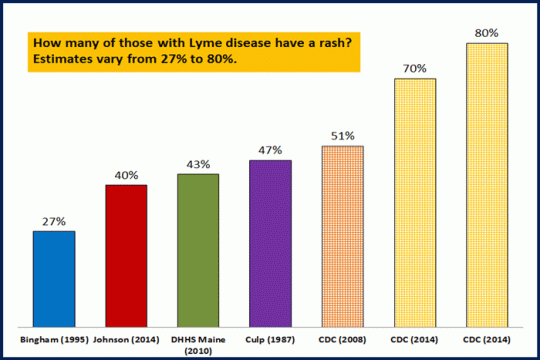
A rash DOES NOT COMMONLY APPEAR.  Depending upon who’s counting the numbers range from 25-80%.  It’s highly variable.  And, the “condition” is not effectively treated with antibiotics.  This narrative needs to be corrected as it continues to be used as if it’s gospel truth.  Antibiotic failure has been reported from the beginning.  The longer you follow the patient, the higher the failure rate.  https://madisonarealymesupportgroup.com/2019/02/22/why-mainstream-lyme-msids-research-remains-in-the-dark-ages/

Unfortunately, it’s an apples and oranges story.  The CDC wants us to believe that antibiotics clear the EM rash, therefore patients are “cured,” when there is absolutely no proof that clearance of the rash equates to clearing a systemic infection.  It’s also important to remember that the rash (if there even is one) will eventually clear on its own without any drugs. 


Grace Period For Ticks – Nope

https://www.lymedisease.org/lyme-sci-tick-attachment-time/

LYME SCI: There’s no grace period for tick bites. Let’s quit implying that there is.