Archive for the ‘Psychological Aspects’ Category

Don’t Feel Bad About Feeling Bad

https://www.psychologytoday.com/us/blog/turning-straw-gold/202002/don-t-feel-bad-about-feeling-bad

Toni Bernhard J.D.

Don’t Feel Bad About Feeling Bad

Blaming yourself for feeling down only makes things worse.

Posted Feb 12, 2020

Public Domain
“On the Green Bench” by Henri Lebasque, 1911
Source: Public Domain


I’ll start with a word that’s becoming increasingly familiar: mindfulness. Mindfulness refers to bringing your attention to your present moment experience, whether it’s something in your environment, or a thought, or an emotion. For me, its greatest value is that it helps me become aware of what’s going on in my mind. That awareness can allow me to see why I’m feeling down and, just knowing that, can start to make me feel better…(See link for article)

________________

**Comment**

This article reminds me of the desperation I had early in Lyme/MSIDS treatment. I too was worried, and I had a good reason: many patients never get well.  I was worried I was going to be one of them.

I remember finding a website written by a patient who gave his experiences and the fact he had fought for his health and won.  On a whim I contacted him.  Surprisingly, he responded back to me.  (I have found that this is typical of Lyme/MSIDS patients as they remember the desperation and are quite helpful).  I’ll never forget what he said:

“Don’t be depressed about being depressed.”

That advice helped me perhaps more than anything else – particularly on the dark, bleak days where hope was hard to find.

I came to realize that self-talk is extremely important.  After all, we believe what we say – so say things that help – not things that tear down and hurt.

If I had a particularly bad day (or week, month, year!) I’d acknowledge it, treat myself with compassion, respect, and kindness, and then tell myself that although this day sucked, there were going to be better days ahead and to just forge ahead with treatment despite my feelings.  Then, just like I’d do with my own children when they were sick, I’d allow myself special things to help me feel better.  This might be watching a favorite movie, or a book that inspired me, or even just taking a nap without guilt.

Funny thing is – these habits have remained even though I’m well.  I no longer feel guilty (ever!) about taking a nap or doing something I enjoy.

There IS a silver lining with Lyme/MSIDS.  One of which is you treat yourself a whole lot better, which has to be a good thing.
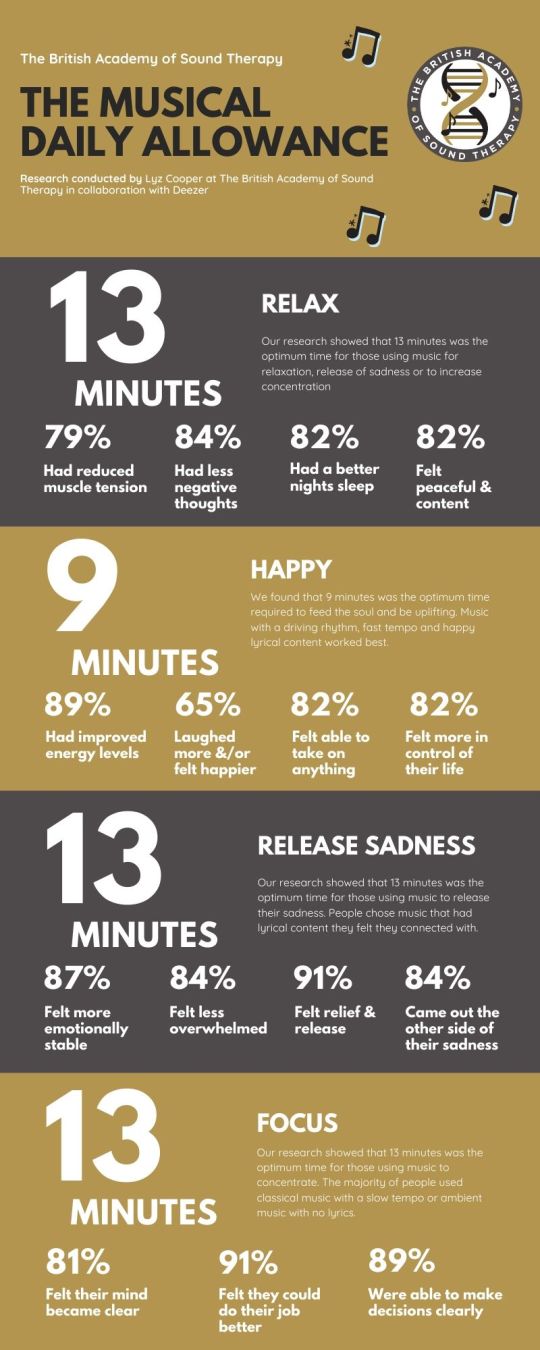
A Daily Musical Allowance For Health?

https://www.britishacademyofsoundtherapy.com/musical-daily-allowance/?

The study in the link above asked 7581 people questions about music. The conclusion states:

There was a general agreement of dosage time across 3 of the 4 domains with 11 minutes being the most common amount of time it took for people to receive the therapeutic benefit from their self- selected music preferences. The only exception was the domain of happiness where the most common length of time for people to become happier after listening to their chosen music was reduced to 5 minutes, suggesting that happy music takes less time to take effect than other music. More studies would need to be undertaken to establish a ‘before’ and ‘after’ mood-state to support these findings. This study revealed many interesting elements of how people use music as medicine.

the-musical-prescription-infographic-BAST-2

For more:  https://madisonarealymesupportgroup.com/2019/07/06/study-finds-listening-to-music-can-help-regulate-mood-during-a-stressful-situation/

https://madisonarealymesupportgroup.com/2019/09/23/top-nine-tips-for-coping-with-social-anxiety/

https://madisonarealymesupportgroup.com/2019/11/30/cope-with-depression-anxiety-when-you-have-lyme/

https://madisonarealymesupportgroup.com/2020/02/09/6-traits-to-look-for-in-a-therapist-when-you-have-chronic-lyme/

New article on “noise pollution”:  https://www.forbes.com/sites/jamiegold/2020/02/25/the-hidden-dangers-of-noise-pollution-at-home/#487060c67504  It’s pretty common for Lyme/MSIDS patients to have sound, smell, and touch sensitivities.  

Woman Tripped 34 Hours on LSD. Said it Cured Pain From Chronic Lyme Disease

https://www.insider.com/woman-who-overdosed-on-lsd-said-it-cured-lyme-disease-2020-2

A woman who tripped for 34 hours on LSD after taking 550 times the normal dose said the drug cured her pain from chronic Lyme disease

psychedelic trip

Photo by Horacio Villalobos – Corbis/Corbis via Getty Images

During the first 12 hours, the woman blacked out for most of it, but remembered vomiting a lot.

  • A woman overdosed, but didn’t die, after consuming 550 times an average dose of the psychedelic drug LSD. She had mistaken it as cocaine and ended up tripping for 34 hours.
  • Following her overdose, the woman microdosed LSD and found it eliminated her chronic pain, a symptom of her Lyme disease.
  • Other psychedelics like DMT and psilocybin also have been shown to manage conditions, like anxiety and depression.  (See link for article)

___________________

**Comment**

Case report found here:  https://www.jsad.com/doi/10.15288/jsad.2020.81.115

Important excerpt:

She’d stopped taking morphine for five days after her LSD experience, and then her chronic pain returned, so she decided to take the morphine again but at a lower dose, and to also microdose LSD, every three days. A microdose of LSD is about a quarter of the typical 10-milligram dose and doesn’t cause a hallucinogenic effect.

Three years later, the woman was able to completely stop using morphine to manage her pain and said she had no withdrawal symptoms.

The pain Lyme/MSIDS can cause is of a magnitude that makes life unbearable.

I remember the story of a woman with Lyme who went into the garage, took a hammer and broke all her fingers on one hand to get her mind off her shoulder pain.

WKOW Updates Lyme Story: Lyme Disease Spread Sexually?

https://wkow.com/2020/02/14/researchers-move-forward-with-shot-to-prevent-lyme-disease/ Interview here

I was pleased to see WKOW updated their story on Lyme disease. The initial interview focused upon the new Lyme vaccine, but they recently updated the website to include new details including the possibility of sexual transmission, the high costs of treatment, and other cognitive and psychological aspects of the disease mainstream medicine does not currently acknowledge.

Kudos to WKOW for spreading the word.

For more on sexual and congenital transmission:  https://madisonarealymesupportgroup.com/2019/05/11/lyme-found-in-genital-lesion-sexual-transmission-studies-screaming-to-be-done/

https://madisonarealymesupportgroup.com/2020/02/01/cdc-website-updated-today-possibility-of-mother-to-fetus-transmission-of-lyme-disease/

https://madisonarealymesupportgroup.com/2017/02/24/pcos-lyme-my-story/

https://madisonarealymesupportgroup.com/2018/06/19/33-years-of-documentation-of-maternal-child-transmission-of-lyme-disease-and-congenital-lyme-borreliosis-a-review/

https://madisonarealymesupportgroup.com/2018/11/11/gestational-lyme-other-tick-borne-diseases-dr-jones/

https://madisonarealymesupportgroup.com/2019/12/26/borrelia-crocidurae-in-vaginal-swab-after-miscarriage/

https://madisonarealymesupportgroup.com/2019/04/02/transmission-of-lyme-disease-lida-mattman-phd/

Hugging it Out: How Physical Connection Helps Us Heal

https://globallymealliance.org/hugging-it-out-how-physical-connection-helps-us-heal/

by Jennifer Crystal

RESEARCH SHOWS THAT HUGGING IS GOOD FOR OUR HEALTH

I remember vividly a scene from the medical show “Grey’s Anatomy” that aired years ago. All that happened in the scene was that a doctor grew overwhelmed and cried, eventually having a panic attack. Slowly, two other doctors embraced her from either side and held her tight. When a fourth doctor came in and asked what was going on, one said, “We’re hugging it out.”

That scene struck me because I saw how the simple act of human touch quelled a serious physiological reaction to emotional stress. Within minutes, the upset doctor’s sobs subsided and her breathing slowed. The original problem that had set off her distress wasn’t gone but her fight-or-flight reaction was.

I have thought of that scene many times during my decades-long journey with chronic illness. So much of that time was spent alone. Patients battling tick-borne or other long-term illnesses are often bedridden with little to occupy their minds besides worry and pain. They may see family members or roommates in the evenings or on weekends, but the endless days of lying in bed can get downright lonely. There were so many times when I thought, I just want a hug.

And there were many times when I got one. When I was convalescing at her home, my mom gave me a hug every day when she came home from work. Friends hugged me when they came to visit. They sent me funny emails and left me voicemails that made me laugh. I sometimes felt hugged even when I didn’t have physical connection with someone.

But I also often felt desperately alone. Lyme disease can be especially isolating because on top of the loneliness that comes from being bedridden, patients often feel misunderstood or invalidated by the people closest to them and by medical professionals. One night I woke from a terrible nightmare with my arms wrapped around myself in a self-hug.

As the “Grey’s Anatomy” scene displayed, physical touch is important for everyone, not just for the infirm. Research shows that hugging is good for our health. In an NBC news report, Michael Murphy, Ph.D., a research associate at the Laboratory for the Study of Stress, Immunity, and Disease in the Department of Psychology at Carnegie Mellon University said, “…touch deactivates the part of the brain that responds to threats, and in turn, fewer hormones are released to signal a stress response, and your cardiovascular system experiences less stress.” Human touch can also stimulate the feel-good hormone oxytocin.[i]

Moreover, touch can help our physical wellness, too. A study by Dr. Murphy’s colleagues, also mentioned in the NBC news report, found that “those who felt socially supported and were hugged more often also experienced less-severe signs of illness.” Physical touch can also boost immunity.

Family therapist Virginia Satir is known for her quote, “We need 4 hugs a day for survival. We need 8 hugs a day for maintenance. We need 12 hugs a day for growth.”  That’s a tall order for a bedridden patient, but there are still ways to get the connection we need. We can ask for or initiate hugs with people with whom we are close. Caregivers and friends can think about giving more hugs to their loved ones who are ill (the benefits go both ways!). The touch aspects of therapies like integrative manual therapy or light massage can also be soothing. And for those who aren’t comfortable with physical touch or who live alone, simply connecting with others—whether it’s through social media, email, an online or in-person support group—can simulate the benefits of hugging and make you feel less alone.

Hugging won’t cure illness, or emotional stress, or the woes of the world, but it can lay the groundwork for subsequent healing. In our technological age, it would behoove us to follow the advice of the old song: “Reach out and touch someone.”

1 https://www.nbcnews.com/better/pop-culture/health-benefits-hugging-ncna920751


jennifer crystal_2

Opinions expressed by contributors are their own.

Jennifer Crystal is a writer and educator in Boston. Her memoir about her medical journey is forthcoming. Contact her at lymewarriorjennifercrystal@gmail.com.


___________________

For more:  https://madisonarealymesupportgroup.com/2020/02/20/lyme-mental-health-discussion/

https://madisonarealymesupportgroup.com/2020/01/03/lyme-mind-podcast-dr-leigner-dr-horowitz/

https://madisonarealymesupportgroup.com/2019/09/17/ignoring-psychiatric-lyme-disease-at-our-peril/

https://madisonarealymesupportgroup.com/2018/06/04/ld-diagnosis-took-forever-because-of-mental-health-stigma/