Archive for the ‘Lyme’ Category

The Complex Story of the Lyme Disease Vaccine

http://www.lymedisease.org/the-complex-story-of-lyme-vaccine/

The complex story of the Lyme disease vaccine

By Dorothy Kupcha Leland
Aug. 25, 2023

Bloomberg Businessweek, one of the top business publications in the US, this week took a look at the question of the Lyme disease vaccine.

Currently dubbed VLA15, the vaccine is being developed by Pfizer, Inc, in partnership with French drug maker Valneva SE. In the final phase of clinical trials, it is expected to be available to the public in 2026.

Bloomberg published the article this week under the following headline:
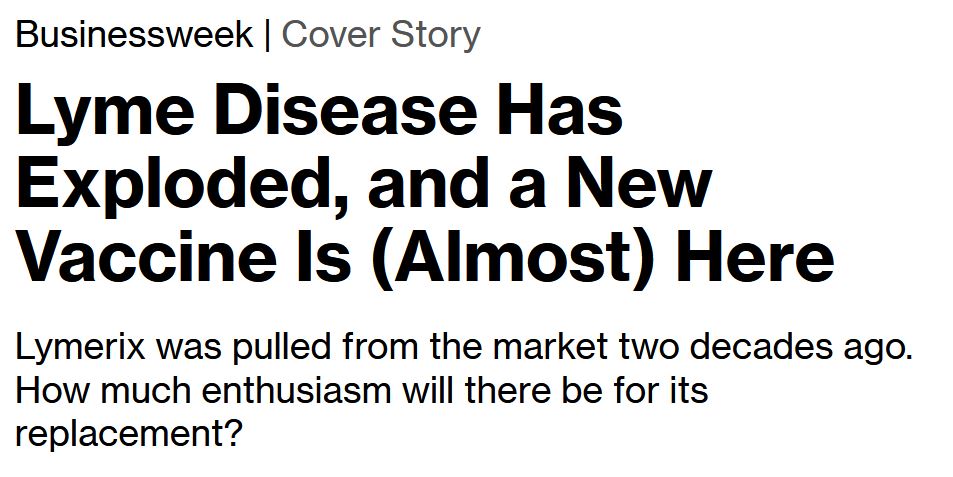
The article gives background on Lymerix, the failed Lyme disease vaccine from 20 years ago. But it doesn’t paint an accurate picture of why the Lyme community continues to view the question of a Lyme vaccine with skepticism.

For that side of the story, I suggest you read the following blogs we posted five years ago. Our concerns haven’t changed.

Stricker: Lyme vaccine failed because safety was ignored

“Powerful” patients axed Lyme vaccine? Baloney!

Important background on Lyme vaccine controversy

As Dr. Raphael Stricker stated in the above-referenced article:

“The Lymerix vaccine failed in large part because valid safety concerns were ignored, and future variations of Lymerix that whitewash these concerns risk the same negative outcome.”

Last week, Lyme Disease Association President Pat Smith told me she had an extensive interview with Kristen Brown, a co-author of the Bloomberg article. Smith said she gave the reporter documents and names of credentialed individuals who would be able to provide information and perspectives on the Lymerix experience, including a private meeting LDA had with the Food and Drug Administration.

However, Smith said, “None of that information appears to be referenced in this article.”

Instead, the article devotes only a few lines to Smith, quoting her as saying: “We are interested in the possibility of a vaccine. The issue is the safety and efficacy.”

That is certainly putting it mildly.

TOUCHED BY LYME is written by Dorothy Kupcha Leland, President of LymeDisease.org. She is co-author of When Your Child Has Lyme Disease: A Parent’s Survival Guide, and of the forthcoming title Finding Resilience: A Teen’s Journey Through Lyme Disease. Contact her at dleland@lymedisease.org.

_________________

**Comment**

Stay tuned for the ongoing saga of the dangerous and ineffective Lyme “vaccine” that gives people Lyme-like symptoms.

I highly recommend Weintraub’s book, “Cure Unknown, Inside the Lyme Epidemic,” as truly very little has changed since it was penned in 2009 (isn’t that sad?).  Weintraub highlights important history and facts every Lyme/MSIDS patient needs to understand.  It’s heavy.  It isn’t fun.  But it’s true.

If you don’t want to tackle a whole book, read Weintraub’s 2001 article which highlights the first Lyme vaccine called “Lymerix,” which maimed people.  Those behind its creation, referred to as The Cabal, of course deflect and deny this and will never in a thousand years admit that many patients suffer with symptoms due to a persistent/chronic infection(s).  It doesn’t fit their vaccine agenda.

More Deaths From Lyme/MSIDS

https://www.atlantajewishtimes.com/obituary-stephanie-maya/

Obituary: Stephanie Maya

Stephanie Maya, 54, died on July 20, after fighting chronic late-stage Lyme disease for 17 years.

Stephanie Maya

Stephanie Maya, 54, died on July 20, after fighting chronic late-stage Lyme disease for 17 years.

Stephanie was born on March 2, 1968, in Philadelphia, Penn.

In 2007, Stephanie contracted Lyme disease, which went misdiagnosed for 5 years before it was finally diagnosed. Stephanie pushed through severe disabling symptoms with her can-do attitude and love for life to continue to enjoy life to its fullest. She will be missed by many.  (See link for article)

________________

**Comment**

Despite having an illustrious eight-year career with the CDC, advising and providing technical assistance and training in developing the Chronic Disease Program in the U.S., this woman succumbed to the very disease that the CDC simply denies the existence of.

https://www.fellerandclark.com/obituary/DrKelly-FranksHenderson

Dr. Kelly Michelle Franks Henderson

April 26, 1973 ~ May 20, 2022

Dr. Kelly Michelle Franks Henderson of Fishers, Indiana (April 26, 1973-May 20, 2022); Kelly Michelle died at Parkview Hospital in Fort Wayne, Indiana, due to complications from a lengthy battle with Lyme disease and multiple co-infections that are too numerous to list. As a result of this illness, Kelly Michelle became an avid advocate for Lyme patients and their treatment, even though she was often too sick to get out of bed, she still found a way to help others. Kelly Michelle had a strong faith in Christ, and it kept her strong through this onerous journey.

(See link for full obituary)

_________________

**Comment**

Despite being a Pharmacist, Master Trainer in the Stanford Chronic Disease Self-Management Program with specialty training in Medication Therapy Management and Pain Management, with critical training an insight into the psycho-social implications of chronic disease, including chronic pain, and being on the Advisory Board to Band Aid Lyne, this highly educated and experienced woman also succumbed to a disease that doesn’t care how smart or how experienced you are.

How many Lyme/MSIDS deaths are unrecognized and uncounted?

For more:

EastEnders Star Suffers From Lyme Disease

https://www.express.co.uk/celebrity-news/1801200/martine-mccutcheon-health-battle-illness

Inside Martine McCutcheon’s brave battle with illness that ‘turns world upside down’

Martine McCutcheon revealed she was hospitalized on her husband’s birthday due to her battle with crippling health conditions which make her life a “living hell”.

EastEnders star Martine McCutcheon struggles with a number of invisible illnesses which sadly left her hospitalised on her husband’s birthday last year. The actress shared her plight on Thursday, explaining that she had been left feeling so dizzy that she could not stand up.

The mum-of-one, 47, was diagnosed with chronic fatigue syndrome (ME) in 2011, a serious and long-term illness that causes extreme tiredness.

She was then diagnosed with Lyme disease, an infectious bacterial infection which is passed on from being bitten by an infected tick. While the condition is easier to treat if diagnosed early, a few people continue to have symptoms like tiredness, aches and loss of energy.

In addition, the Love Actually star also battles fibromyalgia, an incurable condition that causes widespread pain as well as tiredness.  (See link for article)

_______________

**Comment**

Misdiagnosis is a common problem with Lyme/MSIDS patients.  They are bounced from doctor to doctor who are completely in the dark and too afraid to diagnose and treat patients appropriately.  Your best help will come from a Lyme literate doctor.

Healing Chronic Lyme Disease – A Case History

https://medium.com/@daveswallace/healing-chronic-lyme-disease

Healing Chronic Lyme Disease

(Note this article is intended as a case summary, a guide for those newly diagnosed, or family and friends who care enough to help them find a path back to health.)

I acquired Lyme disease in the summer of 2000 while working as a camp counselor in Western Oregon. I removed the tick from my hamstring and later mistook the bullseye for a spider bite, common in my rural upbringing. My only other serious indication of an issue was an infection in my epididymis several weeks later, which was taken care of with a few days of antibiotics. Yet I was never the same afterward. I fatigued easily, fell asleep while reading, had bizarre allergies, and often had body pain. At 18, I just thought I was getting old.

I limped along as best I could. My college and career life was a disappointment compared to my high school promise. Following a long-term relationship with a violent woman, my health collapsed. After two years of testing, I was finally diagnosed in 2012. Initial antibiotic treatments did very little, and even specialist interventions fell short.

I went to work investigating, seeking knowledge and advice while scouring journals for research studies. I then began listening to my body and making life changes. It took four years of work. I have now been symptom-free since 2016, without relapse. Due to my research experience and struggles, I acquired an MS in Organizational Psychology in 2018 and will receive my MA in Clinical Psychology in April 2023. Seven years later, I feel confident in the outcome and the stability of my recovery.

Note that while there may be a significant crossover between our cases, every Lyme infection is unique to the bio/psycho/social context of the individual. I now have an MS in Psychology but I am not a Lyme specialist or doctor. I offer this summary of the experiences and research that led to my recovery in hopes that it may lead to the recovery of others too, whether Lyme disease or other autoimmune conditions.

As concisely as I can, here is what I learned.  (See link for article)

_________________

**Comment**

One of the most thorough articles I’ve read to date with many suggestions that will help many patients.  Again, he is correct in stating that “every Lyme infection is unique,” so always keep an open mind and realize that what helps one patient may not help you.

While his initial antibiotic treatment “did very little,” they sent me to bed where I remained in a fetal position for 3 days straight due to severe a herxheimer reaction; however, I was fortunate to have bypassed mainstream medicine entirely and go to an experienced LLMD who put me on 3-4 things simultaneously.  I do believe this is a key in the puzzle of why some improve on antibiotics and some don’t.  They must be the “right” antibiotics, at the “right” dosage, for the “right” amount of time and this of course also varies for each individual.

For more:

Living Well When You Don’t Feel Well: Overcoming Lyme Disease & Illness

http://  Approx. 18 Min

Living Well When You Don’t Feel Well

Overcoming Lyme Disease & Illness

Joe Trunzo PhD Professor of Psychology

Dr. Trunzo highlights a different way of thinking and coping with diseases (and life), specifically Lyme disease. 

He earned his undergraduate degree in 1993 from Marywood University in Scranton PA and completed his graduate work in 2000 at Drexel University in Philadelphia, PA. He completed his pre-doctoral internship at the University of Vermont and his post-doctoral fellowship at the Centers for Behavioral & Preventive Medicine at Brown University Medical School in Providence, RI. He is a Professor of Psychology and Chair of the Department of Applied Psychology at Bryant University. He is also a licensed, practicing clinical psychologist with expertise in the psychological management of chronic medical illnesses such as cancer and Lyme disease, as well as the treatment of mood and anxiety disorders, especially obsessive compulsive disorder. He serves on several professional committees and belongs to a number of professional organizations. In his spare time, he enjoys being with his family, live music, running, and mountain climbing.

This talk was given at a TEDx event using the TED conference format but independently organized by a local community. Learn more at https://www.ted.com/tedx

_______________

**Comment**

A very sane and logical talk on the Lyme/MSIDS controversy involving three camps of thought, which then moves on into how to develop a mindset that focuses on living the best life you can while sick.  Dr. Trunzo utilizes the mindfulness based, values-oriented behavioral therapy called ACT (Acceptance & Commitment Therapy) to help patients.

He states that by not accepting what patients are feeling and going through, they can trap themselves and create more problems.  I must throw in a personal note here: one of the most helpful things I was ever told early on by another patient who reached the other side was:

“Don’t be depressed about feeling depressed.”

This may be laughingly simple; however, I found that I needed to give myself permission to feel depressed.  Knowing, understanding and accepting the fact I was going to feel miserable and have some really rotten days (or months!) helped me tremendously.  Being chronically/persistently infected with multiple pathogens that work symbiotically and that are in your brain and virtually every organ of your body wreaking havoc, not only affects you physically but emotionally and spiritually.  Add in the fact that mainstream medicine denies this fact entirely and that your friends and family may choose to believe you are a hypochondriac rather than an extremely ill person who needs help, because after-all you “look fine” – and you can become very depressed and isolated indeed, which doesn’t help the healing process at all!

Obviously, the goal here is not to remain sick, but to achieve wellness and health; however, with Lyme/MSIDS that may take years to accomplish, and even then there is a very real potential that facets of your health may never return to the way they were before you became infected.  As with all things in Lymeland, everyone’s journey is unique to them and no two cases look alike.

For more: