Archive for the ‘Lyme’ Category

Doctors Feel the Frustration With Lyme Disease

https://danielcameronmd.com/doctors-feel-the-frustration-with-lyme-disease/

DOCTORS FEEL THE FRUSTRATION WITH LYME DISEASE

In the Canadian Medical Association Journal, author Wendy Glauser describes frustration felt by doctors in Canada regarding Lyme disease.

“People have heard these horrible stories about how Lyme is so awful and you suffer for years and years and nobody knows what’s wrong with you,” says Dr. Michelle Cohen in an interview with Glauser.

Doctors have also shared their frustration in a survey taken by Dr. Lynora Saxinger, an infectious disease specialist and associate professor at the University of Alberta’s medical school.

The survey reported that “30% [of doctors] said they have been pressured to give antibiotics and almost 90% said they didn’t feel they had appropriate educational resources to offer patients.”

“The Association of Medical Microbiology and Infectious Disease (AMMI) in Canada is partnering with the Centre for Effective Practice to develop clinician toolkits to help providers recognize and treat Lyme disease appropriately,” writes Glauser.

However, the proposed toolkit may not resolve doctors’ frustrations. It may simply dismiss chronic manifestations of Lyme disease. “There is an increasing number of people who have bought into the chronic Lyme industry,” states Saxinger.

Mixed messages may continue to cause frustration among doctors. While clinicians are urged to promptly treat early Lyme disease, Dr. Todd Hatchette, president of AMMI seems to recommend otherwise.

“Another common misconception is that Lyme disease snowballs unless treated early,” Hatchette writes, “so it can be difficult to convince patients to wait several weeks to see if symptoms resolve before taking tests.”

Editor’s note: I know from my practice that Lyme disease can be a frustrating illness to treat. There are patients who do well with prompt short-term treatment. Then, there are others, whose symptoms linger and who remain ill.

References:
  1. Glauser W. Combatting Lyme disease myths and the “chronic Lyme industry”. CMAJ. 2019 Oct 7;191(40):E1111-E1112. doi: 10.1503/cmaj.1095806.

________________

**Comment**

The quote by the president of the AMMI shows the lack of appreciation of the severity of this complex illness.  Anyone who recommends waiting several weeks is completely in the dark, uneducated on the organisms, and obviously hasn’t treated many people who suffer with this.  Everyone knows that early treatment makes all the difference.  It is completely illogical to wait and see what happens.

The controversy continues.
Lastly, if you think it’s frustrating being a doctor, try being a patient!


Atypical Presentation of Lyme Neuroborreliosis Related Meningitis & Radiculitis

https://www.ncbi.nlm.nih.gov/pubmed/31871602/

2019 Dec 2;11(4):8318. doi: 10.4081/ni.2019.8318. eCollection 2019 Nov 29.

Atypical presentation of Lyme neuroborreliosis related meningitis and radiculitis.

Abstract

Lyme disease related central and peripheral nervous system manifestations can occur in isolation or together. Radiculitis or inflammation of the nerve root can be seen 3-5% of the time in acute neuroborreliosis affecting the PNS with a typical presentation and meningitis affecting the CNS is usually seen 1% of the time. The appropriate diagnosis and management of neuroborelliosis can be challenging and require meticulous medical approaches. Herein we present a unique case of Lyme disease with neurologic manifestations including both radiculitis and meningitis due to its atypical and challenging clinical presentation and management with updated literature review.

_______________

**Comment**

I assure you, Meningitis and Radiculitis are NOT atypical with Lyme. The problem is many cases just do not get into the literature for a variety of reasons. Again, to get into research studies they often mandate an EM rash and a positive on testing, which is like winning the lottery.

https://madisonarealymesupportgroup.com/2017/09/06/spinal-meningitis-from-tick-bite/

Meningitis is an inflammation (swelling) of the protective membranes covering the brain and spinal cord. A bacterial (such as Lyme) or viral infection of the fluid surrounding the brain and spinal cord usually causes the swelling. However, injuries, cancer, certain drugs, and other types of infections also can cause meningitis.  https://www.cdc.gov/meningitis/index.html  This link also states that parasites, fungus, and amoebas can cause it (all of which can play a part in tick-borne illness).

Radiculitis may occur with Lyme disease as infection causes a localized inflammatory reaction in the root of a nerve or somewhere along the nerve itself.  https://lymediseaseguide.net/lyme-disease-neuropathy-prognosis-treatment

Ironically, this 2017 states both can be presentations of Lyme:  https://n.neurology.org/content/88/16_Supplement/P1.311

Excerpt:  Classic symptoms of Lyme neuroborreliosis include radiculoneuritis, cranial nerve abnormalities, and meningitis. Without a higher clinical suspicion for Lyme disease or other concomitant signs or symptoms, the diagnosis can be easily missed…..Lyme disease is well-known to have symptoms of radiculitis and should be considered in the assessment of cervical pain. A typical early syndrome due to neuroborreliosis has been characterized as a triad of the symptoms mentioned above including radicular pain, cranial or peripheral paresis, and lymphocytic meningitis and is called “Bannwarths syndrome” (Bannwarth, 1941).

And here we see a cluster of Bannwarth cases right here in Wisconsin and Minnesota:  https://madisonarealymesupportgroup.com/2018/02/07/cluster-of-lyme-cases-manifesting-as-bannwarth-syndrome/


2020 Vision for Lyme Warriors

https://globallymealliance.org/2020-vision-for-lyme-warriors/

Woman looking back

by Jennifer Crystal

HERE ARE SOME THINGS I NOW KNOW FOR SURE, THINGS I WISH I’D KNOWN, LOOKING BACK ON MY LYME JOURNEY

As the saying goes, “hindsight is 20/20.” It’s easy for us to look back from the vantage point of experience and say, “I wish I’d done X,” or “If only I could have known Y.” It isn’t always so easy to see those options when we’re living our daily lives, making real-time decisions based on the information we have at the moment.

When I look back across my 20-year health journey, I recall many points of confusion, fear, and desperation. I remember the mixed messages from health professionals. I think back on the skepticism from those who were supposed to help me. I recollect the disbelief in myself, in what my body was telling me. I know so much now that I wish I’d known then. And while I can’t change my past, I hope I can use it to help make another patient’s health journey a little easier.

Here are some things I now know for sure, things I wish I’d known at various crucial points of my own journey:

I really was sick.

When I first developed a rash, and then hypoglycemia, and then a debilitating flu at age 19, I was not going crazy. I was not stressed. I was not run down. I did not need to exercise more. The symptoms were not psychosomatic. I had been bitten by a tick and was sick with real physical illnesses, namely Lyme and two of its co-infections Babesia and Ehrlichia. It would be another eight years until I was properly diagnosed. That delay was so extensive in part because of the disbelief or just plain ignorance of many health professionals. Naturally, I believed them too.

If I had been accurately diagnosed promptly, my whole life would have been different.

I was bitten by a tick in 1997, and perhaps again in 2001 or 2002, but I wasn’t tested for tick-borne diseases until 2005. Testing is faulty now and was even faultier then, so even if I’d been tested for Lyme or co-infections, I might have gotten a false negative and been told I was well.

But I also might have gotten a true positive. If I’d seen a Lyme Literate Medical Doctor (LLMD)—or even known that such a specialist existed then—they might have made a clinical diagnosis right away. I might have taken just three weeks of recommended antibiotics and been fine.

Instead, I developed chronic infections that, 20 years later, are in remission but by no means cured. I went through years of intense antibiotic therapy, including intravenous antibiotics, and I’m still on medications to this day. I don’t live my life with regret, but I would regret it if you were in the same position and didn’t learn from my story. If you discover a tick bite, or have symptoms of tick-borne illness, you don’t have to suffer for years without treatment. You can find a good LLMD in your area and get a head start on your return to wellness.

If a loved one has symptoms and doesn’t know about Lyme disease, or doesn’t know how to find a doctor, offer to go through the process with them. Remember that Lyme patients are often frightened, anxious, and even neurologically impaired. They need real help when it comes to navigating their path.

Lyme Literacy improves over time.

I don’t blame the many health practitioners who missed my case in 1997, because tick-borne disease wasn’t on the radar then. I believe that if I presented now with the same symptoms as I did in 1997, at least one of those practitioners would think about the possibility of tick-borne disease. Thanks to media coverage, increased awareness and education efforts, and, unfortunately, the expanding number of cases, Lyme literacy has greatly improved in the last 20 years. That should give us hope for the future.

Healing is not linear.

It took me a long time to get diagnosed. Therefore it took me a long time to get well. Along the way, there were many bumps in the road, and even some large potholes. Once I was diagnosed, I figured I’d take medicine and slowly get better, as one would from bronchitis or a sinus infection. But that’s not how it works with tick-borne disease. It can take a while for your LLMD to figure out the best treatment protocol for you since each case is unique. You will likely experience a nasty Herxheimer reaction, which means you will feel worse before feeling better. As I discussed in my Gratitude for the Long Game post, the journey through tick-borne disease is an up and down process like a spiraling helix that ultimately stretches towards wellness.

Not everyone will get it.

Lyme patients often spend time and energy they don’t have trying to convince doctors and loved ones that they really are sick. Once they are diagnosed, they may feel a sense of validation, but that doesn’t mean that everyone will immediately understand what they’re going through. I still knew people who didn’t believe me, those who thought my doctor was a quack, those who thought I just needed to “push through it.” These people didn’t understand that Lyme is complicated and comes in myriad forms; they didn’t want to hear about chronic illness and asked, “Aren’t you over that yet?”

At first, I wasted a lot of energy trying to convince these people of the truth. But eventually I realized, I don’t need them to understand. The only people who really need to get it are my doctor and me. I’m focused now on the people in my life who do want to understand, the folks who have offered unconditional support. I stopped worrying about the others. I don’t need their approval.

I came to understand that many of those people were well-intentioned, but were reacting out of fear or ignorance. Some of them did come around. My own family’s understanding of tick-borne illness blossomed alongside my own as they eventually read the books, watched the documentaries, attended the conferences, and accompanied me to doctor’s appointments. So while I have no more time to lavish on the doubters, I do hope that one day they will see the light.

No two cases are alike.

Every case of tick-borne disease is different; that means every treatment protocol is different, too. Patients write all the time to ask me what particular medication I took. But it doesn’t help for me to say which medications I’ve taken. Fact is, I’ve used many different combinations over time but never a single magic cocktail. That’s because what worked for me might not work for you, and vice-versa. It can be easy to think, “Well antibiotic X worked for her in five weeks, so it should work for me too.” Or, “My friend got better from Lyme in one month, so my son should, too.” It’s imperative to remember that each case is unique. Be patient with yourself, or with your loved one, knowing that each body heals at its own pace.

It gets better.

When I was bedridden with exhaustion, migraines, aching joints, and insomnia, I never, ever believed I could have gotten as well as I have. I am heading into the new decade still managing my tick-borne illnesses, but I’m doing it in the context of a full and happy life. Reflecting on my past has given me gratitude, wisdom, and resilience, and those tools will help me see clearly as I step into 2020. May your vision also be clear, and your new year bright!


jennifer crystal_2

Opinions expressed by contributors are their own.

Jennifer Crystal is a writer and educator in Boston. Her memoir about her medical journey is forthcoming. Contact her at lymewarriorjennifercrystal@gmail.com.




A Clinical Diagnostic System For Late-Stage Neuropsychiatric Lyme Borreliosis Based Upon An Analysis of 100 Patients

https://www.mdpi.com/2227-9032/8/1/13

A Clinical Diagnostic System for Late-Stage Neuropsychiatric Lyme Borreliosis Based upon an Analysis of 100 Patients

Healthcare 2020, 8(1), 13; https://doi.org/10.3390/healthcare8010013 (registering DOI)
Received: 8 December 2019 / Revised: 23 December 2019 / Accepted: 3 January 2020 / Published: 6 January 2020
Many late-stage chronic Lyme disease clinical findings are neuropsychiatric. A total clinical assessment is critical in diagnosis, especially since controversy surrounds the reliability of laboratory testing. The clinical findings of one hundred Lyme disease patients with chronic neuropsychiatric symptoms were entered into a database. The prevalence of each clinical finding pre-infection and post-infection was compared and calculated within the 95% confidence interval. Patients had minimal symptoms pre-infection, but a high post-infection prevalence of a broad spectrum of acquired multisystem symptoms. These findings included:
  • impairments of attention span
  • memory
  • processing
  • executive functioning
  • emotional functioning
  • behavior
  • psychiatric syndromes
  • vegetative functioning
  • neurological
  • musculoskeletal
  • cardiovascular
  • upper respiratory
  • dental
  • pulmonary
  • gastrointestinal
  • genitourinary
  • other symptoms

The most prevalent symptoms included:

  • sustained attention impairments
  • brain fog
  • unfocused concentration
  • joint symptoms
  • distraction by frustration
  • depression
  • working memory impairments
  • decreased school/job performance
  • recent memory impairments
  • difficulty prioritizing multiple tasks
  • fatigue
  • non-restorative sleep
  • multitasking difficulties
  • sudden mood swings
  • hypersomnia
  • mental apathy
  • decreased social functioning
  • insomnia
  • tingling
  • word finding difficulties
  • name retrieval
  • headaches
  • sound hypersensitivity
  • paresis
  • anhedonia
  • depersonalization
  • cold intolerance
  • body temperature fluctuations
  • light sensitivity
  • dysfluent speech

The average patient had five symptoms pre-infection and 82 post-infection. Pattern recognition is critical in making a diagnosis. This study was used to develop three clinical assessment forms.

________________

**Comment**

A simple perusal of these symptoms reveals how insidious this complex disease is. This is not what authorities have been telling us Lyme causes. Lyme/MSIDS is a systemic illness that can affect every single organ of the human body – and often collectively.  The idea that 21 days of an antibiotic are going to take care of this is pure comedy if you study it for any length of time at all. It is not uncommon for patients to see numerous specialists for the wide array of issues they must contend with.

Time for mainstream medicine to awaken from its coma.

For more:  https://madisonarealymesupportgroup.com/2019/09/17/ignoring-psychiatric-lyme-disease-at-our-peril/

https://madisonarealymesupportgroup.com/2015/10/18/psychiatric-lymemsids/

https://madisonarealymesupportgroup.com/2018/08/25/neuropsychiatric-lyme-borreliosis-an-overview-with-a-focus-on-a-specialty-psychiatrists-clinical-practice/

https://madisonarealymesupportgroup.com/2018/06/04/ld-diagnosis-took-forever-because-of-mental-health-stigma/

https://madisonarealymesupportgroup.com/2019/08/11/the-unfortunate-connections-between-lyme-disease-mental-illness/

https://madisonarealymesupportgroup.com/2019/08/15/am-i-losing-my-mind-or-is-it-lyme-disease/

https://madisonarealymesupportgroup.com/2017/08/07/understanding-and-treating-depersonalization-and-derealization/

https://madisonarealymesupportgroup.com/2019/11/30/cope-with-depression-anxiety-when-you-have-lyme/

https://madisonarealymesupportgroup.com/2018/03/09/aggressiveness-violence-homicidality-homicide-lyme-disease/

https://madisonarealymesupportgroup.com/2018/03/07/obsessive-compulsive-symptoms-in-adults-with-ld/

https://madisonarealymesupportgroup.com/2017/11/01/lyme-mental-illness-dr-jane-marke/

Is There a Definitive Way To Know That Your Lyme Disease is Gone?

https://www.bca-clinic.de/en/way-know-lyme-disease-gone/

Is There A Definitive Way To Know That Your Lyme Disease Is Gone?

BCA-clinic - Lyme disease patient

Lyme disease confounds doctors all over the world. There are many reasons for this, all of which compound each other. The end result is a particularly insidious disease that is currently sweeping the globe in a pandemic-like way. Yet doctors simply don’t know enough about the disease to combat it effectively. Chronic Lyme isn’t even regarded as a legitimate condition, a fact that continually muddies the waters of conversation around the disorder. Because of this, patients often feel like there is no light at the end of the tunnel, as their doctors are unable to offer them satisfactory answers. So is there a cure for Lyme disease somewhere in the pipeline? And if there is, how can patients be totally sure that their symptoms are gone, and that they won’t relapse?

What is Lyme Disease?

Lyme disease is a relatively new disorder; it was first named in 1975 in Connecticut, and even today, many people still associate Lyme solely with the north-east of America. It is a condition spread by certain species of ticks and caused by a strain of bacteria called Borrelia burgdorferi. Not all ticks carry the Borrelia strain, but a significant number do. When these ticks find a human host, there is a chance that the bacteria can be transmitted during the feeding process.

There are two forms of Lyme disease: acute and chronic. Acute Lyme produces flu-like symptoms and, more pertinently, a bullseye rash at the site of the bite. When this recedes after a few weeks, chronic Lyme starts to set in. This involves a complicated mix of infection and inflammation symptoms, with the most predominant caused by the body attacking itself.

BCA-clinic - Lyme testing
Image by kkolosov on Pixabay: The blood test traditionally used to diagnose Lyme (known as an ELISpot) can often return false negatives.

How Accurate Are Lyme Disease Tests?

Curing chronic Lyme is problematic, but diagnosing it in the first instance can be the bigger challenge. Lyme disease is sometimes known as ‘The Great Imitator’ because its symptoms are often generalised and mimic the manifestations of other long-term, chronic conditions. Therefore, Lyme disease will often be found very low on a doctor’s priority list, if it’s there at all. To compound matters, the blood test traditionally used to diagnose Lyme (known as an ELISpot test) can often return false negatives, especially for the chronic form. The blood test only detects antigens related to active infection. As chronic Lyme is a mix of active infection and self-induced inflammation – the ratio of which differs for every patient – false negatives are, unfortunately, all too common.

Lyme specialists like BCA-clinic have taken measures to combat this ineffective testing by helping to develop their own, much more accurate blood test, called the LymeSpot. This takes into account ‘memory’ antigens (signifiers of an established infection), as well as ‘attacking’ antigens. The end result is a much clearer and more specific snapshot of the state of the disease.

How Do I Know If Lyme Disease Is Gone?

The key to eradicating an infection in the body is the immune system. There is no other way to achieve it. The predominant issue with Lyme is that it compromises the immune system by overwhelming it with bacteria. The immune response then misfires, resulting in a whole new set of symptoms that will become locked in a negative feedback loop over time. This is why we see some patients who have very little traces of infection left in the system, but are still suffering from a high degree of inflammation symptoms. Although this is still classified as Lyme, antibiotics will not work in this case.

Lyme specialists are acutely aware of this dichotomy, and places like BCA-clinic treat both strands of the disease simultaneously. The bacterial population is eradicated with antibiotics, while the inflammation symptoms are addressed by supporting the body’s natural defences through nutritional regimes.

It might sound simple to say, but with a disease as complex as Lyme, the only indicator of recovery is good health – that is, the eradication of symptoms. BCA-clinic considers this the definitive measure of how successful a patient’s treatment was. It is impossible to test every cell or tissue for traces of bacteria. There is no test in the world that can achieve this. Instead, BCA-clinic tests the response (or absence of a response) the body has against a particular pathogen, and the clinical status of the patient.

BCA-clinic - doctor clinic
Image by DarkoStojanovic on Pixabay: The predominant issue with Lyme is that it compromises the immune system by overwhelming it with bacteria.

Is It Possible to Live Symptom-Free?

Some good news: yes, it is absolutely possible to live free from the symptoms of Lyme. BCA-clinic has treated many patients who have lived happily and healthily after recovering from the disease. You might ask the question ‘Can Lyme disease come back?’, but recent studies suggest that resurgences of the disease are down to new infections, not relapses. Many patients are encouraged to maintain healthy lifestyles after their bout with Lyme in order to preserve their immune system in the face of new viruses or infections, and to maintain good general health.

If a patient does not recover after prolonged treatment, BCA-clinic believes there is another reason – possibly co-infections that have not been addressed, genetic mutations that inhibit the effectiveness of the treatment, or inappropriate treatment from previous doctors. When a patient comes to BCA-clinic after years of outside treatment, the team begins by looking at factors like these before devising their own plan.

Featured image by freddie marriageonUnsplash

________________

**Comment**

I completely and wholeheartedly disagree that resurgence of disease is only due to new infections and not due to relapses.  My husband and I, as well as many patients have suffered relapses and antibiotics completely cleared these relapses up giving us our health back.  

There is something called “molecular memory,” and you never, ever forget what it feels like when you are infected.  The old symptoms come roaring back with a vengeance making life unbearable.  It’s at this point when you wave the white flag and go back on treatment.

In fact, in this article, I outline Dr. Burrascano’s success with “cycling” therapy where you purposely go off all antibiotics when you’ve been symptom-free for a number of months and then hit hard with antibiotics when symptoms return.  He found this cycling approach to work for himself and many of his patients after 3-4 cycles they remained symptom-free:  https://madisonarealymesupportgroup.com/2019/02/22/why-mainstream-lyme-msids-research-remains-in-the-dark-ages/

The “recent” studies mentioned in this article consist of ONE study done in 2012.  I don’t consider a study conducted eight years ago “recent.” 

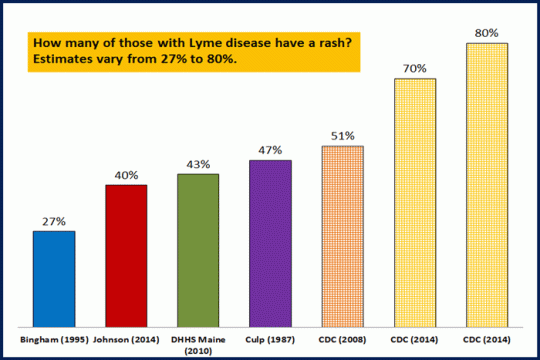
The other glaring issue with this 2012 study is it focused on the EM rash, when research has shown those getting the rash vary considerably with many never getting it:

Rashes-larger-blog-3

Only a quarter of patients from the first ever patient group back in the 70’s got the rash: 1976circularletterpdf

What many don’t realize is the EM rash is mandatory entrance criteria to get into research studies, despite many patients never having the rash.  This myopic and highly stringent criteria has been hurting patients for over 40 years as the research does not reflect a majority of patients yet is used with abandon.

Entrance into research studies have also required a positive on 2-tiered serology, which research has proven serology testing to be abysmal in detecting Lyme:  https://madisonarealymesupportgroup.com/2018/10/12/direct-diagnostic-tests-for-lyme-the-closest-thing-to-an-apology-you-are-ever-going-to-get/

Excerpt:

“These serologic tests cannot distinguish active infection, past infection, or reinfection.”

In plain English, these tests don’t show squat yet are required research study entrance criteria.

Even this ancient 1995 shows a patient with repeated neurologic relapses despite aggressive antibiotic therapy, with obvious Jarisch-Herxheimer reactions with each course of therapy who NEVER had detectable free antibodies to Lyme in serum or spinal fluid:  Seronegative Chronic Relapsing Neuroborreliosis https://www.ncbi.nlm.nih.gov/pubmed/7796837

And advocate Carl Tuttle is absolutely correct in stating that this disease has been pigeon-holed into a narrowly defined parameter so that research yields a pre-determined outcome:  https://madisonarealymesupportgroup.com/2019/11/22/wormsers-junk-science-deliberate-avoidance-of-chronically-ill-patients-a-letter-him-asking-why/

Excerpt:  

WORMSER ET AL DO NOT DISCUSS THE CONSEQUENCES OF UNTREATED LYME DISEASE IN THEIR PLOS PUBLISHED PAPER. WHY DO YOU THINK THAT IS THE CASE DR. HEBER?

Post Treatment Lyme Disease Syndrome after early treatment and untreated late stage Lyme of months, years or decades are two distinctly different disease states with the later going unrecognized for over three decades. The absence of a bulls-eye rash after tick bite allows patients to progress to severe neurological disease instead of obtaining a prompt diagnosis and early treatment. Purposely avoiding the advanced stage of disease hides the horribly disabled and anyone unable to see this is somewhat naïve. Avoiding the seriously disabled Lyme patient population hides the severity of the disease as exposed in the “Under our Skin” documentary.

And please remember the 700+ peer-reviewed papers showing pathogen persistence: Peer-Reviewed Evidence of Persistence of Lyme:MSIDS copy, as well as this 2019 evidence based chronic Lyme disease definition:  https://madisonarealymesupportgroup.com/2019/12/17/chronic-lyme-disease-an-evidence-based-definition-by-the-ilads-working-group/

Excerpt:

Conclusion: This evidence-based definition of chronic Lyme disease clarifies the term’s meaning and the literature review validates that chronic and ongoing Bbsl infections can result in chronic disease.