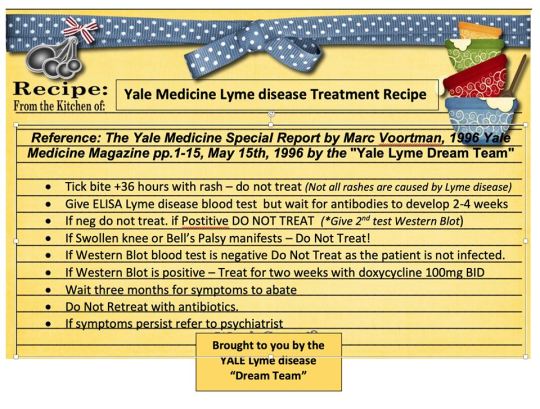
I am not writing to champion “chronic-Lyme-disease” or the many charlatans that create imaginative cures for vague symptoms, I am here to point out a couple facts that are always missing from articles criticizing chronic Lyme disease.
First of all, from the very beginning when Lyme disease was first discovered to be caused by the spirochete Borrelia burgdorferi, the Medical-Experts based all of their conclusions on serology tests.
At that time the patents for the ELISA serology tests from the CDC were held by seven top level CDC administrators, a clear financial conflict of interest in my eyes when stated were mandated to use the CDC tests that lasted the full length of their PATENTs and only ended when their patents expired. Odd coincidence???
All the serology tests for Lyme disease are based on B-31 lab strain of Borrelia burgdorferi we now have 19 Lyme disease Borrelia species and only Bb is detected with these tests. Also Borrelia myamotoi (a TBRF), which is found in the same tick as Lyme disease is transmitted in just 20 minutes. So the theory that Lyme disease can’t be transmitted within 36-48 hours (Yale Medical Report by Marc Voortman) is allowing an undetectable Tick-Borne-Relapsing-Fever to enter the patients and despite Lyme-like symptoms the patients will always test negative on a Lyme disease ELISA test.
The medical experts got many things wrong since 1982:
No transplacental transfer (Gary Wormser and E. Shapiro)
Is not intracellular (Alan Barbour)
Lyme ELISA tests are 99 % accurate (CDC website)
Erythema-migrans Lyme rash must be the size of a basketball or bigger (Dr. Johann Bakken 2016 IDSA President)
No one dies of lyme disease
Two-Tiered testing is better than a single test
Many more inaccurate statements continue to be propagated by the Lyme disease experts of yesteryear. Graphic shows more:
So to find the truth, our group and others turned to PATHOLOGY as the gold standard, and what we found warrants the need for an International Multi-Center Tax-Payer funded Brain Autopsy Study to detect all Borrelia species in the deaths of Chronic Lyme patients, MS patients and dementia brains.
All pseudo-science aside: Lyme patients deserve better science and better studies based on PATHOLOGY not SEROLOGY.
Do the Brain Pathology first, then make your conclusions.
Thomas Grier, Study Administrator
Dr. Paul Duray Pathology Fellowship (A volunteer organization)
The first patient to speak is Representative Karen Whitsett who credits President Trump’s promotion of a malaria drug, hydroxychloroquine, with her recovery from coronavirus. Other COVID-19 survivors also speak after her at the White House. During their informal discussions, Rep. Whitsett, who had a severe case of COVID-19, brought up her chronic Lyme disease as an underlying condition. Throughout the 41-minute meeting, President Trump highlighted how serious and devastating Lyme disease is, stating that it “can kill you.”
__________________________
Although the following patient DID NOT have COVID-19, her Lyme disease herxes made her think she might have had it.
Is it COVID-19 or a Lyme disease herx? One woman’s story.
By Julie Starling
The other night, as I soaked in an Epsom salt bath, I found myself missing my Siberian husky. We lost her in February, at age 12.5 years, to lymphoma. During my years of treating Lyme, she would barge in on me during my baths, whimpering. She knew how painful they were for me.
Crying in sympathy, she would plant several kisses on my face, and then plop herself just outside the door where she could keep a close eye on me. This time, I sulked alone, with only memories of her soft fur and sweet kisses to pass the uncomfortable 20-minute soak.
I had my own scare with COVID-19 last month. I had started treating Lyme again in January after joint pain and mild neuralgia had shown up in December.
By early March, I began to experience the common Herxheimer response,when toxins from die-off build up and the immune system sends in a rush of cytokines. The cytokine storm kicked up migraines, severe fatigue, short spiking fevers and insomnia.
In mid-March, when the San Francisco Bay Area was told to shelter in place, a dry cough showed up. You can imagine the thoughts running through my head as the cough continued day after day despite constant resting.
One night, I received an email from my Lyme doctors explaining their new office policies during the pandemic. The message was thoughtful and meant to clarify how their business would operate and support their patients through this difficult time.
Panic attacks
But it was enough to send me into not one, but two panic attacks.
It’s funny how the body remembers. Despite working through panic disorder for two years after treating Lyme, it all came rushing back with just one email. The fear of not being able to get the care I needed was at the back of my mind. That was a learned response, common to most Lyme warriors after years of misdiagnosis.
But at the front of my mind was the fear of going to the hospital, where the risk of infections is higher and more dangerous for the immune-compromised. Add a viral pandemic to fear of being hospitalized, and you have a hearty recipe for panic attacks.
The next day, I called my doctor for a phone appointment and to get a plan in place. Information and action plans always ease my anxiety. She added one more medication and some supplements and sent me a COVID19 test. There was a lot of confusion on how to take the test, when to take it, and where to send it for processing.
It’s highly unusual for my doctor to be this inefficient or disorganized. It added to my own internal pandemonium and mental jumping to worst-case scenarios. It turns out that doctors, like the rest of us, must also figure out how to navigate the bureaucratic COVID-19 seas.
I learned quickly just how hard it is to get tested for the coronavirus, even when your doctor orders it. In the end, I got tested without having to go to the hospital. Thankfully, it came back negative.
My symptoms were the result of a cytokine storm from my Lyme medication.
Between a rock and a hard place
To a healthy person, trying to stay ahead of COVID-19 can be daunting. For the chronically ill, it can be nearly impossible. I found myself between a rock and a hard place. Should I treat Lyme and risk kicking up the cytokines while the coronavirus lurks around us? Or leave the Lyme untreated and tolerate its pain?
After watching a few podcasts from leading Lyme physicians and consulting with my doctor, I chose to discontinue treatment and let the Herxheimer response die down. It would be difficult to distinguish between cytokines from die-off reaction of Lyme disease and cytokines from the virus. It didn’t seem prudent to fight this battle now when COVID-19 can be so deadly, even to the healthiest among us. I realize that I’m fortunate to be able to make this choice at all. Many with chronic Lyme are in a critical period of treatment and don’t have the luxury of this choice.
It’s impossible to escape the news that bombards us every day with coronavirus statistics. The web offers a flurry of ways to disinfect everything coming into your home and how to protect yourself when you go to the grocery store. I read one story of a young woman with Lyme disease who did everything by the book and more. She disinfected everything that came in her home, sheltered in place, washed her hands repeatedly, showered when she got home and even used a UV wand to disinfect household items. Still, she contracted COVID-19.
I can’t control the future
So now I find myself decorating the chalkboard in my dining room with an old Buddhist adage and the very thing I need to hear most right now. It reminds me that no matter how vigilant I am, I cannot control every thing or person in my environment. That I cannot control the future.
The only thing I can do is live in the present and deal with what is in front of me right now. The best actions I can take are to keep my immune system supported, stay on top of my detox regimen, wash my hands silly, and sleep like my life depends on it. Above all, I should relax, because nothing is under control.
Julie Starling is a writer who has lived with Lyme disease for many years. She holds an M.A. in Health Psychology and is a certified yoga instructor. You may reach her at www.wilddingo.com or follow her on Instagram @ wild.dingo.
Rafal Tokarz, Teresa Tagliafierro, Adrian Caciula, Nischay Mishra,b, Riddhi Thakkar, Lokendra V. Chauhan, Stephen Sameroff, Shannon Delaney, Gary P. Wormser, Adriana Marques, W. Ian Lipkin,
A B S T R A C T
Borrelia miyamotoi is an emerging tick-borne spirochete transmitted by ixodid ticks. Current serologic assays for B. miyamotoi are impacted by genetic similarities to other Borrelia and limited understanding of optimal antigenic targets. In this study, we employed the TBD-Serochip, a peptide array platform, to identify new linear targets for serologic detection of B. miyamotoi.
__________________
Today’s letter to the corresponding author……
April 9, 2020
Columbia University Mailman School of Public Health
722 West 168th St.
NY, NY 10032 Attn: Rafal Tokarz, PhD, Assistant Professor of Epidemiology
Dear Prof Tokarz,
In reference to the detection of tick-borne disease, please take a moment if you will to review the following list of publications using direct detection methods for identifying ongoing spirochetal infection. I will summarize the purpose of this correspondence at the end of this list:
“We report an unusual patient with evidence of Borrelia burgdorferi infection who experienced repeated neurologic relapses despite aggressive antibiotic therapy. Each course of therapy was associated with a Jarisch-Herxheimer-like reaction. Although the patient never had detectable free antibodies to B. burgdorferi in serum or spinal fluid, the CSF was positive on multiple occasions for complexed anti-B. burgdorferi antibodies, B. burgdorferi nucleic acids and free antigen.”
“Fatal Lyme carditis caused by the spirochete Borrelia burgdorferi rarely is identified. Here, we describe the pathologic, immunohistochemical, and molecular findings of five case patients.”
Borrelia burgdorferi was identified via special stains, immunohistochemistry, and polymerase chain reaction. The findings support B. burgdorferi as the causative agent for his fulminant carditis and that the patient suffered fatal Lyme carditis.
The patient had active, systemic Borrelia burgdorferi infection and consequent Lyme hepatitis, despite antibiotic therapy. Spirochetes were identified as Borrelia burgdorferi by molecular testing with specific DNA probes.
Rudenko and colleagues reported culture confirmation of chronic Lyme disease in 24 patients in North Carolina, Florida, and Georgia. All had undergone previous antibiotic treatment
6. DNA sequencing diagnosis of off-season spirochetemia with low bacterial density in Borrelia burgdorferi and Borrelia miyamotoi infections. https://www.ncbi.nlm.nih.gov/pubmed/24968274
Faulty/misleading antibody tests landed a sixteen year old male in a psychiatric ward when his lab results did not meet the CDC’s strict criteria for positive results. His Western blot had only four of the required five IgG bands. Subsequent DNA sequencing identified a spirochetemia in this patient’s blood so his psychiatric issues were a result of neurologic Lyme disease misdiagnosed by antiquated/misleading serology. This patient was previously treated with antibiotics.
Autopsy tissue sections of the brain, heart, kidney, and liver were analyzed by histological and immunohistochemical methods (IHC), confocal microscopy, fluorescent in situ hybridization (FISH), polymerase chain reaction (PCR), and whole-genome sequencing (WGS)/metagenomics. We found significant pathological changes, including borrelial spirochetal clusters, in all of the organs using IHC combined with confocal microscopy.
“This pilot study recently identified chronic Lyme disease in twelve patients from Canada. All of these patients were culture positive for infection (genital secretions, skin and blood) even after multiple years on antibiotics so there was no relief from current antimicrobials. Some of these patients had taken as many as eleven different types of antibiotics.”
________________________
Note: For the sake of time this is just a short list of the hundreds of publications identifying persistent Borrelia infection.
What is the purpose of this email?
Direct detection methods, specifically DNA testing has the ability to identify persistent infection whereas serology cannot be used to gauge treatment failure or success. Not to mention that humans do not produce antibodies against Borrelia for 4-6 weeks after a tick bite. By the time serology tests are positive, the spirochetes have already invaded various deep tissues, like those in syphilis, and are hard to eradicate with antibiotics.
Serology has allowed the 30-year dogma to persevere [1]whereas direct detection methods are exposing the exact opposite.
We are dealing with a life-altering/life-threatening infection with faulty/misleading antibody tests, inadequate treatment, no medical training and absolutely no disease control whatsoever; a public health disaster.
It is time to utilize 21st century technology for the purpose of rapid detection and efficacy of treatment.
If DNA testing is accepted for the 21st century pandemic (COVID-19)[2] ; why not for the 20th century plague (Lyme disease) that has been allowed to proliferate unchecked?
Respectfully Submitted,
Carl Tuttle
Lyme Endemic Hudson, NH
Cc: The tick-Borne Disease Working Group
References
1. Lyme Disease Is Hard to Catch And Easy to Halt, Study Finds New York Times By GINA KOLATA Published: June 13, 2001
Email to the attention of Dr. Paul Mead, Chief of the CDC Bacterial Diseases Branch
Today’s letter to Paul Mead of the CDC regarding the continued use of serology mentioned in the latest study on Borrelia miyamotoi at the top of the page.
Apr 13, 2020
Division of Vector-Borne Diseases
Centers for Disease Control and Prevention
3156 Rampart Rd
Fort Collins, Colorado CO 80521 Attn: Paul Mead, MD, MPH Acting Branch Chief
pfm0@cdc.gov
Dear Dr. Mead,
In October of 2018 you coauthored the following paper in Clinical Infectious Diseases and made the following statement regarding serologic testing for Lyme disease:
“… serologic tests cannot distinguish active infection, past infection, or reinfection. Reliable direct-detection methods for active B. burgdorferi infection have been lacking in the past but are needed and appear achievable.”
Dr. Mead…. So why is the National Institutes of Health funding Dr. Gary Wormser’s study for the serologic detection of B. miyamotoi?
Obviously Dr. Wormser didn’t get your memo or you are just providing lip service to give the illusion that our public health officials have everything under control.
What is the status of Direct Diagnostic Tests for Lyme Disease Dr. Mead? Persistent infection after extensive antibiotic treatment has been identified through the use of direct detection methods in academic centers and autopsy findings [1]yet the average patient cannot obtain these tests to justify how sick they are with their chronic active infection.
Please provide a list of grants issued by the CDC or National Institutes of Health for studies actively involved in developing Direct Diagnostic Tests for Lyme Disease.
The CDC has controlled Lyme testing for decades and it rules like the iron curtain even though research clearly shows it is abysmal and misses at least half of all cases – and often times much more.
Lyme disease often occurs when a person in an area populated by the Ixodes scapularis tick gets bitten and picks up a spiral-shaped Borrelia burgdorferi bacterium from the bite. Most people will then develop a target-shaped rash around the bite – known as Erythema migrans. Credit: Shutterstock.
A ‘typical’ case of Lyme disease looks like this: a person in an area populated by the Ixodes scapularis tick gets bitten and picks up a spiral-shaped Borrelia burgdorferi bacterium from the bite. Most people will then develop a target-shaped rash around the bite – known as Erythema migrans – which usually appears within a week, but can take up to a month to materialise. More than 300,000 new cases are reported in the US each year, with a further 65,000 cropping up in Europe.
The bite is often accompanied by flu-like symptoms such as fever, headaches, muscle pain and fatigue. Some patients may not develop or notice a rash, only visiting a doctor when they begin to feel physically unwell, and end up having the infection confirmed by a blood test instead. If the symptoms are ignored the illness can progress to cause more serious neurologic and arthritic problems, known as late disseminated Lyme disease, but even then 30 days of doxycycline should be able to clear things up. (See link for article)
______________________
Microbiologist Tom Grier’s Letter to the Editor:
Lyme disease: What’s actually going on here?
I am a microbiologist that has done 25+ years of work on Borreliosis and the effects of Borrelia infection of the human brain.
The only reason there is a controversy about the persistence of LIVE Borrelia spirochetes in patients that have been treated with antibiotics is simply that the CDC, NIH, Yale, Mayo Clinic, and SUNY all have patents on blood-tests for Lyme disease, and base their conclusions on blood tests. This is not only a financial conflict of interest, but now is a problem with reputations and jobs. ConflictReport
The most notable Lyme disease experts have not done a single brain autopsy to confirm the absence of infection. Not one tax-payer dollar has been spent on brain pathology to investigate Borrelia species in dementia, MS, or chronic Lyme disease or neuro Borrelia myamotoi.
Several private funded pathologists have done the research and found persistence and some interesting pathology.
Borrelia can persist behind the blood-brain-barrier for decades. Further, the spirochete can take refuge inside human brain-neurons. No blood test can detect this type of persistence, because the peripheral immune system stops detecting the infection.
To make things more difficult both Borrelia burgdorferi and Borrelia myamotoi form clusters surrounded by secreted glycoprotein gel and embeds inside amyloid plaques.
This is low hanging fruit waiting to be picked by the CDC or State Health Departments, but they refuse to do the brain pathology needed, even though many brain-banks offer ample easy access and samples they haven’t and won’t spend a dime that would ruin the reputations of the serology-cartel.
Attached are just a few of hundreds of images showing persistence despite negative blood tests.
“Thomas Grier M.S. studied Clinical Immunology and Microbiology at the University of MN Duluth, and began a doctorate program in Geriatrics until the program was discontinued. He then worked on human vaccine development and developed antibody testing to detect bacteria in Pylonephritis. He also worked on a T-cell model of Leukemia in mice trying to target the immune system against Leukemia-Lymphocytic markers to reduce Lymphocyte levels. In 1990, he was misdiagnosed with MS and was finally diagnosed with Lyme Encephalitis in 1991. Following his fight with recovering from this disease, he wrote the “Lyme Disease Survival Manual” for patients, which sold worldwide. Currently, Tom is the Executive Director of Pathology Studies at MIBDEC. MIBDEC is an non-profit organization trying to register Dementia and MS patients to donate their brains to science to look for spirochetes (Lyme) as a possible connection to some (not all) dementias. He does this because of the refusal by health departments, the NIH or CDC to do the proper work to rule out spirochetes within the brain as a cause of our increased rate of dementia in America and around the temperate latitudes of the Northern Hemisphere. Also like many in his field, he is concerned about the government not telling us the truth about epidemic diseases and the purposely funding of bad science. There are also conflicts of financial interest that prevent good science from prevailing.”
Trump Holds Meeting With Recovered COVID-19 Patients – First One Has Chronic Lyme
The first patient to speak is Representative Karen Whitsett who credits President Trump’s promotion of a malaria drug, hydroxychloroquine, with her recovery from coronavirus. Other COVID-19 survivors also speak after her at the White House. During their informal discussions, Rep. Whitsett, who had a severe case of COVID-19, brought up her chronic Lyme disease as an underlying condition. Throughout the 41-minute meeting, President Trump highlighted how serious and devastating Lyme disease is, stating that it “can kill you.”
EXCERPTS OF LYME DISEASE DISCUSSION DURING MEETING
Starting at 2:15 – Whitsett’s’ husband talks about getting hydroxychloroquine late at night for his wife as she was not doing well. Rep. Whitsett goes on to say she’s lost several family members to COVID-19. Evidently, many of them were turned away from the hospital. She brings up the important point that this treatment needs to be available for everyone – not just her, due to her name and position.
Starts at 9:40- STATE REPRESENTATIVE WHITSETT: The shortenings of — the shortening of breath is what really got me afraid because I do have Lyme disease. And thank you for always mentioning about Lyme disease.
THE PRESIDENT: Yeah. Yeah. No, Lyme disease is a big deal.
STATE REPRESENTATIVE WHITSETT: Thank you for always bringing that to the forefront.
THE PRESIDENT: Do you think you still have Lyme disease?
STATE REPRESENTATIVE WHITSETT: I do. I have chronic Lyme disease because I was never treated in time.
THE PRESIDENT: Can that be — can you get rid of it?
STATE REPRESENTATIVE WHITSETT: I’m hoping that we’ll talk about that.
THE PRESIDENT: Lyme disease is a thing that people don’t talk about. It is brutal —
STATE REPRESENTATIVE WHITSETT: It is brutal.
THE PRESIDENT: And if you have a certain type of blood, you have no chance.
STATE REPRESENTATIVE WHITSETT: It’s brutal. It’s brutal. And then, on top of having COVID-19 with it, it is a nightmare.
THE PRESIDENT: Incredible.
STATE REPRESENTATIVE WHITSETT: But the breathing is what scared me the most. And it came — I went from 0 to 100. It was from getting tested that day on March 31st to trying to do a few things around the house, to just all of a sudden my breathing became labored.
(Later In Discussion)
Start at 15:40 THE PRESIDENT: Yeah. No, if — by the way, we have tremendous endorsements. But if it were somebody else other than President Trump that put it forward — if some other person put it forward, they’d say, “Oh, let’s go with it.” You know.
What do you have to lose? They’ve been taking it for 40 years for malaria, which — by the way, it’s an unbelievable malaria pill. Unbelievable lupus pill. Unbelievable. In fact, the problem we had is people with lupus —
STATE REPRESENTATIVE WHITSETT: And with Lyme disease.
THE PRESIDENT: Huh?
STATE REPRESENTATIVE WHITSETT: And with Lyme disease. It was (inaudible) with Lyme disease.
THE PRESIDENT: And with — I heard Lyme disease, too.
(Later In Discussion)
Start at 22:00 THE PRESIDENT: I’m a little surprised they can’t do something with your Lyme disease. The Lyme disease is really terrible.
STATE REPRESENTATIVE WHITSETT: That’s because that’s federal. I need you.
THE PRESIDENT: Yeah. Well, but —
STATE REPRESENTATIVE WHITSETT: I need you on that.
THE PRESIDENT: — I mean, I could even have you see the doctor over here, because White — White House doctor. Ask the White House doctor to come.
PARTICIPANT: (Inaudible.)
THE PRESIDENT: Seriously. Because Lyme disease can be very, very bad.
STATE REPRESENTATIVE WHITSETT: Yeah. I don’t have a doctor any longer.
THE PRESIDENT: But it also can be — it also can — is it legal for me to allow her to use the White House doctor? You know what? If it’s not, I will suffer the repercussions. (Laughter.) I don’t care.
STATE REPRESENTATIVE WHITSETT: Well, there are —
THE PRESIDENT: The Democrats might not like that.
STATE REPRESENTATIVE WHITSETT: Well, there are a lot of people in Michigan and I do have eight Lyme bills that I am putting forward for Lyme disease —
THE PRESIDENT: Very good. Do it.
STATE REPRESENTATIVE WHITSETT: — because you cannot get treated in Michigan, as a doctor sees fit, for Lyme disease.
THE PRESIDENT: People don’t know about Lyme disease. It’s a very bad —
STATE REPRESENTATIVE WHITSETT: It’s horrible.
THE PRESIDENT: — very bad thing. And it —
STATE REPRESENTATIVE WHITSETT: So it is something I’m working on.
THE PRESIDENT: But it is something, over a period of time, you can treat generally. It also can kill you. Lyme disease — if you —
STATE REPRESENTATIVE WHITSETT: Yes.
THE PRESIDENT: If you have a certain type blood, you get Lyme disease —
STATE REPRESENTATIVE WHITSETT: Yes.
THE PRESIDENT: — it’s over.
STATE REPRESENTATIVE WHITSETT: I’m glad you know that.
THE PRESIDENT: It’s literally over.
STATE REPRESENTATIVE WHITSETT: I’m glad you know that.
THE PRESIDENT: I think type O — type O blood is not too good. If you have type O blood, stay out of the woods. Right?
STATE REPRESENTATIVE WHITSETT: It’s not even the woods. I got this at home at five years old.
THE PRESIDENT: You got it at home?
STATE REPRESENTATIVE WHITSETT: In Detroit.
THE PRESIDENT: But usually it’s from a deer tick, right?
STATE REPRESENTATIVE WHITSETT: It is a deer tick.
THE PRESIDENT: So where did the tick come from?
STATE REPRESENTATIVE WHITSETT: Well, the tick does not discriminate. It will get on anything.
THE PRESIDENT: So it comes somehow, right?
STATE REPRESENTATIVE WHITSETT: Yes. A squirrel, a bug, a bird — anything. It doesn’t discriminate.
THE PRESIDENT: Well, it’s like when I hit a ball into the rough in golf. (Laughter.) You know what I say? “Enjoy yourself. I’m not going in there.” (Laughter.)
That Lyme disease is pretty tough, right?
STATE REPRESENTATIVE WHITSETT: It is.
THE PRESIDENT: It’s a bad one. I’d like you to see our doctor before you leave, okay?
STATE REPRESENTATIVE WHITSETT: Thank you.
(Last Statements on Lyme)
Starts at 38:20 THE PRESIDENT: But what do I know? Am I allowed to take Karen over to see the White House doctors, see if we can help her out a little bit with Lyme disease? Because Lyme disease is a problem and there are some answers. What do you think? Are you guys going to report me for being a horrible human being? For doing something illegal? Did I do something illegal?
Q We can’t advise you on that, sir.
THE PRESIDENT: And then impeach me. Then you’ll impeach me because I tried to help her out with her Lyme disease. Do you think maybe? Because I’d like to do that. What do you think? Should I do it?
Q I can’t advise you on that, sir. But I — I certainly hope that she —
THE PRESIDENT: See, they never like to take chances, but I do. So, we’ll take a chance on it. Okay?
____________________
**Comment**
I wonder if we can ALL see the White House doctor? Seems like he knows something we don’t.
Fantastic that Lyme disease came up. In the video, Rep Whitsett mentions being tired due to her “underlying condition” of Lyme disease. This is important because the majority of patients I work with have this symptom as a general rule – daily, even without the virus.
President Trump also brings up an important point about people politicizing hydroxychloroquine due to his endorsement of it. This is sad because it is a drug that can help everyone regardless of political affiliation. The fact they would make a life-saving drug political is dumbfounding. To date, 3 states (MI, NV, NY) deny it to COVID-19 positive patients: https://www.thepostemail.com/2020/03/28/three-governors-deny-hydroxychloroquine-to-covid-19-positive-outpatients/
But politicizing drugs isn’t new to Lyme patients. There’s been a hard-core concerted effort to disallow antibiotics to chronically infected patients who remain symptomatic as well as IV antibiotics. The reasons – similar to the ones for plaquenil for COVID, is there are “side effects.” Well, I got news for you: ALL drugs have side-effects.Isn’t that what doctors go go school to learn about so they can make educated decisions with their patients?
Again, the control of drugs albeit opioids, antibiotics, and in this case an anti-malarial, is a common refrain. The only people that get hurt in the process are sick patients.
The study, expected to be completed on April 27, is a phase III randomized, double-blind, placebo-controlled multicenter study to evaluate the efficacy and safety of remdesivir in hospitalized adult patients with mild and moderate 2019-nCoV infections. It will enroll 270 patients and be carried out in the China-Japan Friendship Hospital in Beijing.
We tested the efficacy of the broad-acting antiviral remdesivir in the rhesus macaque model of MERS-CoV (Middle East Respiratory Syndrome) infection. Remdesivir reduced the severity of disease, virus replication, and damage to the lungs when administered either before or after animals were infected with MERS-CoV. Our data show that remdesivir is a promising antiviral treatment against MERS that could be considered for implementation in clinical trials. It may also have utility for related coronaviruses such as the novel coronavirus 2019-nCoV emerging from Wuhan, China.