Archive for the ‘Heart Issues’ Category

What Does Lyme Disease Do To Your Body?

 Approx. 5 Min.

What Does Lyme Disease Do To Your Body?

Published on Apr 23, 2019
What exactly is the connection between a tick bite and lyme disease? While we’re not sure exactly where and when the disease originated, we do know a lot about how it works, its signs, its symptoms in humans and dogs, how it’s spread and its treatment.
SICK is a new series that looks at how diseases actually work inside our body. We’ll be visiting medical centers and talking to top researchers and doctors to uncover the mysteries of viruses, bacteria, fungi and our own immune system. Come back every Tuesday for a new episode and let us know in the comments which diseases you think we should cover next.
____________________
What this video didn’t touch upon is the very real probability that Lyme/MSIDS is spread by more than the sole perp of the deer tick:  https://madisonarealymesupportgroup.com/2019/04/02/transmission-of-lyme-disease-lida-mattman-phd/  From 2005, Dr. Lida Mattman isolated Lyme (borrelia) from:

mosquitoes, fleas, mites, semen, urine, blood, plasma and Cerebral Spinal Fluid. She discovered that this bacteria is dangerous because it can survive and spread without cell wall (L shape). Because L-forms do not possess cell wall, they are resistant to antibiotics that act upon the cell wall.

Others have found other various ways Bb is transmitted as well:

Nobody seems to want to talk about this, yet it’s important.


Case of Endocarditis Caused By Bartonella After Mitral Valve Repair

https://www.ncbi.nlm.nih.gov/pubmed/30981216

2019 Apr 13. doi: 10.1111/jocs.14047. [Epub ahead of print]

Bartonella haenselae infective endocarditis following transcatheter edge-to-edge mitral valve repair: A case report.

Abstract

Infective endocarditis following a Mitraclip procedure might be an under-recognized complication. We describe the case of infective endocarditis by Bartonella henselae as a late complication in a patient with a previously implanted MitraClip system for mitral valve repair. Due to the severity of infection, surgical treatment was performed despite the high preoperative surgical risk, but recurrence of endocarditis of the biological valve implanted occurred. Although infection with Bartonella is known as a possible source of endocarditis, it has never been described before in relation to failed MitraClip therapy.

__________________

**Comment**

A great article came out recently about Bartonella being an under appreciated public health problem:  https://madisonarealymesupportgroup.com/2019/04/24/human-bartonellosis-an-underappreciated-public-health-problem/

And, frankly, that’s an understatement!

Heart issues with Bartonella abound:  https://madisonarealymesupportgroup.com/2017/05/11/bartonella-henselae-in-children-with-congenital-heart-disease/

https://madisonarealymesupportgroup.com/2017/01/04/endocarditis-consider-bartonella/

https://madisonarealymesupportgroup.com/2018/09/28/bartonella-infective-endocarditis-with-dissemination-a-case-report-literature-review/

https://madisonarealymesupportgroup.com/2018/09/07/bartonella-infectious-endocarditis-associated-with-cryoglobulinemia-multifocal-proliferative-glomerulonephritis/

https://madisonarealymesupportgroup.com/2018/07/10/infective-endocarditis-associated-with-bartonella-henselae-a-case-series/

But many other issues abound as well:  https://madisonarealymesupportgroup.com/2019/04/09/abstract-bartonella-in-boy-with-pans/

https://madisonarealymesupportgroup.com/2019/03/21/bartonella-sudden-onset-adolescent-schizophrenia-a-case-study/

https://madisonarealymesupportgroup.com/2019/04/08/case-series-bartonella-ocular-manifestations/

https://madisonarealymesupportgroup.com/2019/03/02/skin-inflammation-nodules-letting-the-cat-out-of-the-bag/


Tick Talk: A Conversation About Lyme – Dr. Neil Spector

Tick Talk: A Conversation About Lyme

Published on Apr 14, 2019

PA still holds the crown for highest number of CDC reported cases of Lyme Disease making our state home to thousands of sick people. @drneilspector, Duke University Oncologist, chats with @Chick2Chick about his own Lyme story and how cancer research is providing hope for Lyme diagnostics and therapies! You can also listen to this as a podcast at your convenience through your favorite online podcast directory – iTunes, Stitcher, Spotify, TuneIn, Podbean or Google Play.
__________________
For more:
Dr. Spector suffered from misdiagnosed Lyme disease for many years, and during that time, his heart was affected. He was near death and only a heart transplant could save his life. He chronicled the experience in his riveting memoir, Gone in A Heartbeat: A Physician’s Search for True Healing.  Since then, Dr. Spector has become a unique advocate for Lyme patients. He thoroughly understands the patient’s viewpoint, including what it’s like to know that something is seriously wrong with your body and yet have doctors dismiss your symptoms.


Human Bartonellosis: An Underappreciated Public Health Problem?

https://www.mdpi.com/2414-6366/4/2/69

Trop. Med. Infect. Dis. 2019, 4(2), 69; https://doi.org/10.3390/tropicalmed4020069

Human Bartonellosis: An Underappreciated Public Health Problem?

Published: 19 April 2019
(This article belongs to the Special Issue Recent Advancements on Arthropod-Borne Infectious Diseases)

Abstract

Bartonella spp. bacteria can be found around the globe and are the causative agents of multiple human diseases. The most well-known infection is called cat-scratch disease, which causes mild lymphadenopathy and fever. As our knowledge of these bacteria grows, new presentations of the disease have been recognized, with serious manifestations. Not only has more severe disease been associated with these bacteria but also Bartonella species have been discovered in a wide range of mammals, and the pathogens’ DNA can be found in multiple vectors. This review will focus on some common mammalian reservoirs as well as the suspected vectors in relation to the disease transmission and prevalence. Understanding the complex interactions between these bacteria, their vectors, and their reservoirs, as well as the breadth of infection by Bartonella around the world will help to assess the impact of Bartonellosis on public health. View Full-Text

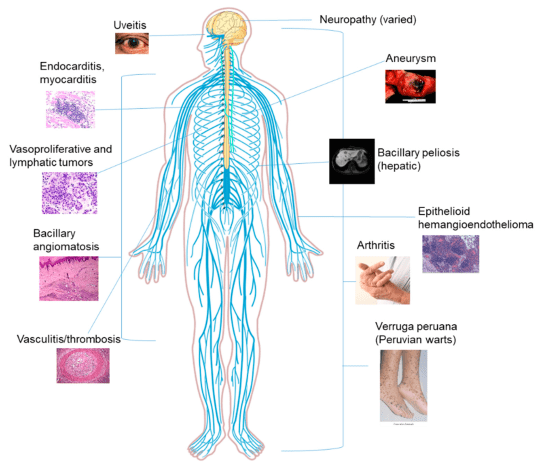
tropicalmed-04-00069-g001
Figure 1  The Clinical Manifestations of Bartonellosis
Excerpt from full-text
Known diseases caused by Bartonella infections include:
  • Carrion’s disease
  • cat-scratch disease
  • chronic lymphadenopathy
  • trench fever
  • chronic bacteraemia
  • culture-negative endocarditis
  • bacilliary angiomatosis
  • bacilliary peliosis
  • vasculitis
  • uveitis [1,2,4,6,7,9,10,11].
Recently, Bartonella infections have been linked to more diverse manifestations such as:
  • hallucinations
  • weight loss
  • muscle fatigue
  • partial paralysis
  • pediatric acute-onset neuropsychiatric syndrome (PANS)
  • other neurological manifestations [6,8,10].

A few case studies have also documented Bartonella in tumors, particularly vasoproliferative and those of mammary tissue [12,13,14]. The potential involvement of this pathogen in breast tumorigenesis is both disconcerting and warrants significantly more research.

Bartonella spp. are zoonotic pathogens transmitted from mammals to humans through a variety of insect vectors including the sand fly, cat fleas, and human body louse [4,5]. New evidence suggests that ticks, red ants, and spiders can also transmit Bartonella [15,16,17,18]. Bed bugs have been implicated in the transmission cycle of B. quintana and have been artificially infected [19]. B. quintana was found in bed bug feces for up to 18 days postinfection [19]. The diversity of newly discovered Bartonella species, the large number and ecologically diverse animal reservoir hosts, and the large spectrum of arthropod vectors that can transmit these bacteria among animals and humans are major causes for public health concern.

Regarding ticks….

3.2. Arachnids (Spiders and Ticks)

Over the last 10 years, the topic of ticks transmitting Bartonella species has been widely debated. Evidence exists to support the transmission of Bartonella through many different species of ticks.

Ixodid ticks, also known as hard ticks, appear to be the main type of tick associated with these bacteria. Tick cell lines have been used to show that Bartonella can replicate and survive within:

  • Amblyoma americanum (Lone Star Tick)
  • Rhipicephalus sanguineus (Brown Dog Tick)
  • Ixodes scapularis cells [77] (Deer Tick)

In California, questing ticks of

  • Ixodes pacificus (Western Black legged Tick)
  • Dermacentor occidentalis (Pacific Coast Tick)
  • Dermacentor variabilis (American Dog Tick)

were collected when in the adult and nymphal stages and tested for Bartonella by PCR for the citrate synthase gene. [78]. All types of ticks were found to contain Bartonella DNA, although in varying percentages and locations. These data alone do not prove that ticks can transmit Bartonella spp. Bacteria; however, the results do show Bartonella DNA occurring naturally in these wild ticks.

In Palestine,

  • Hyalomma spp. (Genus of hard-bodied tick) found in Asia, Europe, & North and South Africa.
  • Haemphysalis spp. (The Asian Long-horned tick is an example)
  • Rhipicephalusspp. (Hard-bodied tick native to tropical Africa)

ticks were collected from domestic animals and tested by PCR for the Bartonella intergenic transcribed spacer (ITS) region [38]. These ticks were infected with 4 strains of Bartonella: B. rochalimae, B. chomelii, B. bovis, and B. koehlerae [38]. While this study tested a collection of ticks found on domestic animals, the results suggest that individuals in close contact with these animals should be aware of the potential for transmission through tick bites.

In a sampling of ticks (Ixodes scapularis and Dermacentor variabilis) and rodents (Peromyscus leucopus) from southern Indiana, the midgut contents of the tick species and rodent blood were analyzed by 16S sequencing. Bartonella was present in a moderate percentage (26% in D. variabilis and 13.3% in I. scapularis) of larvae and nymphs of both tick species, even those scored as unengorged, but was present in the majority (97.8%) of the rodents tested [79].
A survey of ticks from 16 states in the U.S. revealed that the overall prevalence of Bartonella henselae in Ixodes ticks was 2.5% [80].
Interestingly, the highest rate of both Borrelia spp. (63.2%) and B. henselae (10.3%) was found in Ixodes affinis ticks collected from North Carolina.
Ixodes ricinus has been the focus of studies that support tick transmission of Bartonella spp. in Europe. This is because I. ricinus is an important vector for tick-borne diseases in Europe [81]. I. ricinus have been collected in the larval, nymphal, and adult stages in Austria [82]. The analyses revealed that 2.1% of all ticks were infected with Bartonella spp., with the highest rate in ticks derived from Vienna (with a 7.5% infection rate), and that adult ticks had a higher prevalence than other stages [82].
B. henselae, B. doshiae, and B. grahamii DNA were amplified, and this was the first study to find Bartonella-infected ticks in Austria [82].
A recent One Health perspective review on Bartonella indicated that the overall presence of Bartonella in ticks (combining evidence from multiple surveillance studies) was approx. 15% [83].
B. henselae DNA has also been isolated from I. ricinus removed from an infected cat. However, whether the cat gave the tick Bartonella or vice versa cannot be established, so the vector competence of these ticks for transmission cannot be determined [30].
A lab in France has studied the relationship between I. ricinus and Bartonella transmission. One study focused on the ability of ticks to maintain infection from one life stage to the next and tested a vertical transmission from adults to eggs. The authors used B. henselae and found that a transstadial transmission was possible and that a transovarial transmission was not likely [84]. The researchers also supplied evidence to support the vector competency of I. ricinus by amplifying B. henselae DNA from the salivary glands of infected ticks and by amplifying DNA from blood 72 h after infected ticks fed through an artificial system [84]. Although the evidence strongly suggests the ability of ticks to transmit these bacteria, the system employed artificial means for feeding; therefore, one major critique has been that it is not representative of a natural blood meal from a host.
To address this issue, another experiment was performed to the assess vector competency of I. ricinus to transmit Bartonella birtlesii [85]. Mice were infected with B. birtlesii through an intravenous injection via a tail vein, and once mice were infected, naïve ticks were fed on the mice and kept for 3 months to molt. Nymphal ticks were shown to transmit B. birtlesii to naïve mice, and adult ticks were shown to infect blood through a feeder method [85]. B. birtlesii was identified in the blood of the recipient mice through PCR and immunofluorescence [85]. This evidence strongly supports the transmission of these bacteria by ticks. However, the limitation is that this only supports I. ricinus’ ability to transmit a very specific strain of Bartonella, B. birtlesii, which is not linked to human disease.
Concerns such as these related to vector competence and transmission can only be quelled by repeated studies utilizing multiple strains of Bartonella and differing tick species.
An interesting case study provided evidence of spiders transmitting Bartonella. A mother and two sons suffered from neurological symptoms following bites suspected from woodlouse hunter spiders [18]. Bartonella henselae DNA was amplified from the blood of the family as well as from a woodlouse and a woodlouse hunter spider near the family’s home [18]. It cannot be determined if the family contracted the bacteria from the woodlouse or the woodlouse hunter spider or if the lice and spiders contracted the bacteria from the family. This case study points to the importance for diagnosticians to test for bacterial infections after suspected arachnid bites. It also emphasizes the lack of knowledge on the possible vectors that transmit Bartonella as well as the range of manifestations by infection with Bartonella.

___________________

**Comment**

I think we can safely state that Bartonella IS an under appreciated health problem.


How Do Hormones Affect the Heart?

https://www.womensinternational.com/how-do-hormones-affect-the-heart/

How Do Hormones Affect the Heart?

Written by Michelle Violi, PharmD – Women’s International Pharmacy

“How does hormone supplementation affect the heart?” This is a question that our pharmacists hear regularly. Much like the poor, maligned egg in the cardio-healthy diet, hormones have fallen in and out of favor with regard to their effect on the cardiovascular system over the years.

Although a number of studies examine hormonal effects on the cardiovascular system, these studies rarely distinguish between bioidentical and synthetic hormones. However, one study by Dr. Ferdinand Roefsena, Rebecca J. Yang, and Dr. Johannes Veldhuis looked specifically at the bioidentical hormones, estradiol, and progesterone, publishing their results in the Journal of the Endocrine Society. Let’s see what they found!

How Was the Study Designed?

Forty healthy postmenopausal women, ages 50-80, participated in the study. The women were divided into four treatment groups:

  1. Bioidentical estradiol (injection) and bioidentical progesterone (by mouth)
  2. Bioidentical estradiol (injection) and no bioidentical progesterone
  3. Bioidentical progesterone (by mouth) and no bioidentical estradiol
  4. No bioidentical estradiol and no bioidentical progesterone

After 23 days of using these therapies, the women’s blood was drawn and the researchers measured various markers.

What Did the Study Look At?

Because the study was only 23 days long, Dr. Roefsena et al. were unable to evaluate primary endpoints,such as heart attacks or strokes. Instead, they looked at various markers in the blood that have been associated with physical outcomes such as heart disease, stroke, and diabetes. The researchers looked at many significant markers, including:

  1. Total cholesterol
  2. Low-density lipoprotein cholesterol (LDL-C) (referred to as “bad” cholesterol by the American Heart Association)
  3. High-density lipoprotein cholesterol (HDL-C) (referred to as “good” cholesterol by the American Heart Association)
  4. Apolipoprotein B (Apo B)
  5. High sensitivity C-reactive protein (hsCRP)
  6. Adiponectin

With the exception of HDL-C and adiponectin, for which higher levels appear beneficial, decreased levels of the other markers listed above are generally considered favorable, according to the American Heart Association.

What Did the Study Find?

When compared to women who weren’t using any hormone therapies:

  1. Women who used bioidentical estradiol alone had lower levels of total cholesterol, LDL-C, and Apo B. They also had higher levels of HDL-C, which are considered beneficial differences. The researchers had expected this result, based on previous studies as described in the article The Bioidentical Hormone Debate: Are Bioidentical Hormones (Estradiol, Estriol, and Progesterone) Safer or More Efficacious than Commonly Used Synthetic Versions in Hormone Replacement Therapy? by Dr. Kent Holtorf.
  2. Women who used bioidentical progesterone alone had decreased adiponectin, but they were still well within the average reference range (below which would indicate risk).
  3. Women who used bioidentical estradiol and bioidentical progesterone together had lower levels of total cholesterol, LDL-C, Apo B, and HDL-C. While the reduced HDL-C levels are not considered beneficial, other studies, as discussed in Dr. Holtorf’s article, indicate that when synthetic progestins are used instead of bioidentical progesterone, the cholesterol and LDL-C-lowering effect of bioidentical estradiol is also blocked. Bioidentical progesterone did not block this effect!
  4. hsCRP levels were higher in women using bioidentical estradiol and bioidentical progesterone, but still well below the value above which indicates increased risk.

In Summary:

As the researchers expected, the women using bioidentical estradiol exhibited improved cholesterol levels (including decreased LDL-C and increased HDL-C). Even though the bioidentical progesterone was associated with reduced HDL-C levels, it allowed the positive effects of bioidentical estradiol on the other cholesterol levels to remain. Synthetic progestins have been seen to reduce the positive effects of bioidentical estradiol on cholesterol levels, as evidenced by the studies discussed in Holtorf’s article. These findings suggest that bioidentical hormones may be preferable to synthetic.

This study is not without its flaws, such as its short length and small group size. Its short length made it necessary to evaluate markers rather than primary endpoints, and the data was further limited by comparing the groups to each rather than evaluating the differences between the beginning and ending measurements. The patients in the bioidentical estradiol groups were treated with injectable bioidentical estradiol—a form which is rarely used in clinical practice—and used two doses ten days apart as opposed to the usual two- to four-week intervals.

Despite this study’s shortcomings, when we combine its results with information obtained in other studies, we see that bioidentical progesterone doesn’t appear to interfere with the positive effects estrogen has on cholesterol levels. By contrast, other studies have suggested that synthetic progestins do negate these effects. And this makes perfect sense! Why would we assume that a molecule that is similar, but not identical to what the body makes, should have the same effect in the body as a molecule that is identical to what the body makes?

Due to our differences as individuals, no study is perfect. Therefore, the question of whether hormones are good for your heart may never be answered definitively because the answer may differ from person to person. Through studies like that by Dr. Roefsena et al. and others, however, one thing is becoming clear: the difference between bioidentical and synthetic hormones may prove a significant factor in whether hormones are beneficial to the heart.

Additional Resources:

Women’s International Pharmacy has several other articles focused on how hormones affect heart health. Check them out at our Heart Health Resources page!

© 2019 Women’s International Pharmacy

Reviewed by Carol Petersen, RPh, CNP; Women’s International Pharmacy