Archive for the ‘Heart Issues’ Category

Symptomatic High-Grade AV Block & Phase 4 Right Bundle Branch Block – A Previously Unreported Manifestation in Lyme Carditis

https://www.heartrhythmcasereports.com/article/S2214-0271(20)30263-3/fulltext#secsectitle0020

Phase 4 Block of the Right Bundle Branch Suggesting His-Purkinje System Involvement in Lyme Carditis

Open AccessPublished: December 01, 2020DOI:https://doi.org/10.1016/j.hrcr.2020.11.017
We describe an adolescent with symptomatic high-grade AV block and evidence of phase 4 right bundle branch block, a previously unreported manifestation of infra-nodal conduction system involvement in LC.

A previously healthy 14-year-old boy presented via emergency medical services in mid-summer because of syncope (fainting).

Interesting findings:

  • Patient frequently hunts and fishes in wooded, Lyme-endemic region 
  • Didn’t remember tick bites or EM rash
  • Two weeks prior to ER visit patient had a runny nose, cough, abdominal pain, followed by headache and nausea.
  • In the ER he had bradycardia, altered mental status, headache, and vomiting.
  • Initial ECG showed complete heart block
  • He was given 2,000mg of IV Ceftriaxone every 24 hours
  • Testing supported clinical suspicion of Lyme
  • He was given a temporary pace-maker which was removed after 5 days of IV antibiotics and he was switched to oral doxycycline to complete a total of 21 days of antibiotics
  • After being monitored in hospital for 7 days, he was discharged with an auto-detecting wireless monitor until a follow-up appointment and stress test
  • Follow-up appointment patient was well with normal ECG

_____________________

**Comment*

Case study states: 

Significant AV block due to LC occurs in about 1% of LD cases.

I believe this statistic is premature considering many do not test positive and therefore are undiagnosed. I’ve posted numerous articles where patients are sent packing even when they present with positive test results three times in a row! We will never know how many patients with AV block have an underlying tick-borne illness due to abysmal testing and the lack of training and experience of most doctors with tick-borne illness.

And then there’s that nagging concern about long-term effects and if 21 days of antibiotics were enough for his patient. It often isn’t.

Please see:

https://madisonarealymesupportgroup.com/2020/11/25/what-makes-a-doctor-lyme-literate/

Firefighter’s Heart Stopped Due to Lyme Disease

https://vimeo.com/485783302  Video here

Minneapolis Firefighter’s Heart Stopped due to Lyme disease

Dec. 1, 2020

His symptoms were:

  • severe fatigue
  • AV heart block

Unfortunately the infectious disease doctor took a “wait and see” approach waiting for test results which has been hurting people for decades. He needed a temporary pace-maker and remained the the ICU.

Due to his experience he is helping with a project in conjunction with Lyme Awareness Minnesota to put two tick safety books in every elementary school in Minnesota.

Go to:  LymeawarenessMN.com to become a sponsor or make a donation.

For more on Lyme and the heart:  

Chest Palpitations in a Teenager as Unusual Presentation of Lyme Disease: Case Report

https://pubmed.ncbi.nlm.nih.gov/33028242/

Chest palpitations in a teenager as an unusual presentation of Lyme disease: case report

Affiliations expand

Free PMC article

Abstract

Background: The incidence of Lyme disease (LD) in North America has increased substantially in the past two decades. Concomitant with the increased incidence of infection has been an enhancement in the recognition of LD complications. Here, we report a case of Lyme carditis complicated by heart block in a pediatric patient admitted to our children’s hospital. What is unique about this case is that the complaint of chest palpitations is an infrequent presentation of LD, and what it adds to the scientific literature is an improved understanding of LD in the pediatric population.

Case presentation: The patient was a 16-year-old male who presented with the main concerns of acute onset of palpitations and chest pain. An important clinical finding was Erythema migrans (EM) on physical exam. The primary diagnoses were LD with associated Lyme carditis, based on the finding of 1st degree atrioventricular heart block (AVB) and positive IgM and IgG antibodies to Borrelia burgdorferi. Interventions included echocardiography, electrocardiography (EKG), and intravenous antibiotics. The hospital course was further remarkable for transition to 2nd degree heart block and transient episodes of complete heart block. A normal sinus rhythm and PR interval were restored after antibiotic therapy and the primary outcome was that of an uneventful recovery.

Conclusions: Lyme carditis occurs in < 5% of LD cases, but the “take-away” lesson of this case is that carditis can be the presenting manifestation of B. burgdorferi infection in pediatric patients. Any patient with suspected Lyme carditis manifesting cardiac symptoms such as syncope, chest pain, or EKG changes should be admitted for parenteral antibiotic therapy and cardiac monitoring. The most common manifestation of Lyme carditis is AVB. AVB may manifest as first-degree block, or may present as high-grade second or third-degree block. Other manifestations of Lyme carditis may include myopericarditis, left ventricular dysfunction, and cardiomegaly. Resolution of carditis is typically achieved through antibiotic administration, although pacemaker placement should be considered if the PR interval fails to normalize or if higher degrees of heart block, with accompanying symptoms, are encountered. With the rising incidence of LD, providers must maintain a high level of suspicion in order to promptly diagnose and treat Lyme carditis.

___________________

**Comment**

Repeat:  Researchers need to refrain from stating that something is “rare” with Lyme disease as:
  • testing misses more than 70% of cases (thousands go undiagnosed)
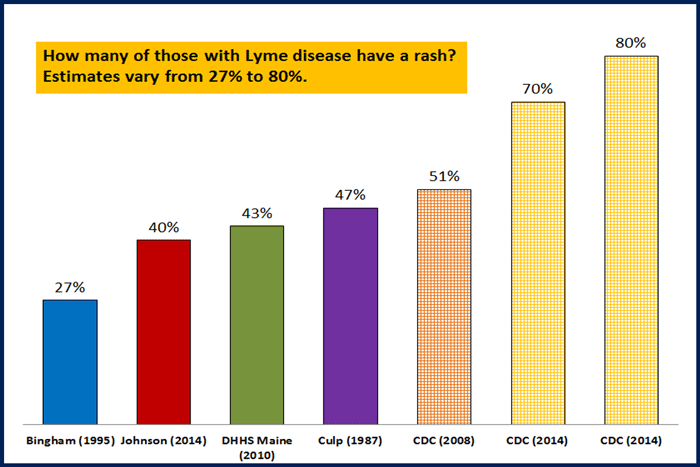
  • much fewer report the EM rash than is quoted
  • this is still a misunderstood illness that doctors are woefully uneducated on.  If a patient doesn’t present with the EM rash, doctors unfamiliar with the wide symptom presentation are not going to catching this.

For more:  https://madisonarealymesupportgroup.com/2020/03/01/study-cdcs-2-tier-lyme-testing-inaccurate-in-more-than-70-of-cases/

Click on image to see better. The graph is clear that there is a wide range of those with those finding the EM rash. While the EM rash is diagnostic for Lyme disease, many do not get it. In the first ever patient group in Lyme, Connecticut, only a quarter had the rash:

https://madisonarealymesupportgroup.com/2019/02/22/why-mainstream-lyme-msids-research-remains-in-the-dark-ages/

Again, mainstream medicine continues with abysmal testing and ancient dogma that is hurting patients.

More accurate scientific language would be: “Heart palpitations are rarely reported in the literature.”  What happens in the real world is often quite different than what is reported in the literature – particularly with Lyme as research has been hijacked by The Cabal:  https://madisonarealymesupportgroup.com/2017/01/13/lyme-science-owned-by-good-ol-boys/

BTW: I had chest palpitations, my husband had chest palpitations, and most of the patients I work with have them.  I don’t think it’s nearly as rare as  is being reported.

It’s a good thing this teen was promptly diagnosed as people have died from this:  https://madisonarealymesupportgroup.com/2020/02/21/17-year-old-dies-from-lyme-carditis/ 

The following statement is quite frightening:

The hospital course was further remarkable for transition to 2nd degree heart block and transient episodes of complete heart block.

https://madisonarealymesupportgroup.com/2018/11/16/advanced-heart-block-in-children-with-lyme-disease-2/

https://madisonarealymesupportgroup.com/2019/12/09/study-identifies-189-children-with-lyme-carditis/

https://madisonarealymesupportgroup.com/2018/09/17/lyme-carditis-heart-block-other-complications-of-ld/  Excerpt:

In 90% of cases, the most common consequence of Lyme carditis is heart block. The severity of the heart block can fluctuate rapidly and the progression to complete heart block can be fatal. Importantly, the heart block in Lyme carditis can be transient and usually resolves with antibiotic therapy. Additionally, Lyme carditis can affect other parts of the heart’s conduction system, as well as the heart’s muscle, valves, and outer layer of the heart wall.

https://madisonarealymesupportgroup.com/2020/08/22/boothbay-harbor-man-recovering-from-near-fatal-lyme-disease-infection/

These links show heart issues caused by Lyme disease are not rare.

Lyme advocate, Phyllis Mervine, makes a case that autopsies should be performed on those with unexpected, sudden death:  https://madisonarealymesupportgroup.com/2018/07/09/with-unexpected-death-autopsies-should-look-for-lyme-carditis/

Signs and Symptoms of Lyme Disease

https://danielcameronmd.com/signs-and-symptoms-of-lyme-disease/

signs and symptoms of lyme disease

The broad range of signs and symptoms of Lyme disease and the varying presentations from person to person make diagnosing the disease challenging. Furthermore, Borrelia burgdorferi spirochete are adept at evading the immune system. The bacterium can travel through the bloodstream, burrow into tissue and remain dormant for days, months, or even years before symptoms arise.

While many people associate Lyme disease with manifestations such as Bell’s palsy, the circular Bull’s-eye rash, and flu-like symptoms, Lyme disease can also cause sensory, cognitive, neurologic, and cardiac complications, even in its earliest stage. But, the signs and symptoms of Lyme disease are all too frequently attributed to another medical condition.

Objective signs of Lyme disease include Bell’s palsy, synovitis of the knee, and the presence of a Bull’s-eye or erythema migrans rash. However, most people exhibit a wide range of signs and symptoms of Lyme disease that may come and go and fluctuate in their intensity.

Initially, Bell’s palsy, also known as idiopathic facial nerve palsy, may not be attributed to Lyme disease. But making the connection early is important, since corticosteroids, a common treatment for facial nerve palsy, can be harmful to patients with Lyme disease.

Furthermore, researchers in the UK remind clinicians to consider Lyme disease in children who present with Bell’s palsy. “In areas endemic with Lyme disease, Lyme disease should be considered as the likely cause of facial nerve palsy in children until proven otherwise.”

Wide range of signs and symptoms of Lyme disease

Studies indicate that at least 50% of patients with Lyme disease do not exhibit the classic Bull’s-eye rash. When a rash is present, it can appear anywhere on the body. It does not always appear at the site of the tick bite. The rash usually appears between 3 – 30 days after the tick bite.

A rash due to Lyme disease is typically not itchy or painful. It may fade and then reappear and it can be confused with a spider bite. Atypical rashes can also occur. And when multiple rashes appear on the body, it may be an indication that the Borrelia burgdorferi spirochete has disseminated beyond the tick bite and the disease is in a more advanced stage.

If left untreated, the infection can spread to other parts of the body, including the brain and central nervous system, cardiovascular system, peripheral and autonomic nervous system, along with the muscles and joints, and eyes.

Neurologic and cardiac manifestations

Lyme disease can cause neurological and cardiac symptoms such as meningitis, encephalitis, and carditis. But, more often symptoms include severe and unrelenting fatigue, joint pain (with or without swelling), sore muscles, neck and back pain, headaches, light, sound and temperature sensitivity, sleep disturbance, night sweats, irritability, anxiety, despair, sadness, lightheadedness, crying, poor memory and concentration, stiff neck, numbness, and tingling sensations.

Although rare, Lyme carditis can cause sudden death. The authors of a case series warn, “These two cases highlight the importance of early recognition. And treatment, even if it’s empirical, may save lives.”

Another researcher reports, “The burden of Lyme disease and Lyme carditis in U.S. children’s hospitals has increased in recent years.” The authors identified 189 children diagnosed with Lyme carditis between 2007 and 2013.

Bartonella Clarridgeiae Found in Patient With Aortic Root Abscess & Endocarditis

https://pubmed.ncbi.nlm.nih.gov/32974498/

Bartonella clarridgeiae infection in a patient with aortic root abscess and endocarditis

Free PMC article

Abstract

Introduction: Bartonella species are increasingly recognized as agents of culture-negative endocarditis. However, to date, almost all human cases have been associated with two members of the genus, Bartonella henselae and Bartonella quintana. B. henselae infections are zoonotic, with domestic cats serving as reservoir hosts for the pathogen. Bartonella clarridgeiae also exploits cats as reservoir hosts, but its zoonotic potential is far less established.

Case presentation: A 34-year-old male presented with palpitations after a history of aortic incompetence. During surgery for an aortic valve replacement, two vegetations were found on the aortic valve. PCR analysis of the vegetation demonstrated the presence of Bartonella species and so the patient was treated post-operatively with ceftriaxone and doxycycline, making a good recovery. Further PCR-based analysis of the patient’s aortic vegetation confirmed the presence of B. clarridgeiae .

Conclusion: This report expands the number of Bartonella species associated with endocarditis and provides clear evidence that B. clarridgeiae should be considered a zoonotic pathogen.

_________________

**Comment**

Aortic root abscess is a life-threatening complication of endocarditis.  In this case, caused by Bartonella clarridgeiae, a strain of Bartonella found to cause cat scratch disease going back to 1997 by none other than Dr. Breitshwerdt, after a veterinarian was bitten on the finger by a cat:  https://jcm.asm.org/content/35/7/1813

Important excerpt:

Within 3 weeks he developed headache, fever, and left axillary lymphadenopathy. Initial blood cultures from the cat and veterinarian were sterile. Repeat cultures from the cat grew Bartonella-like organisms with lophotrichous flagella.

This is a reminder that Bartonella, similar to Lyme (borrelia) is fastidious and hard to find.  Most doctors quit after an initial test returns negative.  In this case the patient was lucky enough to be under the observation of a veterinarian who understands this fact and cultured repeatedly.  The issue of strain variation is important as well.  The test is only as good as what it is testing for.

How many patients have had endocarditis caused by Bartonella species that either aren’t considered pathogenic yet OR weren’t picked up in a singular test?