Archive for the ‘Ehrlichiosis’ Category

Human Ehrlichiosis: Clinical Associations & Outcomes of Transplant Patients & Patients With Hemophagocytic Lymphohistiocytosis

https://www.ncbi.nlm.nih.gov/pubmed/30913447

Human ehrlichiosis at a tertiary-care academic medical center: Clinical associations and outcomes of transplant patients and patients with hemophagocytic lymphohistiocytosis.

Abstract

BACKGROUND:

Ehrlichiosis is an acute febrile tick-borne disease which can rarely be a trigger for secondary hemophagocytic lymphohistiocytosis (HLH).

METHODS:

We reviewed our experience with Ehrlichia infections at a tertiary-care academic medical center.

RESULTS:

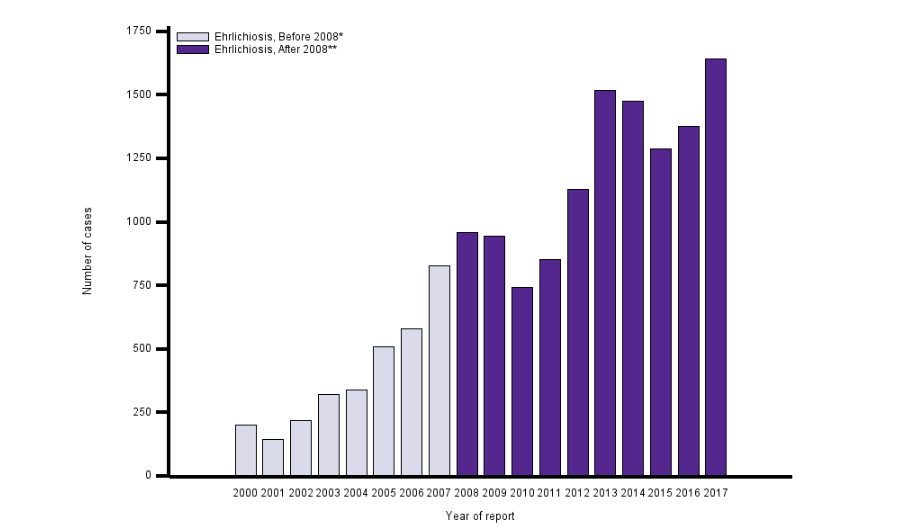
Over 10  years, 157 cases of ehrlichiosis were identified. Ten patients (6.4%) had infection with E. ewingii, 7(4.5%) of whom were transplant patients as compared to 3(1.9%) non-transplant patients (p = .035). Transplant patients were more likely to have leukopenia and elevated creatinine compared to immunocompetent patients; length of hospital stay and early mortality were not different between the two groups. Ten patients met the HLH-2004 diagnosis criteria, which could be an underestimation of HLH occurrence as most patients were not completely evaluated for these criteria. We calculated the H-Score to find the probability of HLH; 25 patients scored high making the occurrence rate of HLH at least 16%. Ehrlichia-induced HLH patients (N = 25) had more anemia, thrombocytopenia, elevated creatinine and AST. Moreover, they had a significantly longer hospital stay (median 9 days) compared to patients without HLH (median 4 days) (p = .006).

CONCLUSIONS:

Ehrlichia-induced HLH is a potential serious complication with relatively high occurrence rate; patients manifest severe disease with end-organ damage requiring longer hospital stay.

________________

For more:  https://madisonarealymesupportgroup.com/?s=ehrlichiosis+


New Comprehensive Testing for Vector-borne Disease – Medical Diagnostic Labs

http://www.genesisbiotechgroup.com/press/VectorBornePR_Final_Branded_3.18.2019.pdf

FOR IMMEDIATE RELEASE

Medical Diagnostic Laboratories, L.L.C., Fights Tick- and Mosquito-borne Epidemic with New Comprehensive Testing for Vector-borne Disease.

Hamilton, NJ., March 18, 2019 –Medical Diagnostic Laboratories, L.L.C., (MDL), a Genesis Biotechnology Group® (GBG) company and CLIA-certified, CAP-accredited laboratory specializing in high-complexity, state-of-the-art, automated DNA-based molecular analyses, has expanded its testing to include a comprehensive program for the detection of vector-borne diseases.

Unfortunately, new tick- and mosquito-borne diseases continue to emerge, increasing in prevalence year after year. The Centers for Disease Control and Prevention (CDC) has reported that the number of disease cases from mosquitoes, ticks, and fleas has tripled from 2004 to 2016. Ticks and mosquitos that carry bacterial, parasitic, and viral pathogens continue to increase in number, species, and geographic range. Currently, tick-borne diseases are widely distributed throughout the United States, with major concentrations in the Northeast, Upper Midwest, and across the middle of the Midwest and Atlantic states.

To combat this growing medical issue, MDL has renewed their efforts to provide the most comprehensive vector-borne disease test menu. Their multi-phase implementation will offer a comprehensive platform blending direct (molecular testing) and indirect (serological) testing methods. This important information helps providers determine their patients’ exposure risk, the pathogen(s) associated with often-overlapping symptomatology, the most effective antimicrobial treatment for active infections, and appropriate prophylactic treatment for exposure. Phase Two, expected to launch in Q2 2019, will feature tick identification. MDL will also offer immune status testing using flow cytometry to evaluate CD3-/CD8-/CD57+ natural killer cells and other immune markers to help assess treatment response for acute and Post-treatment Lyme disease Syndrome patients.

Testing will detect a variety of pathogens associated with tick-borne disease including:

  • Borrelia species (US and European strains of Lyme disease and Relapsing fever)
  • Rickettsia species (Spotted Fever and Typhus Fever)
  • Ehrlichia species (Ehrlichiosis)
  • Francisella tularensis (Tularemia)
  • Babesia species (Babesiosis)
  • Powassan virus and Bourbon virus
  • Mosquito-borne viruses will include Zika virus, Chikungunya virus, Dengue virus, Japanese Encephalitis virus, and Usutu virus.

This is not the first time that MDL has been on cutting-edge of clinical diagnostic testing for vector-borne disease. In 2001 they were the first lab to identify and report, in peer-reviewed scientific journals, co-infections of Ixodes scapularis (deer tick) with Borrelia burgdorferi and Bartonella henselae. According to Dr. Eli Mordechai, Chief Executive Officer (CEO),

“Our laboratory has always poured resources into vector-borne research by developing and enhancing tests in concert with our national and international clinician clients. We’re committed to leading the way in vector-borne diagnostics and partnering with healthcare providers to offer patients the best care possible”.

About MDL

MDL is a CLIA-certified infectious disease laboratory specializing in high-complexity, state-of-the-art, automated, DNA-based molecular analyses. Using unique molecular techniques, MDL provides clinicians from many specialties valuable information to assist in the diagnosis, evaluation, and treatment of viral, fungal, and bacterial infections. MDL is a member of the Genesis Biotechnology Group located in Hamilton, New Jersey, in “Einstein’s Alley”, the research and technology corridor of New Jersey.

About GBG

GBG is a consortium of vertically-integrated corporate research entities, which facilitates the overall market implementation and delivery of biomedical science products and services related to diagnostics and drug discovery. Through the consolidation of research activities, and the collaboration of diverse groups of scientists with expertise in molecular biology, genetics, high throughput screening (HTS), pharmacology, molecular modeling, and medicinal chemistry, GBG is well-positioned to create and sustain complex research platforms in drug discovery and the design of surrogate biomarkers for chronic diseases.

To find out more, please visit www.mdlab.com.

Scott Gygax, Ph.D. sgygax@mdlab.com609.570.LYMEwww.mdlab.com

___________________

More on testing:  https://madisonarealymesupportgroup.com/2018/09/12/lyme-testing-problems-solutions/

https://madisonarealymesupportgroup.com/2018/01/16/2-tier-lyme-testing-missed-85-7-of-patients-milford-hospital/

https://madisonarealymesupportgroup.com/2018/10/12/direct-diagnostic-tests-for-lyme-the-closest-thing-to-an-apology-you-are-ever-going-to-get/

https://madisonarealymesupportgroup.com/2018/08/08/ny-grants-approval-of-igenexs-lyme-immunoblot-tests/

https://madisonarealymesupportgroup.com/2017/10/17/igenex-introduces-3-new-lyme-tests/

https://madisonarealymesupportgroup.com/2018/10/12/paving-the-way-for-better-lyme-diagnostic-tests/

https://madisonarealymesupportgroup.com/2016/12/07/igenex-presentation/

https://madisonarealymesupportgroup.com/2017/12/13/suppression-of-microscopy-for-lyme-diagnostics-professor-laane/

https://madisonarealymesupportgroup.com/2018/09/27/spirochete-culture-microscopy-videos-see-whats-inside-you/

https://madisonarealymesupportgroup.com/2018/09/29/microscopy-of-spirochaete-biofilm/


Danish Study Shows Migrating Birds are Spreading Ticks & Their Pathogens – Including Places Without Sustainable Tick Populations

https://www.ncbi.nlm.nih.gov/pubmed/30709658

2019 Jan 24. pii: S1877-959X(18)30126-2. doi: 10.1016/j.ttbdis.2019.01.007. [Epub ahead of print]

Screening for multiple tick-borne pathogens in Ixodes ricinus ticks from birds in Denmark during spring and autumn migration seasons.

Abstract

Presently, it is uncertain to what extent seasonal migrating birds contribute to the introduction of ticks and tick-associated pathogens in Denmark. To quantify this phenomenon, we captured birds during the spring and autumn migration at three field sites in Denmark and screened them for ticks. Bird-derived ticks were identified to tick species and screened for 37 tick-borne pathogens using real-time PCR. Overall, 807 birds, representing 44 bird species, were captured and examined for ticks during the spring (292 birds) and autumn migrations (515 birds). 10.7% of the birds harboured a total of 179 Ixodes ricinus ticks (38 ticks in spring and 141 in the autumn) with a mean infestation intensity of 2.1 ticks per bird. The European robin (Erithacus rubecula), the common blackbird (Turdus merula), and the common redstart (Phoenicurus phoenicurus) had the highest infestation intensities. 60.9% of the ticks were PCR-positive for at least one tick-borne pathogen. Borrelia DNA was found in 36.9% of the ticks. The Borrelia species detected were B. spielmanii (15.1%), B. valaisiana (13.4%), B. garinii (12.3%), B. burgdorferi s.s. (2.2%), B. miyamotoi (1.1%), and B. afzelii (0.6%). In addition, 10.6% and 1.7% of the samples were PCR-positive for spotted fever group rickettsiae and Candidatus Neoehrlichia mikurensis.

All of the tick-borne pathogens that we found in the present study are known to occur in Danish forest populations of I. ricinus. Our study indicates that migrating birds can transport ticks and their pathogens from neighboring countries to Denmark including sites in Denmark without a sustainable tick population. Thus, a tick-borne pathogen affecting human or animal health emerging at one location in Europe can rapidly be introduced to other countries by migrating birds. These movements are beyond national veterinary control. The current globalization, climatic and environmental changes affect the potential for introduction and establishment of ticks and tick-borne pathogens in Northern Europe. It is therefore important to quantify the risk for rapid spread and long distance exchange of tick-borne pathogens in Europe.

__________________

**Comment** 

Great study until the end.  They have to mention “climatic” changes when this has been proven to be a red-herring:  https://madisonarealymesupportgroup.com/2018/08/13/study-shows-lyme-not-propelled-by-climate-change/

https://madisonarealymesupportgroup.com/2018/11/07/ticks-on-the-move-due-to-migrating-birds-and-photoperiod-not-climate-change/

Ticks are marvelous ecoadaptors and will survive harsh weather by seeking out leaf litter and snow.  In fact, warm winters have proven to be lethal to deer ticks.  In addition to that, please see links above for details on the shoddy science behind the climate model regarding ticks.

And, most importantly, as patients we must continue to insist on tax dollars and monies going for good, solid, transparent research on issues that will relieve human/animal suffering.  

Climate change data has not and will not help patients one iota.


Ehrlichia Found in Argentinian Marsh Deer For the 1st Time

https://www.ncbi.nlm.nih.gov/m/pubmed/30619709/

Evidence of Ehrlichia chaffeensis in Argentina through molecular detection in marsh deer (Blastocerus dichotomus).

Guillemi EC, et al. Int J Parasitol Parasites Wildl. 2019.

Abstract

Vector-borne pathogens are responsible for serious emerging diseases and have been widely described in wildlife. Ehrlichia chaffeensis causes the zoonotic “monocytic ehrlichiosis” in humans, is transmitted by the tick Amblyomma americanum and its reservoir host is the white-tailed deer (Odocoileus virginianus) in North America. Little is known about the native reservoir and the tick vectors involved in the transmission cycle in South America. We report here the detection of E. chaffeensis in a study on marsh deer (Blastocerus dichotomus) mortality in Argentina, in different time periods between 2007 and 2016. Four deer, from two distinct populations, were positive for E. chaffeensis through molecular methods. Additionally, the variable-length PCR target (VLPT) region of positive samples was genotyped. Our results provide the first evidence of E. chaffeensis in autochthonous Cervidae from Argentina, contributing to uncover the distribution of this tick-borne infection in South America.

1-s2.0-s2213224418300889-gr3_lrgFig. 3. Dead marsh deer with high tick burden.

____________________

More on Ehrlichia:  https://madisonarealymesupportgroup.com/2018/12/02/everything-thats-known-about-ehrlichiosis/

https://www.lymedisease.org/ehrlichiosis-tick-borne-disease-no-one-heard/  The author brings up a valid point about the potential of there being undiagnosed Ehrlichia behind a ME/CFS diagnosis in a subset of patients since it infects white blood cells and the mitochondria.  The article also gives helpful percentages of symptoms and the following information:

  • Fever/chills and headache (majority of cases)

  • Fatigue/malaise (over two-thirds of cases)

  • Muscle/joint pain (25% – 50%)

  • Nausea, vomiting and/or diarrhea (25% – 50%)

  • Cough (25% – 50%)

  • Confusion or brain fog (50% of children, less common in adults)

  • Lymphadenopathy (47% – 56% of children, less common in adults)

  • Red eyes (occasionally)

  • Rash (approximately 60% of children and 30% of adults)

OTHER MODES OF TRANSMISSION

Ehrlichia chaffeensis has been shown to survive for over a week in refrigerated blood. Therefore these bacteria may present a risk for transmission through blood transfusion and organ donation. It has also been suggested that ehrlichiosis can be transmitted from mother to child, and through direct contact with slaughtered deer. (14, 15)

https://madisonarealymesupportgroup.com/2018/10/02/north-carolina-ehrlichia-often-overlooked-when-tick-borne-illness-suspected/

https://madisonarealymesupportgroup.com/2018/07/24/oklahoma-ehrlichiosis-central/

https://madisonarealymesupportgroup.com/2018/03/09/dogs-ehrlichiosis/


CAPC Study: Lyme Disease Spreading to Regions Once Thought Low-risk

http://veterinarynews.dvm360.com/capc-study-lyme-disease-spreading-regions-once-thought-low-risk

CAPC study: Lyme disease spreading to regions once thought low-risk

Condition in dogs could signal increasing threat to people, researchers say.

Jan 19, 2019

By dvm360.com staff

DVM360 MAGAZINE

(andriano cz/stock.adobe.com)

The Companion Animal Parasite Council (CAPC) recently released a study that shows that Lyme disease is spreading to regions not previously thought to be at risk for tick-borne disease. States such as Illinois, Iowa, North Dakota, Ohio, Michigan, West Virginia and Tennessee have all seen an increase in the prevalence of Lyme disease, according to a media release discussing the study, which CAPC conducted from January 2012 to December 2016. Results from the study were recently published in Environmetrics.

“The results of this milestone study show increasing risk for Lyme disease in endemic areas and pinpoint regions in the U.S. where Lyme is spreading—areas not historically considered endemic,” says Michael Yabsley, PhD, a professor in the Department of Population Health, College of Veterinary Medicine and Warnell School of Forestry and Natural Resources at the University of Georgia. “This expanding risk of Lyme disease demands heightened vigilance in protecting both our pets and our families.”

New research from CAPC found that the prevalence of Lyme disease is trending up in areas previously thought to be at a lower risk for tick-borne diseases. (Image courtesy of CAPC)

The study was motivated by the increase in Lyme disease cases in the U.S. and, in particular, in states not traditionally considered Lyme-endemic, the release states. Results suggest that:

  • Canine prevalence rates for Lyme disease are rising.
  • Lyme prevalence rates are increasing most in areas where the pathogen has encroached recently.
  • Lyme prevalence in dogs is rising in states traditionally not considered to be of high Lyme risk, suggesting that human risk may also be increasing in these areas, including regions in Illinois, Iowa, North Dakota, Ohio, Michigan and Tennessee.
  • Significant increases in canine Lyme prevalence have been seen in some areas that are not yet reporting significant human incidence. Researchers speculate that canine prevalence is more sensitive to changes in Lyme risk and could serve as an early warning system for changes in human risk.

The study was created to investigate regional trends in the prevalence of antibodies to Borrelia burgdorferi, the disease-causing bacterium of Lyme disease, according to the release. To conduct the research, the CAPC team analyzed more than 16 million Lyme tests from domestic dogs in the U.S. over 60 months. The serologic data was provided by IDEXX Laboratories.

“CAPC research shows the risk for Lyme disease is not static. The way it’s changing varies spatially across the country,” says Christopher McMahan, associate professor in the department of mathematical sciences at Clemson University, in the release.

Crucial in the fight against Lyme, Yabsley says, is year-round tick protection. Different species of ticks are active all 12 months of the year, and ticks that transmit Lyme are active at different times in the year in different regions, the release states. For instance, as you move further south, adult ticks are more active in the winter.

“I’ve been practicing for over 34 years in Nashville where many people don’t think Lyme disease is a concern. But I’ve seen canine Lyme increasing in Tennessee for several years and regularly test and vaccinate for the disease,” says Craig Prior, BVSC, CVJ, a veterinarian and former owner of VCA Murphy Road Animal Hospital in Nashville, Tennessee. “Many people tend to believe that if they don’t go on hikes or spend time in wooded areas, they aren’t at risk for Lyme. Ticks are everywhere—including suburban and gated communities where deer, raccoons, opossum, birds and other hosts frequent back yards. That’s why CAPC recommends year-round tick prevention for dogs—and cats—and regular screening to protect dogs from this debilitating disease that can be extremely hard to treat.

On petdiseasealerts.org, CAPC now provides monthly forecasts for Lyme disease and other tick-borne diseases. It also provides access to monthly canine test results in prevalence maps, a CAPC resource available free online at petsandparasites.org. With more than 21 million canine B. burgdorferi antibody test results collected between 2012 and 2017 in dogs, these maps allow veterinarians, physicians, pet owners and travelers to assess the risk of exposure across the United States and Canada.

__________________

**Comment**

Wisconsin prevalence rate for Lyme, Anaplasmosis, and Ehrlichiosis in pets:  https://capcvet.org/maps/#2012/all/lyme-disease/dog/united-states/wisconsin/  As you can see there are many counties where NO DATA has been collected.  Please remember maps are a very loose guide to what’s happening out there and have been used against patients for decades – denying them accurate diagnosis and treatment.  FYI:  Dane County is at HIGH risk for all 3.

According to independent Canadian tick researcher, John Scott, the reason for this tick proliferation is due to migrating birds and photoperiod, NOT climate change:  https://madisonarealymesupportgroup.com/2018/08/13/study-shows-lyme-not-propelled-by-climate-change/

https://madisonarealymesupportgroup.com/2018/11/07/ticks-on-the-move-due-to-migrating-birds-and-photoperiod-not-climate-change/

Also, infected dogs spread infections as well as ticks when they cross borders:  https://madisonarealymesupportgroup.com/2018/03/09/infected-dogs-with-tbis-spreading-infection-across-borders/  Think of pets as luggage that can and do carry pathogens right into your home.  Please do not allow your dog on your bed or furniture and make sure you use tick prevention on all pets.