FDA Issues Recommendations for Certain High-Risk Groups Regarding Mercury-Containing Dental Amalgam
For Immediate Release:
Statement From:
Director – CDRH Offices: Office of the Center Director
Dr. Jeffrey E. Shuren MD, JD
Part of our role in protecting patients is to regularly evaluate, monitor and update scientific evidence on the risks from medical devices—including issues related to the materials used in devices, such as metals. In the case of implanted and inserted medical devices, where materials may be in contact with the body for extended periods of time, we evaluate safety issues involved with, among other things, the body’s long-term exposure to certain materials, taking into account that sometimes uncertainties remain and more research is needed.
Today, the FDA is issuing updated recommendations concerning dental amalgam and potential risks to certain high-risk individuals that may be associated with these mercury-containing fillings used to restore the missing structure and surfaces of a decayed tooth.
The FDA has found that certain groups may be at greater risk for potential harmful health effects of mercury vapor released from the device. As a result, the agency is recommending certain high-risk groups avoid getting dental amalgam whenever possible and appropriate.
These groups that may be at a greater risk for potential harmful health effects include:
Pregnant women and their developing fetuses;
Women who are planning to become pregnant;
Nursing women and their newborns and infants;
Children, especially those younger than six years of age;
People with pre-existing neurological disease such as multiple sclerosis, Alzheimer’s disease or Parkinson’s disease
People with impaired kidney function; and
People with known heightened sensitivity (allergy) to mercury or other components of dental amalgam.
For over 20 years, the FDA has been reviewing scientific literature, monitoring reports and holding public discussions regarding the public health effects of dental amalgam and amalgam-related mercury vapor. Dental amalgam is a mixture of mercury and a powdered alloy made up of silver, tin and copper.The amalgam releases small amounts of mercury vapor over time. While low-levels of inhaled mercury vapor are generally not harmful to most people, these high-risk individuals may be at increased risk of adverse health outcomes. How much vapor is released can also depend on the age of the filling as well as a person’s habits such as teeth grinding.
These uncertainties in the most vulnerable patients are why today we are recommending people who may be at high risk for adverse health effects of mercury exposure use non-mercury alternatives to dental amalgam, such as composite resins and glass ionomer cement fillings. Dental amalgam-related mercury vapor release may be highest during placement or removal of the filling. The FDA is not recommending anyone remove or replace existing amalgam fillings in good condition unless it is considered medically necessary because removing intact amalgam fillings can cause a temporary increase in exposure to mercury vapor and the potential loss of healthy tooth structure, potentially resulting in more risks than benefits. While the available evidence suggests that dental amalgam use has generally declined over recent years, due to more alternative products being offered and used effectively for dental restorations, high-risk individuals, as noted in our recommendations, should discuss alternative products for restoring teeth with their dentist.
Our reviews and discussions have generally arrived at the same conclusion: while the majority of evidence suggests exposure to mercury vapor from dental amalgam fillings doesn’t lead to harmful health effects for most people, there may be some effects in people with certain health issues such as those who are hypersensitive to mercury. Uncertainties remain about: the effects that long-term exposure to dental amalgam may have on the specific high-risk groups we’ve listed above; the potential for mercury in dental amalgam to convert to other mercury compounds in the body; and whether the accumulation of mercury in some body fluids and tissues results in other unintended health outcomes.
We have made these recommendations after hearing from health care professionals, evaluating published literature and considering the public’s comments about dental amalgam and other metal-containing implants. During the November 2019 meeting of the Immunology Devices Panel of the Medical Devices Advisory Committee, which discussed immunological responses to metal-containing implants and dental amalgam, we heard from several speakers, including those representing underserved communities, who expressed concern about the cumulative effect of mercury vapor exposure from dental amalgam, as well as from other (dietary and environmental) sources.
The FDA continues to believe that the benefits of materials in FDA-approved or cleared implantable and insertable medical devices outweigh their risks for most patients. However, we recognize that it is critical to closely monitor and evaluate new benefit-risk related data as biomedical science is always evolving. We continue to gather input from patients, device manufacturers, researchers and physicians to learn more about their experiences, ideas and feedback related to materials in medical devices, such as dental amalgam. We’re committed to advancing new initiatives that are rooted in sound science with a focus on patient safety remaining at the forefront.
The FDA, an agency within the U.S. Department of Health and Human Services, protects the public health by assuring the safety, effectiveness, and security of human and veterinary drugs, vaccines and other biological products for human use, and medical devices. The agency also is responsible for the safety and security of our nation’s food supply, cosmetics, dietary supplements, products that give off electronic radiation, and for regulating tobacco products.
Well, now that you’ve picked your jaw up off the floor, you may be wondering what to do if you have a mouthful of mercury fillings. Not to worry, there are biological dentists who know how to safely remove mercury fillings.
Please notice that those with pre-existing neurological disease would include Lyme/MSIDS patients.
Now, a word from an experienced gray-hair. Many of you are doling out thousands in Lyme/MSIDS treatment. This is paramount! If you can afford to remove these fillings, great, but if not, DON’T beat up on yourself! Put it on the ever growing list of “to do” or “want” items that cost money you don’t have. Been there, done that. I want to encourage you that if you are doing everything you can with what you currently have don’t fret the stuff you can’t presently address. You are in this for the long-haul. Take a deep breath and keep on keeping on.
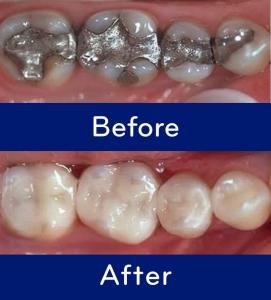
This is what replacing mercury amalgams with a bioidentical glass/resin composite looks like. It comes in both flowable and packable forms. BTW: “silver” fillings HAVE mercury in them. They are NOT solely “silver.”
On a personal note: My husband and I had our mercury fillings removed years ago before we became infected with Lyme/MSIDS. It’s not cheap but like so many other things is an investment in your overall health. Interestingly, the dentist who did it had to retire early. Why? He developed mercury poisoning from all those years of removing mercury fillings.
This week, we celebrate our annual Mercury Awareness week, during which we ask for your continued financial support to put an end to the use of dental mercury worldwide
Mercola.com will match your donations, dollar for dollar, up to $150,000, given by August 31, 2019
In this interview, Charlie Brown shows how Consumers for Dental Choice is blazing four routes to victory for mercury-free dentistry: (1) the Chicago Declaration and its heated challenge to FDA; (2) the state rulemaking to require amalgam-using dentists to show proof they tell patients about amalgam’s mercury, its risks and its alternatives; (3) the phase-out amalgam campaign in Europe that is now spreading across Africa and Asia; and (4) the upcoming Amalgam phase-out amendment battle at the Minamata Convention on Mercury
To make amalgam a business loser, consumers should patronize mercury-free dentists only. Many dentists have seen the light and abandoned amalgam; it’s time for the others to feel the heat
Dr. Mercola raises his match by 20% this year. He asks both health professionals and consumers to consider doing the same!
In this interview, Charlie Brown, former state attorney general of West Virginia and executive director of Consumers for Dental Choice, provides us with an update to the global mercury-free dentistry campaign you’ve so generously helped us support through the past nine years.
We are now incredibly close to the ultimate finish line, thanks to Brown’s persistent and dedicated efforts and your unrelenting financial support. I want to extend a personal thank you to all who have contributed to this mission in the past, and are considering doing so now.
Brown has made it his life’s mission to remove mercury from dentistry across the world, which will also put an end to a large portion of mercury outflow into our environment. This week, we celebrate our annual Mercury Awareness week, during which we ask for your continued financial support to put an end to the use of this pernicious neurotoxin.
“The campaign for mercury-free dentistry has real wins, thanks to the grassroots help of Mercola.com readers,” Brown says. “We are toe-to-toe with the American Dental Association (ADA) and its million-dollar lobbyists across the country and around the world. We are advancing, and the ADA is retreating. Together, we will throw dental mercury into the hazardous waste bins of history.”
Pressure on US Food and Drug Administration is paying off
Over the past year, Consumers for Dental Choice has made advancements on multiple fronts by implementing a number of landmark strategies. In the U.S., Consumers for Dental Choice has applied pressure on the U.S. Food and Drug Administration, the likes of which the agency reportedly has never seen before.
In all, 50 groups, including the Sierra Club, the Organic Consumers Association (OCA) and Greenpeace, signed the Chicago Declaration for Mercury-free Dentistry for America. “That really got FDA’s attention,” Brown says.
When the FDA invited public comment on how it’s doing on its medical devices, 80% of responses — four times that of all other devices combined — were about amalgam.
“People are sick and tired and they made it clear that the No. 1 public interest on medical device regulation is amalgam,” Brown says. “They’re sick and tired of FDA coddling up to the ADA, as it’s done this entire century.
Coming along too is the medical community … the National Medical Association (NMA) and the African-American physicians. They have gotten real interested in this. Their journal published a commentary about how amalgam is unfair to the children of color and other low-income children in this country.
Finally, the trade press is really biting at the heels of FDA. They’re really wanting to know why FDA is still not acting on amalgam. We now have information that FDA is going to move [on this issue].”
While it’s still too early for Brown to give specifics on what the FDA is planning to do, when available, I will bring him back for an update. As for the Consumers for Dental Choice petition to the FDA urging the agency to follow in Europe’s footsteps and eliminate dental mercury for pregnant women and children, more than 48,000 signatures have been received and delivered.
“The European Union, more than a year ago, ended amalgam for children under 15, and for pregnant and breastfeeding women. They required each member state — and there are 28 countries in the EU as of right now — to come up with a plan to go further.
We are saying to FDA, ‘Why are you lagging so far behind Europe? Why won’t you pay attention to the very treaty that the United States not only signed but was the first country in the world to ratify?’
As I said, the heat is building. We think we’re going to move, but they still have been way too close to the pro-mercury dentists. There’s no question. That’s the ADA. The ADA, however, doesn’t have the same clout they used to have because its own members are walking away.
Its own members are saying, ‘Why should I use amalgam just because you want me to? I don’t want to. My patients don’t want to. I don’t want to get people in my office sick.’”
Making amalgam a business loser is a winning strategy
This is undoubtedly a direct response to people following the advice given by Consumers for Dental Choice — the advice to not frequent any dentist who still uses mercury amalgam on ANY of his or her patients, even if it’s not you. By patients abandoning mercury-based dentists, more and more have recognized the folly of sticking with the ADA’s recommendation to keep using it.
“Basically, we are making amalgam into a business loser,” Brown says. We still have a way to go though, to get government-based dentists to follow suit and to get all insurance plans to cover mercury-free dentistry across the board, and not just in some instances.
Fortunately, as the dental amalgam market continues to shrink, amalgam manufacturers are also starting to follow the money and transition into making alternative filling materials instead.
“By making amalgam a business loser for the dentist and a business loser for the manufacturers, we are pursuing a success route,” Brown says. “We want FDA to change. But if FDA doesn’t change, we have a way to win regardless.”
Battleground Maine
In the U.S., Consumers for Dental Choice is also taking on Maine’s Dental Board. After filing a complaint, the board has agreed to create legislation requiring dentists to have informed consent before they can use mercury amalgam on a patient. Brown explains:
“Maine is our battleground state now … I’m in my element. I’ve been challenging dental boards for a long time. Years ago, we got rid of the gag rule. We won factsheet laws. We won disclosures. The Maine Dental Board is ignoring its duty to enforce the law on disclosure.
We have filed our petition, our protest, to the Maine Dental Board. They, in turn, have agreed to write a regulation, which will require the pro-mercury dentists to provide proof that they told the patients amalgam has problems … If they don’t do it, there’s going to be a discipline action against the amalgam-using dentists.”
In short, dentists using amalgam in Maine will be required to present patients with a factsheet detailing in clear language the adverse health effects of amalgam, and information on available alternatives.
Once given this information, patients are unlikely to choose amalgam, given the choice. It will undoubtedly also encourage more dentists to go mercury-free, as they have to admit, with documentation, that they’re putting toxic material into your mouth.
“When I started in this, the dental boards were prosecuting mercury-free dentists. Now we’ve turned the tables and said, ‘You’ve got to prosecute the pro-mercury dentists because they’re not following the law.’ We think with this success in Maine, we’re on the way.
They’re writing a rule. We’ve got a battle ahead this fall in 2019. It will be a prototype for other states. We’re going to prepare a kit for other states. If you want to get active in your state, you, the consumer, you, the dentist, you, the health professional, write me at Charlie@ToxicTeeth.org.
Write me, and I will work with you to get you the material so that in your state, you can parallel what we’re accomplishing in the state of Maine, our model state …
The good news is that the director of health, who wrote and approved that factsheet, her sister is now the governor of Maine. So, we think we’ve got support all the way to the top in Maine to get this thing done.”
Global progress
In addition to the success in the EU, Consumers for Dental Choice is also making great progress in the effort to eliminate dental mercury in Nigeria, Mauritius, Tanzania, Vietnam, Bangladesh and India.
“[The U.S.] Pentagon says they can’t afford the switch. They’re giving mercury fillings. The richest agency in the world — I’m sure — is not giving mercury-free dentistry to its soldiers and sailors, but Bangladesh is. India is.
India has the third biggest army in the world. Bangladesh is one of the poorer countries in the world. Yet no one in the Bangladesh Armed Forces gets amalgam. No one in their family gets it. They’ve gone completely mercury-free. Well, if Bangladesh can end using amalgam in their armed forces, so can the Pentagon,” Brown says.
Consumers for Dental Choice and its international allies were also instrumental in getting dental amalgam included in the Minamata Convention, which calls for significant reductions in mercury pollution from multiple sources.
“Things come to a head this November 2019,” Brown says. “During the last week of November, the governments from every country in the world will again convene. There are well over 140 countries to sign this Convention. Over 100 have ratified it. The United States was the first to ratify.
We will bring a team of people from the Americas, from the island states, from Africa, Asia and Europe — our dentists, engineers, lawyers, journalists and environmental leaders …
The governments, starting in Africa with the country of Gabon, and then a number of other countries, have proposed an amendment to the Minamata Convention: the amalgam amendment. It would phase out amalgam for children in two years, and phase it out for everybody else on a date that people would agree on.
That will be debated this November. We are mounting a full-fledged campaign. We’ve been asked by the African governments to lead civil society — lead the organizing from the outside while they work the inside and work the government.”
Much at stake in November
In the summer of 2019, four EU nations — Czech Republic, Finland, Ireland and Slovakia — followed in Sweden’s footsteps and phased out amalgam for all patients as of a specific date. During the November debate, Consumers for Dental Choice will fight to get all nations to agree to a complete phase-out.
“That’s going to be what they call the Third Conference of the Parties. This again has come, Dr. Mercola, because you dug in with us way back in 2011. You helped us put together this worldwide organization. You matched funds. You’re matching them again.
You’re matching them more than you ever have: $150,000. We hope to raise $150,000 dollars, which we’ll double with your funds to $300,000. We use it effectively. We use it efficiently …
Our staff size is the same as it was in 2011, when we started. Our money goes to the field. It went to the [creation of the] Chicago Declaration. It went to the Maine team that we organized to get front and center in our model state. It goes to some of the best environmental leaders I can imagine in Africa, Europe, Asia and Latin America. We have founded centers and intermediaries.
There’s the Latin-American Center for Environmental Health in Montevideo, the Asian Center for Environmental Health in Dhaka, Bangladesh, the African Center for Environmental Health in Abidjan, Ivory Coast …
The European Center for Environmental Medicine in Berlin … These are headed by talented people. They run the campaigns for us … We’re pretty darn good at organizing. If people choose to donate funds to us, I think our track record is pretty clear. We get things done …
One of the priorities this November is bringing our team to Geneva and winning at the table and getting the countries to agree, yes, it’s time to set an end date for this plague, this horrible mistake of putting mercury in the mouth. Now, here comes the world’s chance to correct that mistake.”
Please consider making a donation to Consumers for Dental Choice right now, and I will match your gift dollar for dollar, up to $150,000. Mercury is difficult to get rid of once it’s in your body.
Clearly, preventing exposure is the best strategy, and dental amalgams is one of the biggest contributors to mercury toxicity. By donating to this cause, you can help prevent the poisoning of literally billions of people around the world. You’ll also help protect our global environment from mercury pollution, a significant source of which is mercury-based dentists. As noted by Brown:
“The symbol of the Minamata Convention was the fish, because we all agreed we don’t want mercury in the fish that children eat. It causes permanent brain damage to them. That mercury came from many sources. One of the major sources was amalgam.
You can’t tell where that mercury came from, but everybody agreed we’ve got to work on all major sources. That’s how we got amalgam [included] as an environmental issue. It was the right strategy to start the beginning of the end of amalgam.”
Future projections
June 3, 2020, the European Commission will decide whether to recommend the phasing out of amalgam for all. Brown believes they will. After all, several European countries have already done it. Other nations are down to between 1% and 4% use. Similarly, Zambia has expressed willingness to phase out amalgam by 2021.
“We’re seeing that in one country after another that I visit,” Brown says. “For the Minamata Convention itself, we have the phase-down requirement. We are trying to shift that to phase-out. We will make a huge effort at that. This November, we hope to succeed.
If we don’t succeed, they will meet again in two years. Our chance to get the victory is 2019. Failing that, we’ll take another turn at that in 2021. By then, I believe we will win … We are very near the finish line. Again, I urge people to stay with us, because we can put this mercury into the hazardous waste bins of history.”
If you’re watching this, I encourage you to participate in this annual donation drive, and make a donation — large or small — to this worthy cause. Remember, I will match donation dollar for dollar, so it’s a win-win for everyone.
I raised my match 20% this year, from $125,000 to $150,000. Please consider doing the same, and raising your gift, at whatever level you give, by 20% too.
As I said before, Brown runs a really lean, mean organization. He doesn’t waste a cent. Your donations — as history has proven — will be used wisely, judiciously, frugally yet effectively, to end the use of mercury through legislative capacity within the next couple of years in several nations, and the entire world within 10. It’s a great goal, and I hope you will decide to play a part in this historical effort.
Dr. Mercola will match your gift for mercury-free dentistry
On August 25 through August 31, we launch Mercury-Free Dentistry Week. Mercury is an incredibly potent neurotoxin; it doesn’t take much to cause serious damage because it’s an absolute poison, it should never be used in dentistry — which is why I partner with Consumers for Dental Choice to get it banned from the planet.
I am so passionate on this cause that I am raising my match cap by 20%! Instead of matching $125,000, I will match up to $150,000 for all donations during Mercury-Free Dentistry Awareness Week. When it comes to mercury-free dentistry, I am proud to put my money where my mouth is!
The sole mission of Consumers for Dental Choice and of its leader Charlie Brown (pictured with me above) is to end the use of mercury fillings. This nonprofit group busts down one barrier after another to shift an entire medical profession from reliance on mercury fillings to foreswearing mercury fillings — spurred forward by a massive shift in consumer demand and key changes in government policies. Well on its way to success, this Herculean undertaking must continue — and it will continue if donors like you and I step up together!
Three major accomplishments
Consumers for Dental Choice leads the campaign to transition the world to mercury-free dentistry. Their campaign is not just working — it’s accelerating!
Consumers for Dental Choice’s success at the Minamata Convention treaty talks resulted in a requirement that countries must reduce their amalgam use. Now, many countries want to go even further: they have proposed an amendment to phase OUT amalgam use.
Consumers for Dental Choice’s ongoing European campaign resulted in a ban on amalgam use in children under 15, pregnant women and breastfeeding mothers in the EU. This summer four more EU countries — Czech Republic, Finland, Ireland and Slovakia — announced the full phase out of amalgam use on a timetable!
Consumers for Dental Choice is bringing the momentum of the Minamata Convention on Mercury home, igniting changes here in America:
The Chicago Declaration to End Mercury Use in the Dental Industry (2018), endorsed by more than 50 nonprofit groups including several environmental powerhouses, calls for the end of amalgam for children now, and the general phase-out with time-limited exceptions by 2020.
Uniting grassroots activism with mercury-free dentists, Consumers for Dental Choice is building the heat on the Food and Drug Administration. Almost 50,000 people signed the Consumers for Dental Choices petition to the U.S. Food and Drug Administration demanding the end of amalgam use in children. And more than 80% of all comments that flooded to FDA in response to its request for patient preference information in medical devices focused on amalgam. See a recent Op-Ed by Charlie.
Via its campaign against the state dental boards, Consumers for Dental Choice freed up mercury-free dentists to advertise, advocate and advise mercury-free dentistry. This summer, putting the Maine dental board under fire for disregarding its duty to implement the fact sheet law, Consumers for Dental Choice took legal action to compel the board to enforce the law.
How you can help the campaign for mercury-free dentistry
Consumers for Dental Choice and its team have made amazing progress toward mercury-free dentistry. But there’s still hard work ahead as Consumers for Dental Choice is breaking barriers that limit consumer access to mercury-free dentistry, forcing federal and state government agencies to be accountable, and mobilizing synergistic campaigns around the world.
Please consider making a generous donation. If you donate between August 25 and August 31, 2019, I will match your gift dollar for dollar! This year, I am putting up the highest match amount I ever have tor this cause: $150,000.
To succeed in the battle against the FDA, they need to reach this goal — please push the “DONATE TODAY” button below. Or if you prefer, you may mail your donation to: Consumers for Dental Choice, 316 F Street N.E., Suite 210, Washington DC, 20002
All donations made from August 25 to August 31, 2019, are matched by Dr. Mercola (up to a cap of $150,000).
Lyme disease and dental health: What you need to know
Lyme disease, also known as Lyme borreliosis, is caused by the tick-borne spirochete bacterium Borrelia burgdorfer.
Lyme disease is a multisystem inflammatory disease, and neurologic, articular, and cardiac manifestations may follow untreated early infection. While the B. burgdorferi bacterium does not make toxins or cause direct tissue damage, local inflammation results from host response mechanisms.
Three phases of general clinical manifestations
Early localized: distinct, bull’s eye or target skin lesions in warm areas of the body (groin, axilla or belt line) that may itch, burn or hurt.
Early disseminated: if treatment is not initiated involvement of brain or heart may occur.
Late disease: also called as Post Treatment Lyme Disease Syndrome (PTLDS), this phase leads to muscle and bone involvement.
The link between Lyme disease and dental health
It has been observed that Lyme and many other chronic diseases are fed by the unique bacteria that develop in root canals and where teeth have been extracted. Lyme bacteria exists in the teeth, not in the enamel. The spirochete bacterium love to occupy in the dentin and some three miles of tiny tubules.
Its clinical manifestations may include facial and dental pain (tooth ache), facial nerve palsy, headache, temporomandibular (jaw) joint pain, and masticatory (chewing) muscle pain. The effects that can precipitate when performing dental procedures on a patient with Lyme disease must also be considered. 1
Symptoms of oral presentations
Symptoms associated with Lyme disease include headache and facial pain that often mimics dental pathology and temporomandibular (such as TMJ) disorders.
Other oral symptoms can be:
Dry mouth
Tooth sensitivity
Pulpitis, or the oral inflammation of dental pulp
Bell’s palsy, or partial facial paralysis
Cranial nerve palsy may occur in early disseminated disease. Bell’s palsy is a form of usually temporary facial neuropathy resulting from inflammation/damage to the seventh cranial nerve (i.e., facial nerve)
Involvement of the saliva producing glands may manifest as brief inflammation of the gland
Getting the right treatment
Because Lyme bacteria resides in the mouth, the disease can cause tooth pain unrelated to cavities or any other dental issues, which might indicate Lyme disease to your dentist. However, the misdiagnosis of any of these symptoms by a dental professional could result in unnecessary procedures, like root canals. Knowing the above oral symptoms can help a patient identify Lyme disease early.
Fortunately, oral symptoms will disappear after a successful treatment. That doesn’t mean you should drop your guard though. Another tick bite could mean another bout of Lyme disease. People who have been bitten by a tick or who live in tick infested regions should take these oral symptoms and other symptoms of Lyme disease seriously.
If a patient is worried about contracting Lyme disease, he/she should visit a medical care provider and dental hygienist to check the mouth for indications of Lyme.
References
Lyme disease: considerations for dentistry. J Orofac Pain. 1996 Winter;10(1):74-86.
Lyme disease awareness for the New Jersey dentist. A survey of orofacial and headache complaints associated with Lyme disease. J N J Dent Assoc. 1998 Winter;69(1):19, 21, 62-3 passim.
Lyme disease: College of Dental Hygienists of Ontario
______________________
**Comment**
Lyme disease is not just an inflammatory disease. Let us never forget it is bacterial but also often viral, fungal, and parasitical due to the coinfection involvement in many cases. While these pathogens cause widespread inflammation, it should never be treated solely as inflammatory – which would only be a bandaid on an infectious disease that requires antimicrobials.
Many never go through the three “phases” or “stages” of Lyme or if they do, they can be in any order. The EM rash is often absent.
Our upcoming support group meeting (Feb. 16, 2019) is about biological dentistry, something we should all consider in our journey toward health. The following information should educate about the importance of oral health as well as the substances used.
Interestingly, my biological dentist had to retired early. The reason?
Visual demonstration of toxic mercury vapors generated during a dental amalgam filling removal
Oct. 2012 Approx. 7Min
Dr. Christopher Shade says there are ways to find out from testing how your body is handling a toxin.
Oct. 2012 Approx. 5 Min
Dr. Christopher Shade had 17 amalgam fillings removed. He talks about the risk involved and how it should be done properly. He also talks about the after affects of getting the mercury out and what people might expect to feel.
http://www.publichealthalert.org/removing-dental-amalgams-silver-fillings-while-enduring-lyme-disease.html (Lyme patient’s, Michelle McKeon, story of having silver amalgams removed) “Dental amalgam can harm anyone who had them in their mouth. Though, there are many conditions that can cause people to be even more sensitive to mercury toxicity, such as Alzheimer’s disease, ALS, Autism, Chronic Fatigue Syndrome, MS, Parkinson’s disease, and Lyme disease.”
“In the Alternative Medicine Definitive Guide that I contributed to back in 1993, and also the update that came out in 2002, the Alternative Medicine Guide had a section on dentistry and the effects on health. And there was a chart in there of 1500+ patients whose mercury amalgams were removed, and the results of that were reported to the FDA. They found that well over eighty percent of the patients had a significant improvement in a variety of symptoms, just by having the mercury amalgams out. A lot of those had had the tests done, to look for mercury in their body before they had the mercury out of their teeth, and the tests were negative, but they persisted anyway and got a dentist to take the mercury out of their teeth…..In a lot of states if a dentist tells the patient that they’re toxic from the mercury amalgam in their teeth, the dentist can lose their license. So, in some states you have to take the mercury out for cosmetic reasons.”



 Madison Area Lyme Support Group